
NEWS
King Charles Hosts AI Leaders at His Harmony House
King Charles will host an AI gathering at Dumfries House with Huang and Hassabis; a royal official says he will not share his views.

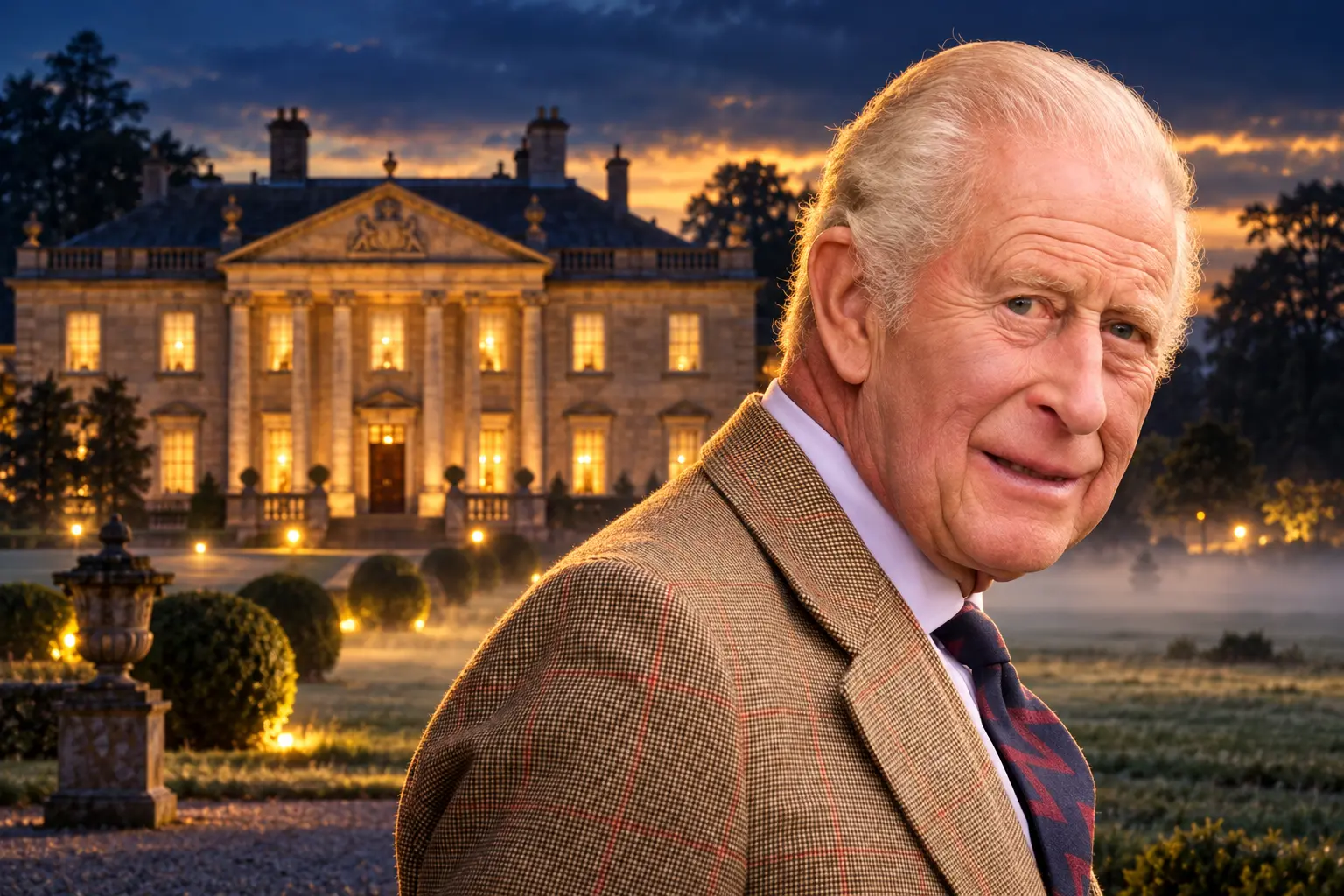
King Charles will host a private AI gathering of about 30 industry figures at Dumfries House in Scotland later in September. Nvidia chief executive Jensen Huang, Google DeepMind chair Demis Hassabis and Vatican adviser Paolo Benanti are on the list, according to two people familiar with the plans, which have not been publicly announced.
A royal official said the king would not issue his own thoughts. He wants to listen. The venue is the headquarters of The King’s Foundation, the nature charity Charles founded in 1990, and the meeting is being put together by the Ditchley Foundation, with government ministers invited too.
A Palladian House With a Harmony Brief
Dumfries House is an 18th-century Adam house on a 2,000-acre estate in Ayrshire, saved for the nation in 2007 by a consortium Charles led when he was Prince of Wales. He has used it since as a working model of heritage-led regeneration in former coal country, with free public access, training workshops and a health centre on the grounds.
The charity describes itself as his nature and sustainability organisation. Its own site says 10,000 students taught each year pass through the estate, and that the work rests on Charles’s philosophy of Harmony, the idea that people are part of nature rather than set against it. He first put that argument in a 2010 book. A documentary the Foundation released with Prime Video still treats Dumfries House as the place where the idea is supposed to be visible on the ground.
THE DUMFRIES HOUSE LEDGER
- Students: The Foundation says 10,000 learners a year are taught on the estate.
- Crafts: Six of the skills taught sit on the Red List of Endangered Crafts.
- Health centre: 15,000 people have been supported at the Health and Wellbeing Centre.
- Founded: Charles set up the charity in 1990; the house became its Scottish base after the 2007 rescue.
In 2018 he told editor Dylan Jones he objected to the idea that people must become part human and part machine, and said a rush into AI and robotics would send people back toward traditional crafts. That is the brief this house was built to prove. The guest list now walking through it is the industrial AI court.
Huang, Hassabis and a Friar Share One Table
Only three names have been attached to the roughly 30 invitations, and none of those three has confirmed. Nvidia did not respond. A DeepMind representative said the company could not comment on Hassabis’s movements. Benanti declined to comment. Hassabis, the British founder who now chairs DeepMind, called in July for a U.S.-based global standards body for AI, which makes a Scottish country house an unusual next stop on that argument.
THE THREE NAMES ON THE LIST
| Name | Role | Public response |
|---|---|---|
| Jensen Huang | Nvidia chief executive | Company did not respond |
| Demis Hassabis | Google DeepMind founder and chair | Firm would not discuss his movements |
| Paolo Benanti | Vatican AI adviser; Franciscan friar | Declined to comment |
Huang is there because his company sells the chips that train and run the large models. Hassabis is there because DeepMind is Britain’s most famous AI lab. Benanti is there because the Holy See wants a moral vocabulary in the same rooms as the labs, and his presence is the detail that still surprises people who follow this industry as a chip-and-model story.
WHAT WE KNOW
- The venue: Dumfries House in Ayrshire, headquarters of The King’s Foundation.
- The organiser: The Ditchley Foundation, with UK ministers also invited.
- The king’s line: He will convene, engage, listen and encourage debate, and will not issue his own thoughts.
- The status: The gathering has not been publicly announced.
WHAT IS UNCONFIRMED
- The date: Only “later in September” has been described, with no day attached.
- The full list: Beyond the three names, the other invitations have not been disclosed.
- Attendance: Huang, Hassabis and Benanti have not confirmed they will be in the room.
- The output: No agenda, paper or communique has been described.
Huang’s name is doing most of the public work. In market chatter the meeting is being read as another Nvidia booking, which tells you how the guest list is being ranked even before anyone sits down.
The King Already Handed Huang a Safety Speech
This is not Charles’s first pass at the same people. He has spent three years trying to stay in the AI conversation without taking a government brief, and the Scottish night sits on that track rather than arriving out of nowhere.
CHARLES AND AI SINCE 2018
- 2018: Tells Dylan Jones he objects to a future in which people become part human and part machine, and argues that more AI and robotics will revive traditional crafts.
- November 1, 2023: In a recorded address to the UK AI Safety Summit at Bletchley Park, he says advanced AI is “no less important than the discovery of electricity” and that its risks must be met with “a sense of urgency, unity and collective strength.”
- September 2025: Hosts a Windsor Castle banquet during President Donald Trump’s UK visit, with Huang and OpenAI chief executive Sam Altman among the tech guests, as US firms pledge £31 billion (about $42 billion) into British AI, quantum and nuclear projects and a US-UK Tech Prosperity Deal is signed, later suspended over trade fights.
- November 5, 2025: Presents the Queen Elizabeth Prize for Engineering at St James’s Palace to Huang and six other machine-learning pioneers, and hands Huang a copy of the Bletchley address.
- April 28, 2026: Meets Huang, Amazon founder Jeff Bezos, Apple chief executive Tim Cook, AMD chief executive Lisa Su, Salesforce chief executive Marc Benioff and Alphabet president Ruth Porat at Blair House in Washington, talking up the “valley of death” that kills university spinouts.
- September 2026: Invites about 30 AI figures to Dumfries House, with Huang, Hassabis and Benanti named by people familiar with the plans.
After the St James’s Palace ceremony, Huang said the king came straight to the point. “He said, there’s something I want to talk to you about. And he handed me a letter.”
It was his speech on AI safety. He obviously cares very deeply about AI safety.
Jensen Huang, Nvidia chief executive, after the Queen Elizabeth Prize ceremony at St James’s Palace
The gifted text included the line, “If we are to realize the untold benefits of AI, then we must work together in combatting its significant risks.” The prize itself honoured Huang and chief scientist Bill Dally for the GPU architectures that power today’s AI. Huang used the same week to sit with UK science ministers at 10 Downing Street. The Scottish invitation is a continuation of that courtship, moved from a palace and a White House guest house to a charity estate.
At Blair House, Huang told the king Britain needed a stronger venture scene if it wanted to catch AI, quantum and robotics. Charles shot back that the executives were “deadly competitors,” and Huang replied that no one had to die. The joke landed because the room already knew why it had been assembled: Britain wants the capital, and the king can get the people who write the cheques into one place.
Why Scotland’s Greens Call the Meeting Hypocrisy
Dumfries House sits in East Ayrshire, a county still marked by the end of coal, which is why Charles has spent nearly two decades talking about crafts, food, health and local jobs there. AI’s physical plant does not look like that brief. Data centres eat power and water, and Scottish projects are already drawing fights over both.
Campaigners have warned that a planned £2 billion AI data centre could hit water supplies on a protected stretch of the River Tweed. Scottish Green MSP Laura Moodie put the Dumfries House guest list in that fight. “An exclusive gathering of royalty and corporate bosses shows a system that allows wealth and inherited privilege to buy access, while the communities impacted fight to have their voices heard,” Moodie said.
Power and water for Scottish data halls are political questions. The king’s official line is that he will not offer a view on them. Hosting the industry at the headquarters of his green charity is what Moodie is calling out. The Foundation can teach endangered crafts in the morning and clear the Tapestry Room for Huang in the evening. Those two uses of the same estate are now on the same calendar.
Off the Record at a Country House
Ditchley is not a royal body. Sir David Wills founded it in 1958 to back the transatlantic alliance, and it still works from Ditchley Park as a confidential forum. Its own programme sits under four headings, geopolitics, democracy, technology, and energy and climate, and it describes invitation-only technology convenings that mix public and private leaders and do not promise a tidy result.
That method is the format to expect at Dumfries House: a small room, senior people, no paper at the end. Ditchley runs monthly conferences, smaller back-channel talks and the odd large lecture. The Scottish night looks like the middle category, with a royal host and a borrowed house. Conspiracy accounts have already tried to fold Ditchley into older secret-salon lore. The plainer reading is enough. This is how Britain still does elite conversation when it does not want a communique.
Benanti’s UNESCO roundtable on agentic AI was on September 2. A few weeks later he is being described as a Dumfries House guest. The ethics circuit and the capital circuit are being asked to share a table, which is the whole Ditchley trick. Whether anyone changes a training run or a site licence because of it is a different question, and it is the question this format is designed not to answer in public.
Ministers Get a Seat While the King Stays Quiet
The constitutional move is the quiet one. Charles cannot make AI policy. He can still fill a room that ministers want to be in, and he can do it on charity ground rather than at Buckingham Palace, which keeps the evening one step away from a state act.
One of the king’s unique abilities as sovereign and global statesmen is his ability to convene top level stakeholders.
A royal official, describing the Dumfries House gathering
The same official stressed that Charles would not issue his own thoughts and wanted to “convene, engage, listen and encourage debate” on one of the biggest issues of the age. That formula lets the Crown stay in the AI argument without a white paper. Ministers get the proximity. The labs get the photograph of a royal house. The Foundation gets to look like the place where the next settlement might be talked about, even if no settlement is published.
It is also a tighter bind than Bletchley. In 2023 the king spoke on tape to a government summit. In 2025 he handed Huang the text. In April he joked with chip and cloud bosses in Washington. In Ayrshire he is being described as a host who will not speak. The volume has gone down as the guest list has got more precise.
What a Closed Room Can Still Move
Benanti’s other project is already on paper. On February 28, 2020, the Pontifical Academy for Life, Microsoft, IBM, the UN Food and Agriculture Organization and Italy’s innovation ministry signed the Rome Call for AI Ethics, a non-binding list built around transparency, inclusion, accountability, impartiality, reliability, security and privacy. Microsoft and IBM could live with it. Nvidia was not in that first cluster. Putting Benanti across the table from Huang is how you test whether a moral document survives contact with the firm that sells the racks.
Benanti has warned that people treat AI systems “like idols, like oracles, like demigods,” and that the real risk is handing decisions about lives to machines in ways the public never sees. That is the speech a Harmony house is built to hear. It is also the speech a chip chief can nod through and leave on the train south.
The named guests have not confirmed. Nvidia has not spoken. DeepMind will not discuss Hassabis’s diary. Benanti has said nothing about Ayrshire. Ditchley rooms do not issue statements, and a royal official has already said the king will not issue thoughts. The product on offer is the room itself, in a house Charles saved to prove that industrial speed was not the only future, now waiting for the people who sell that speed.

Pixel Buds Firmware 6.144 Ties New Features to Pixel Gear

Eve Markoski-Wood Backs Her Mum as Wood Fights Bail

Trump Rejects an Iran Deal as Diesel Holds Near Records

Amazon Cuts the S26 Ultra to $979 After Samsung’s Hike

Ice Caves Land in Minecraft 26.4 Snapshot 3

Warsh Rejects Rate Guidance and Still Moves Markets

Dana-Farber Exits an MGB Medicare Advantage Network Early

NASA Launches the Roman Space Telescope’s Cosmic Bet

Russia Recycles Its Old Warning Over Storm Shadow Plants

OpenAI’s Cyber Letter Puts the Defense Bill on Governments
-
 BUSINESS2 months ago
Warsh Rejects Rate Guidance and Still Moves Markets
-
 BUSINESS1 month ago
Dana-Farber Exits an MGB Medicare Advantage Network Early
-
 NEWS2 months ago
NASA Launches the Roman Space Telescope’s Cosmic Bet
-
 NEWS2 months ago
Russia Recycles Its Old Warning Over Storm Shadow Plants
-
 NEWS2 months ago
OpenAI’s Cyber Letter Puts the Defense Bill on Governments
-
 ENTERTAINMENT4 weeks ago
Primetime’s $2.7 Million Preview Tops Pitt’s Costlier Film
-

 BUSINESS2 months ago
Jet Drones Lock Down Kyiv and Strip Kherson of Heat
-
 BUSINESS2 months ago
Record Cyclospora Outbreak Follows Seven Years Without an Inspection