
NEWS
NASA Launches the Roman Space Telescope’s Cosmic Bet
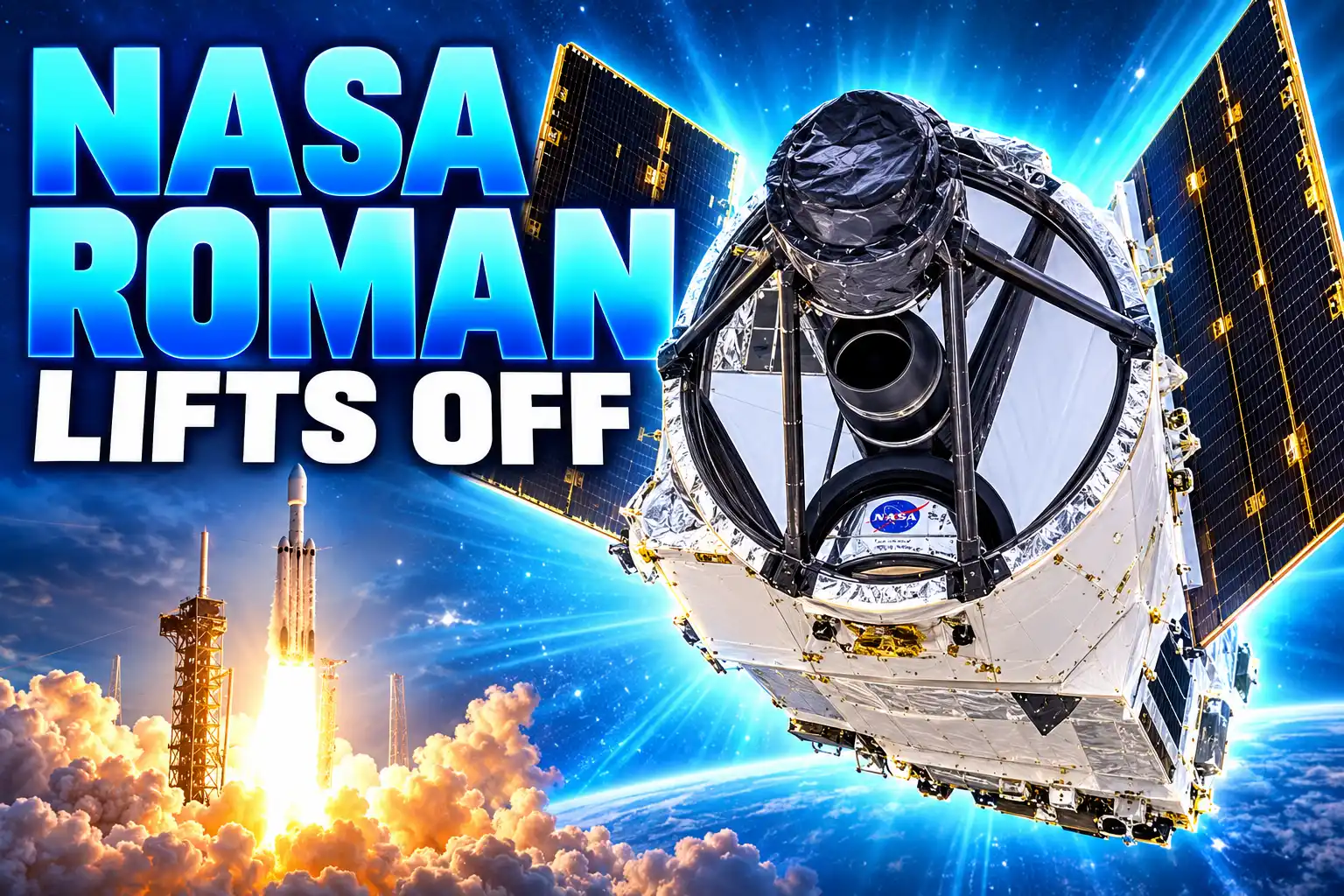
The Nancy Grace Roman Space Telescope launched Aug. 30, a $4.3 billion bet that a leftover spy mirror can settle the Hubble tension.

NASA’s $4.3 billion Nancy Grace Roman Space Telescope left Florida on Aug. 30, beginning a million-mile trip to test whether the universe’s expansion model is wrong. A SpaceX Falcon Heavy lifted the observatory from Launch Complex 39A at 7:26 a.m. EDT, and Goddard controllers locked onto telemetry seven minutes later.
The hardware bet already cleared the pad ahead of schedule. The science bet, on dark energy and the so-called Hubble tension, will take the five-year primary mission to pay or fail.
Roman Left Pad 39A at 7:26 a.m.
The rocket performed as planned, and the observatory separated 31 minutes into flight, at 7:57 a.m. EDT. Side boosters returned to Landing Zone 2 and Landing Zone 40. Solar panels and the lower instrument sun shade opened an hour and 23 minutes after liftoff, and the Deep Space Network took over communications about 70 minutes in.
NASA said Roman has started a three-month, million-mile journey to an orbit around the second Sun-Earth Lagrange point, or L2. Administrator Jared Isaacman called the flight “exactly the kind of success story we want to see across NASA,” and said the mission was delivered ahead of schedule and on budget.
LAUNCH DAY AND THE FIRST BURN
- Aug. 30, 2026, 7:26 a.m. EDT: Falcon Heavy lifts off from Launch Complex 39A at Kennedy Space Center.
- 7:33 a.m. EDT: Controllers acquire a signal through a Tracking and Data Relay Satellite.
- 7:57 a.m. EDT: Roman separates from the second stage and flies on its own.
- 8:49 a.m. EDT: Solar arrays and the lower sun shade deploy.
- Aug. 31, 12:02 p.m. EDT: Roman fires a roughly 3-minute mid-course correction, the first of two planned burns.
NASA’s Roman blog said orbital insertion is due about 100 days after launch, with station-keeping burns about every 28 days once the halo orbit is set. A second correction was listed as optional later in the week of Aug. 31. First public images are targeted for early 2027, after a commissioning stretch that turns on the Wide Field Instrument a few weeks into the cruise and powers the Coronagraph Instrument in the first days.
The Nancy Grace Roman Space Telescope has officially launched and is heading to its forever home at L2!
Over the next three months, the observatory will perform final checks and power its instruments before revealing its first images by early 2027.https://t.co/IdabpolHmh pic.twitter.com/tuDHAEzgKh
— Nancy Grace Roman Space Telescope (@NASARoman) August 30, 2026
The Mirror Began as Surplus Spy Glass
Roman’s eye is Hubble-sized because an intelligence agency no longer needed it. The National Reconnaissance Office contacted NASA in 2011 with unused telescope assemblies from the canceled Future Imagery Architecture program, and the transfer became public in June 2012. Early WFIRST designs had called for a 1.3-meter to 1.5-meter mirror. The donated glass was 2.4 meters across, the same aperture as Hubble, and it forced a larger observatory, a wider camera, and room for a coronagraph.
L3Harris Technologies in Rochester, New York, reshaped the inherited optic and built the rest of the Optical Telescope Assembly around it. NASA’s account of the finished hardware says the 2.4-meter primary mirror NASA inherited now weighs 410 pounds (186 kilograms), less than one-quarter the weight of Hubble’s, and carries a silver coat chosen for near-infrared light. The assemblies did not include a science camera, a spacecraft bus, or a rocket. NASA still had to fund those, which is why a “free telescope” is the wrong shorthand.
The leftover optic is also why the field of view exists in this form. A shorter focal length than Hubble’s, plus 18 detectors instead of a narrow camera, lets Roman stare at a patch of sky more than 100 times larger in one exposure while keeping Hubble-class sharpness. Pointing that glass up, rather than down at Earth, is the whole civil mission.
Can Roman Settle the Hubble Tension?
Daniel Scolnic, a Duke University cosmologist on a Roman supernova infrastructure team, has said recent measurements suggest the standard model might be wrong, and that Roman will nail whether it is right or wrong. The split is simple to state and hard to close. Local distance-ladder work clustered near 73 kilometers per second per megaparsec. Cosmic microwave background fits clustered near 67.
THE HUBBLE CONSTANT SPLIT
| Measurement | H0 (km/s/Mpc) | What it uses |
|---|---|---|
| Planck CMB in ΛCDM | 67.4 ± 0.5 | Early-universe sound horizon |
| Planck+ACT+SPT combo | 67.19 ± 0.38 | Joint CMB spectra and lensing |
| SH0ES Cepheid ladder | 73.04 ± 1.04 | Cepheids plus Type Ia supernovae |
| Local Distance Network | 73.50 ± 0.81 | Combined local rungs, 1.09% error |
That gap has sat at about 5 sigma for years and, in some combined local samples, higher. Roman’s wager is not another single H0 number. It is a space-based Type Ia supernova sample out to greater distances than Hubble could assemble, plus weak lensing and baryon acoustic oscillations over a wide infrared map, so the expansion history can be traced instead of argued from two endpoints.
Masao Sako of the University of Pennsylvania, co-chair of the committee that set the High-Latitude Time-Domain Survey, said Roman is designed to find tens of thousands of Type Ia supernovae. The wide tier covers a bit more than 18 square degrees, about 90 full moons, and reaches objects from the past 7 billion years. A 6.5-square-degree deep tier goes fainter, as far as 10 billion years back, with a roughly five-day cadence through the middle two years of the mission.
Roman will be able to make high precision tests that should tell us whether these hints are real deviations from our current standard model or not.
Risa Wechsler, director of Stanford’s Kavli Institute for Particle Astrophysics and Cosmology, NASA survey briefing
David Weinberg at Ohio State University called cosmic acceleration the biggest mystery in cosmology, and maybe in all of physics. NASA’s own forecast for the High-Latitude Wide-Area Survey is that Roman will measure dark energy’s effects 10 times more precisely than current data, across more than 5,000 square degrees, about 12 percent of the sky, in under a year and a half. About 600 million of the galaxies in that map should be sharp enough for weak-lensing shapes, and spectra from about 20 million galaxies will freeze the baryon-acoustic “ruler,” rings about 500 million light-years wide today, at many epochs.
Hubble Sharpness Across a Patch 100 Times Wider
Julie McEnery, Roman’s senior project scientist at Goddard, has compared the hardware to Hubble in sensitivity and sharpness, then in speed. One month of Roman time to survey the Milky Way would take about a century with Hubble, she said. NASA now puts the survey-speed claim at a thousand times Hubble’s, because the observatory is stiff enough to scan without long pauses between pointings.
ROMAN NEXT TO HUBBLE
| Feature | Roman | Hubble (IR camera) |
|---|---|---|
| Primary mirror | 2.4 meters | 2.4 meters |
| Field of view | 0.28 square degrees | About 100 times smaller |
| Survey speed | Up to 1,000 times Hubble | Baseline |
| Main camera | 300 megapixels, 18 detectors | One 1,024-pixel IR detector on WFC3 |
| Daily science data | 1.4 terabytes | Far lower |
Each of those 18 Teledyne detectors is a 4,096-by-4,096-pixel chip about the size of a saltine, sensitive from 0.48 to 2.3 micrometers. NASA said Roman will send back 1.4 terabytes of data every day, the highest rate of any NASA astrophysics mission so far, matching the technical sheet’s 11 terabits. Machine learning and citizen scientists are expected to flag transients in that flood. About 75 percent of the five-year primary mission, which has a 10-year operating goal, is reserved for three core community surveys.
Nicky Fox, associate administrator for NASA’s Science Mission Directorate, called Roman a discovery machine with a large field of view and fast survey speeds. Weinberg’s display math is the part that sticks: even one Roman pointing needs a wall of 4K screens at full resolution, and the whole high-latitude survey would take half a million 4K televisions, enough to cover 200 football fields.
Microlensing Reaches Planets Other Methods Miss
Scott Gaudi at Ohio State University helped build the gravitational microlensing method Roman will use in the bulge. Einstein described the bending of starlight in 1936 and thought it would be impractical. Gaudi said the team is looking for planets that are completely undetectable by any other method, including worlds toward the center of the galaxy that are analogous to Jupiter, Saturn, Uranus, and Neptune.
The Galactic Bulge Time Domain Survey plan spends more than a quarter of the five-year mission on a crowded strip toward the Milky Way’s center, imaging on a cadence of about 12 minutes in the high-cadence seasons. STScI’s user documentation says the survey will collect photometry and astrometry for more than 100 million stars, and that it is also expected to find more than 100,000 transiting exoplanets as a byproduct.
YIELDS THE BULGE SURVEY IS BUILT TO CATCH
- Bound microlensing planets: About 1,400 detections above roughly 0.1 Earth masses in the Penny et al. forecast for a full five-year survey.
- Transiting planets: Pixel-level simulations predict 60,000 to 200,000 transiting planets, including about 7,000 to 12,000 smaller than four Earth radii.
- Free-floating planets: A fiducial mass function in the Johnson et al. study predicts roughly 250 detections, with a log-uniform case near 1,000.
The Coronagraph Instrument, a JPL technology demonstration, is a separate bet. NASA said it will try to image Jupiter-like planets by blocking starlight, as a step toward a future Habitable Worlds Observatory. It is scheduled to power on in the first days of the cruise, long before the wide-field camera starts its sky factory.
Kentucky Classrooms Will See the Data With Princeton
Roman is a catalog machine, and NASA has said those catalogs will be public after processing, not locked behind a guest-observer queue. McEnery put it in classroom terms: a teacher in a high school in Kentucky and a professor in Princeton get the data at the same time. That is a shift from Hubble’s early culture of scarce orbits, and it follows from the data rate as much as from policy.
Wendy Freedman, an astronomer at the University of Chicago, said the history of astronomy shows that a new survey capability teaches something unexpected, and that she is open to what this telescope will find. Ryan Hickox of Dartmouth College, co-chair of the wide-area survey committee, said the team set out to build the ultimate wide-area infrared survey. Olivier Doré at NASA’s Jet Propulsion Laboratory warned that the weak-lensing standards are so tight the whole community will inherit high-quality images, which he said will lead to discoveries no dark-energy memo listed.
The namesake is part of that public claim. Nancy Grace Roman was NASA’s first chief astronomer, the agency’s first female executive, and the official who spent the 1960s and 1970s arguing Congress into a large optical space telescope. Colleagues later called her the Mother of Hubble. She died in 2018 at 93. NASA renamed WFIRST for her in 2020. The observatory that carries her name is, in a dry way, Hubble’s wide-field cousin built from glass that was never meant to look at galaxies.
First Images Are Due in Early 2027
Commissioning fills the next three months: high-gain antenna and aperture cover deployments, the optional second trajectory burn, instrument turn-on, and calibrations while Roman coasts toward L2. NASA said the Wide Field Instrument activates a few weeks into the voyage. Science operations follow insertion, and the agency anticipates releasing the first images by early 2027.
We’ve never been able to view the universe with eyes like Roman’s before. There’s no telling what more we’ll know and have seen by this time next year.
Julie McEnery, Roman senior project scientist, NASA Goddard, launch release
The $4.3 billion covers development, manufacturing, launch, and five years of operations, about $300 million above the 2020 development estimate. Isaacman’s on-budget claim is the agency’s scorecard for the build. The scorecard for cosmology is still blank, and it will stay blank until those supernovae, lensing shapes, and bulge light curves are in hand.

Pixel Buds Firmware 6.144 Ties New Features to Pixel Gear

Eve Markoski-Wood Backs Her Mum as Wood Fights Bail

Trump Rejects an Iran Deal as Diesel Holds Near Records

Amazon Cuts the S26 Ultra to $979 After Samsung’s Hike

Ice Caves Land in Minecraft 26.4 Snapshot 3

Warsh Rejects Rate Guidance and Still Moves Markets

Dana-Farber Exits an MGB Medicare Advantage Network Early

NASA Launches the Roman Space Telescope’s Cosmic Bet

Russia Recycles Its Old Warning Over Storm Shadow Plants

Primetime’s $2.7 Million Preview Tops Pitt’s Costlier Film
-
 BUSINESS1 month ago
Warsh Rejects Rate Guidance and Still Moves Markets
-
 BUSINESS4 weeks ago
Dana-Farber Exits an MGB Medicare Advantage Network Early
-
 NEWS1 month ago
Russia Recycles Its Old Warning Over Storm Shadow Plants
-
 ENTERTAINMENT2 weeks ago
Primetime’s $2.7 Million Preview Tops Pitt’s Costlier Film
-

 BUSINESS1 month ago
Jet Drones Lock Down Kyiv and Strip Kherson of Heat
-

 NEWS1 month ago
Congo Starts Ervebo Vaccinations for a Different Ebola Virus
-
 ENTERTAINMENT1 month ago
Midnight Spider-Man Turns Peter Parker Into Oscorp’s Hybrid
-

 BUSINESS1 month ago
Record Cyclospora Outbreak Follows Seven Years Without an Inspection