
BUSINESS
A Third Carrier Arrives as Hormuz Tankers Keep Burning
Trump says the Iran war is militarily over, but a third U.S. carrier is in the Gulf and Hormuz tanker attacks have not stopped.

The USS Theodore Roosevelt entered U.S. 5th Fleet on Nov. 15, a third American aircraft carrier in the Middle East, as Iran said the Strait of Hormuz stays shut. President Donald Trump has told audiences the war with Iran is winding down and, in his words, militarily is effectively over. On the water, tankers are still being hit, and Tehran is still tying any reopening to U.S. concessions.
U.S. Central Command confirmed the Roosevelt’s presence on Monday. The British military’s United Kingdom Maritime Trade Operations centre, in the same 24-hour stretch, recorded fresh projectile strikes on tankers using the southern lane Iran now calls illegal. Brent crude still slipped 0.7 percent to $91.8 a barrel in Asian trade on Nov. 17, with U.S. West Texas Intermediate down 0.7 percent to $85.1, because a lot of Gulf oil has already found other doors out.
Three Carriers, One Unfinished War
The Roosevelt, hull number CVN-71, left San Diego in September with Carrier Strike Group 9. Navy photographs dated Nov. 15 show the ship in the Indian Ocean as it chopped into the Central Command area. It joins the USS George H.W. Bush, which arrived in April, and the USS George Washington, which arrived in August from its usual forward station in Japan.
The Navy says the Arabian Sea force now includes the three carriers, 13 destroyers, two cruisers and one littoral combat ship, with two more destroyers in the Red Sea. The Roosevelt sailed with the USS Makin Island amphibious group and about 2,000 Marines; those landing ships have not arrived. Officers have described the Roosevelt as the ship that would relieve George Washington, but Washington has not been announced as leaving, so the overlap is the point.
THE THREE CARRIERS ON STATION
- USS George H.W. Bush (CVN-77): In the region since April, originally the relief for USS Gerald R. Ford after a 326-day cruise.
- USS George Washington (CVN-73): In the region since August, the Japan-based carrier that followed USS Abraham Lincoln.
- USS Theodore Roosevelt (CVN-71): Chopped into 5th Fleet on Nov. 15 with Carrier Air Wing 11, cruiser USS Chosin, and destroyers USS Paul Hamilton and USS Decatur.
This is the second three-carrier stack in the Middle East this year. The first, in April, was the first such concentration there since 2003. Keeping it means fewer decks in the Pacific. Abraham Lincoln went home after 321 days; two of its escorts, USS Michael Murphy and USS Spruance, stayed on, and Spruance’s Navy release put that cruise at 357 days and more than 88,000 nautical miles.
After meeting Qatari Prime Minister Sheikh Mohammed bin Abdulrahman Al Thani last week, Trump said the war could end fairly soon. The third carrier is a different message, aimed at Tehran and at anyone still trying to take a hull through Hormuz without Iranian papers.
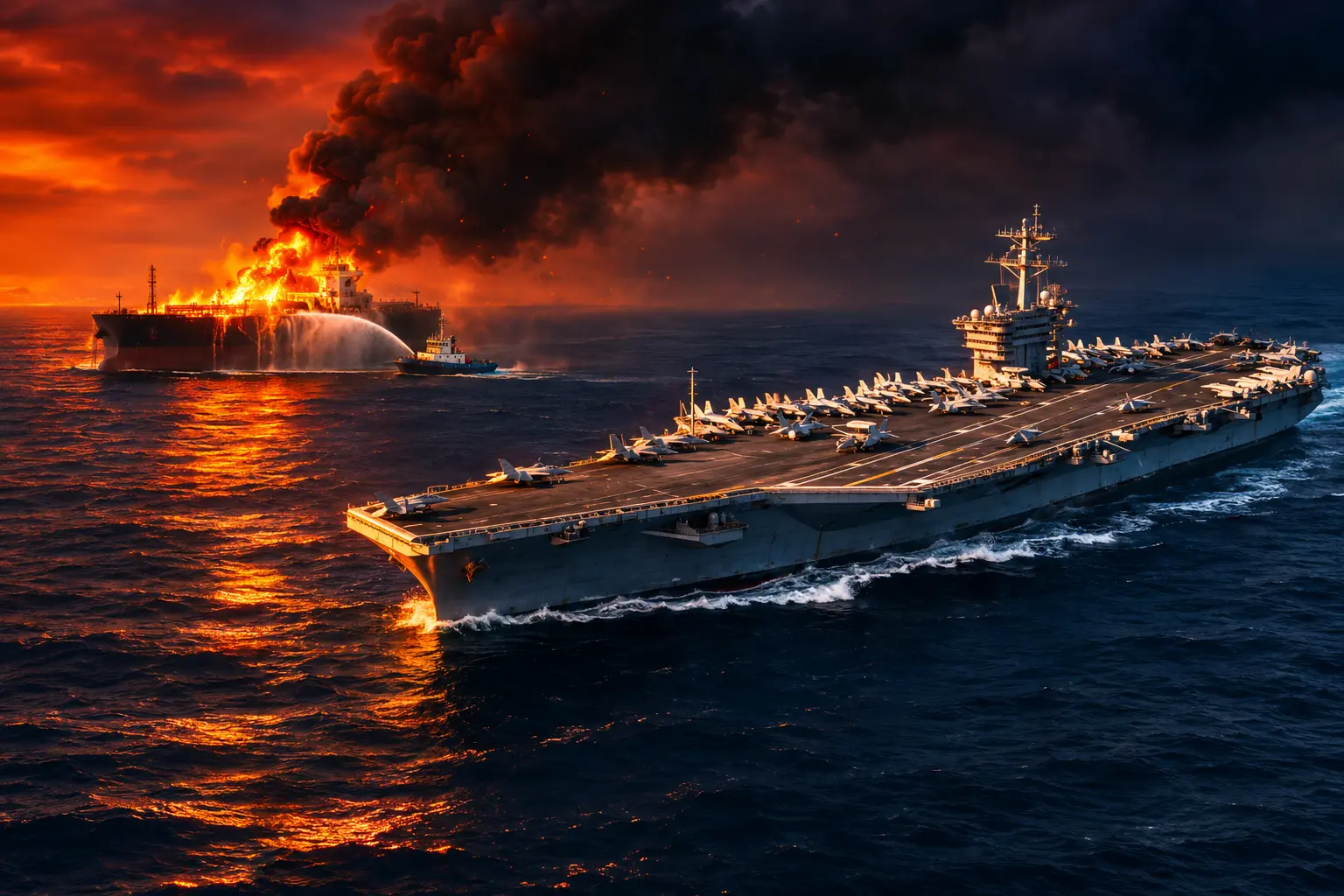
A Second Strike Left a Tanker Crew Unaccounted For
UKMTO’s public log is the cleanest record of what actually hit commercial ships, and it does not match Iran’s mine narrative. The centre recorded two tanker attacks logged Monday in the strait, then updated the second after a further hit.
THE STRIKES UKMTO LOGGED THIS WEEK
- Nov. 14, 2026: Indian shipping authorities report an attack on a tanker heading east through the Arabian Gulf before the strait; crew safe, damage unknown.
- Nov. 16, 2026: Warning 207, a company security officer reports an unknown projectile on an outbound tanker, fire in the engine room, all crew accounted for.
- Nov. 16, 2026: Warning 208, a third party reports an attack about 7 nautical miles north of Khasab, Oman, disabling a tanker and starting an engine-room fire; crew first reported safe.
- Nov. 17, 2026: UKMTO update 001 on Warning 208, a maritime security agency says the same ship took a second strike; the crew are unaccounted for and damage is unknown.
Security consultancy Vanguard Tech identified the outbound ship in the first Monday case as the Panama-flagged tanker On Phoenix, a 114,623-deadweight-ton vessel listed as UAE-owned and managed by AET, hit about three nautical miles off Oman around 05:58 UTC. UKMTO itself did not name either hull and did not blame mines.
UKMTO WARNING 208-26
Click here to view the full product.⤵️ https://t.co/1JXxssoZve#MaritimeSecurity #MarSec pic.twitter.com/SU61tvuxKj
— UKMTO Operations Centre (@UK_MTO) November 16, 2026
Iran’s Revolutionary Guards Navy told shipowners the U.S.-backed southern route is fully closed and a minefield of fire. A Guards statement circulated in regional media claimed two tankers guided by American officers hit mines on that route, that explosions lit the strait for hours, and that this was the sixth tanker to catch fire and sink since the day before. U.S. Central Command had not posted a matching denial at the time those claims moved, and UKMTO’s files still describe unknown projectiles.
WHAT WE KNOW
- Official logs: UKMTO has two confirmed Monday attacks plus a Nov. 17 update that the Khasab ship was hit again.
- Crew status: The outbound ship’s crew were accounted for; the Khasab crew, after the second strike, were not.
- Southern lane: Most recent projectile reports sit on the U.S.-coordinated corridor in Omani waters, not on Iran’s northern permit route.
WHAT IS UNCONFIRMED
- Mine hits: Iran’s count of four, then six, burning tankers has not been matched to named ships in the UKMTO log.
- Sinkings: The Guards’ claim that hulls sank and that pollution covered the whole strait is unverified.
- Who fired: UKMTO has not attributed the projectiles, and it has not adopted the mine language.
The pattern is not a one-off. UKMTO’s November file is a drumbeat of engine-room hits, waterline blasts and the odd small-boat charge with charges stuck above the waterline. The International Maritime Organization’s tally, as of Nov. 11, stood at 136 confirmed incidents and 25 seafarer deaths since the fighting began.
Why Iran Will Not Reopen the Strait
Brig. Gen. Mohammad Akrami-Nia, the Iranian Army spokesperson, said on Nov. 16 that Iranian forces hold the strait and that it will not reopen until Iran’s terms are met. Those terms, repeated through the autumn, are a lift of U.S. sanctions, an end to the naval blockade of Iranian ports, and a halt to fighting on all fronts. Secretary of State Marco Rubio called the package absurd on Nov. 10. On Nov. 12 Trump wrote that the United States does not need a deal with Iran and pulled Vice President JD Vance off the negotiating track.
The reopening of this strategic waterway is only possible through the United States accepting the conditions of the Islamic Republic of Iran.
Brig. Gen. Mohammad Akrami-Nia, Iranian Army spokesperson, IRNA
The war started on Feb. 28, when the United States and Israel struck Iran and Tehran answered against Israel and against Gulf states that host American bases. Iran declared the strait closed to hostile shipping; the Guards confirmed that closure on March 2. The Islamabad Memorandum on June 17 produced a partial reopening. The ceasefire collapsed on July 8, and Washington put the blockade back on Iranian ports from July 14.
Ships that still move do so on two tracks. One is a U.S.-coordinated southern corridor in Omani waters. The other is Iran’s northern route, which requires a permit from Tehran’s Persian Gulf Strait Authority. That authority’s blacklist of ships that used the American lane or skipped its toll stood at 240 vessels as of mid-November. At its narrowest the strait is 21 nautical miles wide, with traffic lanes about two miles each way, which is why a few well-placed hits can change how owners, insurers and navies behave even when some oil still gets out.
Gulf Oil Found Other Doors Out
That is the awkward fact under the fire alerts. Trackers that watch AIS transponders see almost no commercial ships. The U.S. Energy Information Administration, using tanker tracking plus port analysis because so many hulls now sail dark, still records a partial rebound in barrels.
OIL THROUGH HORMUZ BY QUARTER
| Period | Total oil (million b/d) | Crude and condensate | Petroleum products | LNG (billion cubic feet a day) |
|---|---|---|---|---|
| Q4 2025 | 21.6 | 15.9 | 5.7 | 10.5 |
| Q1 2026 | 15.0 | 10.9 | 4.1 | 7.4 |
| Q2 2026 | 5.1 | 3.8 | 1.2 | 0.8 |
| Q3 2026 | 9.1 | 7.3 | 1.8 | 1.4 |
Those oil flows through the Strait of Hormuz are EIA figures based on Vortexa tracking. The third-quarter rebound is real and still less than half the late-2025 pace. LNG has barely come back at all. Independent AIS counts tell a harsher story about hulls, not cargo: hormuz.now, drawing on IMF PortWatch, puts AIS-visible traffic at about 8 percent of the pre-crisis average, 6.6 crossings a day over the past week against 84.8 before the war, and only two visible commercial ships in the 24 hours to Nov. 17. Nov. 17 is day 263 of the crisis on that clock.
Kpler’s September read shows why prices can fall on a day tankers burn. At least 16.5 million barrels a day left the region that month excluding Iran, matching the pre-war average once Iranian barrels are taken out, and 40 percent of the region’s crude now leaves without crossing Hormuz, against 17 percent before the war, through Saudi and UAE pipelines. Iran is the exporter still trapped by policy. Central Command said in late October that primary transit routes remained free of Iranian sea mines and that more than 3,000 commercial vessels had crossed with U.S. support in six months. On Nov. 7 it said it had redirected 147 commercial ships and disabled five merchant ships since July.
So the market is pricing a strait that is dangerous and half-empty of AIS tracks, not a strait that has taken Gulf crude off the board. Owners pay for that gap in war-risk cover, in waiting time at Fujairah and Sohar, and in crews who now broadcast nationality or armed guards in their AIS destination field because that is the message they want the next skiff to read.
Bahrain’s Radar Sites Draw Fresh Drone Attacks
The other front this week was ashore, and it sat on the same argument as the strait: Iran is still willing to shoot at the American presence in the Gulf even while it says a path to a deal remains open. The Islamic Revolutionary Guard Corps said on Sunday it launched six drones at a U.S. air-defense radar at Bahrain’s Riffa (Al-Riffa) helicopter base, the second claimed attack on the kingdom in three days. Bahrain said its air defenses intercepted and destroyed several of the incoming aircraft, the first such intercepts it has claimed since September. Sirens sounded, and the interior ministry told residents to stay calm and move to a safe place.
Friday’s earlier claim, that Guards drones had wrecked a U.S. early-warning radar, was denied by Central Command, which said two one-way drones were shot down with no damage and no injuries. On Tuesday the Guards said they had carried out a precision operation against a U.S. radar at Sheikh Isa Air Base. Central Command said multiple Iranian one-way attack drones toward Bahrain that day were intercepted without damage to U.S. equipment or injury to American personnel.
Secretary of State Marco Rubio called Bahraini Foreign Minister Abdullatif bin Rashid Al Zayani on Monday, condemned the attacks, and restated the U.S. commitment to Bahrain and other Gulf partners. Bahrain hosts the U.S. Navy’s 5th Fleet. Hitting radar there is a way to test American defenses without trying to sink a carrier, and it keeps Gulf capitals inside a war some of them would rather mediate than fight.
In Washington the temperature is different and more personal. Iranian threats prompted Treasury Secretary Scott Bessent to move into military housing last week. U.S. officials held meetings on assessments of possible plots against senior administration figures. A White House spokesperson said the administration remains vigilant and is monitoring potential threats, but that at this time there are no credible threats to the homeland.
Economic Pressure Has Not Produced a Deal
Ian Bremmer, president of Eurasia Group, has been blunt about the theory behind the extra carrier and the blockade. Washington, he said, is working from the idea that Iran cannot take the economic pain and will accept better terms, which he called a misread of the Iranian leadership and their capacity to resist. He expects Tehran to keep hitting tankers and, at times, U.S. military targets, and he expects Washington to answer by tightening the maritime squeeze rather than by offering the sanctions relief Iran has listed as a price of reopening Hormuz.
The presumption is that eventually Iran can’t handle the economic pressure and will accept better terms.
Ian Bremmer, president, Eurasia Group
After the Nov. 3 midterm elections, Bremmer argued that Iranian officials read the Republican losses, and Vance’s comment that the war helped cause them, as extra leverage. In that reading the IRGC can wait, keep striking ships, and hit back if Washington bombs again. Qatar’s foreign ministry said on Nov. 10 that both capitals had responded positively to a proposal linking a Hormuz reopening to renewed nuclear inspections, a blockade lift and some unfrozen Iranian funds. Trump’s Nov. 12 line that America does not need a deal cut across that, and Mohsen Rezaei, secretary of Iran’s Supreme National Security Council, has denied that a meeting with Vance is planned.
THE STRAIT IN NUMBERS
- Visible traffic: About 8 percent of the pre-war AIS average, with two commercial crossings in the last 24 hours.
- Human cost: 136 confirmed shipping incidents and 25 seafarer deaths as of Nov. 11, per the IMO count.
- Blacklist: 240 ships listed by Iran for using the U.S. corridor or skipping its toll.
- Oil versus ships: Third-quarter Hormuz oil at 9.1 million barrels a day, against 21.6 million in late 2025, while pipelines now carry a much larger share of Gulf crude.
Two AIS-visible commercial ships crossed the strait in the 24 hours to Nov. 17. Three U.S. carriers are in the same theater. Iran says the waterway stays closed until Washington accepts its terms, and the Khasab tanker’s crew, after a second strike, has not been accounted for.

Ken Urker’s Accidental Overdose Leaves His Finders Waiting

A Third Carrier Arrives as Hormuz Tankers Keep Burning

Shoe Prices Hit a Record as Flagship Pairs Stay Put

Nvidia’s First Call Without Huang Tests the Money Machine

Blake Griffin Says Oklahoma City Taxpayers Bought a Thunder Arena

Warsh Rejects Rate Guidance and Still Moves Markets

Davina McCall Reveals Cardiovascular Disease After Cholesterol Warnings

Dana-Farber Exits an MGB Medicare Advantage Network Early

NASA Launches the Roman Space Telescope’s Cosmic Bet

OpenAI’s Cyber Letter Puts the Defense Bill on Governments
-
 BUSINESS3 months ago
Warsh Rejects Rate Guidance and Still Moves Markets
-
 ENTERTAINMENT4 weeks ago
Davina McCall Reveals Cardiovascular Disease After Cholesterol Warnings
-
 BUSINESS2 months ago
Dana-Farber Exits an MGB Medicare Advantage Network Early
-
 NEWS3 months ago
NASA Launches the Roman Space Telescope’s Cosmic Bet
-
 NEWS3 months ago
OpenAI’s Cyber Letter Puts the Defense Bill on Governments
-

 NEWS3 months ago
Russia Recycles Its Old Warning Over Storm Shadow Plants
-

 ENTERTAINMENT2 months ago
Primetime’s $2.7 Million Preview Tops Pitt’s Costlier Film
-

 BUSINESS3 months ago
Jet Drones Lock Down Kyiv and Strip Kherson of Heat