
NEWS
Russia Recycles Its Old Warning Over Storm Shadow Plants
Moscow’s threat to hit British military sites repeats its 2024 wording. The new fact is UK clearance for Storm Shadow assembly in Ukraine.

Russia said on Aug. 27 it could strike British military targets in Ukraine and beyond if Kyiv fires British cruise missiles into Russia. Foreign Ministry spokeswoman Maria Zakharova issued the warning in Moscow, a day after the Kremlin blamed Storm Shadow missiles for a shopping-center strike in occupied Donetsk.
The wording tracks a May 2024 demarche almost line for line. On Aug. 24, Prime Minister Andy Burnham told Kyiv that missile-maker MBDA could release classified data on British parts for the SCALP cruise missile, the French twin of Storm Shadow, so Ukraine and France can set up assembly lines in Ukraine.
A Familiar Briefing in Moscow
Zakharova told reporters that London was “one step away” from legal complicity, in Moscow’s telling, in “terrorism” against Russian civilians. She warned of “inevitable catastrophic consequences” unless Britain changed course, and said the war could climb to “an entirely new level.”
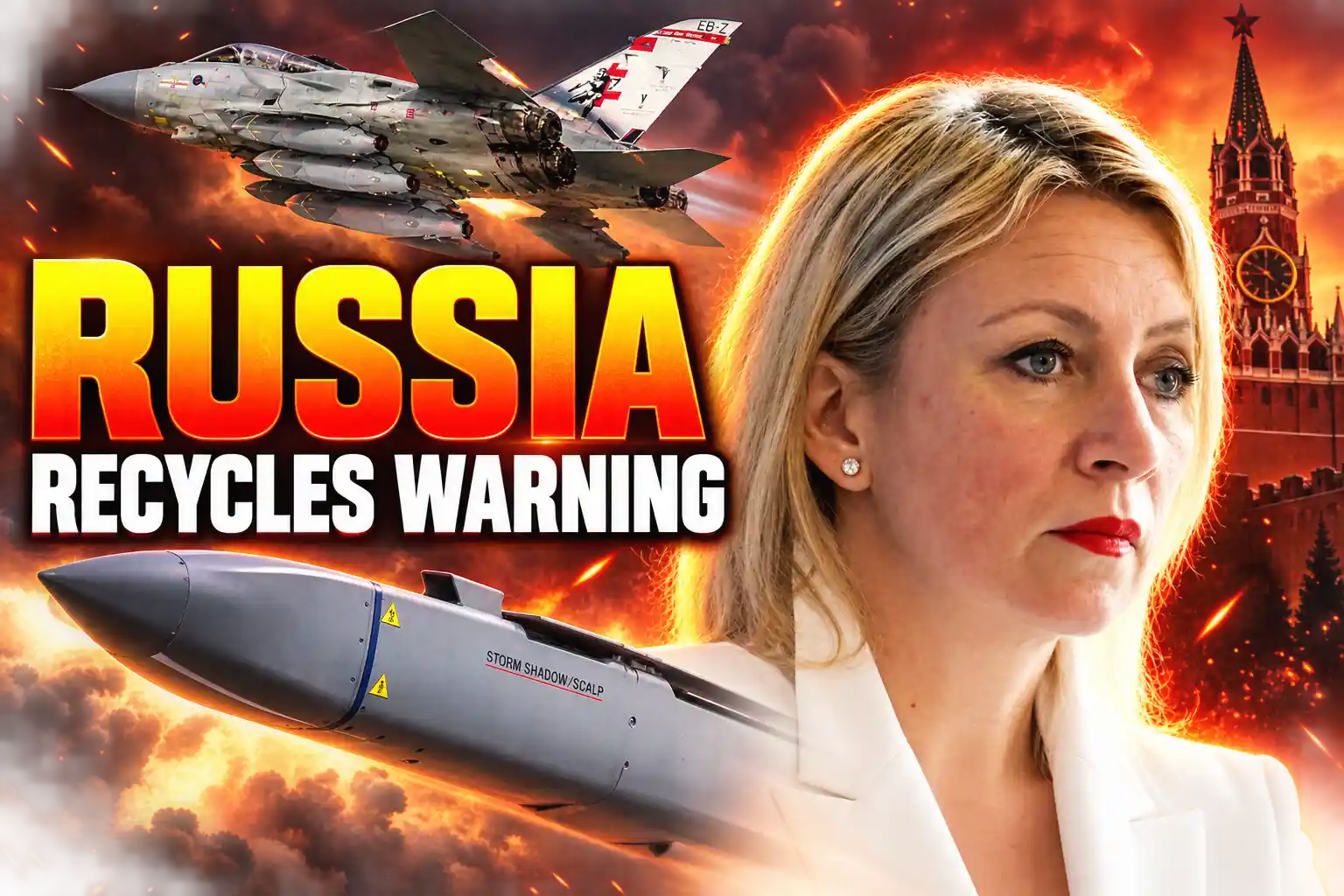
The trigger she named was Ukrainian use of Franco-British Storm Shadow/SCALP missiles against targets inside Russia, or against land in eastern Ukraine that Moscow claims as its own. She said any British military installations and equipment “in Ukraine and beyond its borders” could be hit in reply.
We have repeatedly warned that any British military installations and equipment in Ukraine and beyond its borders could be targeted in response to Ukrainian strikes on Russian territory carried out using British weapons.
Maria Zakharova, Foreign Ministry spokeswoman, August 27 Moscow briefing
She asked British leaders to “immediately, in the most resolute and unequivocal manner, abandon the hostile, aggressive line.” France was in the same dock. She said London and Paris were “playing with fire” by handing over sensitive missile technology, and that they were trying to park blame on Ukrainian factories after the fact.
The August 27 Moscow briefing tied that charge to a specific date. Zakharova said that on Aug. 26, “in broad daylight,” British and French Storm Shadow/SCALP-EG missiles hit the Donetsk-City shopping centre and injured eight people, including two children. Kyiv had no immediate public reply, and the claim was not independently confirmed.
She also went at Burnham by name. He seemed to think he had a mandate for escalation, she said, and had chosen the most dangerous path on Ukraine. Kremlin spokesman Dmitry Peskov had already called Britain “participating in the war” and “pouring fuel on the fire” after the Kyiv announcement.
Burnham Cleared MBDA to Share the Blueprints
Burnham was in Kyiv for Ukraine’s 35th Independence Day, on his first international trip to Kyiv as prime minister. The Prime Minister’s Office said MBDA could release classified information on UK-made parts for SCALP so Ukraine and France can move toward local assembly.
“On Ukraine’s 35th anniversary of independence, the Ukrainian people should be in no doubt: the UK is behind you today and for as long as it takes,” Burnham said in that release. “Russia should be in no doubt of our resolve. We will not back down until there is a just and lasting peace.”
In Kyiv he called Moscow’s warnings “outrageous threats” and said British support would not waver. “Despite Russia’s outrageous threats to my country, we will continue our support for Ukraine,” he told the Independence Day ceremony.
SCALP is the French-service name for the same air-launched missile Britain calls Storm Shadow. Both use shared British and French technology. France had already given its assent to license the weapon; British approval still mattered because British-built parts, including the warhead, sit inside the round.
The blueprint share also feeds British work on low-cost long-range strike weapons under Project Brakestop. In 2025, London and Paris had already said they would relaunch SCALP/Storm Shadow production and work in parallel on a replacement munition.
Burnham co-chaired a Coalition of the Willing meeting with French President Emmanuel Macron and German Chancellor Friedrich Merz. Leaders there agreed to raise military support, treat Ukrainian air defense as an urgent priority, and share technology, including through an anti-ballistic missile group.
Moscow had already pulled its ambassador in London, Andrey Kelin, in July and had not put a replacement name to the Foreign Office. The industrial announcement landed in that thinner diplomatic channel, which is one reason a briefing-room threat now does more work than an ambassador’s protest note.
The Missile Britain Is Helping Ukraine Build
Storm Shadow has been in Ukrainian service since 2023, when Britain became the first country to give Kyiv a long-range strike weapon of this class. MBDA describes it as an air-launched deep strike weapon for pre-planned attacks on hardened bunkers and other fixed sites.
Company figures put the missile at 1,300 kilograms and 5.10 metres long. It is built for Typhoon, Rafale, Mirage 2000 and Tornado. After launch it drops to terrain-hugging height, then uses an infrared seeker to match the target with a stored image. Public range figures from MBDA literature exceed 250 kilometers (155 miles).
The warhead is a BROACH penetrator, a British-developed charge designed to break a structure and then detonate inside it. That is why Moscow treats each round as a tool against command posts and plants, and why a shopping-center claim, if it stood up, would be a propaganda gift.
WHAT CHANGED ON AUG. 24
| Fact | Before the Kyiv visit | After Burnham’s clearance | |
|---|---|---|---|
| Missile in Ukrainian service | Yes, since 2023 | Unchanged | |
| Used on targets Russia claims as its own | Yes | Unchanged | |
| British classified data for local assembly | Withheld | MBDA cleared to release UK component data | |
| French-led assembly lines in Ukraine | Talks already underway | British legal block on shared parts lifted |
Early readings after the announcement said finished missiles would not roll off a Ukrainian line in a hurry. Zakharova’s briefing did not wait for that. She treated the handover of “technological data needed to independently assemble” the missiles at Ukrainian factories as the offense, and added that labour there is cheaper than in Europe.
May 2024 Already Named British Sites Beyond Ukraine
The sentence that ran around the world last week is not new. On May 6, 2024, the Russian foreign ministry summoned then-ambassador Nigel Casey after then-Foreign Secretary David Cameron said Ukraine “absolutely has the right to strike back at Russia” and that London did not put “caveats” on British-supplied weapons.
Moscow told Casey that if Ukrainian forces used British weapons to strike Russia, it could hit “any UK military facility and equipment on Ukrainian territory and beyond.” It urged him to reflect on the “inevitable catastrophic consequences” and to refute Cameron “in the strongest and most unequivocal manner.” Nuclear drills were announced in the same news cycle.
Britain did not empty its bases. Storm Shadow later flew against targets inside Russia, with public confirmation in late 2024 after an earlier period when London had confined the weapon to Crimea and mainland Ukraine. Vladimir Putin said Russia then had the “right” to attack military facilities in countries that supply long-range weapons. The kinetic reply that followed stayed inside the war: an intermediate-range ballistic missile fired at Dnipro, not a strike on an RAF station.
THE WARNING SEQUENCE
- May 2023: Britain supplies Storm Shadow to Ukraine, the first long-range Western cruise missile of this type in Kyiv’s inventory.
- May 6, 2024: Moscow summons the British ambassador and says UK military facilities “on Ukrainian territory and beyond” could be hit if British weapons strike Russia.
- November 2024: Ukraine uses Storm Shadow inside Russia; Putin claims a right to hit military sites in supplier countries; Russia fires an intermediate-range missile at Dnipro.
- Aug. 17, 2026: Russia says Britain will pay a “price” after British-made drones are reported used against military and industrial targets inside Russia.
- Aug. 24, 2026: Burnham, in Kyiv, clears MBDA to release classified British component data for SCALP/Storm Shadow assembly in Ukraine.
- Aug. 26, 2026: Moscow says Storm Shadow/SCALP-EG missiles hit the Donetsk-City shopping centre, injuring eight people, two of them children.
- Aug. 27, 2026: Zakharova repeats the installations-and-equipment formula, adds “terrorism” and “catastrophic consequences,” and groups Britain with France on technology transfer.
The pattern is a verbal red line that moves when Britain adds a capability, then a reply that stays inside the existing war. Hybrid pressure on Britain (sabotage, cyber, deniable arson) has been the cheaper tool. Open fire on a British base has not.
Why Moscow Named British Sites Again
Moscow is trying to freeze a production decision, not just punish one more missile already on a Ukrainian pylon. Zakharova said that by handing “assembly functions” to Ukrainians, London and Paris were trying to duck responsibility for strikes deep into Russia. The legal story she is building is complicity through know-how, not only through a finished round stamped in Stevenage or Bourges.
That is a different problem for the Kremlin than a finite British stockpile. A licensed line in Ukraine, even a slow one, is a stockpile that does not need another vote in London or Paris each time it is replenished. Russia’s military, she said, would “naturally” not allow Ukrainian forces to refill that arsenal, and London would not be able to shift the blame onto “Kyiv puppets.”
The shopping-center allegation is the civilian hook for that legal story. Independent tallies cut against the idea that Russia is the only party taking civilian pain. The Conflict Intelligence Team, which tracks the war, estimates 327 civilians were killed inside Russia in the first seven months of this year, the highest rate it has recorded since 2022. U.N. figures still show far more Ukrainian civilians killed than Russian ones. Both sides deny aiming at civilians.
THREE TRACKS IN ONE WARNING
- The data: Classified British component information, including parts of the warhead chain, without which a French-led line cannot legally copy the shared missile.
- The plants: Ukrainian assembly of SCALP/Storm Shadow, which Moscow says is a way to keep firing while London and Paris step back from each launch.
- The cheap follow-on: Project Brakestop and other low-cost long-range weapons, which would matter more than a handful of 1,300-kilogram cruise missiles if they ever arrive in volume.
An earlier warning over missile plants had already pointed at that industrial file after the Kyiv visit. Thursday’s briefing raised the same file to British military sites “beyond” Ukraine, which in plain language reaches toward British equipment in Europe and, if read at full stretch, toward the United Kingdom itself. The May 2024 note used that stretch once already. It did not come with coordinates.
London’s Answer Has Not Changed
A Ministry of Defence spokesperson said London stood “shoulder to shoulder” with Ukraine and would keep sending the equipment Kyiv needs “to defend itself against (President Vladimir) Putin’s illegal invasion.”
“Russia should be in no doubt about the resolve of this Government to stand against Russian aggression, in Ukraine and against the UK and our allies,” the spokesperson said.
That is the same posture Britain has held through each previous version of the warning. Burnham’s government is new; the missile policy is not a clean break. Storm Shadow went to Ukraine in 2023. Use inside Russia followed in 2024. The 2026 step is production knowledge, which is slower than a shipment and harder to walk back once the files are copied.
Western analysts quoted after the briefing said the extra heat in Zakharova’s language tracked fury at that knowledge transfer, not a newly discovered British radar site in Kharkiv. The ministry’s own phrasing (“we have repeatedly warned”) admits the rerun. The audience for a rerun is London, Paris, and anyone in Washington who has to decide whether a British base is now a live target.
Trump Calls a NATO Strike Unlikely
The same Thursday, President Donald Trump said in a phone interview he was not concerned Russia would attack a NATO member. CIA Director John Ratcliffe had been in Moscow earlier in the week to meet Sergei Naryshkin, head of Russia’s foreign intelligence service, the SVR. Naryshkin called the session routine and said they stayed inside intelligence-service business. Trump called the trip “semi-routine.”
Those two tracks ran side by side and did not meet in public. Moscow named British military sites as possible targets. Washington’s political line was that a NATO war was not on the table. Britain, which is the NATO member being named, answered with the MoD formula it has used since the first Storm Shadow shipment.
By Sept. 1, the foreign ministry’s English-language feed had moved on to other briefings, from Latvia to Vladivostok. No British installation was hit in the days after Zakharova spoke. Nuclear-torpedo chatter attached itself to the same week in commentary; the briefing she gave named military installations and equipment, and a shopping centre in Donetsk, not a doomsday weapon.
The files Burnham cleared are still the part of this story that did not exist in May 2024. The threat language did.

Pixel Buds Firmware 6.144 Ties New Features to Pixel Gear

Eve Markoski-Wood Backs Her Mum as Wood Fights Bail

Trump Rejects an Iran Deal as Diesel Holds Near Records

Amazon Cuts the S26 Ultra to $979 After Samsung’s Hike

Ice Caves Land in Minecraft 26.4 Snapshot 3

Warsh Rejects Rate Guidance and Still Moves Markets

Dana-Farber Exits an MGB Medicare Advantage Network Early

NASA Launches the Roman Space Telescope’s Cosmic Bet

Russia Recycles Its Old Warning Over Storm Shadow Plants

Primetime’s $2.7 Million Preview Tops Pitt’s Costlier Film
-
 BUSINESS1 month ago
Warsh Rejects Rate Guidance and Still Moves Markets
-
 BUSINESS4 weeks ago
Dana-Farber Exits an MGB Medicare Advantage Network Early
-
 NEWS1 month ago
NASA Launches the Roman Space Telescope’s Cosmic Bet
-
 ENTERTAINMENT2 weeks ago
Primetime’s $2.7 Million Preview Tops Pitt’s Costlier Film
-
 BUSINESS1 month ago
Jet Drones Lock Down Kyiv and Strip Kherson of Heat
-

 NEWS1 month ago
Congo Starts Ervebo Vaccinations for a Different Ebola Virus
-
 ENTERTAINMENT1 month ago
Midnight Spider-Man Turns Peter Parker Into Oscorp’s Hybrid
-

 BUSINESS1 month ago
Record Cyclospora Outbreak Follows Seven Years Without an Inspection