
NEWS
Congo’s Ebola Outbreak Crosses 10,000 Cases Without a Vaccine
Congo’s Bundibugyo Ebola outbreak has reached 10,060 cases and 4,887 deaths, with most new infections still coming from people health teams never listed as contacts.

Congo’s public health institute has recorded 10,060 confirmed Ebola cases and 4,887 deaths from Bundibugyo virus, a case fatality ratio of 48.6%.
The figures, as of Oct. 25 and released Tuesday, make this the fastest-growing Ebola outbreak on record and the deadliest in Congo. Most new infections still appear in people who were never listed as contacts, which is why the official tally keeps jumping.
Congo’s Count Hits 10,060 Confirmed Cases
The Institut National de Santé Publique put the toll at 10,060 confirmed cases and 4,887 deaths as of Oct. 25, with cases in 66 of the country’s 178 health zones across eight provinces. Ituri still holds 71.7 percent of the confirmed cases, and this is Congo’s 17th Ebola outbreak. At least 2,600 patients have recovered.
The outbreak was declared on May 15, two days before WHO named it a public health emergency of international concern. The virus is Bundibugyo, a species with no licensed vaccine and no approved specific drug, unlike the Zaire virus behind the West Africa epidemic of 2014 to 2016. That earlier catastrophe infected more than 28,000 people and killed more than 11,000, still the largest Ebola outbreak ever recorded. This one has moved faster.
U.S. CDC situation summaries say the response passed 1,000 confirmed cases within 40 days of being activated. Congo’s 2018 outbreak took about 235 days to pass the same mark. A CDC comparison chart, using data through Oct. 25, shows West Africa had recorded 3,052 cases at a similar point on its curve, which means Congo’s Bundibugyo wave is running at more than three times that early pace.
HOW FAST THIS OUTBREAK MOVED
| Outbreak | Days to 1,000 confirmed cases | What the same-point record shows |
|---|---|---|
| Congo Bundibugyo, 2026 | 40 after response activation | 10,060 confirmed cases as of Oct. 25 |
| Congo, 2018 | about 235 | Licensed Ervebo was available for the Zaire virus |
| West Africa, 2014-2016 | slower early climb | 3,052 cases by day 164; final toll above 28,000 |
The count has kept climbing when the Bundibugyo outbreak passed 9,000 cases earlier this month, and South Kivu has reported no confirmed case since May 29 even as Ituri and North Kivu stay hot. Responders have said treatment centres in some zones are full, and health workers have walked off the job over wages that did not arrive.
Most Recent Deaths Still Happen in Communities
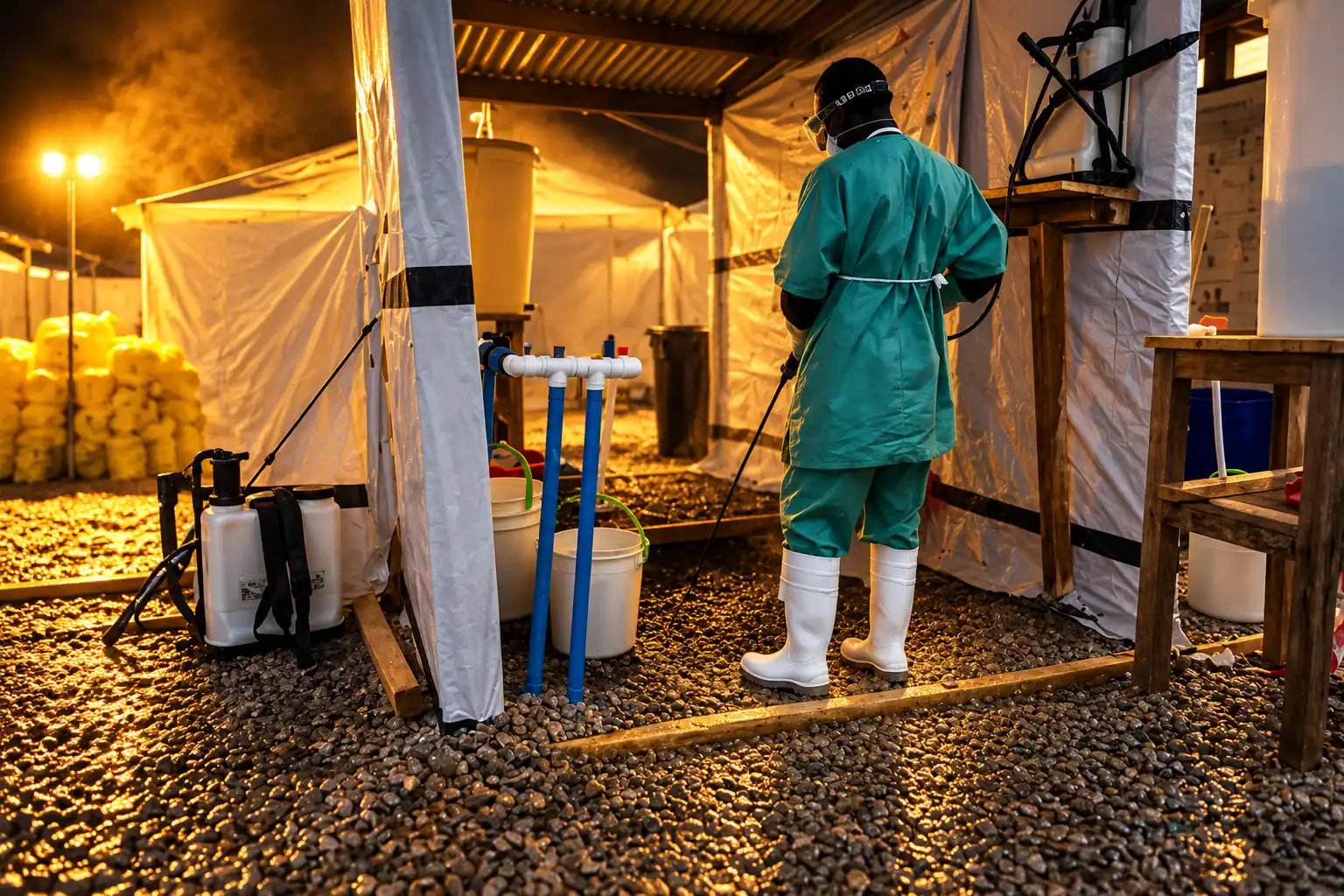
A high share of people are still dying before they reach a bed. WHO’s bulletin covering data as of Oct. 20 found 307 of 482 recent deaths in communities, against 175 in treatment centres. That is 64 percent of those deaths occurring outside care, which matches what field teams have been saying for months: families often do not report symptoms at all.
In June, a CDC model treated isolation as the lever that would decide the size of this outbreak. If 70 percent of patients entered isolation, one in 20 simulations exceeded 10,000 cases within three months. If only 20 percent were isolated, 85 percent of those runs crossed 10,000. The 10,060 figure did not land on that August calendar, but the death mix in October still looks like the low-isolation path: people sick at home, funerals that are not safe, and chains that start again.
THE TALLY BEHIND 10,060
- Confirmed cases: 10,060 in Congo as of Oct. 25, according to the public health institute.
- Confirmed deaths: 4,887, a case fatality ratio of 48.6 percent.
- Community deaths: 307 of 482 deaths in WHO’s last published slice happened outside treatment centres.
- Zones hit: 66 of 178 health zones across eight provinces.
As of Oct. 20, WHO still listed Ituri as the epicentre, with 7,040 confirmed cases and 3,271 deaths, while North Kivu had 2,146 cases and 1,199 deaths and the highest provincial fatality ratio, at 55.9 percent. Tshopo, where a nurse was killed on Saturday, had 76 cases and 27 deaths in that older bulletin. The national fatality ratio has sat near 48 percent for weeks, at the top of the 25 to 50 percent range described for earlier Bundibugyo outbreaks, which killed 30 percent of patients in Uganda in 2007 and 50 percent in Congo in 2012.
Contact Teams Miss the 95% Control Line
About 80 percent of recorded cases still come from people who were not among monitored contacts. Africa CDC has said officials need 95 percent of cases to come from known contacts before they can say the outbreak is largely in hand. That gap is the reason a round-number case count does not mean the map is shrinking.
A second, related test is daily follow-up of people already on a list. WHO said that as of Oct. 20, teams saw 24,017 of 30,130 contacts in 24 hours, a follow-up rate of 79.7 percent, still under the 95.0 percent line that agency uses as a minimum. North Kivu, which has been adding large daily caseloads, was at 73.3 percent.
CONTACT FOLLOW-UP ON OCT. 20
- Bas-Uélé: 98.9 percent (740 of 748), above the 95 percent line.
- Sud-Ubangi: 97.3 percent (109 of 112), also above the line.
- Ituri: 92.8 percent (6,382 of 6,879), with seven contacts becoming suspected cases.
- Haut-Uélé: 89.9 percent (1,286 of 1,430).
- Tshopo: 83.7 percent (1,077 of 12,086).
- North Kivu: 73.3 percent (14,423 of 19,675), the weakest of the six provinces WHO listed.
Those percentages describe people already identified. They do not capture the larger group that never made the list. Late testing has been a running flaw since May, when WHO noted a gap of about four weeks between symptom onset and laboratory confirmation, and first cases in new countries have often been confirmed long after people fell ill or after they had already travelled.
A Well-Known Nurse Was Killed in Bafwasende
On Saturday, a nurse was killed and another health worker was badly hurt while answering an Ebola alert in Bafwasende, a town in Tshopo province. The nurse worked at the general hospital there and had been sent out to talk to residents about the virus. Local youths accused the pair of contaminating water and spreading Ebola, according to Radio Okapi, and the group was joined by people with machetes and batons. The nurse died before emergency crews from the hospital could reach them.
A local health official said the dead man was a familiar face, not an outsider, and that colleagues were sleeping at the hospital under police guard because they were afraid to go home. The army briefly deployed to the area. Julien Harneis, the senior United Nations Ebola coordinator, said the killing was a loss to the response and a greater loss to patients, and he called for an investigation. WHO Director-General Tedros Adhanom Ghebreyesus said people working to protect communities must be able to work in dignity and safety.
The attack sits on top of a wage fight that has already pulled teams out of the field. In Nia Nia, in Ituri, surveillance and community engagement officers went on strike over unpaid bonuses owed since late August, a pattern responders say is common in affected localities. Armed conflict, bad roads, and rumours have made it harder to persuade families to send sick relatives in or to allow a safe burial.
Some people still don’t seem to understand the seriousness of the situation even though they are directly exposed to the risk.
Sephora Bgosi, Ebola burial team, Ituri province
Bgosi, whose team handles the dead in the epicentre, also said Ebola is extremely dangerous and can be deadly. That is the message burial workers have been carrying into communities that have lived through years of violence and repeated epidemics, and it is the message that got a nurse killed in Bafwasende.
Maternal Deaths in Ituri Rose Nearly 70%
The outbreak has pulled staff, beds, and attention off the rest of a health system that was already thin. United Nations figures show maternal deaths in Ituri rose nearly 70 percent between May and July compared with the same months a year earlier. The United Nations Population Fund has reported a drop of more than 30 percent in hospital deliveries and a 50 percent drop in treatment for obstetric complications over that stretch.
Pregnant women have been staying away from hospitals because they fear infection and isolation. In some clinics, prenatal registrations have fallen from dozens of women a month to about 10, and births on the ward have dropped sharply. Aid workers have described women arriving too late, including after untreated malaria, and they have warned that childhood vaccination and paediatric visits fell in the first three months of the outbreak as parents kept children home.
WHAT ELSE THE OUTBREAK HAS INTERRUPTED
- Maternal care: Ituri maternal deaths up nearly 70 percent, May to July, versus a year earlier, per United Nations figures.
- Deliveries: Hospital births down more than 30 percent, and care for obstetric complications down 50 percent, per UNFPA.
- Childhood shots: Routine immunisation and paediatric visits fell as families avoided clinics.
- Other outbreaks: Cholera work and other essential services lost staff and focus as Ebola absorbed the response.
- Schooling: Classes have been interrupted for children in a country where millions are already out of school.
Fear of the treatment centre is now a second cause of death. Occupancy at Isiro’s general hospital in Haut-Uélé fell to about 30 percent in August after Ebola patients were placed in the same buildings, and ordinary patients stopped coming. Teams have been trying to separate Ebola circuits from maternity and paediatric wards so women will walk back through the door.
Why Bundibugyo Still Has No Approved Vaccine
Bundibugyo virus disease spreads through direct contact with the body fluids of a sick or dead person, and through contaminated surfaces. The incubation period runs from two to 21 days, and people are not infectious before symptoms start. Early signs look like malaria, which is why laboratory confirmation is the difference between isolation and a missed chain. Outbreak control, WHO says, still rests on finding cases fast, isolating them, tracing contacts, burying the dead safely, and keeping communities willing to cooperate, because no approved vaccine or specific treatment exists for this virus.
Dr. Jean Kaseya, head of Africa CDC, has put the missing shot in blunt terms. “If this outbreak was in Western countries, vaccine would already be available,” he said. He added that some partners treated Bundibugyo as an African problem and were not interested. Africa CDC has been backing trials, including a candidate from an Egyptian manufacturer, while Congo and Uganda have been exploring whether Ervebo, the licensed Zaire vaccine, offers any cross-protection.
On Oct. 23, the Tumaini trial launched in Bunia, with first participants enrolled in Bunia on a Phase 2/3 platform that will test candidates around contacts of confirmed cases. The first person vaccinated received Ervebo. Organisers say the study is also expected to include pregnant women and children aged 12 and above, groups often left out of outbreak research. Other candidates in earlier testing include a ChAdOx1 Bundibugyo construct from Oxford and the Serum Institute of India, an rVSV Bundibugyo construct from IAVI, and a Moderna product. WHO expert groups have also flagged the monoclonal antibodies MBP134 and maftivimab, plus remdesivir, for treatment trials, and obeldesivir tablets for post-exposure study.
Those protocols are not a stockpile. Front-line teams have already been offered vaccinations with a shot built for a different Ebola virus, inside research rules, because that is what exists. Until a Bundibugyo-specific product is shown to work, the daily fight is still lists, beds, and burials.
Kenya and Nigeria Report Imported Bundibugyo Cases
Cases have been recorded in five countries since May 15: Congo, Uganda, France, Kenya, and Nigeria. Uganda’s flare-up, 21 confirmed and probable cases and 3 deaths, with the last confirmed case on June 21, was declared over in August. France reported one imported case and has no active cases. Kenya and Nigeria are the new tests of whether an imported patient becomes a local outbreak.
Kenya’s first case was a man who travelled from Congo through Uganda, arrived in Nairobi on Oct. 3, tested positive, and died on Oct. 5. European CDC figures list nine confirmed cases, including two deaths in Kenya as of Oct. 25, all linked to that first patient, with the second death on Oct. 23. WHO said the eight later cases were four family members and four health workers, all already in quarantine when symptoms began, and that 135 contacts had been traced. As of Oct. 22, Kenya had screened 709,093 travellers and tested 461 samples. There is no evidence of spread outside that cluster.
Nigeria confirmed one imported case in Abuja on Oct. 20, in a woman who had travelled from Uganda, developed symptoms on Oct. 7, sought care on Oct. 11, and tested positive nine days later. WHO said 44 contacts were identified as of Oct. 20. The patient was in isolation. WHO has advised against travel and trade bans on affected countries and has told governments to keep watching borders, laboratories, and clinics instead.
WHERE CONFIRMED CASES STAND
| Country | Confirmed cases | Deaths | Status |
|---|---|---|---|
| Congo | 10,060 as of Oct. 25 | 4,887 | 66 health zones, eight provinces, ongoing |
| Kenya | 9 | 2 | One Nairobi cluster, no community spread reported |
| Nigeria | 1 | 0 | Imported case in Abuja, contacts under watch |
| Uganda | 21 confirmed and probable | 3 | Declared over in August |
| France | 1 | 0 | No active cases |
Dr. Kaseya has called this the most geographically widespread Ebola outbreak in history and said the response has to move faster across borders. Inside Congo, the harder test is still the one Africa CDC set for control: 95 percent of cases coming from people already on a contact list. At 10,060 confirmed infections and 4,887 deaths, that share is about 20 percent. The next situation report will move the headline number. It will not, by itself, move that ratio.
Disclaimer: This article is news reporting on an ongoing infectious-disease outbreak and is for information only. It does not constitute medical advice, a diagnosis, or guidance on treatment, vaccination, isolation, or travel. Anyone with symptoms, a possible exposure, or plans to travel through affected areas should consult a licensed physician or a local public health authority before acting. Case counts, deaths, contact-tracing rates, and vaccine-trial status match the ministry, WHO, CDC, and Africa CDC figures cited in this report and will change as new situation reports are issued.

Ken Urker’s Accidental Overdose Leaves His Finders Waiting

A Third Carrier Arrives as Hormuz Tankers Keep Burning

Shoe Prices Hit a Record as Flagship Pairs Stay Put

Nvidia’s First Call Without Huang Tests the Money Machine

Blake Griffin Says Oklahoma City Taxpayers Bought a Thunder Arena

Warsh Rejects Rate Guidance and Still Moves Markets

Davina McCall Reveals Cardiovascular Disease After Cholesterol Warnings

Dana-Farber Exits an MGB Medicare Advantage Network Early

NASA Launches the Roman Space Telescope’s Cosmic Bet

OpenAI’s Cyber Letter Puts the Defense Bill on Governments
-
 BUSINESS3 months ago
Warsh Rejects Rate Guidance and Still Moves Markets
-
 ENTERTAINMENT4 weeks ago
Davina McCall Reveals Cardiovascular Disease After Cholesterol Warnings
-
 BUSINESS2 months ago
Dana-Farber Exits an MGB Medicare Advantage Network Early
-
 NEWS3 months ago
NASA Launches the Roman Space Telescope’s Cosmic Bet
-
 NEWS3 months ago
OpenAI’s Cyber Letter Puts the Defense Bill on Governments
-

 NEWS3 months ago
Russia Recycles Its Old Warning Over Storm Shadow Plants
-

 ENTERTAINMENT2 months ago
Primetime’s $2.7 Million Preview Tops Pitt’s Costlier Film
-

 BUSINESS3 months ago
Jet Drones Lock Down Kyiv and Strip Kherson of Heat