
ENTERTAINMENT
The AFM Wants Session Musicians Paid for Label AI Deals
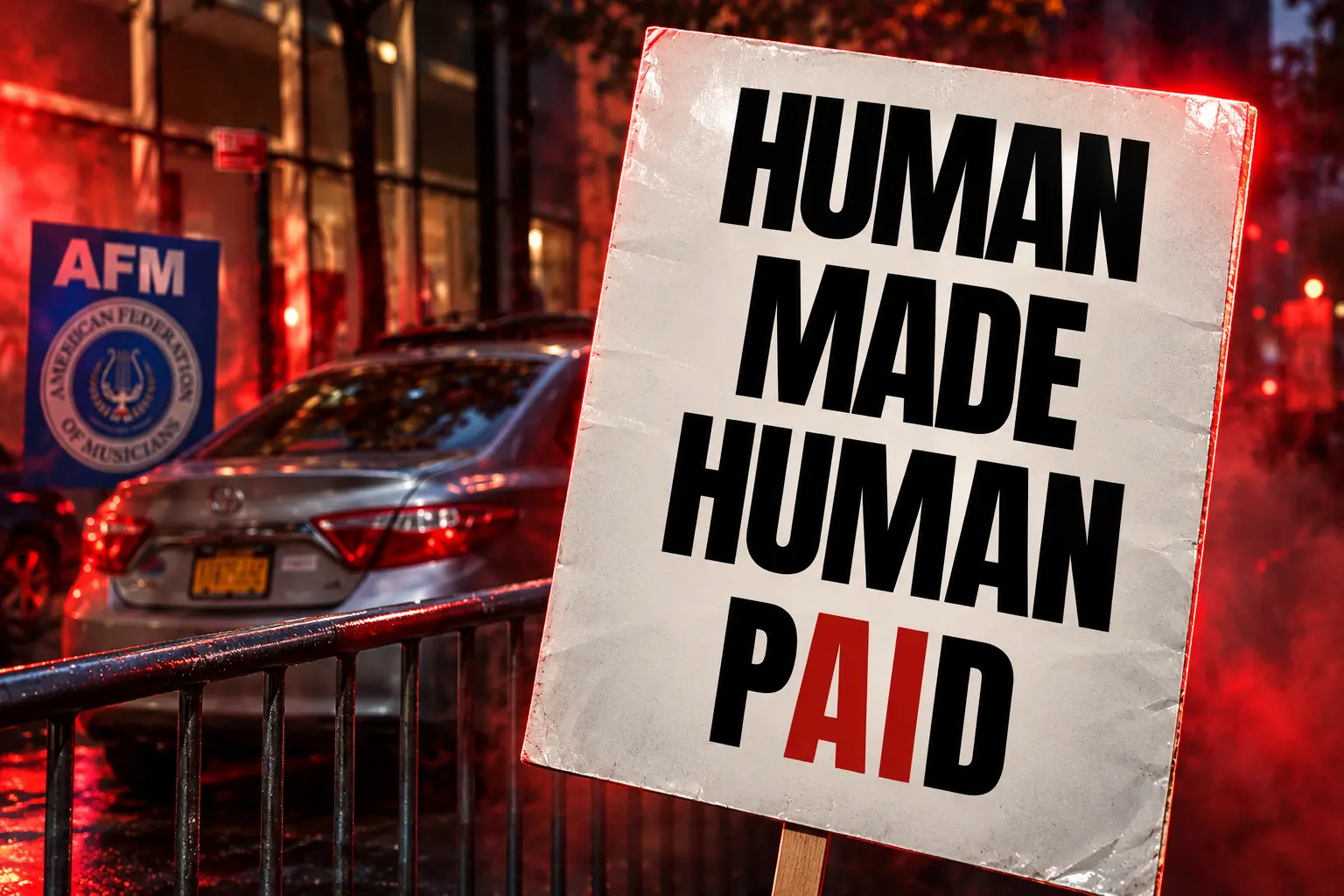
The AFM’s Human Made, Human Paid campaign asks major labels to pay session musicians for AI training, a cut featured artists are already being promised.

The American Federation of Musicians opened a public campaign on October 20, 2026, to put session players into the AI licensing money major labels have already collected. Human Made, Human Paid asks Universal Music Group, Sony, Warner, and Disney’s Hollywood Records for consent, credit, and pay when recordings are used to train models or to generate new tracks. Talks on the Sound Recording Labor Agreement restart in November.
The people named in that contract are not, as a rule, the stars on the album cover. They are the side musicians who sat the date, took scale, and then watched the master walk out the door.
Working Musicians Already Sold the Performance for Scale
The AFM says it represents more than 80,000 professional musicians. The Sound Recording Labor Agreement is the deal that covers their work on major-label records in the United States and Canada, along with pension and health payments tied to those dates. A featured artist may own a royalty stream. A side musician is paid for the hours in the room.
Under the scale sheet that ran from February 3, 2025, through the contract’s July 31, 2026 extension, a side musician’s basic three-hour call is $488.29. The leader or contractor gets double that. The employer adds a 14.09% pension contribution on scale, plus $30 in health and welfare for the first session of the day and $25 for each one after. That check is the sale of the performance. It is not a share of whatever the label later does with the tape.
Union recording work has always had a second door, and that is why this fight exists. If a finished track is later used in a film, a TV show, or a commercial, musicians can collect new use fees when recordings move into that other medium. If a later hit samples the original, a separate payment goes into the Sound Recording Special Payments Fund and is split among the players on the date. AI training has no line on that sheet.
HOW A UNION DATE GETS PAID AFTER THE SESSION
| Use of the recording | Who is paid | What the contract pays |
|---|---|---|
| Basic studio session (SRLA) | Side musician on the date | $488.29 for three hours, plus 14.09% pension and $30 health |
| Leader or contractor on that date | Leader or contractor | $976.58, double side-musician scale |
| Sample licensed into a new song | Musicians who played on the original | $400 for the first sample, $250 for each one after, split by the fund after costs |
| Track licensed to a TV ad or film | Musicians who played on the original | New-use pay equal to that medium’s scale, including pension |
| Catalog licensed to train generative AI | No SRLA rate yet | Labels collect the license; session players have no posted fee |
The sampling column is not theoretical. For 2025, the fund paid $311,107, or had it payable, to 1,933 musicians on 543 sampled songs. Contributions are generally $400 the first time a covered song is sampled and $250 each time after, unless the new song makes more than $25,000. The fund keeps 30% for administration and payroll taxes. Four players on a $400 sample would take $70 each. That is a small check. It is still a check with a rule attached.
Suno and Udio Already Have the Catalogs
The majors spent two years telling courts that unlicensed AI music replaces human work. Then two of them sold licensed access anyway. Universal settled with Udio in October 2025. Warner settled with Udio and, days later, with Suno in November 2025. Sony has not settled with either company and is still fighting them in court.
Those licenses are the money the union wants in the contract. They are also the facts already in front of a New York judge. AFM International President Tino Gagliardi said the labels built multi-million-dollar AI deals on members’ work and that the players have not seen a dime.
FROM COPYRIGHT SUITS TO A UNION CAMPAIGN
- June 24, 2024: Universal, Warner, and other record companies sue Suno and Udio, saying the models copied protected recordings and risk replacing human artists.
- October 2025: Universal settles with Udio and announces a licensed AI music platform.
- November 2025: Warner settles with Udio, then with Suno, and grants catalog access for training and generation in return for fees covering licenses and past claims.
- June 5, 2026: The AFM sues Universal and Warner in the U.S. District Court for the Southern District of New York, saying member recordings were licensed without pay or credit.
- July 24, 2026: An amended complaint names Warner Records and Atlantic Recording Corp., the SRLA signatories, in place of the Warner parent company.
- October 20, 2026: The union launches Human Made, Human Paid ahead of November bargaining.
Sony sits at the November table and is not a defendant in the AFM case. Hollywood Records sits there too. The lawsuit tracks the companies that already cashed an AI license. The campaign tries to bind the ones that have not.
AFM Sues Universal and Warner Over AI Licenses
The union’s lawsuit against Universal and Warner Records does not ask a judge to ban AI. It asks the court to treat AI training and generation as a “new use” under Article 21 of the Sound Recording Labor Agreement. That clause, the AFM says, has long required notice and extra pay when a recording made under the deal is later used for a purpose the original session did not cover, the way a pop track licensed into a commercial or a video game triggers a fresh payment.
Record labels built multi-million-dollar AI deals on the backs of our members, yet the artists whose life’s work powered these technologies haven’t received a single dime. The labels cannot pocket massive payouts while cutting working musicians out of the equation. This lawsuit is about transparency, accountability, and ensuring our artists receive every cent of the new use royalties guaranteed to them under our collective bargaining agreement.
Tino Gagliardi, AFM International President, union statement
Universal and Warner have moved to throw the case out. Their reading is the reverse of the union’s. Because the SRLA never named generative AI, they argue, Article 21 does not mint a fee for it. Extra pay for a new medium has to be bargained, they told the court, as video-game use was bargained in earlier rounds. Warner also said the parties are already negotiating the same issue and that the lawsuit is an attempt to win at the courthouse what has not been won at the table.
The union’s own papers describe AI use as a purpose the SRLA does not cover, then say that gap is exactly why Article 21 applies. That loop is now the case. It is also why the October campaign exists. If a judge will not imply a rate, the rate has to be written into the next deal.
What Human Made, Human Paid Asks the Labels
The public campaign is short on purpose. It is timed to the restart of SRLA talks and built to put three words in front of the majors and anyone who will sign. Anyone can add a name to the Human Made, Human Paid petition, member or not.
THE THREE CONTRACT DEMANDS
- Consent: Musicians would get the right to approve or refuse the use of their recordings to train AI models.
- Credit: Use that goes forward would carry clear credit for the human performance that fed the system.
- Compensation: Players would be paid for AI use and would share in the licensing deals labels sign with AI firms.
Gagliardi’s campaign line matches the lawsuit almost word for word. Labels cannot pocket profits built on human artistry while cutting working musicians out, he said, and the AFM will not let tech deals bypass the artists who made the catalogs valuable. New York’s Local 802 put the petition in front of members the day the campaign opened.
HUMAN MADE HUMAN PAID Sign the petition now with @The_AFM 🎵 https://t.co/8wRifBFIRD
— Local 802 AFM (@Local_802_AFM) October 20, 2026
Will Wells, an AFM member who has worked with Anthony Ramos, Cynthia Erivo, and the Netflix series Emily in Paris, said the demand is not a campaign against machines. “We are pro-human creators and pro compensation for our labor. That’s what it comes down to. We don’t want to stop the advancement of technology,” he said. “We just want to make sure that people can have a viable career and there’s a viable pathway forward for music makers to sustain a living.” He also said the idea that theft of intellectual property would be tolerated, and that musicians would have no say in how their work is exploited, is “chilling.”
Los Angeles Local 47 used a harder image in early October, before the national branding landed. Users of Suno and Udio are not creating from nothing, the local wrote. They are being handed raw material. If humans made the music, the local said, those humans should be able to consent before it is blown up and reassembled, then be credited and paid. That is the session player’s version of the same three words.
Warner’s Suno Split Names Artists, Not Players
The hole in the SRLA is easier to see once Warner describes who it has already chosen to pay. On September 9, 2026, as Suno launched v6 models trained with material from Warner, BMG, and Believe, Warner Music Group Chief Executive Robert Kyncl told staff that Warner artists and songwriters would share revenue from Suno’s more than 2 million paying subscribers. He called it the first time that talent had been paid from music creation as well as from consumption.
Artists and songwriters are names on a split. Side musicians are names on a B-4 session report. Kyncl’s memo does not put the players who performed the licensed recordings into that new pot. The AFM’s campaign is the attempt to do it by contract, because the master recording, not the hourly performance, is what the label sold.
That is the old recording-studio bargain wearing new software. The person who sang the hit may have leverage in an artist deal. The string section, the drummer, the hired guitar, and the copyist took scale and a pension contribution and, if they were lucky, a later sample check. Royalty artists are carved out of some SRLA side payments already. AI licensing followed the same path unless the union can force a new sentence into the deal.
Labels still talk, in court and in public, as if they are defending human catalogs against machines. Universal and Warner warned in 2024 that AI systems risked replacing human artists with huge volumes of generated sound. They then settled, licensed the same catalogs, and kept the session players off the recoupment statement. Sony’s unfinished war with Suno and Udio does not close that gap for AFM members. It only means one major has not yet signed the kind of deal the union is suing over.
Bargaining Resumes Before the Court Has Ruled
Successor talks on the Sound Recording Labor Agreement have been running through 2026. The union says those talks stalled because it is insisting on AI protections in the contract. AFM Local 47 told members in early October to expect more on this as the next round of talks in early November with the major labels gets closer. The written term that began March 13, 2023, was first set to end January 31, 2026, then extended through July 31, 2026. The November room is where a successor has to deal with a use the last sheet never priced.
WHERE THE UNION AND THE LABELS DISAGREE
- The AFM: Licensing recordings to train and generate AI music is a new use under Article 21, so labels must notify the union and pay the musicians who played on those tracks.
- Universal and Warner: Generative AI is not a purpose the SRLA covers, Article 21 does not create a fee by itself, and any new payment has to be negotiated, which they say is already underway.
- Sony: It has not settled with Suno or Udio and is not a defendant in the AFM case, but it is still at the SRLA table with the other majors and Hollywood Records.
Both tracks can stay open at once. A court can still decide whether the old clause reaches the new licenses. The November bargaining can still write a rate, a consent rule, and a credit line that the last contract never had. The petition is the public pressure on that room. The lawsuit is the claim that the money already moved without the people who made the records.
Gagliardi will walk into that round with the same three words he put on the campaign site. Consent, credit, and compensation are easy to print. They are harder to draft onto a session that was paid, in cash, years before anyone licensed the catalog to a model.

Ohtani Game 4 Logoman Card Sells for $3.24 Million

Cole Kmet’s Season Ends, and Chicago’s Tight End Plan Starts

NBA Seeks Soccer Money After EuroLeague Clubs Refused

Amazon’s First Bond Tests Leave the Broccoli Chair Empty

Tyrese Maxey Owns the Night Built for LeBron James

Warsh Rejects Rate Guidance and Still Moves Markets

Dana-Farber Exits an MGB Medicare Advantage Network Early

NASA Launches the Roman Space Telescope’s Cosmic Bet

OpenAI’s Cyber Letter Puts the Defense Bill on Governments

Russia Recycles Its Old Warning Over Storm Shadow Plants
-
 BUSINESS2 months ago
Warsh Rejects Rate Guidance and Still Moves Markets
-
 BUSINESS1 month ago
Dana-Farber Exits an MGB Medicare Advantage Network Early
-
 NEWS2 months ago
NASA Launches the Roman Space Telescope’s Cosmic Bet
-
 NEWS2 months ago
OpenAI’s Cyber Letter Puts the Defense Bill on Governments
-
 NEWS2 months ago
Russia Recycles Its Old Warning Over Storm Shadow Plants
-

 ENTERTAINMENT4 weeks ago
Primetime’s $2.7 Million Preview Tops Pitt’s Costlier Film
-

 BUSINESS2 months ago
Jet Drones Lock Down Kyiv and Strip Kherson of Heat
-

 ENTERTAINMENT2 months ago
Midnight Spider-Man Turns Peter Parker Into Oscorp’s Hybrid