
NEWS
China Bans Two Ministers as Paraguay Speeds Its Taiwan Bet
China barred ministers from Paraguay and Belize over Taiwan ties, but both capitals treated the bans as empty and kept a $200 million data-center bet moving.

China on October 12 sanctioned sitting ministers from Paraguay and Belize, two of Taiwan’s last 12 diplomatic allies, over their ties with Taipei. The orders freeze any property they hold in China, bar Chinese firms from dealing with them, and deny them entry to the mainland, Hong Kong, and Macau.
Both men said they have little or nothing in China to freeze. Paraguay’s tech minister called the ban an incentive to speed a $200 million data center with Taiwan, and Belize’s foreign minister called it interference in a sovereign choice.
Orders 21 and 22 Freeze Property Inside China
The Chinese Foreign Ministry published two decrees on October 12 and put them into force the same day. Order No. 21 names Gustavo Emigdio Villate Samaniego, Paraguay’s minister of information and communication technologies. Order No. 22 names Francis Fonseca, Belize’s foreign minister, who also holds the trade, education, culture, science, and technology portfolios.
Spokeswoman Mao Ning told the regular briefing in Beijing that the pair had “willingly serve[d] as chess pieces for the DPP authorities in their pursuit of independence by soliciting external support.” She said their visits to Taiwan, and the welcome they gave visiting Taiwanese officials, amounted to interference in China’s internal affairs, and she accused them of spreading “Chinese cyber attack” claims that she called false. The decrees, she said, were an action of warning and deterrence.
Until now Beijing had pointed this personal tool mainly at Western politicians who back Taiwan. Naming sitting cabinet ministers from the island’s remaining diplomatic allies is a new cut. The legal hook is Articles 3, 4, 6, 9, and 15 of China’s 2021 law on countering foreign sanctions, adopted on June 10, 2021, by the Standing Committee of the National People’s Congress.
THE THREE BANS IN THE ORDERS
- Property freeze: Movable and immovable property, and other assets the two men hold inside China, are frozen.
- Deal ban: Organizations and individuals in China may not transact, cooperate, or otherwise deal with them.
- Entry ban: They are denied visas and barred from the mainland, Hong Kong, and Macau.
Those are real penalties on paper. They are thin in practice against two officials from countries that do not recognize Beijing and rarely send ministers there. Mao still aimed the warning past them, at “the very few countries left which still have so-called ‘diplomatic ties’ with China’s Taiwan region,” and said betting on “Taiwan independence” would cost them development and leave them isolated.
Certain politicians in Paraguay and Belize willingly serve as chess pieces for the DPP authorities in their pursuit of independence by soliciting external support. Their visits to Taiwan and reception of “Taiwan independence” separatist forces in their countries constitute severe interference in China’s internal affairs.
Mao Ning, Foreign Ministry spokeswoman, regular press briefing in Beijing
Paraguay’s foreign ministry rejected the move the same day and said it would “generate unnecessary friction with our country.” It “once again ratifies its firm support for the Republic of China,” the ministry said, using Taiwan’s formal name. The orders were written against two men, which lets Beijing say it is not punishing Paraguay or Belize as states. Both capitals treated that split as fiction.
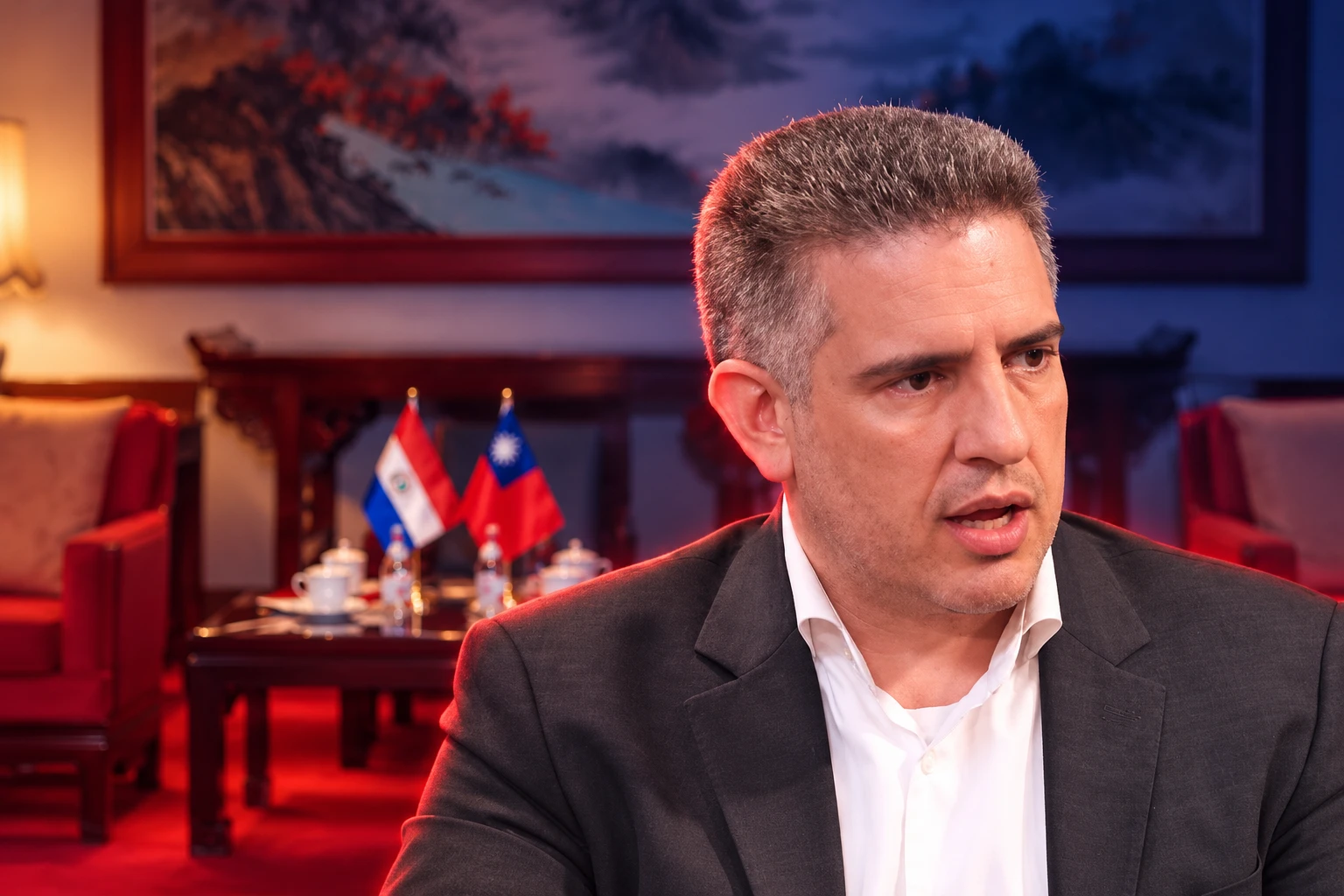
Paraguay’s $200 Million Data Center Is What Beijing Cited
Villate said he learned of the ban at dawn on October 12 and that he had been expecting some form of pressure, given the work Paraguay is doing with Taiwan. On local radio he said that, for him, the visa cut was “an incentive.” He later told interviewers it was “like a medal of honor.”
The project that sits behind that shrug is Yguazú Digital, a planned data center Taiwan would help stand up in Paraguay. In a June interview Villate said Taiwan was looking at a $200 million investment for about 10 megawatts of computing capacity, with a hope of being on line by the end of 2027. Taiwan would supply Nvidia chips and other kit. Paraguay would put in government land near Asuncion, cheap hydropower, and basic works.
The Peña government planned legislation for a company split evenly with Taiwan, also called Yguazú Digital, that would own the hall and later bring in private money. Villate said both sides were talking to the U.S. International Development Finance Corporation about financing. That is a conversation, not a signed loan. In early October, President Santiago Peña invited Foxconn, the Taiwanese electronics assembler, to look at joining the same hub.
Peña visited Taipei earlier in 2026 and signed deals on cybersecurity and computing investment. On October 10, Taiwan’s National Day, Villate posted that Paraguay “reaffirms its relationship of friendship and cooperation, based on shared values and principles: the self-determination of peoples, human rights and democracy.” The Chinese orders landed two days later.
After the decrees he wrote that Paraguay’s digital systems follow technical and national-security rules set at home, that no outside ban would condition those choices, and that work with Taiwan would move faster, not slower. He listed Yguazú Digital, a technology park, the Taiwan-Paraguay Polytechnic University, and a health information system among the files to push.
La infraestructura digital del Paraguay se rige por criterios técnicos y de seguridad nacional, decididos soberanamente.
Ninguna sanción externa condiciona nuestras decisiones.
Juntos, con Taiwán, vamos a acelerar cada proyecto conjunto. Yguazú Digital, el Parque Técnológico,…
— Gustavo Villate (@gvillate) October 12, 2026
Taipei’s embassy in Asuncion cheered that post. A local critic answered that the minister, not the country, had chosen a fight over Taiwan’s status. A Chinese-language reply said the penalty hit Villate personally and should not be sold as an attack on Paraguay. That is the line the orders were drafted to support. It did not move the ministry that runs the data-center file.
A July Cyber Review Set Up the Charge of Disinformation
Mao’s other count against the two men was that they had spread false claims about Chinese hacking. The public record she is fighting is a U.S.-Paraguay statement issued on July 10, 2026, by Villate’s own ministry.
In that text, Washington and Asuncion said a joint review of government networks had found “multiple” threat actors linked to the Chinese government inside Paraguayan state systems. They tied that finding to an earlier joint review in 2024 that named Flax Typhoon, a China-based cyber-espionage group the two governments said has direct links to Beijing, as having already gotten into Paraguayan government systems.
Paraguay’s public prosecutor opened a criminal case in July after a MITIC complaint about improper access to state computers. Beijing rejected the hacking charge as politics. Mao then folded “Chinese cyber attack” talk into the October 12 indictment of Villate, which puts a technical dispute inside a sovereignty fight.
FROM THE 2021 LAW TO THE OCTOBER ORDERS
- June 10, 2021: China’s legislature adopts the law on countering foreign sanctions, the statute later cited in Orders 21 and 22.
- 2024: A U.S.-Paraguay cyber review names Flax Typhoon as having infiltrated Paraguayan government systems.
- June 2026: Villate, in interviews, describes the $200 million, 10 megawatt Yguazú Digital plan and DFC financing talks, and meets Taiwan’s deputy foreign minister in Paraguay.
- July 10, 2026: Washington and Asuncion publish the joint finding of China-linked actors in state networks.
- September 2026: Taiwan Foreign Minister Lin Chia-lung visits Belize and meets Fonseca; the two sides sign a diplomatic-training arrangement.
- October 10, 2026: Villate marks Taiwan’s National Day online; two days later, Beijing issues the orders.
The sequence is the point of the timing. Beijing waited until a cyber accusation, a training pact, and a data-center plan were all on the table, then hit the two ministers who had put their names on those files.
Belize Rejects a Note Delivered From Kingston
Fonseca said he first heard of the sanctions around 5:30 a.m. His “initial reaction was shock.” China’s embassy in Jamaica sent a formal note to Belize’s protocol office, and Fonseca said the text pointed at Belize’s decision to receive Lin last month.
“It doesn’t affect me personally, and obviously, I do not have any assets in China,” he said. He also said he has never visited the mainland. He still called the step “a very serious matter” and “an act really of interference with our right, our sovereign right as a nation to chart our own course when it comes to foreign policy.”
The foreign ministry in Belmopan rejects measures against Minister Fonseca in a statement issued at 11:40 a.m. local time on October 12. It said Belize is a sovereign state, that under the UN Charter every state may run its foreign policy free from outside pressure, and that small states depend on sovereign equality and non-intervention.
Belize’s diplomatic relationship with Taiwan was established by a sovereign decision of our country. It is a partnership that has delivered cooperation in development, health, education, and infrastructure, the environment and agriculture for the benefit of the Belizean people. The Minister has acted at all times in his official capacity, on the instructions of the Government and in the national interest of Belize. Measures directed at an individual for carrying out the lawful duties of his office are unwarranted, and we reject them.
Ministry of Foreign Affairs of Belize, Belmopan, October 12, 2026
The ministry said the bans will not alter Belize’s foreign policy and that the government “continues to stand fully behind Minister Fonseca.” It asked other states to refrain from unilateral coercive measures against officials of other states. Belize’s embassy in Taipei had just marked 37 years of ties. Lin’s September visit, and the training deal signed there, is the concrete act Order No. 22 is built to punish.
Taiwan’s Formal Allies Now Number 12
Paraguay is Taiwan’s only remaining partner in South America. Belize is one of the Central American and Caribbean governments that still exchange ambassadors with Taipei. Mao’s “very few countries left” line is the audience for Orders 21 and 22 as much as Villate and Fonseca are the named targets.
GOVERNMENTS THAT STILL RECOGNIZE TAIWAN
| Region | Governments | Count |
|---|---|---|
| Latin America and the Caribbean | Belize, Guatemala, Paraguay, Haiti, Saint Kitts and Nevis, Saint Lucia, Saint Vincent and the Grenadines | 7 |
| Pacific | Marshall Islands, Palau, Tuvalu | 3 |
| Africa | Eswatini | 1 |
| Europe | Vatican City | 1 |
Those 12 are the full formal list. Beijing has already peeled away larger Latin American partners, including Panama, the Dominican Republic, El Salvador, Nicaragua, and Honduras, by pairing diplomatic pressure with investment. Paraguay has long heard the complaint at home that Taipei’s friendship produced less cash than China’s offers next door. Yguazú Digital is Asuncion’s answer to that complaint: chips and computing, not another aid plaque.
Taiwan’s deputy foreign minister, Chen Ming-chi, who met Villate in Paraguay in June, called the decrees another case of “transnational repression.” “Taiwan’s international visibility is growing higher and higher, and they will be kept busy by this fact. Do they plan to sanction the whole world?” he said.
Washington Answers With Hemisphere Language
On October 13, U.S. State Department spokesman Tommy Pigott put the Trump administration on the record. “The Trump administration opposes coercion and aggression by China against countries in our hemisphere for exercising their sovereign rights,” he said.
Pigott pointed back to Secretary of State Marco Rubio’s line that the United States “will not allow our region to become a base of operation for adversaries, competitors, and rivals to threaten our security or undermine our partnerships.” “We stand with our friends and partners, including Taiwan, to advance our shared prosperity, security, and values,” Pigott added.
China’s Foreign Ministry told U.S. officials to “stop sending the wrong signals to Taiwan separatist forces.” The exchange makes the personal decrees harder to keep personal. A freeze that does not touch a bank account in Asuncion or Belmopan still pulled Washington into a hemisphere frame, which is the opposite of isolating two small partners.
DFC money for Yguazú Digital is still only a discussion Villate has described. Foxconn has been invited, not announced as a builder. The 10 megawatt hall is not pouring concrete because of a visa stamp. What did change on October 12 is that Beijing put two cabinet ministers on a sanctions list, and both governments answered by repeating the Taiwan file rather than opening a channel to Beijing.
Fonseca said he has never visited the mainland he is now barred from and holds no assets there. Villate is still trying to stand up a 10 megawatt data center near Asuncion with Taiwan. The two Foreign Ministry orders took effect on October 12.

Ohtani Game 4 Logoman Card Sells for $3.24 Million

Cole Kmet’s Season Ends, and Chicago’s Tight End Plan Starts

NBA Seeks Soccer Money After EuroLeague Clubs Refused

Amazon’s First Bond Tests Leave the Broccoli Chair Empty

Tyrese Maxey Owns the Night Built for LeBron James

Warsh Rejects Rate Guidance and Still Moves Markets

Dana-Farber Exits an MGB Medicare Advantage Network Early

NASA Launches the Roman Space Telescope’s Cosmic Bet

OpenAI’s Cyber Letter Puts the Defense Bill on Governments

Russia Recycles Its Old Warning Over Storm Shadow Plants
-
 BUSINESS2 months ago
Warsh Rejects Rate Guidance and Still Moves Markets
-
 BUSINESS1 month ago
Dana-Farber Exits an MGB Medicare Advantage Network Early
-
 NEWS2 months ago
NASA Launches the Roman Space Telescope’s Cosmic Bet
-
 NEWS2 months ago
OpenAI’s Cyber Letter Puts the Defense Bill on Governments
-
 NEWS2 months ago
Russia Recycles Its Old Warning Over Storm Shadow Plants
-

 ENTERTAINMENT4 weeks ago
Primetime’s $2.7 Million Preview Tops Pitt’s Costlier Film
-

 BUSINESS2 months ago
Jet Drones Lock Down Kyiv and Strip Kherson of Heat
-
 ENTERTAINMENT2 months ago
Midnight Spider-Man Turns Peter Parker Into Oscorp’s Hybrid