
NEWS
The Amazon’s Record Low Hides Where Brazil Still Cuts
Amazon clearing fell to 3,335 square kilometers, but the Cerrado still lost more land, and Brazil’s runoff is about who may still cut legally.

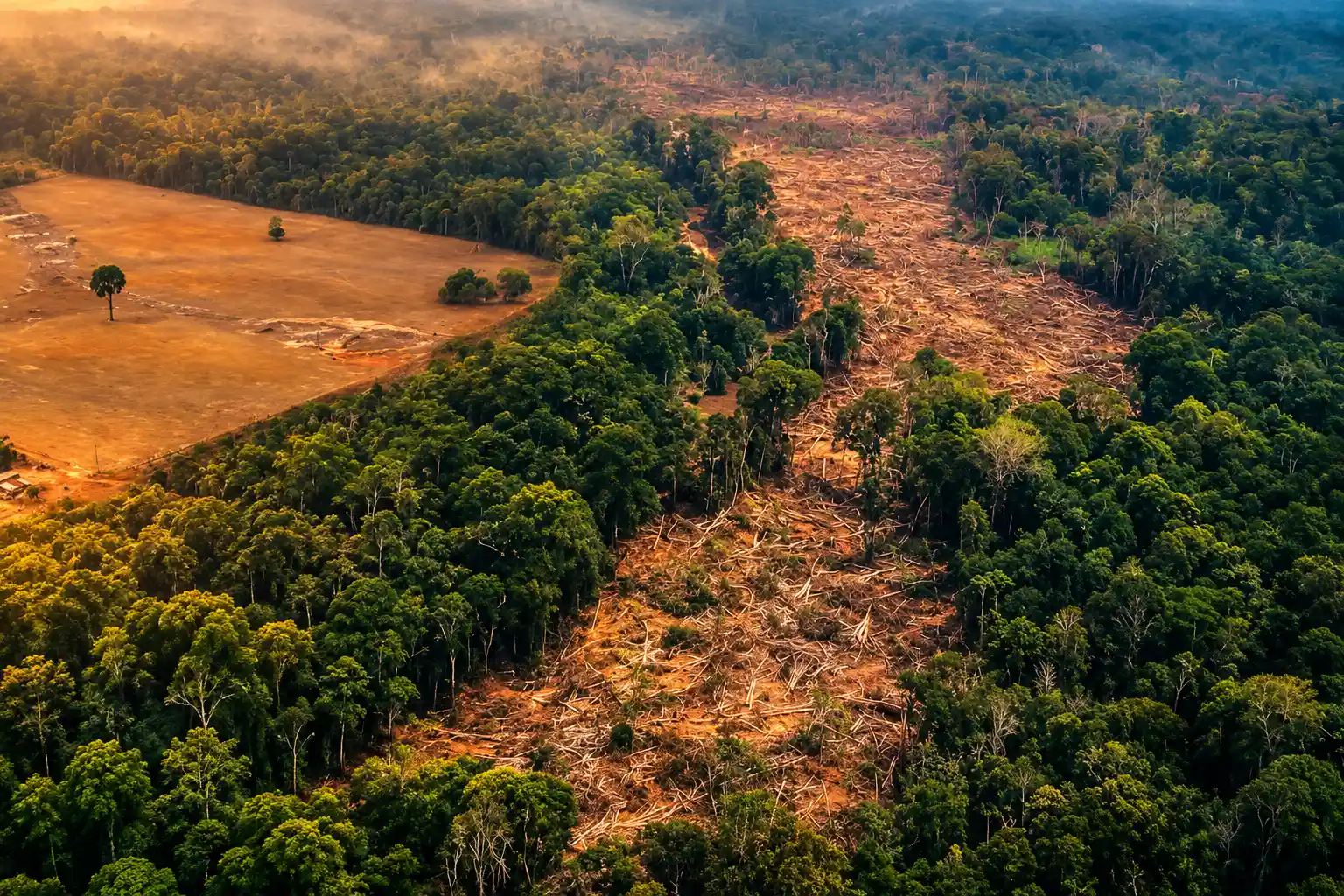
Brazil’s space agency recorded 3,335 square kilometers of Amazon deforestation in the year to July, the lowest total since monitoring began in 1988. The 41.8% drop from the prior Prodes year landed nine days before the October 25 runoff.
The Cerrado still lost 5,516.69 square kilometers. Several mid-October polls had President Luiz Inácio Lula da Silva and Senator Flávio Bolsonaro inside a point or two of each other.
Amazon Clearing Hits 3,335 Square Kilometers
The National Institute for Space Research (INPE) measured native vegetation cut in the Legal Amazon from August 1, 2025, through July 31, 2026, at 3,335 square kilometers (1,288 square miles). That is the lowest Amazon rate on record in a series that started in 1988, and 1,236 square kilometers below the previous floor of 4,571 square kilometers in 2012.
The prior Prodes year, August 2024 to July 2025, closed at 5,731 square kilometers. Against 2022, the last full year of Jair Bolsonaro’s presidency, INPE puts the four-year fall at 71.2%. Annual losses peaked near 30,000 square kilometers in the mid-1990s.
THE PRODES YEAR TO JULY 2026
- Amazon total: 3,335 km², down 41.8% from 5,731 km².
- Four-year change: 71.2% below the 2022 Amazon rate.
- Previous floor: 4,571 km² in 2012, now beaten by 1,236 km².
- Status: an estimate from priority images; the final Amazon count is due in the first half of 2027.
Pará still led what remains, at 1,130 km², down 45.3% from 2,064 km². Mato Grosso cut 849 km² and Amazonas 525 km². Those three states account for 75.1% of the Amazon total, each down more than 45%. Roraima was the only Amazon state to rise, from 285 km² to 286 km².
Environment Minister João Paulo Capobianco, speaking at the Planalto Palace on Friday, October 16, called the reduction a continuous process built on science, public participation, and deals with states and cities, not an isolated episode or a stroke of luck. Márcio Astrini, executive secretary of the climate network Observatório do Clima, called the figures a historic achievement and said political will can halt chainsaws and greenhouse gases.
The Amazon figure Brazil is using through the runoff is still an estimate. INPE’s consolidated Amazon rate, built from the full set of images, is published in the first half of the following year. The INPE Prodes 2026 technical slides and the ministry FAQ make that split explicit. The Cerrado figure is already a full-territory count.
The Savanna Still Lost More Ground
The Cerrado, the wooded savanna south and east of the forest, lost 5,516.69 km², down 23.8% from 7,235.27 km². That is the lowest reading in a Cerrado series that began in 2001, and it sits below the previous Cerrado floor of 6,319 km² in 2019. Against 2022, the Cerrado is down 48.4%.
The savanna still shed more native vegetation than the Amazon. Maranhão, Tocantins, Piauí and Bahia, the Matopiba farm belt, accounted for 74.3% of Cerrado clearing.
TWO BIOMES, ONE PRODES YEAR
| Biome | 2025-26 (km²) | Change vs prior year | Change vs 2022 | Previous low |
|---|---|---|---|---|
| Amazon | 3,335 | -41.8% | -71.2% | 4,571 km² (2012) |
| Cerrado | 5,516.69 | -23.8% | -48.4% | 6,319 km² (2019) |
Maranhão lost 1,718.59 km², Tocantins 1,263.06 km², Piauí 625.24 km² and Bahia 489.75 km². Piauí’s drop, 53.7%, was the sharpest among the large Cerrado states. Mato Grosso’s Cerrado slice barely moved, from 455.39 km² to 454.52 km².
Prodes Cerrado counts forest, savanna and grassland formations, not only trees. The two tallies also cannot be added as printed, because the Amazon product covers the nine Legal Amazon states, which already include some Cerrado, while the Cerrado product covers the whole biome.
Why Cerrado Farms Can Still Cut Legally
Prodes maps the suppression of native vegetation. It does not say whether a given hectare was licensed. The ministry’s own FAQ states that legality has to be checked against cutting permits and land records, that a Rural Environmental Registry listing does not by itself authorize clearing, and that the annual series mixes authorized and unauthorized cuts.
That gap is wider in the Cerrado because the Forest Code asks private owners to keep less vegetation standing. Properties in Amazon forest inside the Legal Amazon must keep an 80 percent Legal Forest Reserve. Cerrado inside the Legal Amazon is set at 35%. Outside that boundary the reserve is 20%, whatever the vegetation.
WHAT THE FOREST CODE REQUIRES
- Amazon forest: 80% of a rural property inside the Legal Amazon must stay as Legal Forest Reserve.
- Cerrado inside that boundary: the reserve falls to 35% on savanna.
- Outside the Legal Amazon: the reserve is 20% on private land, which is where much of Matopiba sits.
IPAM’s reading of those Legal Reserve rules on private land is the same split. Official radio covering the October 16 briefing noted that part of Cerrado suppression is authorized by law and therefore is not subject to embargoes and fines. A zero-illegal target can shrink on paper if the next government licenses more of the remaining 5,516.69 km². Amazon forest researcher Philip Fearnside has put that fork in plain words: one path is to stop the cutting, and the other, likelier path is to legalize the cutting already under way.
Fines, Embargoes and 460 New Inspectors
Lula restored the Amazon and Cerrado action plans in 2023, restaffed inspectors, and tied rural credit to environmental status. Ibama, the federal environment agency, ran 76,095 inspection actions from 2023 through 2026 and issued 25,101 flora infraction notices, with R$11.8 billion in fines. In the same stretch it embargoed 18,630 km², wrote 15,306 seizure orders worth R$2.6 billion, and issued 4,088 destruction orders worth R$1.26 billion.
The Amazon Fund approved R$825.7 million for Ibama’s FortFisc program, money meant for remote inspection, aircraft and systems. In September 2025 the agency hired 460 new staff, 330 of them environmental analysts. The ministry says the drop in Amazon and Cerrado clearing from 2023 through 2026 avoided more than 1.1 billion tonnes of carbon dioxide, on the order of Japan’s yearly emissions.
On October 11, five days before the Prodes release, Capobianco overflew fires in Amazonas and said many of the cores sat inside standing forest, which he read as arson meant to degrade the canopy and open it for later cutting. Thirty-six municipalities in the state were under emergency decrees. The Prodes year closed on July 31, so those October burns are not in the 3,335 km². A heat spot is not a burned area, and a burned area is not automatically deforestation unless the canopy collapses under INPE’s rules.
That is why a record-low cut is easy to doubt from a smoky street in Manaus. The two ledgers measure different damage, and the fire season now under way sits outside the map INPE just published. Last year’s comparable release came on October 30. This year’s dropped on October 16.
Most Rural Properties Showed No New Clearing
Capobianco used the briefing to shift the blame map. Standing with Casa Civil minister Miriam Belchior and Agriculture minister André de Paula, he said deforestation in the latest year showed up on only a thin slice of the country’s farms.
We got used to generically blaming the rural producer and agribusiness for deforestation. But we are showing that this reality has changed. Of 8.5 million [rural properties], deforestation happened in only 1.8% of rural properties. The immense majority of rural producers did not deforest in the last year.
João Paulo Capobianco, environment minister, Planalto Palace briefing, October 16, 2026
If 1.8% of 8.5 million properties account for the remaining loss, the political fight is no longer a cartoon of every rancher against every ranger. It is about which of those properties the next government treats as crime and which it treats as licensed conversion. Flávio Bolsonaro’s manifesto already draws that line: end illegal deforestation by 2029, aim enforcement at organized crime, and spare extractive workers and small farmers.
The Runoff Puts Illegal Cutting on the Ballot
Lula took office in 2023 pledging to end illegal deforestation by 2030, after Amazon clearing jumped about 60% under Bolsonaro, to a 15-year high, at about 11,600 km² a year. On October 16 he restated the 2030 illegal-zero goal in a single line.
Nossa meta é alcançar o desmatamento ilegal zero até 2030. pic.twitter.com/fWmldw6T5i
— Lula (@LulaOficial) October 16, 2026
Flávio, 42, is the eldest son of the former president, who is serving a 27-year sentence under house arrest for coup plotting and is barred from running until 2030. The younger Bolsonaro has praised his father for opposing what he calls a radical environmental agenda, and as a lawmaker he backed a 2019 bill to drop the share of native vegetation Amazon landowners must keep. He still promises to beat Lula’s illegal-zero date by a year.
The forest has barely featured on the trail. A Quaest survey of 2,154 people from October 10 to 13 put Flávio at 46% and Lula at 44%, a statistical tie inside a 2-point margin. CNT/MDA had Flávio at 46.8% and Lula at 45.9%. Datafolha had 47% to 45%. An AtlasIntel poll found the two men tied at 47% each on the environment, the issue these numbers were supposed to move.
On October 4 Flávio won 56,104,503 votes and Lula 53,879,538. The winner takes office on January 5, 2027. Claudio Angelo, international policy coordinator at Observatório do Clima, has said there is no reason to expect Flávio to govern the forest differently from his father. Conservation groups have spent the runoff warning that a change of president can unwind the Ibama rebuild faster than satellite maps can catch it. A bill advancing in Congress would also clip Ibama’s power to embargo land from satellite evidence, the same tool behind the 18,630 km² freeze.
Brazil’s Last Record Low Did Not Hold
The 2012 Amazon floor of 4,571 km², set in Dilma Rousseff’s first term, did not become a new normal. The fall that produced it broke after 2014. Cerrado losses, which had been worst in the early 2000s, rose again under Bolsonaro and only resumed falling in 2024. The present Amazon streak of annual declines is the first since that 2014 break.
HOW THE AMAZON RATE GOT HERE
- 1988: INPE begins the Prodes Amazon series, the yardstick for every later record.
- Mid-1990s: Annual Amazon losses peak near 30,000 km².
- 2012: The rate bottoms at 4,571 km², the previous record low.
- 2014: The multi-year Amazon decline that produced that floor is interrupted.
- 2019-2022: Amazon clearing averages about 11,600 km² a year, about 60% above the prior four years.
- 2023: Lula restores the Amazon and Cerrado control plans and rebuilds inspection staff.
- August 2025-July 2026: Amazon clearing is estimated at 3,335 km²; Cerrado is counted at 5,516.69 km².
- October 25, 2026: Brazilians choose who sets the next four years of those rules.
A record that depended on inspectors, credit locks and federal-state pacts can move as fast as the people who run those offices. The 3,335 km² Brazil will campaign on until October 25 is still an estimate. The consolidated Amazon rate is due in the first half of 2027, after whoever wins has already taken the oath.

Ohtani Game 4 Logoman Card Sells for $3.24 Million

Cole Kmet’s Season Ends, and Chicago’s Tight End Plan Starts

NBA Seeks Soccer Money After EuroLeague Clubs Refused

Amazon’s First Bond Tests Leave the Broccoli Chair Empty

Tyrese Maxey Owns the Night Built for LeBron James

Warsh Rejects Rate Guidance and Still Moves Markets

Dana-Farber Exits an MGB Medicare Advantage Network Early

NASA Launches the Roman Space Telescope’s Cosmic Bet

OpenAI’s Cyber Letter Puts the Defense Bill on Governments

Russia Recycles Its Old Warning Over Storm Shadow Plants
-
 BUSINESS2 months ago
Warsh Rejects Rate Guidance and Still Moves Markets
-
 BUSINESS1 month ago
Dana-Farber Exits an MGB Medicare Advantage Network Early
-
 NEWS2 months ago
NASA Launches the Roman Space Telescope’s Cosmic Bet
-
 NEWS2 months ago
OpenAI’s Cyber Letter Puts the Defense Bill on Governments
-
 NEWS2 months ago
Russia Recycles Its Old Warning Over Storm Shadow Plants
-

 ENTERTAINMENT4 weeks ago
Primetime’s $2.7 Million Preview Tops Pitt’s Costlier Film
-

 BUSINESS2 months ago
Jet Drones Lock Down Kyiv and Strip Kherson of Heat
-

 ENTERTAINMENT2 months ago
Midnight Spider-Man Turns Peter Parker Into Oscorp’s Hybrid