
BUSINESS
Qantas Ground Crews Vote to Strike After $90 Million Fine
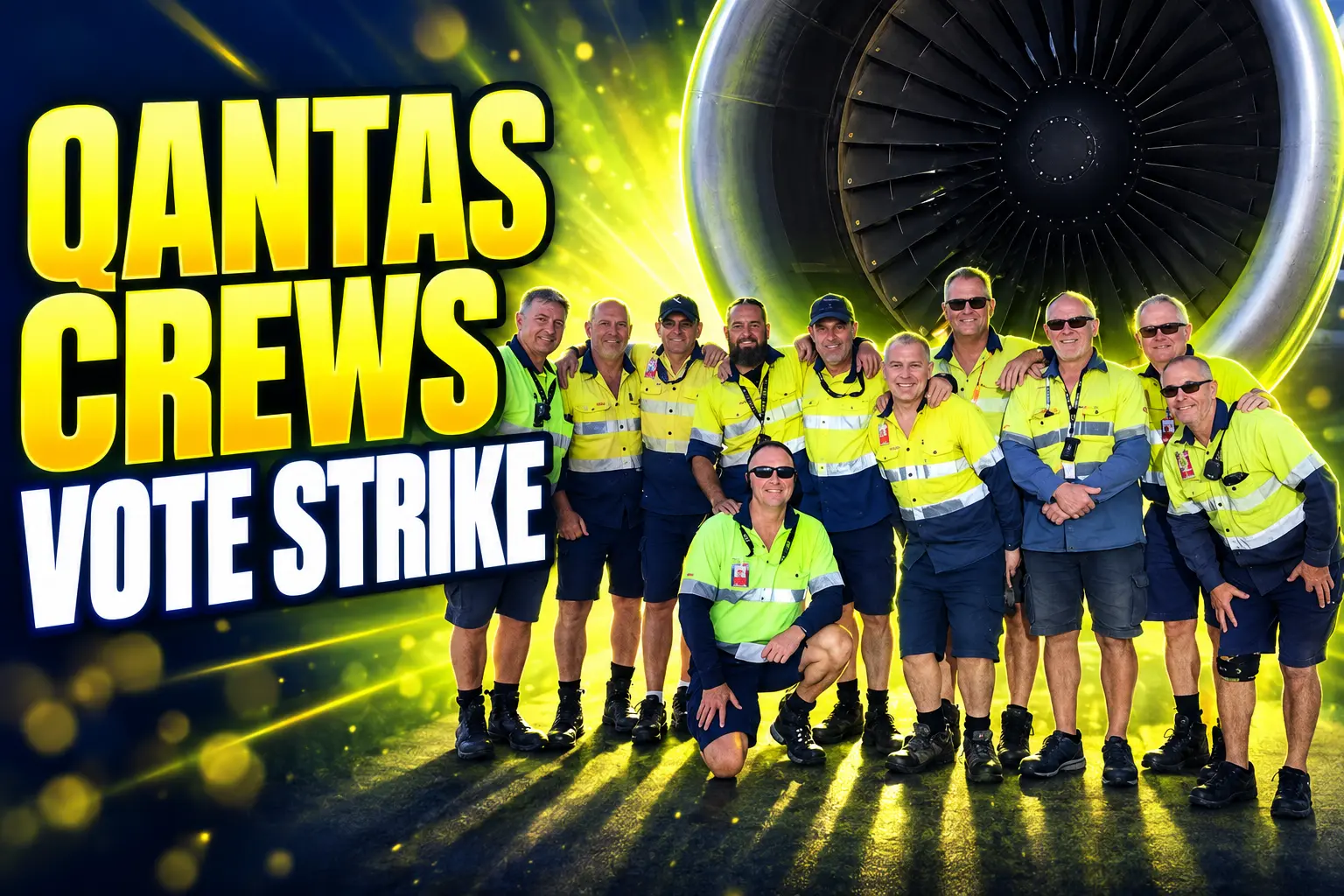
Qantas Ground Services staff voted 97 percent to strike over pay, targeting freight and regional ramps the 2020 outsourcing never fully erased.

Qantas Ground Services staff voted 97 percent on 31 August 2026 to authorize strike action over pay and job security. The Transport Workers Union said the ballot gives over 600 workers the right to walk off for between one and 24 hours, once they give three days of notice.
They do not load mainline or international jets. They work for Qantas Freight, including a large share of Australia Post cargo, and for the regional Q-Link service, and they are still employed as casual and part-time staff inside a Joyce-era unit the new management has not closed.
Freight Yards and Regional Ramps, Not the International Gates
Qantas Ground Services, a wholly owned unit set up to hire on cheaper terms than the old Qantas Airways Limited books, is what remains after the 2020 outsourcing of 1,820 ground jobs. The people on this ballot handle freight and regional turns. A stoppage would hit cargo docks and smaller ports first, not the Sydney to London queue.
Qantas said it has contingency plans to limit any effect on customers and operations if notice is given. The airline also said these QGS employees do not service mainline flights, which is why a 24-hour stoppage can look small on a departure board and still stall parcels and regional sectors.
WHERE A STOPPAGE WOULD LAND
- Qantas Freight: QGS labour on a network the airline’s own freight material says moves more than 4,000 air shipments a day, including a large share of Australia Post work.
- Regional Q-Link: The same crews turn the regional service that the union says was left inside Qantas after the 2020 outsourcing of most below-the-wing work.
- Australian Air Express: More than 100 staff in a separate Qantas-owned freight company are lined up for their own ballot, and they also want one banner.
That split is the point of the claim. The union is not only asking for a rise. It wants the scattered work groups brought back under a single Qantas name so the same ramp job is not priced through different companies standing next to each other.
Alan Joyce Built a Subsidiary to Pay the Same Work Less
Alan Joyce, then chief executive, set up Qantas Ground Services in 2008 so part-time staff could do the same ground work as Qantas Airways Limited crews on lower pay and weaker conditions. The union says the group then vowed not to hire another worker onto the old agreement, and the direct-hire ramp shrank as the cheaper unit grew.
In 2011 the airline grounded its worldwide fleet during a fight over job security, a step the union still cites as the template for shutting down industrial leverage. On 30 November 2020, in the first pandemic year, Qantas outsourced remaining ground handling and fleet presentation at the major airports, keeping Q-Link regional work in Sydney as the in-house exception.
Four Federal Court judges, then the High Court, found that outsourcing illegal because it was timed to stop workers using their bargaining rights. The remnant QGS crews now doing freight and Q-Link work are the people still on the group’s own books, and they are still casual and part-time.
HOW THE GROUND WORKFORCE WAS SPLIT
- 2008: Joyce sets up Qantas Ground Services to hire part-time ground staff on poorer terms than the old Qantas Airways Limited agreement.
- 2011: Qantas grounds its worldwide fleet during a job-security dispute with ground staff.
- 30 November 2020: The airline outsources remaining ground handling at major airports, affecting 1,820 workers, while Q-Link regional work in Sydney stays in house.
- 2021 to 2022: The Federal Court, then the High Court, find the outsourcing unlawful because it was designed to block bargaining and protected action.
- 18 August 2025: Justice Michael Lee imposes a $90 million penalty, on top of a $120 million compensation fund.
- 7 September 2025: A labour-hire worker is killed at the Qantas Freight terminal in Sydney.
- 27 August 2026: Qantas posts FY26 results, then QGS staff vote on 31 August, with Fair Work talks listed for 18 September.
Michael Kaine, national secretary of the Transport Workers Union, said new management had made the right promises and was still using the same tactics that forced Joyce out. He said Joyce created new companies under Qantas to pit work groups against each other, and that the practice has not ended.
The $90 Million Fine Did Not Close Qantas Ground Services
Justice Lee’s $90 million penalty for illegal outsourcing is the largest of its kind in Australian industrial law. Of that sum, $50 million was directed to the union that ran the case and $40 million to the affected workers, on top of the $120 million compensation fund already ordered for the 1,820 people who lost the work.
Those penalty payments began reaching the sacked crews in early September 2026, almost a year after the fine and nearly six years after the jobs went. The unit that survived inside the group is QGS, still paying casual and part-time rates for freight and regional work, which is why a court bill and a strike ballot now sit on the same calendar.
Four days before the vote, Qantas reported an underlying profit before tax of $2.06 billion for the year to 30 June 2026, down $330 million on the prior year. Statutory profit after tax was $1.29 billion. The group put a $420 million net dent on the Middle East conflict and said the fuel bill came in $610 million higher than planned. It still returned $700 million to shareholders.
THE FY26 BILL NEXT TO THE COURT BILL
| Item | Amount |
|---|---|
| Underlying profit before tax, FY26 | $2.06 billion |
| Fall on the prior year | $330 million |
| Capital returned to shareholders | $700 million |
| Federal Court penalty, 18 August 2025 | $90 million |
| Compensation fund for sacked ground crew | $120 million |
| Share grant to non-executive staff | $1,000 each, around 25,000 people |
Kaine put the profit next to a 17 percent board pay rise and said the public could see through any claim the airline was poor. The 17 percent figure is the union’s. Qantas, for its part, pointed to a year of high fuel costs and said it was still investing in fleet, training, and staff.
Australia Post Freight Would Feel a Stoppage First
A protected stoppage of one hour, or of 24, does not need to cancel an A380 to matter. Qantas Freight is a daily machine for parcels and belly cargo, and the union says QGS labour now does a large proportion of Australia Post work through that system. Regional Q-Link turns are the other exposed roster.
Safety is inside the same fight. TWU health and safety representatives in New South Wales have served Qantas with 14 provisional improvement notices over alleged failings at Qantas Freight, where investigations continue after a labour-hire worker was killed last year.
That worker died on 7 September 2025 after being struck by a vehicle at the Sydney freight terminal. The union said the person was employed by Wymap and had lost a Jetstar job in the 2020 outsourcing. Richard Olsen, TWU president and New South Wales branch secretary, called on Qantas to build up direct-hire labour and cut its use of hire firms, saying workers had warned that a serious incident was coming.
The union also says Qantas workers who were once hired in one place are now spread across 38 subsidiaries and labour-hire companies. That claim is the union’s count. What is not in dispute is that QGS, Australian Air Express, and hire firms still sit on the same freight floor with different deals for similar tasks.
Long-Haul Pilots Settled After Their Own August Ballot
Long-haul pilots voted for industrial action in early August 2026, then reached an in-principle deal with Qantas later that month through the Australian Federation of Air Pilots and the Australian and International Pilots Association. That group can stop the long-haul network. These QGS crews cannot.
The contrast is leverage, not virtue. Pilots got a four-year long-haul agreement after a public ballot. The remnant ground unit is still in the Fair Work Commission, still casual and part-time, and still asking to be folded back under one banner. Vanessa Hudson, Qantas Group chief executive since 6 September 2023, has talked about a reset with customers and staff. The union’s charge is that the reset has not reached this roster.
Hudson told the FY26 results audience that the year asked a lot of the workforce and that customers had noticed. She said the group had created nearly 4,400 new operational roles in Australia since 2023 and would create thousands more as the network and fleet grow. Those hires sit beside a ground unit that, on the union’s telling, still cannot get a full-time week.
What Qantas Has Offered QGS Staff
Qantas said it remains committed to an agreement with Qantas Ground Services employees that includes annual pay rises. A spokesperson said Fair Work Commission discussions have been constructive and that talks are continuing, with the focus on pay and more full-time opportunities, which is the first time the company has put extra permanent hours on the public table for this group.
The airline will not publish the numbers in that offer. The union will not call the offer enough. QGS staff want job security, a rise after years of wage freezes, and the scattered groups brought together under a single Qantas banner instead of being set against each other. Until those terms are on one page, the 97 percent result remains a live right to stop work, not a date on a picket.
These ground workers don’t want to go on strike, but after being sold a false promise that this airline would finally treat them with respect, they’ve got no other choice.
Michael Kaine, national secretary, Transport Workers Union
Hudson, on the results morning, put the company’s own marker down for how it says it is sharing the year with staff.
I am pleased we can share our success with our people, with around 25,000 employees receiving $1,000 of shares through our Employee Ownership Plan.
Vanessa Hudson, Qantas Group chief executive, FY26 results speech
A $1,000 share parcel is not a new enterprise agreement, and an annual rise with more full-time jobs is not, on the union’s test, the same as killing the subsidiary. Both things can be true at once: the airline is paying a grant and hiring into other roles, and the remnant freight crews are still on the 2008 structure.
Both Sides Return to Fair Work on 18 September
No strike date has been set. The union must give three days of notice before any stoppage, and Qantas says it will be told in time to use those contingency plans. The next listed session is 18 September 2026 at the Fair Work Commission, Australia’s workplace tribunal, nine days after this ballot became a week-old fact and 18 days after the vote itself.
Australian Air Express staff, more than 100 of them, still have their own ballot to run. If that vote lands the same way, the freight floor could have two Qantas-owned groups with protected action rights, still on separate deals, still asking to be combined. That is the next mechanical step, and it does not need a passenger headline to change a night shift in a cargo shed.
WHAT WE KNOW
- The ballot: 97 percent of the 350 who voted backed protected action, covering more than 600 QGS staff for stoppages of one to 24 hours.
- The work: QGS crews serve Qantas Freight and regional Q-Link, not mainline or international flights, and a large share of that freight is Australia Post.
- The next date: Both sides are listed to return to the Fair Work Commission on 18 September 2026, and three days of notice must precede any walk-off.
WHAT IS UNCONFIRMED
- A strike date: None has been notified, so no ramp has been told to stop.
- The offer: Qantas has not released the size of the annual rise or how many extra full-time roles it would create inside QGS.
- The AAE ballot: The union says a vote for more than 100 Australian Air Express workers is coming, with no result yet.
Kaine said it was time for Qantas to treat its people as an investment, not a cost to be driven down, and that these workers were willing to take action to force that. The airline says the talks are constructive and the plans are ready. On 18 September, those two sentences have to occupy the same room.

Pixel Buds Firmware 6.144 Ties New Features to Pixel Gear

Eve Markoski-Wood Backs Her Mum as Wood Fights Bail

Trump Rejects an Iran Deal as Diesel Holds Near Records

Amazon Cuts the S26 Ultra to $979 After Samsung’s Hike

Ice Caves Land in Minecraft 26.4 Snapshot 3

Warsh Rejects Rate Guidance and Still Moves Markets

Dana-Farber Exits an MGB Medicare Advantage Network Early

NASA Launches the Roman Space Telescope’s Cosmic Bet

Russia Recycles Its Old Warning Over Storm Shadow Plants

Primetime’s $2.7 Million Preview Tops Pitt’s Costlier Film
-
 BUSINESS1 month ago
Warsh Rejects Rate Guidance and Still Moves Markets
-
 BUSINESS4 weeks ago
Dana-Farber Exits an MGB Medicare Advantage Network Early
-
 NEWS1 month ago
NASA Launches the Roman Space Telescope’s Cosmic Bet
-
 NEWS1 month ago
Russia Recycles Its Old Warning Over Storm Shadow Plants
-
 ENTERTAINMENT2 weeks ago
Primetime’s $2.7 Million Preview Tops Pitt’s Costlier Film
-

 BUSINESS1 month ago
Jet Drones Lock Down Kyiv and Strip Kherson of Heat
-

 NEWS1 month ago
Congo Starts Ervebo Vaccinations for a Different Ebola Virus
-

 ENTERTAINMENT1 month ago
Midnight Spider-Man Turns Peter Parker Into Oscorp’s Hybrid