
GAMING
The White House Pulled Build the Wall, Not Rio Run
The White House removed Build the Wall after Tetris cited copyright. Four other Arcade.gov clones, including a deportation Snake game, remain live.

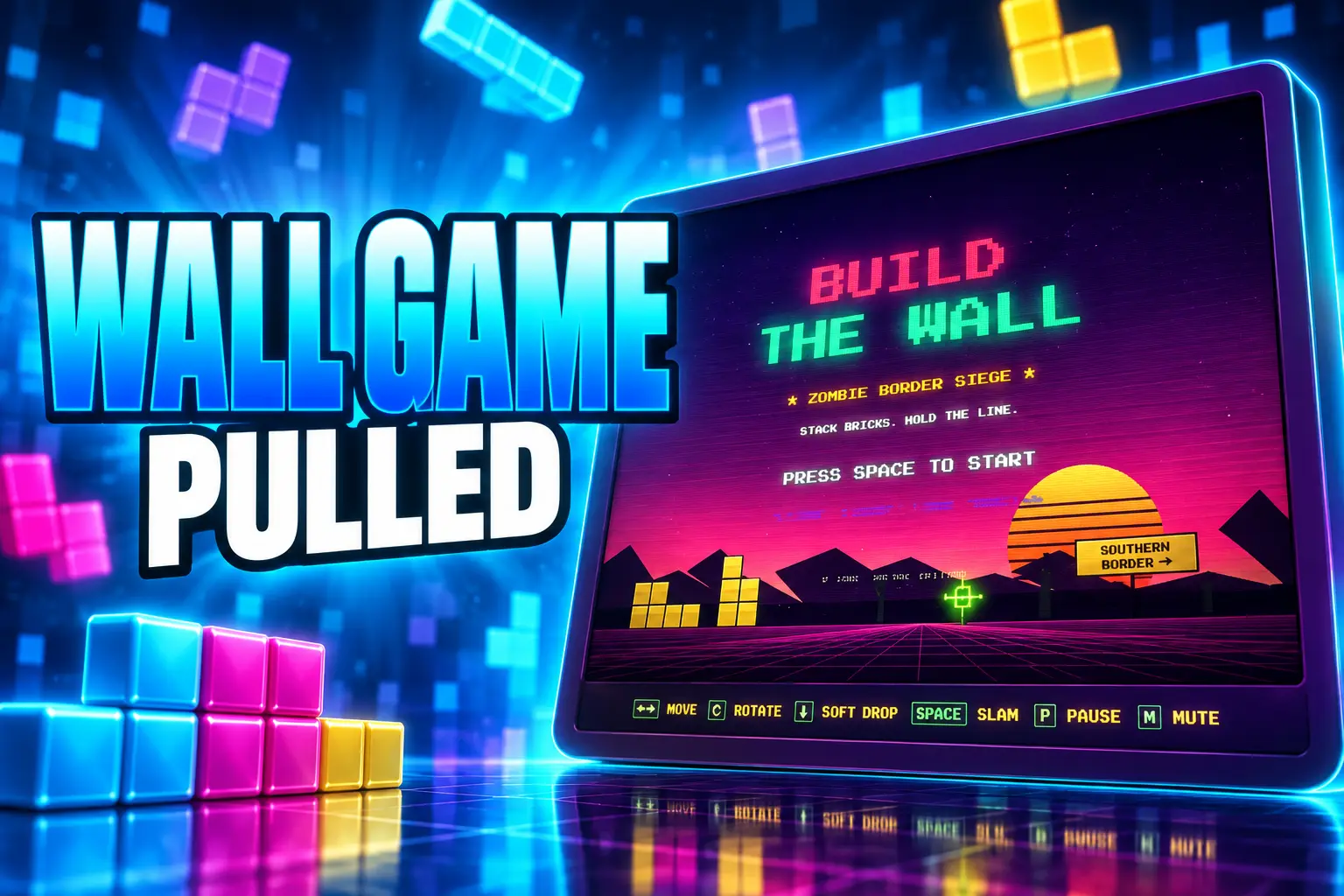
The White House took down Build the Wall, its falling-block border game, after The Tetris Company warned it takes copyright infringement very seriously. Four other Arcade.gov titles, including a Snake-style game about catching border crossers, are still up. The clone that vanished was the one a 2012 federal ruling already treated as protected look and feel.
Build the Wall Now Returns a 404
The game went live on Sept. 3, 2026, on whitehouse.gov/arcade and on Arcade.gov, one of five low-resolution browser titles tied to administration talking points. Its own blurb told players to “Protect the border from the coming horde.” The subtitle on the well was Zombie Border Siege. Pixel figures marched in from a sign marked Southern Border while tetromino-style bricks dropped from the top of the screen.
Those bricks did not vanish when a row filled. Each piece stayed in place and thickened the barrier, so the round was a race to wall off the well before the stack hit the top. When it did, the game flashed “Border Breached.” That invert of Tetris scoring made the clone dull to play and, in a bitter joke, almost guaranteed a loss screen. It did not make the pieces look any less like Tetris.
Amerika Garcia Grewal, co-director of the Texas migrant-rights group Frontera Federation, said the people who built the game “have lost touch with what it means to be human and care for others.” The Build the Wall page now a 404 on the White House site, and it has been missing since sometime after the morning of Sept. 6, three days after launch. An archived copy of Build the Wall remains playable on the Internet Archive.
THE WEEK BUILD THE WALL VANISHED
- Sept. 3, 2026: The White House opens the Arcade with five browser games and posts “CAN’T STOP WINNING. Build the wall. Deport. Fill a Trump Account.”
- Sept. 4, 2026: The Tetris Company posts that it did not make Build the Wall and that it takes copyright infringement very seriously.
- After the morning of Sept. 6, 2026: The Build the Wall URL starts returning “404 / Page Not Found.”
- Sept. 8, 2026: The empty slot is public. The other four games still load.
A White House official, asked about the arcade at launch, called it “an effort to further contrast between a culture of fun and winning and the dark socialist vision Democrats have for America.” The official did not say who coded the games or whether taxpayer money paid for them.
Tetris Buried the Threat Under a P.S.
The rights holder did not lead with a lawsuit. It led with a community note, then put the legal warning where a P.S. usually goes. On Instagram and on its official X account, the company wrote that it believes “in the power of connection and bringing people together, not dividing them,” and told fans, “we love you, we see you, and we’re grateful to have you in our community.”
P.S. The Tetris Company was not involved in the creation of ‘Build the Wall’. P.P.S. We take copyright infringement very seriously.
The Tetris Company, @Tetris_Official
P.S. The Tetris Company was not involved in the creation of ‘Build the Wall’.
P.P.S. We take copyright infringement very seriously. pic.twitter.com/Fu02khRpT3
— Tetris (@Tetris_Official) September 4, 2026
A spokesperson said the firm “was not involved in the creation of ‘Build the Wall’ and did not authorize or license the Tetris brand or intellectual property for the game,” and that it was “reviewing the matter.” In a longer note the company added that for more than 40 years Tetris has brought people together “across generations and cultures through play and joy,” and that “the objective of the game has always been to stack with purpose to clear as many lines as possible.” Build the Wall did the opposite of that objective on purpose. Neither side has said a formal cease-and-desist went out.
Some players treated the unity line as a political sermon they no longer wanted from a puzzle brand. Others offered to buy extra copies if the company actually sued. Phone stores have been stuffed with falling-block clones for years, so the surprise was never that a clone existed. The surprise was a clone sitting on a.gov domain, which is a public claim that this look is free to take.
What the 2012 Mino Case Protects
A New Jersey federal judge already drew this line on May 30, 2012, in Tetris Holding, LLC v. Xio Interactive, Inc. Xio’s iPhone game Mino copied Tetris on purpose, its owner Desiree Golden admitted, and argued that only unprotectable rules had been taken. The court granted summary judgment for Tetris Holding on copyright and trade dress. Rules and mechanics stay free. The chosen look of those rules does not.
Without being told which is which, a common user could not decipher between the two games. Any differences between the two are slight and insignificant.
U.S. District Court for the District of New Jersey, Tetris Holding, LLC v. Xio Interactive, Inc., May 30, 2012
The same opinion said a common user could not decipher the two titles, and that the visual match was “akin to literal copying” even though Xio had not stolen source code. Judge Freda Wolfson wrote that Tetris Holding is “as entitled to copyright protection for the way in which it chooses to express game rules or game play as one would be to the way in which one chooses to express an idea.” Xio’s own expert had conceded there were an “almost unlimited number of ways” to design a puzzle game. Copying this one anyway was the problem.
As of that case, Tetris had sold 200 million copies worldwide. Plaintiffs Tetris Holdings LLC and Tetris Company LLC listed a bundle of visual choices they said Mino had taken wholesale. Several of those choices showed up again on Arcade.gov.
WHAT THE 2012 COURT TREATED AS EXPRESSION
- The pieces: Four-square blocks, each brick outlined, joined into seven shapes with bright colors and interior shading.
- The motion: The way those pieces fall, rotate, lock at the bottom, and change color when they lock.
- The well: A tall rectangular playfield plus extras such as ghost pieces, a next-piece window, garbage lines, and a fill-in when the game ends.
- The dress: Colored four-block pieces on a taller-than-wide field, which the court also treated as trade dress, not just copyright.
Dr. Mario-style cousins that only share the broad idea of falling, rotating blocks were cited as safe. A game that kept the tetromino kit, the well, and the motion was not. Build the Wall dropped the line-clear rule and still borrowed the kit. That is exactly the split the 2012 court drew, which is why a broken wall game could still be the one title the White House could not keep.
Four Games Still Run on Arcade.gov
Select Your Game on the official Arcade page now offers four titles still listed for play. The missing fifth is the only change. Rio Run is the one that still does the border work Build the Wall advertised, and its own loss label has read “0 deported.”
WHAT IS STILL PLAYABLE
| Game | Line on the Arcade page | Familiar template |
|---|---|---|
| Flappy Bill | Fly the bald eagle down the National Mall | Tap-to-flap flyer through gaps |
| Rio Run | Border patrol along the Rio Grande | Snake, grow by collecting targets |
| Supply Line | Sort the school lunch to Make America Healthy Again | Conveyor sorting |
| Trump Savings Tycoon | Fill your kids’ Trump Accounts | Catch cash and prizes in midair |
Rio Run’s instructions told players to “Patrol the line along the river. Pick up every crosser in the lot. Never double back over the line.” Supply Line is the Make America Healthy Again entry, a school-lunch belt where the player keeps some foods moving and pulls others. Trump Savings Tycoon plugs the accounts that send $1,000 to eligible children born during the current term. None of those four pages 404.
Why Flappy Bill Survived the Same Weekend
Flappy Bill is a bald eagle carrying legislation through monuments, which is a reskin of a 2014 tap game whose original maker, Dong Nguyen, lost the U.S. trademark in a 2024 default at the Patent and Trademark Office. A later holder styling itself The Flappy Bird Foundation grabbed the name after Nguyen, who lives in Vietnam, did not answer the filing. He later wrote that he did not sell anything. Game mechanics such as tapping to dodge gaps were never a patent, and courts do not let anyone own that idea. A.gov eagle flying through the Mall does not collide with a 2012 look-and-feel opinion the way a tetromino well does.
Snake is older still. Growing a line by collecting targets is an idea, and Nokia’s phone classic never got a Mino-style federal ruling that froze its exact grid, colors, and motion as protectable dress. Warner Bros. still holds Tapper, and Nintendo still holds Duck Hunt, if anyone wants to argue those templates. No matching public warning from those companies went out after Arcade.gov launched. Microsoft, Sony, Sega, and Nintendo also stayed quiet through Sept. 5, even as the launch spots borrowed their boot-up theater.
The Pokémon Company, after a White House clip paired “Gotta Catch ’Em All” with ICE-raid footage, said it had not given permission and that it was “not affiliated with any political viewpoint or agenda.” That is a distance statement, not a takedown demand. Tetris is a licensing company whose product is one puzzle. Leaving a federal clone up would have taught every copycat that the 2012 opinion stops at the water’s edge of a.gov domain.
Sega’s Logo and Three Console Boot Screens
The games were only half the launch. The White House social team posted parody videos that mimicked console start-up sequences, then pointed players at Arcade.gov. Those spots are still the record of how the site was sold, and they were not pulled with Build the Wall.
WHAT THE LAUNCH SPOTS COPIED
- Sega’s mark: The Sega logo animation morphs into MAGA, using the same fat type and red field.
- Green Hill Zone: The Sonic the Hedgehog stage theme underscored the promo.
- Three boots: Loading-screen gags copied the GameCube, Xbox 360, and PlayStation 2 start-ups, which puts Nintendo, Microsoft, and Sony in the same unpaid cast.
A music cue in a social video and a playable tetromino well are different legal objects. One is a clip that can be argued as commentary or ignored as a headache. The other is a game you can sit down and play on a federal domain, using the same piece kit a district judge already called original expression. The White House has used game imagery before, including Halo art in military posts that drew no public reply from Microsoft. Arcade.gov made the borrowing interactive, and only one rights holder answered in public.
The Empty Slot Already Promises Another Game
The Arcade page now ends on a Coming Soon tile. Under that header the site says, “A new adventure awaits Stay tuned.” It does not say whether the next title will avoid tetrominoes, avoid border themes, or avoid both. Rio Run still asks players to pick up crossers. Flappy Bill still flies a bill down the Mall. The wall game is the only one that had a 14-year-old federal opinion sitting behind it, and it is the only one that is gone.
Tetris clones will keep appearing on phone stores, and most of them will keep getting ignored until a letter arrives. A falling-block well on whitehouse.gov was a harder thing to ignore, because it turned a private licensing fight into a government exhibit. The White House solved that problem by deleting one URL. The rest of the arcade is still waiting for a player.

Verity Beats Cruise as Warner’s Auteur Bet Comes Due

Bonduelle Writes Down Americas as Fresh Sales Shrink

FAO Food Prices Rise Beside a Near-Record Cereal Harvest

Tony Romo Leaves CBS After Naming Pain and Alcohol

Pitt Stays Perfect After Mason Heintschel Leaves on Crutches

Warsh Rejects Rate Guidance and Still Moves Markets

NASA Launches the Roman Space Telescope’s Cosmic Bet

Dana-Farber Exits an MGB Medicare Advantage Network Early

Russia Recycles Its Old Warning Over Storm Shadow Plants

Primetime’s $2.7 Million Preview Tops Pitt’s Costlier Film
-
 BUSINESS1 month ago
Warsh Rejects Rate Guidance and Still Moves Markets
-
 NEWS1 month ago
NASA Launches the Roman Space Telescope’s Cosmic Bet
-
 BUSINESS4 weeks ago
Dana-Farber Exits an MGB Medicare Advantage Network Early
-
 NEWS1 month ago
Russia Recycles Its Old Warning Over Storm Shadow Plants
-
 ENTERTAINMENT1 week ago
Primetime’s $2.7 Million Preview Tops Pitt’s Costlier Film
-

 BUSINESS1 month ago
Jet Drones Lock Down Kyiv and Strip Kherson of Heat
-

 NEWS1 month ago
OpenAI’s Cyber Letter Puts the Defense Bill on Governments
-

 NEWS1 month ago
Congo Starts Ervebo Vaccinations for a Different Ebola Virus