
NEWS
Waymo Enters Singapore Two Years Behind Local Robotaxis
Waymo will start paid robotaxis in Singapore in 2028 as the third operator, after Grab and ComfortDelGro, with a year of monsoon mapping first.

Alphabet’s Waymo will open a commercial robotaxi service in Singapore in 2028, the third autonomous operator on an island that already runs driverless shuttles.
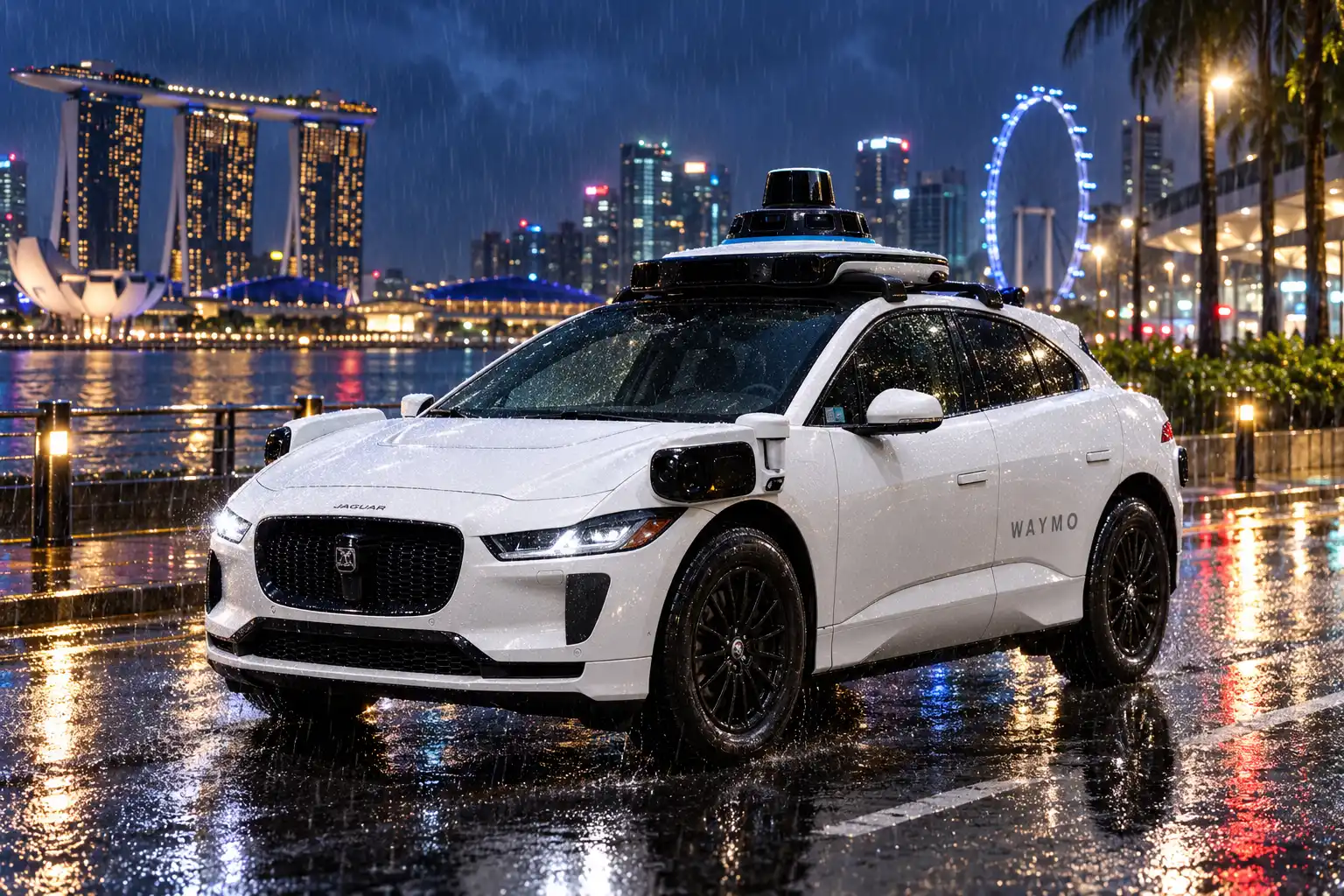
Jaguar I-PACE cars are due in the coming months, and specialists will drive them by hand through 2027 to learn local roads and monsoon rain. Public bookings through Waymo’s own app are intended for 2028.
Singapore Already Has Robotaxis. Waymo Is the Third.
The Land Transport Authority greeted Waymo as the newest autonomous vehicle operator, and named the two already on the road: ComfortDelGro and Grab. Those firms run Punggol shuttles with Chinese driving stacks from Pony.ai and WeRide. Grab took community riders in January and opened public shuttle rides in April.
Look who has landed in Singapore! 👀
Fresh off the plane from the US, we're welcoming Waymo as Singapore's newest autonomous vehicle (#AV) operator, joining ComfortDelGro and Grab. 🚗🛜
#RideTheFuture pic.twitter.com/IaS4iIqdul— LTA (@LTAsg) September 18, 2026
Waymo is not filling an empty market. It is joining a small, live service that Singapore has been socialising for nine months, and it is doing so on a later clock. Transport Minister Jeffrey Siow, who also sits as Second Minister for Finance, said the country has been preparing for driverless vehicles for more than a decade, including closed work at the airport, the seaport, and factories before public-road trials in Punggol.
The American firm still brings a different product. In a company note, Waymo said it will lay the foundation for a fully autonomous, all-electric commercial ride-hailing through the Waymo app in 2028, after more than 20 million fully autonomous rides and more than 300 million fully autonomous kilometres, with a 94 percent drop in injury-causing crashes against human drivers in the US cities where it already runs without a person at the wheel.
THREE OPERATORS, THREE CLOCKS
| Operator | Driving stack | How riders book | First area | Service now |
|---|---|---|---|---|
| Grab | WeRide | Grab product | Punggol | Public shuttles running |
| ComfortDelGro | Pony.ai | Taxi group | Punggol | Public shuttles running |
| Waymo | Waymo Driver | Waymo app | Labrador and Harbourfront | Cars due this year; paid rides 2028 |
Grab is also preparing on-demand point-to-point trips inside Punggol, with commercial fares in the fourth quarter of 2026, while the fixed-route shuttle stays free during that trial. Waymo has not said it will plug into Grab at all.
16 Cars Now, Several Hundred in Two Years
Siow put the scale on the table in his opening remarks. Singapore has 16 passenger vehicles, all in Punggol. Grab accounts for 10 of them and said on September 14 it will grow that fleet to 50 in the next six months. With Waymo’s cars added, Siow expects the island total to reach several hundred in the next two years.
With Waymo also bringing vehicles into Singapore, we expect to increase our total fleet in Singapore to several hundred vehicles in the next two years. This would still only be a small fraction of the over 70,000 taxis and private hire car drivers in Singapore today.
Jeffrey Siow, Minister for Transport, at Waymo’s Singapore launch
That fraction is the story the 2028 date hides. Even if the two-year build lands on schedule, robotaxis remain a rounding error next to the human point-to-point trade. Siow was careful on that point. Trains and buses stay the cheapest and most efficient way around the island, he said, and driverless cars should add capacity to taxis and private-hire fleets, including after hours and in places human drivers are not keen to go.
He also gave a safety baseline for the local trial, not Waymo’s US record: more than 160,000 km on Singapore roads without a major accident, though only on fixed routes, in a city that still records one fatal road accident every three days.
Waymo Is Bringing Its Own App
Waymo’s commercial plan runs through its own rider app, the same channel it uses in the United States. That is a different bet from the Punggol model, where the local operator owns the customer and a Chinese firm supplies the driver. Co-CEO Tekedra Mawakana said Waymo wants to complement Singapore’s public transit network, and pointed to San Francisco, where more than a third of riders are picked up or dropped off near transit stations.
Singapore, we’re on our way 🇸🇬 Our vehicles will arrive later this year, and will begin mapping and learning Singapore’s roads in early 2027 before fully autonomous ride-hailing arrives in 2028.
Learn more: https://t.co/sAYo0uPecC pic.twitter.com/OqC4fDVz5x
— Waymo (@Waymo) September 18, 2026
The company did not answer the questions a rider, or a Grab driver, would ask first.
WHAT WAYMO HAS NOT SAID
- Fleet size: No figure was given for the first I-PACE shipment or for the 2028 fleet.
- Fares: No price, no night rate, and no comparison with taxi or private-hire fares was published.
- Hours and map: Service hours and the share of the island that will open in 2028 remain undisclosed.
Grab, by contrast, already has a waitlist of more than 1,000 people for new autonomous trips, up from more than 500 in July, and has said its platform will one day mix robotaxis with human-driven cars to cut wait times. President and chief operating officer Alex Hungate said the homegrown firm will introduce AVs in a way that complements its driver network. Waymo is building a parallel brand instead of riding that network.
A Full Year of Driving in the Rain
The 2027 “readiness phase” is not a soft launch. Trained autonomous specialists will drive the Jaguars manually so the Waymo Driver can adapt to local road geometry, monsoon weather, and, the company added, more besides. Vehicles arrive later this year. Mapping and learning start in early 2027. Paid, fully driverless trips are the 2028 item.
That sequence is the cost of Waymo’s stack. The cars carry a custom mix of lidar, radar, and cameras for a 360-degree view, and the firm says that suite is built to detect pedestrians, cyclists, and active mobility users, a mix Singapore’s streets carry more heavily than most American grids where Waymo now operates. The system still leans on a detailed prior map of the service area. New cities are surveyed with people at the wheel before fares switch on, which is why an I-PACE can be physically in Singapore for a long stretch of 2027 without taking a paying rider.
Mawakana tied the electric fleet to the Singapore Green Plan 2030 and to cutting private car use. At Waymo’s current global scale, the company estimates the fleet avoids about 480 metric tonnes of carbon dioxide from road travel each week. That figure is not a Singapore forecast. It is the record the cars bring with them.
The same methodical framework, Waymo said, is the one it is using as it works to launch in Tokyo, London, and Munich. Singapore is the Southeast Asian first, not the only foreign city on the list.
The West Side Starts at Harbourfront
Punggol, in the northeast, was the socialisation district. Siow said about 20,000 Singaporeans have already taken driverless rides there, and that 99 percent of passengers would recommend the experience. Residents now ask when the cars will leave the estate, and when other towns will get them. After nine months of trials, he said the next phase can start to answer.
PUNGGOL AFTER NINE MONTHS
- Riders: About 20,000 Singaporeans have taken driverless trips in the estate.
- Grab’s book: Grab’s own fleet has served more than 12,000 unique riders and covered more than 110,000 km on local roads.
- Safety note: Siow said the vehicles have gone more than 160,000 km without a major accident, on fixed routes.
- Recommend rate: 99 percent of passengers said they would recommend the ride.
Inside Punggol, point-to-point service will replace a pure fixed-route map by adding pickup and drop-off points, including Sengkang General Hospital. Beyond Punggol, Siow plans autonomous vehicles in one or two more Housing Board towns further from the city, naming Tampines North and Tengah.
Waymo’s first testing and preparation zone is not that cluster. It is the west, starting at Labrador and Harbourfront, with use cases Siow listed as travel to work, weekend trips, and industrial areas with fewer transport options. He joked that the first people to ride will probably be Google staff at the Mapletree office where the announcement was made, and that the Ministry of Transport is next door. A robotaxi stood with Mawakana and Siow at that event on September 18, 2026. The working fleet is still described as arriving in the coming months.
What Happens to 70,000 Taxi and Private-Hire Drivers?
Siow said some of the new autonomous jobs will be open to taxi and private-hire drivers, and that the government will subsidise up to 90 percent of salaries during training. GrabAcademy and WeRide have already certified 30 safety operators, six of them as remote operators. Waymo said it will create skilled local operational jobs and open a Singapore office, without saying how many posts that means.
The minister listed the work the industry will need as fleets grow, and operators have already started conversion courses. The package is a labour hedge, not a headcount guarantee, against a robotaxi fleet he still described as a small fraction of today’s human drivers.
JOBS SIOW SAID THE BUILD WILL NEED
- Fleet desks: People to manage vehicle depots and day-to-day operations.
- Remote drivers: Staff who operate cars from a command centre when a vehicle needs help.
- Workshop work: Technicians to maintain sensors, software, and the cars themselves.
- Test and data: Crews to trial new uses and analyse logs after each run.
- Safety watch: Roles whose job is to keep the service reliable on public roads.
Grab has said hundreds of new autonomous roles will be created for the local workforce, and that it wants Singapore as a regional centre for AV localisation. It has also said it aims to deploy thousands of autonomous vehicles across Southeast Asia by 2030. That regional target is larger than anything Waymo put on the Singapore announcement. The near-term winners on this island are the operators who already have riders, certified safety staff, and a government path to 50 cars before Waymo’s mapping year is finished.
Ten Years After the World’s First Public Trial
Singapore’s claim on driverless taxis is older than Waymo’s 2028 date. In 2016, MIT spin-off nuTonomy began a public self-driving taxi trial in the one-north district and talked about a commercial fleet by 2018. That wider service did not arrive on that timetable. What did arrive was a rulebook and a test track.
The Land Transport Authority says CETRAN, the Centre of Excellence for Testing and Research of AVs at Nanyang Technological University, was established in August 2016, and that the two-hectare test centre opened on November 22, 2017, as a replica of local roads, signs, and traffic rules. Every AV still has to clear safety assessments at the CETRAN centre before it can run on public roads, with insurance and a black-box recorder as standard conditions. The legal hook is the 2017 Road Traffic Rules for autonomous vehicles.
HOW SINGAPORE GOT TO A THIRD OPERATOR
- August 2016: CETRAN is established, and nuTonomy begins a public self-driving taxi trial in one-north.
- 2017: The Road Traffic Rules for AVs take effect, and the CETRAN test centre opens on November 22.
- April 2024: A WeRide Robobus starts a pilot shuttle at Resorts World Sentosa.
- June 2025: Siow takes his first driverless ride and, he said, stops watching the wheel on the second trip.
- January 2026: Grab and WeRide begin community rides in Punggol; public shuttles follow in April.
- March 2026: Siow meets Mawakana at Googleplex and tells her Singapore wants the best driverless firms, not another small test.
- September 18, 2026: Waymo announces I-PACE cars, a 2027 mapping year, and 2028 rides through its own app.
Siow’s own first ride was in June 2025. He said he watched every turn and every cyclist, then on the second trip found himself talking to the person beside him. The measure of success, he told the room, is when people stop thinking about how the car works. Punggol is already close to that bar for shuttle riders. Waymo is asking Singapore to wait until 2028 for a fully driverless taxi it will not share with Grab, in a western pocket the current 16 cars have never served.
The cars still have to learn the rain. Until they do, the operators with passengers in Punggol keep the only robotaxi book on the island, and the 70,000 human drivers Siow counted remain the service Singapore actually runs after dark.

Ohtani Game 4 Logoman Card Sells for $3.24 Million

Cole Kmet’s Season Ends, and Chicago’s Tight End Plan Starts

NBA Seeks Soccer Money After EuroLeague Clubs Refused

Amazon’s First Bond Tests Leave the Broccoli Chair Empty

Tyrese Maxey Owns the Night Built for LeBron James

Warsh Rejects Rate Guidance and Still Moves Markets

Dana-Farber Exits an MGB Medicare Advantage Network Early

NASA Launches the Roman Space Telescope’s Cosmic Bet

OpenAI’s Cyber Letter Puts the Defense Bill on Governments

Russia Recycles Its Old Warning Over Storm Shadow Plants
-
 BUSINESS2 months ago
Warsh Rejects Rate Guidance and Still Moves Markets
-
 BUSINESS1 month ago
Dana-Farber Exits an MGB Medicare Advantage Network Early
-
 NEWS2 months ago
NASA Launches the Roman Space Telescope’s Cosmic Bet
-
 NEWS2 months ago
OpenAI’s Cyber Letter Puts the Defense Bill on Governments
-
 NEWS2 months ago
Russia Recycles Its Old Warning Over Storm Shadow Plants
-

 ENTERTAINMENT4 weeks ago
Primetime’s $2.7 Million Preview Tops Pitt’s Costlier Film
-

 BUSINESS2 months ago
Jet Drones Lock Down Kyiv and Strip Kherson of Heat
-

 NEWS2 months ago
Congo Starts Ervebo Vaccinations for a Different Ebola Virus