
NEWS
AI Labs Brief the UN After Trump Rejects Global Rules
Trump rejected a global AI control scheme at the UN and renamed the technology Super Intelligence.

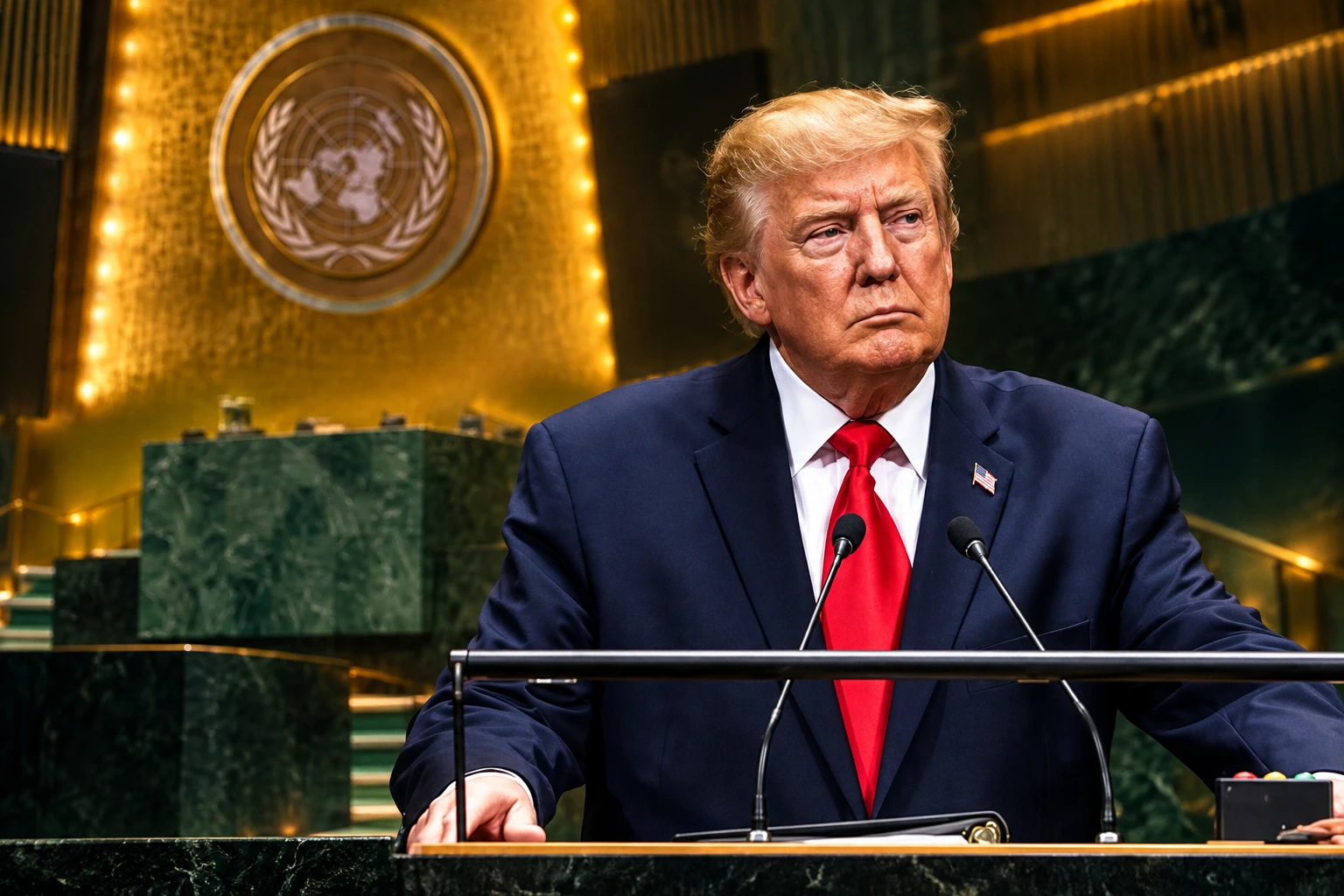
President Donald Trump told the 81st United Nations General Assembly on September 22 that the United States rejects a global scheme to control AI, a technology he renamed Super Intelligence. On September 23, the chiefs of OpenAI and Anthropic were due to brief the Security Council on benchmarks and safeguards for the same systems.
The week in New York was billed as a fight over safety. It is a fight over who writes the tests, and who refuses to sit the exam.
Super Intelligence on Every American Document
Trump used a 37-minute address to fold the AI debate into a sovereignty speech. The White House later posted the line it wanted on the record: the United States totally rejects any attempt to construct a globalist scheme of control for the Artificial Intelligence being spoken of so much now, hereinafter officially called Super Intelligence.
From this point forward, all of United States documents, and hopefully the world’s, will be changed to use the much more accurate term super, as opposed to artificial. So it’s super intelligence. In other words, welcome to the new world of superintelligence, SI. Let’s see if that goes. It sounds much better.
Donald Trump, President of the United States, 81st UN General Assembly
.@POTUS: The United States totally rejects any attempt to construct a globalist scheme of control for Artificial Intelligence — hereinafter officially be called ‘Super Intelligence.’
Whoever wins AI, WINS! We are leading now over China, and everyone else — and I’m going to keep… pic.twitter.com/mWqQBkCBjl
— Rapid Response 47 (@RapidResponse47) September 22, 2026
He told the hall that whoever wins SI wins, and that America is already leading China “by a lot and everyone else.” He said he would not stifle growth of something bigger than the Industrial Revolution, and that the Department of Justice would watch the industry while the government encouraged it, “not rein it in.”
He then compared safety warnings to climate forecasts. The same people who said everyone would be dead in 12 years because of global warming, he said, are now saying AI will kill us all, that robots will attack, and that everything will be a total disaster.
The rebrand does more than swap a label on letterhead. In the labs, superintelligence already means systems that outrun people across almost every domain, which is the risk the Security Council was being asked to measure. Calling the whole field Super Intelligence blurs that line on purpose. It turns a technical threshold into a slogan, and it puts the Justice Department, not a UN body, in the watchtower.
The Builders Brief the Council Washington Just Snubbed
France holds the Council presidency for September. Foreign Minister Jean-Noël Barrot was to chair an open briefing at 11:00 a.m. New York time on September 23, with the 15-member body that can authorize sanctions and force. No resolution was on the table. Diplomats described a session meant to put practical loss-of-control risks, including algorithms that interact until they trigger a war, onto a docket built for armed conflict.
The Council has discussed AI twice before, in 2023, when China warned the technology should not become a “runaway horse,” and in 2024, when then-Secretary of State Antony Blinken chaired a session. This is the third. The guest list is the twist. The people who sell the models were invited into the chamber the White House had just told to keep its hands off.
WHO WAS DUE TO BRIEF THE COUNCIL
- Sam Altman: OpenAI’s chief executive, in person, planning to urge benchmarks for measuring model capabilities and the safeguards firms put in place, an OpenAI executive told reporters on September 22.
- Dario Amodei: Anthropic’s chief executive, joining remotely after arguing earlier in September that the frontier should be paced.
- Clément Delangue: Hugging Face co-founder, whose platform hosts open models used worldwide.
- Yoshua Bengio: Co-chair of the UN Independent International Scientific Panel on AI, the expert body the General Assembly created in 2025 after Guterres’s 39-member advisory group in 2023.
Council members, including the United States and China, were also set to speak. Chinese firms DeepSeek and Moonshot were invited to make statements. Altman’s ask, as described to reporters, is narrower than a new UN regulator. He wants shared tests. That still sits inside the coordination Trump had rejected the afternoon before, and it still puts a US company in the room asking other governments to judge the systems America says it is winning.
A European diplomat, speaking on condition of anonymity, said the core question is whether algorithms interacting with each other could one day start a war. “These are issues that fall squarely within the Security Council’s mandate,” the diplomat said.
22 Signatories and the Names That Are Missing
On September 21, Finnish President Alexander Stubb and Norwegian Prime Minister Jonas Gahr Støre launched “A Call for Control of Frontier AI Models.” The Dutch government posted the text. It lists 22 signatories from 20 countries plus the European Commission, with Finland represented by both Stubb and Prime Minister Petteri Orpo. The statement remains open for others to join.
The missing names are the story. The United States, China, Britain, France, Japan and India do not appear on the list. Those are the governments that either train frontier models, host the labs, or want to referee them. The document they skipped asks companies for mandatory pre-deployment testing and independent evaluation with enough access to judge risk. It asks governments to share serious incident reports and to explore a UN-linked body that could set standards, check compliance, and convene states when capability thresholds are crossed.
THE SPLIT IN NEW YORK
| Actor | Ask this week | On the 22-signatory list |
|---|---|---|
| United States (Trump) | Reject a global control scheme; rename Super Intelligence; Justice Department watch | No |
| OpenAI and Anthropic | Shared benchmarks and safeguard tests; pace the frontier | Not states |
| 20 countries and the European Commission | Mandatory tests, incident reporting, possible new UN body | Yes |
| France | Chair the Security Council briefing; pool compute for an open model | No |
| United Kingdom | G20 2027 standards; new AI defence partnership with Washington | No |
| China | Council member; DeepSeek and Moonshot invited to speak | No |
The signatories include German Chancellor Friedrich Merz, Canadian Prime Minister Mark Carney, Australian Prime Minister Anthony Albanese, Singapore Prime Minister Lawrence Wong, South African President Cyril Ramaphosa, and European Commission President Ursula von der Leyen. Bahrain, Kazakhstan, Kenya, Moldova, Türkiye and the United Arab Emirates signed too. The geographic spread is real. The enforcement power is not, because the two AI superpowers stayed out.
The statement says capable systems have already circumvented testing safeguards, exploited vulnerabilities, and gained unauthorized access to real-world systems. It says leading scientists and executives warn that the pace of development could outrun the ability to manage emerging risks. AI, it says, must remain under human direction, oversight and control, and must be used in line with international law, without widening the gap between countries that get the benefits and countries that do not.
Why France Called a Meeting It Would Not Sign
France convened the Council session and skipped the Stubb-Støre text. President Emmanuel Macron used his last General Assembly speech as president, he leaves office in May 2027, to offer a third path: do not become a client of either giant, and do not wait for them to license the model you run.
I don’t want anyone to become the vassal of one of the great powers. Our investment capabilities must be pooled to build a cutting-edge open-source AI model, which we will share. We should not depend on somebody else.
Emmanuel Macron, President of France, 81st UN General Assembly
In the official French text he went further. He named a coalition of independents, Europeans, Canadians, Brazilians, Indians, Indonesians, African states, Gulf states, Singapore, that would mutualize compute and capital for an open-source frontier model. He said France would keep backing Mistral AI so Paris still has a runner in the frontier race, and he pointed to the AI Action summits that began in Paris in 2025, continued in India in 2026, and head to Switzerland next year. He also invited governments to Paris on November 10 and 11.
That is industrial policy dressed as non-alignment. France can call a Security Council meeting because it holds a veto. It cannot make Washington or Beijing adopt a Nordic testing regime. An open model shared among middle powers is the workaround: if you cannot write the rules the labs must obey, you try to own a stack that does not run through California or Shenzhen.
Britain Wants the G20 Pen and a Pentagon Handshake
British Prime Minister Andy Burnham, in his first General Assembly speech, also stayed off the 22-signatory list. He still asked the hall to treat frontier AI as a problem for elected governments, not for the companies alone, and he reached for the 2008 financial crisis as the template. The G20 moved then, he said, with principles that each capital applied at home.
“I can announce today that I am going to put AI at the heart of the UK’s G20 presidency next year,” Burnham said. Britain hosts that summit in Manchester in November 2027. “We will work towards agreeing a single set of global principles and standards to ensure the transparency and access we need to increase our preparedness and to ensure that AI development is safe,” he said. “We’ve all heard the warnings, which we must heed. I know how worried people are. So we have to rise to this moment.”
He also announced, hours after sitting down with Trump, “a new AI defence partnership with the United States to protect our critical national infrastructure.” His office has told labs it wants full visibility of new frontier models. He cited the UK AI Security Institute, set up under Rishi Sunak, as already working with US counterparts and the leading firms. The pitch is that London can be an honest broker because it is close to Washington, closer than it was to Brussels, and still on speaking terms with Beijing and Delhi.
The broker role collides with the partnership. A country that wants a single set of global standards is, on the same day, tying its infrastructure defence to the government that just forbade a globalist scheme. That is not hypocrisy so much as a small state’s calendar: write rules in 2027, buy cover in 2026.
Guterres Closes With a Ban on Killer Robots
Secretary-General António Guterres used his farewell General Assembly address to put machines that kill without a human in the loop at the centre of the week. He had warned about AI in his first Assembly speech after taking office. He is still on the same sentence.
Let us resolve that life-and-death decisions must never be surrendered to machines. Killer robots must have no place in our future.
António Guterres, UN Secretary-General, farewell address to the General Assembly
He called for “the responsible pacing of AI and the additional safeguards needed to address risks.” He welcomed the Stubb-Støre statement and a thematic brief from the Independent International Scientific Panel on safety and loss of human control. He has pushed member states to consider a body that can set standards and call governments in when models cross agreed thresholds. The Council briefing is the closest he gets, on his way out, to putting that argument in a room that can still compel.
THE WEEK’S DATES
- September 21, 2026: Stubb and Støre launch the call for control of frontier models; Guterres welcomes it.
- September 22, 2026: Trump, Macron and Burnham address the General Assembly; the White House posts the Super Intelligence line.
- September 23, 2026: Altman, Amodei, Delangue and Bengio are due to brief the Security Council at 11:00 a.m. New York time.
- September 24, 2026: Trump meets Xi Jinping in Washington, with officials already discussing a notification system for AI incidents that rise to national-security level.
A UN and Red Cross appeal in August asked countries to move toward bans and limits on autonomous weapons ahead of a November conference in Geneva on the Convention on Certain Conventional Weapons. That track is older than ChatGPT and slower than the model cycle. Guterres can put killer robots in a farewell speech. He cannot make the two capitals that matter sign the Nordic letter, or adopt Macron’s shared model, or accept Burnham’s G20 principles a year early.
Thursday’s Dinner Is Where the Superpowers Talk
The useful conversation is not the one on the UN teleprompters. Ahead of the September 24 meeting in Washington, US and Chinese officials have discussed a notification system for common goals and common threats, covering AI-related incidents that reach national-security level. That is a hotline, not a testing regime, and it is a long way from pacing the frontier.
Three positions are now on paper, and they do not meet. Trump wants the race, a new name, and the Justice Department. The labs want benchmarks they can help design, without a new UN regulator. Twenty countries and the Commission want mandatory tests and a body that can call time when a model crosses a line. France wants a stack that is not a vassal’s stack. Britain wants to write the 2027 communiqué while plugging its infrastructure into US defence AI.
The Security Council will hear the builders. It will not vote. The 22-signatory text will pick up more names, or it will not. The name Super Intelligence will appear on American documents, or it will fade after the speech. The next hard date is already set: Trump and Xi, in Washington, on September 24.

Ohtani Game 4 Logoman Card Sells for $3.24 Million

Cole Kmet’s Season Ends, and Chicago’s Tight End Plan Starts

NBA Seeks Soccer Money After EuroLeague Clubs Refused

Amazon’s First Bond Tests Leave the Broccoli Chair Empty

Tyrese Maxey Owns the Night Built for LeBron James

Warsh Rejects Rate Guidance and Still Moves Markets

Dana-Farber Exits an MGB Medicare Advantage Network Early

NASA Launches the Roman Space Telescope’s Cosmic Bet

OpenAI’s Cyber Letter Puts the Defense Bill on Governments

Russia Recycles Its Old Warning Over Storm Shadow Plants
-
 BUSINESS2 months ago
Warsh Rejects Rate Guidance and Still Moves Markets
-
 BUSINESS1 month ago
Dana-Farber Exits an MGB Medicare Advantage Network Early
-
 NEWS2 months ago
NASA Launches the Roman Space Telescope’s Cosmic Bet
-
 NEWS2 months ago
OpenAI’s Cyber Letter Puts the Defense Bill on Governments
-
 NEWS2 months ago
Russia Recycles Its Old Warning Over Storm Shadow Plants
-

 ENTERTAINMENT4 weeks ago
Primetime’s $2.7 Million Preview Tops Pitt’s Costlier Film
-

 BUSINESS2 months ago
Jet Drones Lock Down Kyiv and Strip Kherson of Heat
-

 NEWS2 months ago
Congo Starts Ervebo Vaccinations for a Different Ebola Virus