
NEWS
Vučić’s Snap Vote Meets a Leaderless Student List
Vučić called Serbia’s snap election to freeze a two-year student revolt. A 150,000-person Belgrade rally is the Student List’s bet it can win 126 seats.

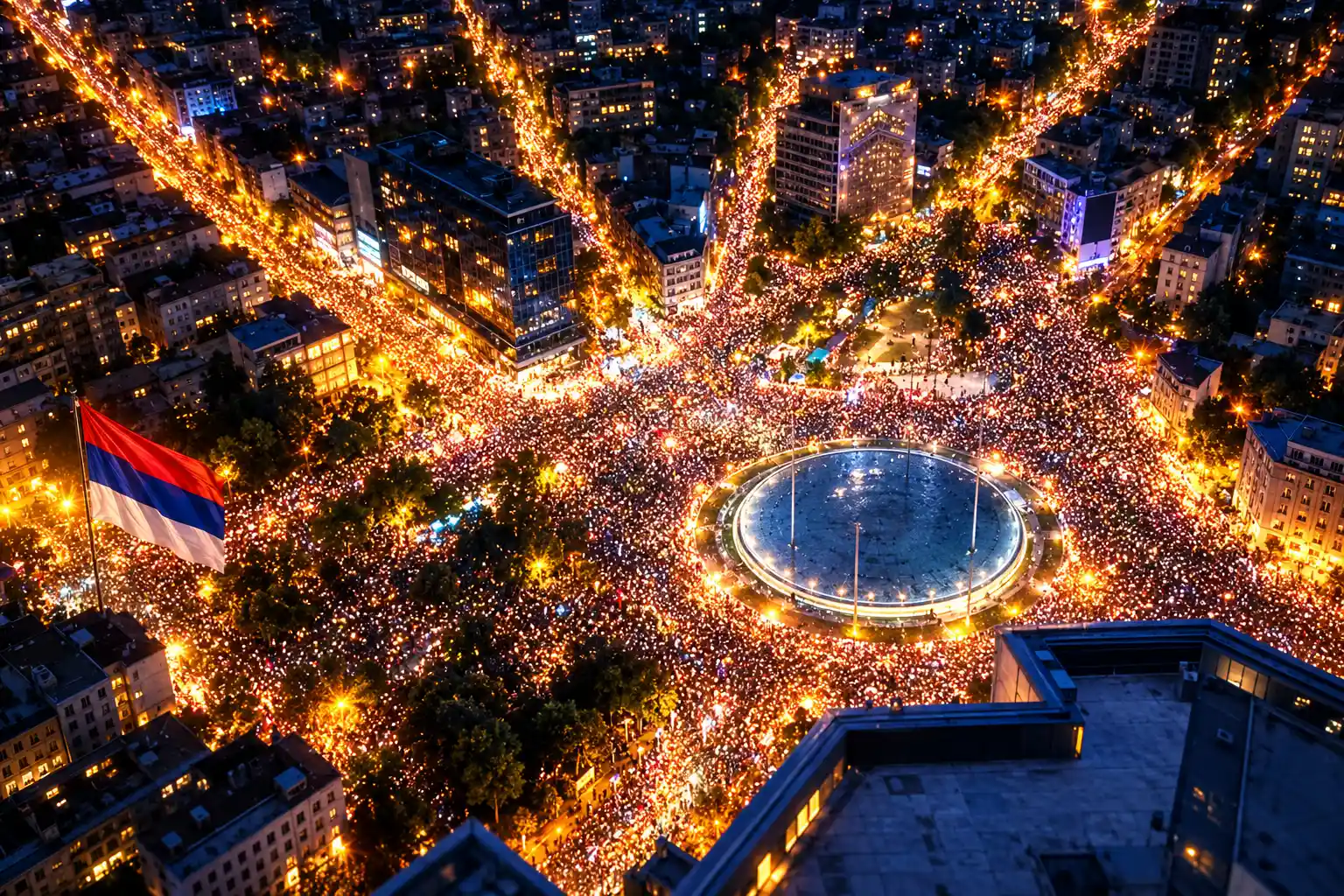
About 150,000 people filled Belgrade’s Slavija Square on 22 October, two days before Serbia’s snap parliament vote. The Student List is a leaderless slate of 250 outsiders trying to end 14 years of Serbian Progressive Party rule.
Aleksandar Vučić dissolved parliament on 9 September and later quit the presidency to run as prime minister, gambling that a street movement cannot win 126 seats in a campaign of just over six weeks.
Vučić Called the Vote to Catch Them Short
The parliamentary election was not due until late 2027. On 9 September, after a government proposal two days earlier, Vučić dissolved parliament and set 25 October as polling day. He resigned the presidency on 27 September so he could head the list “Aleksandar Vučić, United Serbia” and seek the prime minister’s chair he last held from 2014 to 2017.
Ana Brnabić, the speaker and a former prime minister, became acting president. Đuro Macut stays on as caretaker prime minister. A separate presidential election must be held by 27 December, and Vučić cannot stand; he has already served two terms.
Unable to break the protests by force, split or insult, he chose speed. The Student List answered by filing 250 names on 14 September with 69,099 valid signatures, nearly seven times the 10,000 the law requires, then packing Slavija for a last rally on 22 October.
HOW THE SNAP VOTE WAS SET
- 1 November 2024: A concrete canopy at Novi Sad’s railway station collapses at 11:52, killing 16 people and starting student blockades.
- 9 September 2026: Vučić dissolves the assembly elected in December 2023 and calls a vote for 25 October.
- 14 September 2026: The Student List files 250 candidates and 69,099 signatures with the Republic Electoral Commission.
- 27 September 2026: Vučić resigns as president to run for prime minister.
- 8 October 2026: The commission confirms 18 lists and 2,418 candidates on the ballot.
- 22 October 2026: About 150,000 people gather at Slavija; Vučić speaks to supporters in a Belgrade sports hall. Campaigning must stop at midnight.
- 25 October 2026: Polls open from 07:00 to 20:00 for all 250 seats.
University professor Jugoslav Gasic, one of the 250, told the square the list meant to end 14 years of humiliation, chaos and betrayal, and decades of putting party interest first.
You deserve better, and we know how to deliver it. Students are winning!
Jugoslav Gasic, Student List candidate, Slavija Square, 22 October 2026
Vučić, 56, spoke the same evening under ticker tape and balloons. He has called the movement a foreign-funded coup attempt.
Let us never forget how they tried to bring down our state. Let us always protect and defend it. Let us go out and defeat them! Defeat them decisively!
Aleksandar Vučić, United Serbia list leader, Belgrade sports hall, 22 October 2026
Marija Nedeljkovic Radic, 47, said she came because young people had given her hope it was possible to live in a normal country, and that she believed it for the first time in her life. Igor, 35, called it the last rally and asked people to meet on 25 October at the polling stations. Serbian law then imposes two days of electoral silence before the vote.
A List With No Students on It
No student is a candidate. Anyone enrolled in 2024/25, or with studies on hold, is barred. The drafters did not want a charge that students were building careers off the blockades. The list is headed by Ilija Srdanović, a cardiologist and professor at the Faculty of Medicine in Novi Sad, and that slot does not make him the automatic prime minister if they win.
The names were chosen through faculty plenums, open assemblies that vote with no spokespeople. More than 160 of the 250 hold doctorates, mixed with doctors, artists, farmers, a former basketball player, a former central bank governor and a rapper. Former members of the ruling coalition’s 20 parties are out, and so are former officials of parliamentary opposition parties. Ordinary opposition members were not barred, but almost none with a party past made the cut.
WHO MAY NOT STAND FOR THE STUDENT LIST
- Current students: Anyone enrolled in 2024/25, or with studies on hold, is excluded so the slate cannot be called a student job scheme.
- Ruling-party past: Former members of the governing coalition’s 20 parties cannot run in the movement’s name.
- Opposition office-holders: Former officials of parties already in parliament are barred; the list is built as a set of outsiders.
- Plenum veto: In August the assemblies challenged 99 of more than 300 names; in September 38 candidates and substitutes stepped aside, including Belgrade rector Vladan Đokić after 43 of 85 plenums voted him off.
- Thin pledge: Candidates accept only “moral and political” responsibility. A plan to limit mandates to 16 to 18 months was voted out in 2025.
None of those rules has legal force. Any of the dropped names could have refused to go. None did, the rector included. The rulebook enforced only by consent is the bet inside the bet: that a movement without leaders can keep its MPs in line after it no longer controls the list order.
The list sits at number 3 on the ballot. Supporters in Niš carried balloons shaped like a three. Several older opposition parties have stood down in its favour. European Serbia, led by Marinika Tepić and Zdravko Ponoš, and Authentic Right, led by Miloš Jovanović, are still running on their own. Ivica Dačić’s Socialists, long a partner of the Progressives, are running separately this time.
Why Sunday’s 126 Seats Are So Hard to Win
A lead in a crowd, or even in a poll, is not a government. Serbia elects all 250 members of the National Assembly by a closed-list vote in one constituency. Seats are shared out by the d’Hondt method. A list needs 3 percent of votes cast to enter, unless it is a recognised national-minority list. A majority is 126.
THE RULES ON 25 OCTOBER
| Rule | What it does |
|---|---|
| Seats | 250 in one nationwide constituency |
| Majority | 126 seats to form a government |
| Threshold | 3% of votes cast; minority lists are exempt |
| Method | d’Hondt; seats follow list order |
| Hours | 07:00 to 20:00, at home and in missions abroad |
| Voters | 6.45 million registered |
| Lists | 18 on the ballot, 2,418 names in total |
If most smaller lists fall under 3 percent, almost every vote above the line converts into seats for one of the two big lists. That is why the race has taken on a referendum feel. It is also why the Student List’s refusal to bargain with the ruling parties, which Progressive officials treat as proof it cannot govern, is part of the wager: a plurality that will not deal can still miss 126.
The new assembly must meet within 30 days of the final results. It then has 90 days to elect a government, or it is dissolved. Voting abroad follows Serbian time, so in Australia, New Zealand and Chicago part of the day falls at night. On 15 and 16 October the Administrative Court rejected two Student List appeals against those overseas rules.
Polls Split, Markets Still Back Vučić
Serbia does not have a stable independent polling field, and the last surveys do not agree on who is ahead. They agree on the shape: two lists far above the rest, and everyone else scraping at 3 percent.
THE POLLS THAT DISAGREE
| Poll | Fieldwork | United Serbia | Student List | Note |
|---|---|---|---|---|
| NSPM | 25 Sep to 5 Oct | 42.7% | 44.5% | Phone, 1,050 people; 18.3% undecided left out |
| Ipsos Strategic Marketing | 20 to 22 Oct | 47.4% | 40.0% | 3,624 people; paid for by the Vučić list; turnout put at 64.7% |
| CRTA and Stanford DAL | Published July | 35.7% | 44.9% | Share among decided voters, 70% of the sample |
NSPM also put Dačić’s list at 2.9 percent, European Serbia at 2.7 percent and Authentic Right at 2.5 percent, all under the line. Ipsos, paid for by the Vučić list, put the Socialists at 3.2 percent, which would bring a familiar partner back into parliament. NSPM said 79.8 percent of its sample would definitely vote. High turnout is widely expected to help the Student List, because the Progressive machine already knows its 1.2 to 1.5 million core.
Prediction markets on 22 October still priced a United Serbia win at 68 percent and a Student List win at 33 percent. The same markets put Vučić at 67 percent to be the next prime minister and Srdanović at 26 percent, with Đokić, already vetoed by the plenums, at 4 percent and Brnabić at 1 percent. The street and the betting shops are not measuring the same thing. A square of 150,000 is a turnout machine. It is not a voter register, a news bulletin or a public-sector payroll.
Ana Stojiljković, a campaign consultant with a doctorate from the University of Leeds, said this is the first cycle since 2012 in which the Progressives face another actor of about equal strength. That is the students’ case. The markets are pricing the other half of the bet: the party that still holds the state.
CRTA Logged 116 Attacks and Threats
The Centre for Research, Transparency and Accountability, which has watched Serbian elections since 2016, said the campaign ran on an unaudited voter list and on unequal ground. Its observers logged 116 incidents of violence and threats by the last week, about three a day since the vote was called. Physical and verbal incidents tripled from the first stretch of the campaign to the penultimate week.
WHAT CRTA RECORDED IN THE CAMPAIGN
- 116 incidents: Physical violence and verbal threats on the ground by the final week, across 66 municipalities and cities.
- 650 of 1,500: Public-official events flagged for possible misuse of office or state resources; about a third of United Serbia’s recorded activity.
- 250-plus pressure cases: Jobs, social aid or a public service used to extract support, often from pensioners and people on state help.
- 98 percent: Guests on the public broadcaster’s main evening news, Dnevnik 2, who were government representatives in CRTA’s August sample.
Raša Nedeljkov, CRTA’s programme director, said the prosecution has not fully investigated a single election-related incident, from vote-buying to attacks on student activists. He also described ministry staff using dual-citizenship records in Bosnia and Herzegovina, and canvassing among Serbs in Vienna, before the election had even been called. CRTA says at least seven of the 18 lists look like fakes or satellites, a tactic the ruling party has used before to split opposition votes.
On 21 October the Higher Public Prosecutor’s Office in Belgrade questioned six people over a suspected plan for violence, riots and attacks on election day. Five were held in Novi Sad, one in Belgrade. Prosecutors later asked a court to keep five in custody and released a 26-year-old woman. The claims have not been tested in court. Macut said on television that nothing that could break public order on 25 October should happen, and that a coup would be the wrong way to settle the country’s arguments.
The European Parliament’s October 2025 resolution on Serbia counted more than 1,028 arrests and at least 340 incidents of violence during the protest years, and said those figures were incomplete. OSCE election observers are in the country for Sunday. The Office for Democratic Institutions and Human Rights has already said several older recommendations, including on pressure on voters and misuse of state resources, remain open.
Novi Sad’s Dead Still Have No Verdict
The wager began under a slab of concrete. On 1 November 2024, at 11:52, a 48-metre canopy at Novi Sad’s main railway station fell on the pavement and killed 16 people. The station, built in 1964, had been rebuilt from 2021 to mid-2024 with Chinese Belt and Road money. A consortium of China Railway International and China Communications Construction Company did the work under an interstate deal, with no public tender.
Students first asked for the reconstruction files, then for prosecutions, then for an early vote. Almost two years later, no one has been held to account for the deaths. Former construction minister Goran Vesić and others were charged over public safety; a Novi Sad court dropped some of those counts in December 2025, and an appeal has dragged. A separate organised-crime case has alleged that inflated invoices on the Chinese-led works damaged the state budget by $115.6 million. No Chinese citizens have been charged.
The protests grew from faculty blockades into some of the largest crowds since the fall of Slobodan Milošević in 2000. Archive of Public Gatherings put 180,000 to 190,000 people at Slavija on 23 May this year. On 15 March 2025, during 15 minutes of silence for the Novi Sad dead, forensic audio researchers at Earshot said it was highly probable a directed acoustic weapon was used on the crowd. The government denies it. Military analyst Aleksandar Radić said a sonic weapon was used, was later detained, and has left the country with a warrant out for his arrest.
That is the pile of unfinished business Vučić tried to freeze in a short campaign. The Student List’s original demands still start with the Novi Sad file, the names of people who beat students, dropped charges against detained protesters, a 20 percent rise in the higher-education budget, and a full inquiry into the 15 March panic on Kralja Milana Street.
The Street Majority That Cannot Fire an MP
Otpor, the leaderless student movement that helped topple Milošević, became a party, won 1.7 percent in 2003 and melted into the Democrats a year later. The Student List has taken a different door into power: the plenums pick the names, and no student sits on the slate. Before polling day those assemblies can still strike a candidate. After it, Serbian law says the seat belongs to the MP. Blank resignation letters, once used by parties to recall deputies at will, were struck down years ago.
The published programme for the vote is heavier on courts, media and corruption than on the world outside Serbia. On the European Union, the list says it will push for IBAR status through work on chapters 23 and 24, justice and fundamental rights. Membership itself has been left to a referendum. Kosovo is called part of Serbia. On Ukraine, the text tracks the present line: no sanctions on Russia, and support for Ukraine’s territorial integrity. Igor Bandovic, director of the Belgrade Centre for Security Policy, said foreign policy is the biggest gap in the programme, and that a membership referendum could slow accession further. Serbia has not opened a new negotiating cluster since 2021.
Moscow has backed the government and treated the protests as a Western “colour revolution.” China has stayed quiet and, Bandovic said, is likely to prefer the status quo. The Progressives still sell a foreign policy that keeps Russian gas, Chinese building contracts and an open EU file in the same briefcase. Vučić told state television this week that Vladimir Putin knows there will be no sanctions on Russia only if the populists win.
Fans of Red Star and Partizan, clubs that usually spend Saturday at war with each other, were on the streets in the same chants against the ruling party as the campaign closed. That kind of conversion is what the list has to repeat in 6.45 million names, not in one square. Consultancy Teneo wrote that a student-backed government would try to break patronage networks and would hit bureaucratic resistance that could shake institutions in the short run.
Sadie Zarris, who reviewed the movement’s internal Directive while based in Belgrade, put the hard limit in one line. Before an election, the plenums can take a name off the list. After it, they cannot take back a seat. Sunday tests whether a crowd of 150,000 can become 126 names in the chamber. The day after tests whether those names still answer to the square that sent them.

Ohtani Game 4 Logoman Card Sells for $3.24 Million

Cole Kmet’s Season Ends, and Chicago’s Tight End Plan Starts

NBA Seeks Soccer Money After EuroLeague Clubs Refused

Amazon’s First Bond Tests Leave the Broccoli Chair Empty

Tyrese Maxey Owns the Night Built for LeBron James

Warsh Rejects Rate Guidance and Still Moves Markets

Dana-Farber Exits an MGB Medicare Advantage Network Early

NASA Launches the Roman Space Telescope’s Cosmic Bet

OpenAI’s Cyber Letter Puts the Defense Bill on Governments

Russia Recycles Its Old Warning Over Storm Shadow Plants
-
 BUSINESS2 months ago
Warsh Rejects Rate Guidance and Still Moves Markets
-
 BUSINESS1 month ago
Dana-Farber Exits an MGB Medicare Advantage Network Early
-
 NEWS2 months ago
NASA Launches the Roman Space Telescope’s Cosmic Bet
-
 NEWS2 months ago
OpenAI’s Cyber Letter Puts the Defense Bill on Governments
-
 NEWS2 months ago
Russia Recycles Its Old Warning Over Storm Shadow Plants
-

 ENTERTAINMENT4 weeks ago
Primetime’s $2.7 Million Preview Tops Pitt’s Costlier Film
-

 BUSINESS2 months ago
Jet Drones Lock Down Kyiv and Strip Kherson of Heat
-
 ENTERTAINMENT2 months ago
Midnight Spider-Man Turns Peter Parker Into Oscorp’s Hybrid