
ENTERTAINMENT
Sarah Khalifa Death Sentence Fits Egypt’s Capital Drug Pattern
Sarah Khalifa’s death sentence follows Egypt’s capital-drug script: 28 defendants, a required mufti opinion, hundreds of hang sentences a year.

A Cairo criminal court sentenced Egyptian TV host Sarah Khalifa and 11 co-defendants to death by hanging on 5 September 2026. She is 39. The court convicted them of forming an organised group that imported materials to make synthetic drugs for sale, and of holding unlicensed firearms and ammunition.
The ruling followed a required opinion from Egypt’s Grand Mufti and can still be appealed. Nine other defendants got life terms. Seven of the 28 people on the docket were acquitted. Khalifa’s lawyer, Mohamed El-Gendy, said the defence will challenge the judgment.
The Court Split 28 Defendants Three Ways
The Public Prosecution had sent Khalifa and 27 others to trial on charges of importing raw materials, making synthetic narcotics, trafficking the product, and possessing guns and ammunition without a licence. Investigators said they seized more than 750 kilograms (1,653 pounds) of synthetic drugs and the chemicals used to make them, and that two Cairo apartments had been used as laboratories.
The referral rested on statements from 20 witnesses plus messages, photographs and videos taken from devices. Roles were split, prosecutors said, among import, manufacture and distribution. Two defendants remained at large, were placed on travel bans and watch lists, and were tried in absentia.
HOW THE CAIRO DOCKET BROKE
| Outcome | Defendants | Extra order |
|---|---|---|
| Death by hanging | 12, including Khalifa | Fine of 500,000 Egyptian pounds ($9,800) each |
| Life imprisonment | 9 | Same firearms conviction as the capital group |
| Acquitted of all charges | 7 | Released from the narcotics counts |
| Total on the indictment | 28 | Assets and bank accounts frozen |
The court also ordered confiscation of the drugs, vehicles, manufacturing kit, jewellery and phones. That split is the record of a long trial, not a single headline. Seven people walked out of the same file that sent 12 toward the gallows.
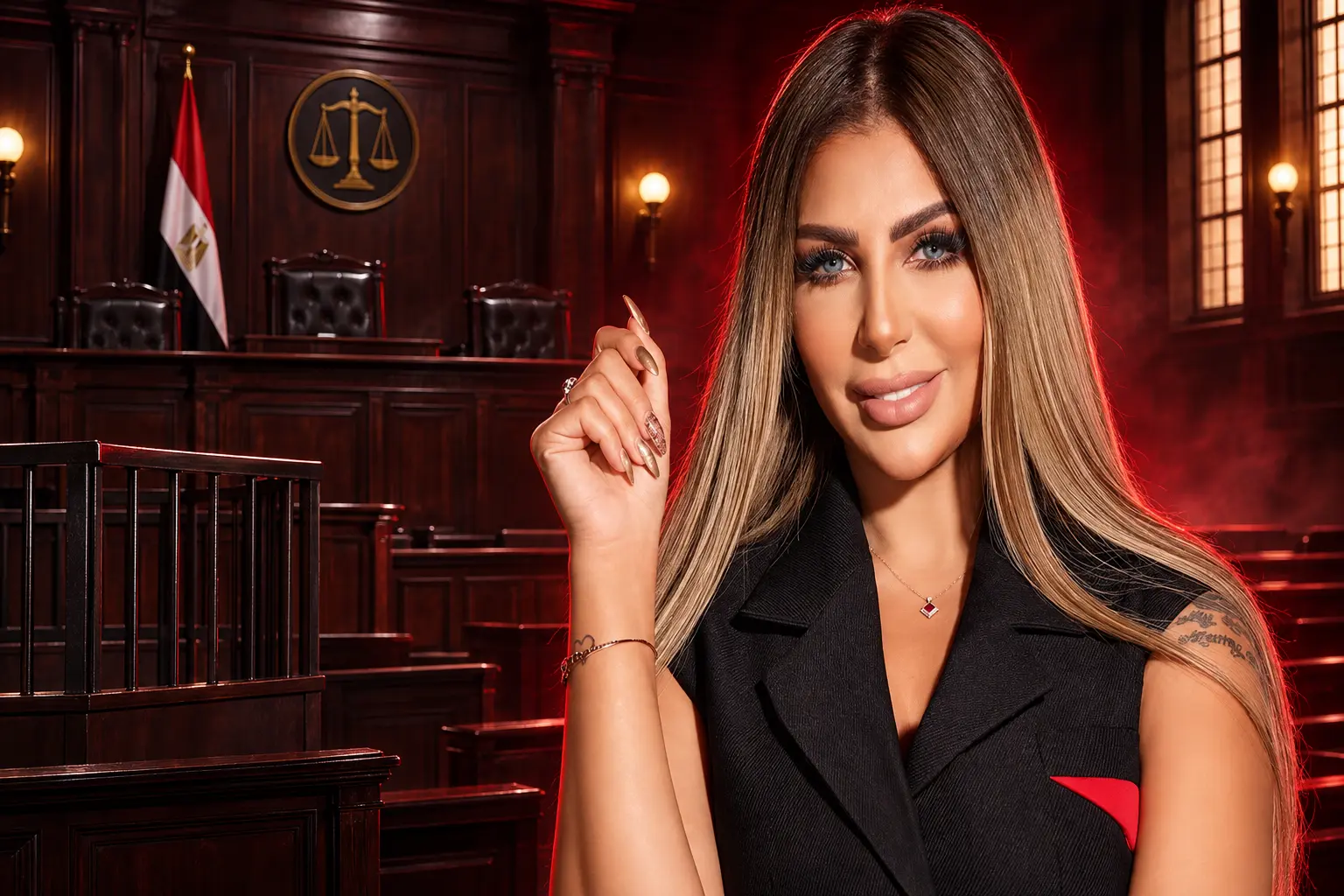
Prosecutors Called Khalifa the Dealmaker
Prosecutors listed Khalifa as the fourth defendant and described her as the group’s manager, the person who funded expenses, and the link between members inside Egypt and those outside it. They said she travelled abroad to meet other defendants and used companies to move money. Two of the men they named as organisers were abroad.
WHAT THE PROSECUTION SAID SHE DID
- The job title: Manager of the criminal formation, according to the closing arguments.
- The money: Funder of the group’s expenses and a dealmaker among its members.
- The travel: Trips abroad to coordinate with defendants who were not in Cairo.
- The businesses: A cosmetic surgery clinic and an events company that prosecutors treated as cover for transfers.
Khalifa denied knowing about any drug work. She told investigators she had never smoked a cigarette in her life. In court last September, asked about her alleged role, she said she had never seen any drugs until she was photographed with them inside the anti-narcotics authority’s offices.
I don’t need drug money.
Sarah Khalifa, addressing the Cairo Criminal Court
Defence lawyers attacked the arrest and the searches. An arrest warrant was issued on 17 April 2025. Khalifa told prosecutors she was taken into custody that day; the formal seizure report was dated 19 April. Lawyers asked for location data to back her claim of an earlier detention, questioned the phone examination, disputed handwriting evidence, and alleged coercion. A three-member court committee said the seized compounds could produce prohibited synthetic cannabinoids. The defence challenged that science and the legal tables used to classify the substances.
On the same Saturday, the court imposed a separate term of three years’ rigorous imprisonment for assault and for filming a young man. That judgment is not the narcotics case, and the death sentence was not imposed for that assault.
Why Synthetic Drugs Carry a Hanging Sentence
Egypt already treated trafficking, manufacture and unlicensed import of narcotics as capital crimes under Law 182 of 1960. The Khalifa file was built on a later change aimed at laboratory drugs that did not sit neatly on the old schedules.
On 16 July 2019, Law 134 added a new offence: death for anyone who imported, exported, made or produced synthetic substances with a narcotic effect or a harmful effect on the mind, body or nerves. Possession of those substances with intent to traffic was set at life imprisonment and a fine. The 2019 amendment to Egypt’s narcotics law is the statute hanging over this docket.
WHAT THE 2019 AMENDMENT ADDED
- The hanging count: Import, export, manufacture or production of synthetic substances with a narcotic or harmful effect.
- The life count: Possession of those substances with intent to traffic, plus a fine of 100,000 to 500,000 pounds.
- The tables: The health minister sets the tests that decide which laboratory compounds fall under the new article.
That is why a case about imported powders, apartment labs and analogue chemicals can end in a death sentence even when the product is not heroin or hashish. The court still has to find that the group formed to make and sell the drugs, and that each defendant’s role meets the statute. Seven acquittals show that test is not automatic.
The File Had to Go to the Grand Mufti
Egyptian criminal procedure does not let a trial bench pronounce death on the day it first agrees on guilt. After hearings end, the judges must be unanimous on capital punishment. Then they send the papers to Dar al-Ifta.
Article 2/381 of the criminal procedural law makes that obligatory referral before a death verdict. Three appeals-court counsellors review the file inside Dar al-Ifta. The Grand Mufti then issues an opinion in the institution’s name. The fatwa is advisory. The court is not bound by it. In this case the bench had referred Khalifa and 12 other defendants to the mufti, then confirmed 12 death sentences on 5 September.
THE 506 DAYS FROM WARRANT TO VERDICT
- 17 April 2025: An arrest warrant is issued for Khalifa in Cairo. She tells prosecutors she is detained the same day.
- 29 July 2025: Prosecutors refer all 28 defendants to the criminal court and freeze assets and bank accounts.
- 6 September 2025: The trial opens. The court later hears forensic evidence, then a technical committee in June 2026.
- 4 August 2026: After final submissions, the court sends the capital files to the Grand Mufti.
- 5 September 2026: The Cairo Criminal Court issues the death sentences, 506 days after the warrant and 364 days after the trial opened.
Duration does not prove every defence point was handled well. It does show the hanging order was not a same-week police announcement. The written reasons, once they circulate in full, will be the document the next court actually reads.
Egypt Issued 461 Death Sentences in 2025
Put Khalifa’s Saturday in that wider docket and the celebrity frame shrinks. The Egyptian Initiative for Personal Rights, counting from families and published reports, documented criminal courts issuing death sentences against 461 people in 320 cases in 2025, a minimum. Judges referred 405 defendants in 260 cases to the Grand Mufti. The Prison Authority carried out at least 15 hangings in 10 cases, including one woman. The Court of Cassation upheld death sentences against 31 people in 23 cases, putting them on death row.
EGYPT’S 2025 CAPITAL COUNT
- Trial and appeal benches: 461 death sentences in 320 cases, the lowest figure researchers could confirm.
- Mufti referrals: 405 defendants in 260 cases sent for a religious opinion on execution.
- Cassation: 31 people in 23 cases added to death row after the high court upheld hanging.
- Hangings carried out: at least 15 people in 10 cases, one of them a woman.
That is more than 30 death sentences for each hanging the group could document. A first-instance capital verdict in Cairo is a legal stage. It is not the rope. Amnesty International, in its global monitor, recorded 2,707 executions across 17 countries in 2025 and listed Egypt among the states that still carried them out. The local arithmetic still matters more for this file: most people sentenced to hang in Egypt last year were not hanged last year.
English-language posts treated the Khalifa order as proof that Egypt is simply tough on drugs, and as if the hanging were already scheduled. Looks, follower counts and a crime-show clip do not move a charge sheet. They also do not turn a first-instance judgment into an execution date. Seven acquittals and two absent organisers sit on the same record as the death sentences, and the next court has not sat.
Her Programme Was a Difficult Mission
Khalifa was a public face with a clinic, an events firm and more than two million Instagram followers. She briefly married the footballer Mahmoud Abdel-Moneim, known as Kahraba, in 2016. That is a real profile. It is not the same thing as a long-running national crime franchise.
Published profiles trace her television work to ART’s From Cairo, Iraq’s Al-Sharqiya, a 2015 show on the private Al-Mehwar satellite channel, and a later programme, Trend, on Ten. The Al-Mehwar title was Mohemma Saaba, Arabic for Difficult Mission or Hard Mission. English copy often rendered it as Mission Impossible. Archived episodes included police-station visits and interviews about robbery and kidnapping, and they also profiled people doing hard jobs. Her documented 2024 appearance was an online entertainment slot with mahraganat singer Hamo Bika.
After the arrest, the Egyptian Media Syndicate said she was not registered and not licensed to work as a presenter. Syndicate head Tarek Saada described her as impersonating a media professional and warned channels against putting unlicensed people on air. Old logos and clips remained easy to find, which is how a scattered presenting history hardened into the biography of a leading crime-show host once the death sentence landed.
None of that decides guilt. It does decide what kind of story this is. The court convicted a businesswoman and occasional presenter who prosecutors called a financier, not the host of a nightly national manhunt. The 2015 programme is part of her record. It is not a moral twist the verdict needs in order to exist.
The Sentence Can Still Be Overturned
El-Gendy said the defence will appeal and will argue procedural errors. He said the trial court’s verdict would be treated as if it had never existed and would be cancelled at the appeal stage, before the case reached cassation. In capital files the prosecution must also start a review. A higher criminal court can uphold, cut or throw out the sentences. The Court of Cassation, Egypt’s highest court for criminal cases, can commute, overturn or order a retrial if it finds legal defects.
As if it never existed and it will be cancelled at the appeal stage before reaching cassation.
Mohamed El-Gendy, defence lawyer for Sarah Khalifa
Dar al-Ifta’s own guidance is blunt on the same point: the judge’s decision is a first step in a long process, and every defendant may appeal to the Court of Cassation. Khalifa is a convicted defendant under a judgment that still has to survive that ladder. The 11 others sentenced with her, the nine serving life, and the two men tried in absentia are on that ladder too.
Until a higher court writes the next order, the hanging announced on 5 September is a sentence on paper, issued the way Egypt issues hundreds of them, after the mufti’s file came back and before anyone is taken to the gallows.

Pixel Buds Firmware 6.144 Ties New Features to Pixel Gear

Eve Markoski-Wood Backs Her Mum as Wood Fights Bail

Trump Rejects an Iran Deal as Diesel Holds Near Records

Amazon Cuts the S26 Ultra to $979 After Samsung’s Hike

Ice Caves Land in Minecraft 26.4 Snapshot 3

Warsh Rejects Rate Guidance and Still Moves Markets

Dana-Farber Exits an MGB Medicare Advantage Network Early

NASA Launches the Roman Space Telescope’s Cosmic Bet

Russia Recycles Its Old Warning Over Storm Shadow Plants

Primetime’s $2.7 Million Preview Tops Pitt’s Costlier Film
-
 BUSINESS2 months ago
Warsh Rejects Rate Guidance and Still Moves Markets
-
 BUSINESS1 month ago
Dana-Farber Exits an MGB Medicare Advantage Network Early
-
 NEWS2 months ago
NASA Launches the Roman Space Telescope’s Cosmic Bet
-
 NEWS2 months ago
Russia Recycles Its Old Warning Over Storm Shadow Plants
-
 ENTERTAINMENT4 weeks ago
Primetime’s $2.7 Million Preview Tops Pitt’s Costlier Film
-

 NEWS2 months ago
OpenAI’s Cyber Letter Puts the Defense Bill on Governments
-

 BUSINESS2 months ago
Jet Drones Lock Down Kyiv and Strip Kherson of Heat
-
 NEWS2 months ago
Congo Starts Ervebo Vaccinations for a Different Ebola Virus