
NEWS
Russia’s Wartime Duma Vote Runs Through Empty Pumps
Russia opened a wartime State Duma election on September 18 after banning Yabloko and cutting vote targets as fuel ran short.

111 million Russians became eligible to fill all 450 seats in the State Duma when polls opened on September 18, the first parliamentary election since the 2022 invasion of Ukraine. Voting runs three days and closes at 1800 GMT on Sunday, September 20.
President Vladimir Putin told the country the ballot would show that “millions of people stand behind our fighters.” He voted online the same morning. United Russia is placed to keep the chamber. The war he wants certified has already reached the pumps, and in Sochi it reached the polling stations.
The First Wartime Duma Vote Opens Under Drone Alerts
Stations opened first in Kamchatka and Chukotka, then across 11 time zones, from 08:00 to 20:00 each day. By 2 p.m. Moscow time the Central Election Commission put turnout at 10.41 percent, an early day-one reading, not a final count.
In Sochi, Mayor Andrey Propushin said members of election commissions, observers and voters were moved to shelters until a drone warning was lifted. The civic ritual meant to bless the war had to pause for it.
Putin framed the election as proof of unity and of support for the army. Sabine Fischer of the German Institute for International and Security Affairs wrote in a September 14 comment that the presidential administration had already cut United Russia’s target to 45 percent, down from 60 percent at the start of the year, and had eased the turnout aim from 55 percent to 50 percent.
That climbdown is the tell. Seats were never in doubt. The number the Kremlin now needs is a turnout figure it can still sell as consent.
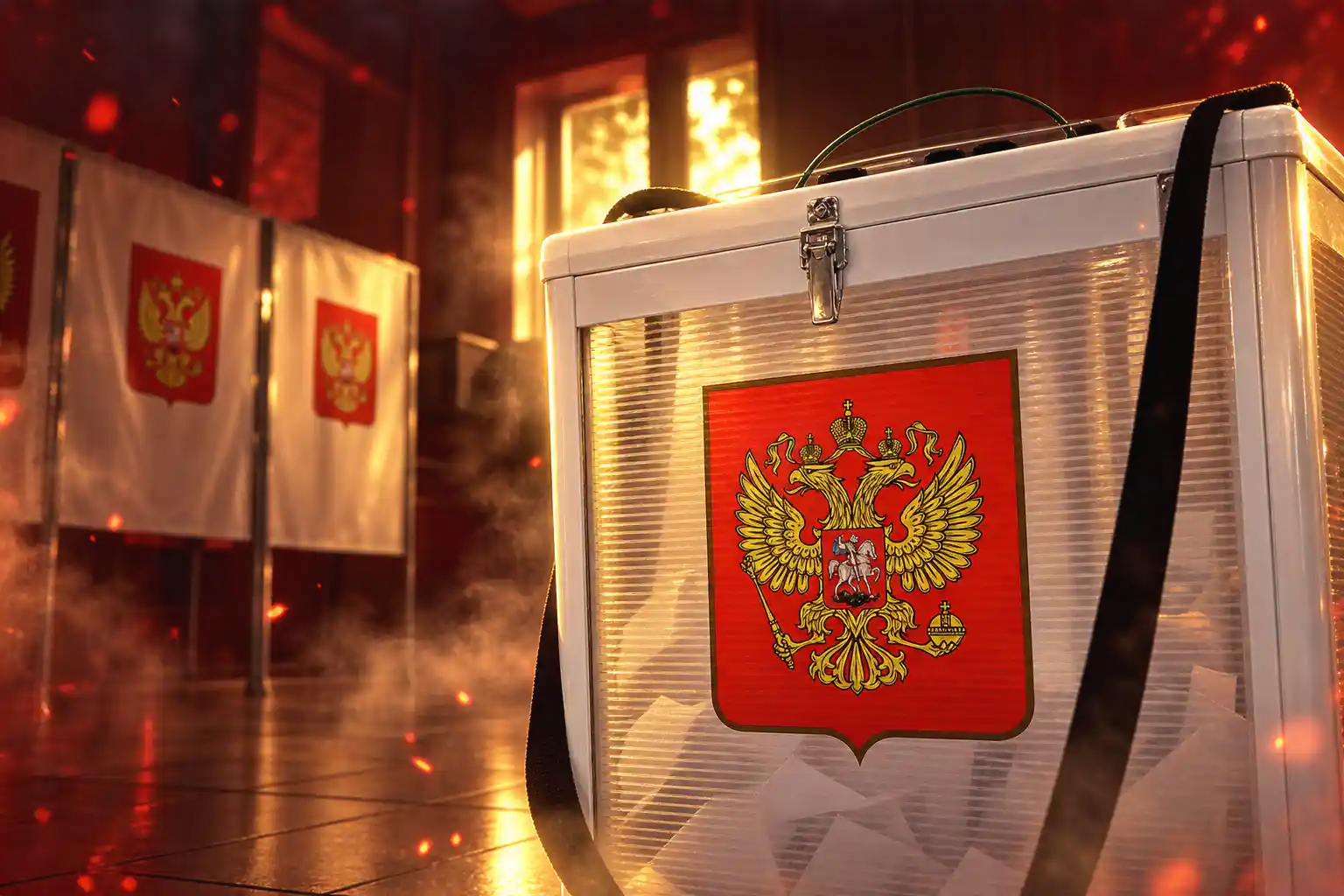
United Russia Already Holds the Chamber
Voters get two ballots. Half the chamber is filled from party lists, with a 5 percent threshold. The other 225 seats are single-member races. A party needs 226 seats for a majority and 300 to change the constitution on its own.
United Russia took 324 seats and 49.82 percent in 2021, when turnout was 52 percent and 56,329,690 ballots were counted. It still holds 310 seats in the outgoing house, above that 300-vote line. Dmitry Medvedev remains party leader; he is not on the federal list. Foreign Minister Sergey Lavrov heads it, with Moscow Mayor Sergey Sobyanin, war correspondent Yevgeny Poddubny, children’s rights commissioner Maria Lvova-Belova and Yunarmiya chief Vladislav Golovin.
The party nominated candidates in every single-member district and replaced 110 of the 198 incumbents who won those races in 2021. Some 400 names sit on its list, with dozens of governors parked at the top in the old “locomotive” pattern, expected to hand seats down after the count.
THE 2021 DUMA THIS VOTE REPLACES
| Party | 2021 seats | 2021 vote share | Outgoing seats | Leader |
|---|---|---|---|---|
| United Russia | 324 | 49.82% | 310 | Dmitry Medvedev |
| Communist Party (CPRF) | 57 | 18.93% | 56 | Gennady Zyuganov |
| LDPR | 22 | 7.55% | 22 | Leonid Slutsky |
| A Just Russia | 27 | 7.46% | 27 | Sergey Mironov |
| New People | 13 | 5.32% | 15 | Alexey Nechayev |
Ten parties remain on the printed party-list ballot. The commission registered 4,436 candidates in all, including more than 180 people billed as participants in the “special military operation.” United Russia put up 389 names, the Communists 329, New People 295 and the LDPR 234.
At the last sitting of the outgoing Duma on July 27, Speaker Vyacheslav Volodin said 68.5 percent of laws had been backed by every parliamentary group. He closed with, “There are many parties, but only one Russia,” then led a chant of “Russia, Putin, Victory.”
The smaller parties in that chamber vote with the government on the war, the budget and the security laws. They are the décor. They are also the only legal choice left on the list ballot.
The Court Cleared Yabloko, Then Struck It Off
Yabloko, whose name means apple, was the only registered party running on a ceasefire platform. The Central Election Commission put its federal list on the ballot on July 29. Three weeks later the Supreme Court took it off, on a suit by the nationalist Rodina party.
Nikolay Rybakov leads the party. Grigory Yavlinsky, a founder, last met Putin in October 2023, a contact other opposition groups have long treated as a shield. It did not hold. About 500 people, most of them young, gathered outside the court on August 10. Videos of apples, and of a pop song with that title, had already spread as a quiet code for the banned list.
YABLOKO’S PATH OFF THE PARTY LIST
- June 27, 2026: The party convention nominates a federal list headed by Yaroslav Shcherbakov and a program built around a ceasefire.
- July 29, 2026: The Central Election Commission registers that list, one of 11 then cleared to run without collecting signatures.
- August 7, 2026: Rodina files at the Supreme Court. The Communists, the LDPR and A Just Russia call the same day for Yabloko to be dropped.
- August 10, 2026: Judge Vyacheslav Kirillov, who also handled the 2021 Memorial ban, orders the list off the ballot. The party says the formal grounds in the court’s reasoned ruling were foreign-linked donations, online ads and copyright claims, and that the real target was its “For Peace and Freedom!” platform.
- August 17, 2026: The appeals chamber upholds the ban. In Pskov, deputy leader Lev Shlosberg is sentenced to 11 years and one month in a penal colony for “discrediting” the armed forces.
The commission left the numbering on the ballot unchanged, so United Russia stays at slot one and the LDPR sits at slot three, with Yabloko’s two skipped. Some 127 Yabloko candidates in single-member districts were not struck at the same time. They cannot carry a national anti-war vote.
CEC chair Ella Pamfilova, asked about Russians who had left the country, said those who had “betrayed” it should “go to hell.” She also asked the next Duma to bar “foreign agents” abroad from voting. The justice ministry’s foreign-agent register now lists more than 900 people and groups. Golos, the last large independent vote monitor, announced it was dissolving in 2025.
18 Percent for a Party Absent From the Ballot
ExtremeScan, a telephone pollster, interviewed 800 adults across Russia from September 4 to 10, with a margin of error of ±3.5 percent. When interviewers named the parties still on the ballot, United Russia drew 23.9 percent of all respondents and 35.6 percent of those who had picked a party.
Asked a separate question, whether they would vote for Yabloko if it were listed, 18 percent would vote for Yabloko. That is 141 people unweighted, 18.0 percent after weighting. Among respondents treated as decided once Yabloko is restored to the choice set, the party’s share is 24.6 percent, with United Russia at 31.8 percent.
Elena Koneva’s team warned that a stand-alone question can inflate a banned party’s pull. In July, when Yabloko was still read out with the others, it took 4 percent of all voters and 6 percent of the decided. The later figure is not a seat forecast. It is a measure of a protest that has no box.
INDEPENDENT PARTY STANDINGS BEFORE THE VOTE
| Party | Share of all respondents | Share of decided voters | Share among parties over 5% |
|---|---|---|---|
| United Russia | 23.9% | 35.6% | 38.5% |
| Communist Party | 16.0% | 23.9% | 25.8% |
| New People | 10.8% | 16.2% | 17.5% |
| LDPR | 7.3% | 11.0% | 11.8% |
| A Just Russia | 4.0% | 5.9% | 6.4% |
Those shares cover the list ballot only. ExtremeScan did not model the 225 district races, where United Russia’s local machines are strongest. Even so, 32.7 percent of respondents said results nationwide would be “substantially altered,” and 49 percent said the Duma cannot disagree with the president on important matters. Four in ten, 40.2 percent, said laws passed since 2021 had done more harm than good.
The Levada Centre, in July, found 62 percent wanted peace talks to start and 28 percent wanted the war to go on. If talks failed, 56 percent backed heavier strikes on Ukraine and 25 percent backed concessions. Fischer noted Putin’s approval, depending on the poll, had slipped from 85 percent at the start of 2026 to as low as 65 percent.
At a Moscow station on Friday, pensioner Galina Vavilova said ending the war “is the main thing, of course.” “Everyone wants peace, that’s what it comes down to. So that our guys are safe and sound,” she said. Vladimir Chubarev, 72, a professor, said he hoped “for victory.” Both wishes go into the same box.
Refinery Strikes Left Pumps Dry Into the Vote
The International Energy Agency, in a September 17 commentary, said Ukrainian drones had hit a Russian refinery on average once every three days in the first eight months of 2026. In June, refinery throughput fell to 3.8 million barrels a day, the lowest in more than 20 years and about 30 percent below a year earlier.
THE FUEL SHOCK BEHIND THE CAMPAIGN
- June throughput: 3.8 million barrels a day, with gasoline output down 20 percent from 2025 and diesel down nearly 30 percent.
- Empty regions: By the end of June, shortages were reported in 92 percent of regions, two-thirds of them rationing, with some waits of up to 40 hours.
- Pump prices: Rosstat said on August 26 that average gasoline had risen more than 19 percent since January and diesel about 18 percent.
- The strike count: As of September 15 the IEA’s tracker had 190 confirmed hits on 28 refineries; only five major plants, all in the far east, had not been struck.
Moscow’s 250,000-barrel-a-day refinery was so badly damaged in June that it is reported offline until early 2027. On July 7 drones reached Gazprom Neft’s Omsk plant, about 2,500 kilometres from Ukraine. Russia banned diesel exports from July 8 and has extended that ban through September 30. Fuel-quality rules were loosened through July 1, 2027, to let older, higher-sulphur grades back onto the market.
Putin said in June the shortage was “obvious” and “not critical.” Conditions eased in late July, then tightened again after a new wave of strikes in the second half of August. The same summer, fires hit warehouses used by Wildberries and Ozon, the two big online retailers, and mobile internet was cut for hours at a time on security grounds.
This is the home front the Duma vote is being asked to applaud. A voter who spent July in a petrol queue is now being told that a United Russia ballot is a gift to the people at the front.
How Occupied Districts Enter the Duma Map
The 2025 redistricting carved seven new single-member seats out of Ukrainian land Moscow claims but does not fully hold. Crimea, annexed in 2014, was redrawn as well. Ukraine and the European Union say none of those polls is lawful.
OCCUPIED SEATS ON THE NEW DUMA MAP
- Donetsk: Three constituencies, named for Makiivka, Donetsk and Horlivka.
- Luhansk: Two constituencies, Luhansk and Alchevsk.
- Zaporizhzhia: One constituency.
- Kherson: One constituency.
On the Russian-held side of Donetsk, voters dropped ballots into a box while an armed soldier stood and watched. Election staff have also been going through courtyards and apartments with mobile urns, a “special procedure” CEC officials have described as a security measure. Kyiv has told its citizens that helping to run the vote can be a crime, and has asked other governments not to recognise it.
Christian Wigand, a European Commission spokesman, called the occupied polls illegal and said they deepen the “erosion of democracy in Russia.”
These so-called elections represent yet another blatant violation of international law. The European Union does not, and will never recognize either the holding of these, so-called elections, sham elections, in the temporarily occupied territories of Ukraine or their results.
Christian Wigand, European Commission spokesperson
Russia did not invite the Organization for Security and Co-operation in Europe, which last sent a full mission for the 2018 presidential vote. The commission instead asked 103 states in Asia, Africa, Latin America and the near abroad, plus 12 non-Western organisations, to send guests. Abroad, 333 polling stations are listed in 152 countries. Moldova protested plans for stations in Transnistria.
Mikhail Khodorkovsky, the exiled former oil executive, said the new Duma should not be recognised as the representative of the Russian people because the vote includes occupied Ukrainian land.
Fake 'elections' to Russia's State Duma begin today, and they will produce a fake parliament.
The new State Duma must not be recognised as the legitimate representative of the Russian people.
[1/13] pic.twitter.com/XqPYuKxrVv
— Mikhail Khodorkovsky (@khodorkovsky_en) September 18, 2026
Kremlin-aligned accounts answered, as they do in every cycle, that Ukraine has not held a national election since 2022. That dispute does not put a rifle on a Kyiv ballot box. It does sit beside the image from Donetsk.
Online Ballots Cover 33 Regions
Remote electronic voting is open in 33 regions that together hold roughly 48 million eligible voters, up from a much smaller trial in 2021. More than 4 million people applied on the federal portal. Moscow runs a separate system on its own city site.
By 9:35 a.m. Moscow time on September 18, the federal portal showed 1,332,353 completed electronic ballots, after more than 200,000 in the first half hour. By 1:30 p.m., officials said about 1.6 million people had voted online in Moscow alone, and that more than 2 million of the federal applicants had already voted, a 54 percent take-up among that group, excluding the capital.
Three-day voting, first used in the 2020 constitutional vote as a public-health measure, is now the default. Independent monitors, while they still existed, argued that extra days and extra channels make it easier to apply workplace pressure and harder to watch a count. The commission says the extra time raises turnout. Both things can be true in a managed vote.
The CEC also said the electoral system had come under cyberattacks on Friday. It gave no damage figure. For a Kremlin that has spent the summer lowering the bar, the remaining job is simple and grim. Get bodies to the terminals, keep the occupied map in the count, and print a United Russia majority that can still pass war budgets, conscription bills and the next round of security law.
Polls close at 1800 GMT on Sunday, September 20. The commission will then report a turnout number and a seat tally. United Russia is positioned to keep the chamber. The pumps, the shelters in Sochi and the empty Yabloko slot will not be on the result sheet.

Ohtani Game 4 Logoman Card Sells for $3.24 Million

Cole Kmet’s Season Ends, and Chicago’s Tight End Plan Starts

NBA Seeks Soccer Money After EuroLeague Clubs Refused

Amazon’s First Bond Tests Leave the Broccoli Chair Empty

Tyrese Maxey Owns the Night Built for LeBron James

Warsh Rejects Rate Guidance and Still Moves Markets

Dana-Farber Exits an MGB Medicare Advantage Network Early

NASA Launches the Roman Space Telescope’s Cosmic Bet

OpenAI’s Cyber Letter Puts the Defense Bill on Governments

Russia Recycles Its Old Warning Over Storm Shadow Plants
-
 BUSINESS2 months ago
Warsh Rejects Rate Guidance and Still Moves Markets
-
 BUSINESS1 month ago
Dana-Farber Exits an MGB Medicare Advantage Network Early
-
 NEWS2 months ago
NASA Launches the Roman Space Telescope’s Cosmic Bet
-
 NEWS2 months ago
OpenAI’s Cyber Letter Puts the Defense Bill on Governments
-
 NEWS2 months ago
Russia Recycles Its Old Warning Over Storm Shadow Plants
-

 ENTERTAINMENT4 weeks ago
Primetime’s $2.7 Million Preview Tops Pitt’s Costlier Film
-

 BUSINESS2 months ago
Jet Drones Lock Down Kyiv and Strip Kherson of Heat
-
 NEWS2 months ago
Congo Starts Ervebo Vaccinations for a Different Ebola Virus