
NEWS
Russia Hits Kyiv Data Centers to Blind Air-Raid Alerts
A week of strikes on Kyiv data centers cut internet for about 100,000 homes and hit alert networks as jet drones slipped through and NATO rejected a.

Russia spent seven days striking Kyiv data centers that carry internet traffic, TV feeds and air-raid alerts. On 29 September the Russian Defense Ministry named the Bi-mobile internet exchange and the Parkovy center among the hits, and listed a locomotive depot it said held FP-5 Flamingo cruise missiles.
Overnight into 30 September that digital campaign ran with a power barrage. Moscow said it hit the De Novo hub again, plus the Kyiv hydroelectric plant and the Trypilska thermal plant, in a wave Ukrainian officials put at nearly 190 drones and missiles.
Russia Has Spent a Week Hitting Kyiv’s Servers
The first large outage came on 23 September, when Ukraine’s Ministry of Digital Transformation said about 100,000 households in Kyiv and the region lost fixed-line internet after data halls used by providers including Pavutyna and UTELS were damaged. Foreign Minister Andrii Sybiha said two people had been killed and more than 40 injured in that morning’s wider bombardment, and that a college in Kyiv was struck while students were on campus.
Moscow has described the halls as military nodes. It said Bi-mobile was one of Kyiv’s main internet traffic exchanges, used to keep information, including intelligence, moving for Ukraine’s armed forces, and that Parkovy handled state and commercial data, including military traffic. Ukraine calls the same buildings civilian plant. Most of the country’s data centers sit in the capital, so a hole in one hall can knock users off hundreds of kilometres away.
FROM ONE HALL TO A CAMPAIGN
- 2 July 2026: A Kyiv data center is damaged in an isolated strike, before the later September wave.
- 8 to 11 September 2026: Drones hit the We Are Ukraine newsroom and a Kyivstar building.
- 23 September 2026: Combined missile and drone strikes damage at least three Kyiv data centers and cut service to about 100,000 households.
- 25 to 26 September 2026: Datagroup is hit; Cosmonova is struck twice and shuts down, taking TV channels off air.
- 27 September 2026: Kyivstar’s headquarters is hit, with no casualties, and Russia says it struck a Vodafone Ukraine data center.
- 28 to 29 September 2026: Russia posts a “Digital detox” caption, hits the National Academy of Sciences, then names Bi-mobile, Parkovy and the Flamingo depot.
- 30 September 2026: The Defense Ministry says De Novo was hit again in a barrage that also targeted Kyiv-area power plants and Izmail port.
Anatolii Frolenkov of the 1-IX internet exchange said September was the point at which the strikes became systematic. Kyivstar, Ukraine’s largest mobile carrier, had already been hit twice in the month before the headquarters strike. Parkovy is an exhibition and convention complex that also houses a large data hall; after a repeat strike, the complex said events were off and journalist Andriy Tsaplienko described fire damage inside and out.
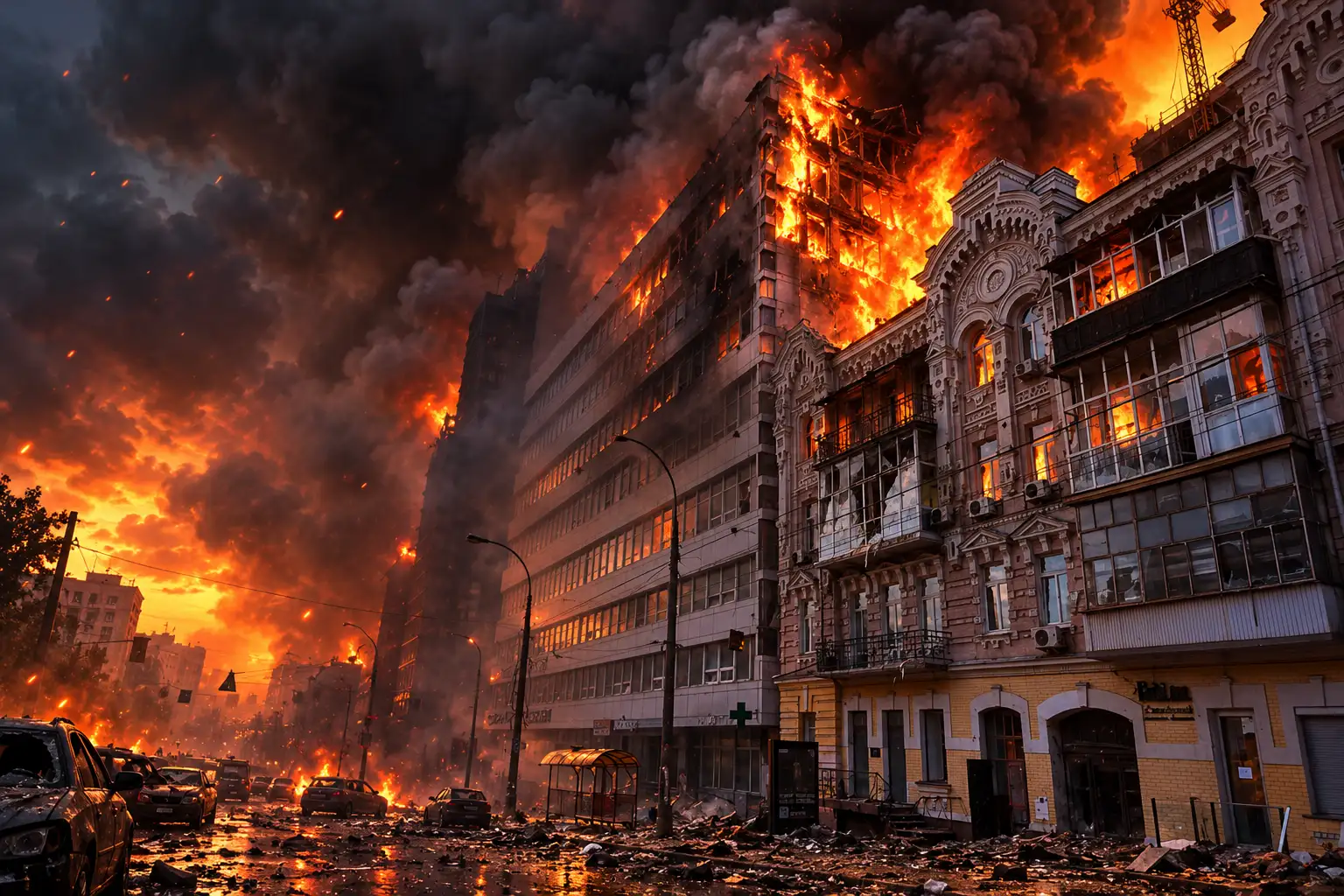
The Drones That Outrun the Cheap Interceptors
The halls are being reached by weapons Ukraine’s cheap interceptor fleet was not built to chase. On 28 September, President Volodymyr Zelenskyy said the daytime attack already included more than 120 drones, 90 of them jet-powered. He put the intercept rate against those jet types at 57%, with a combined rate of 70% when slower propeller drones were counted in.
Against piston Geran-2 and Shahed-type drones, Ukraine’s Defense Ministry figures for March 2026 still showed shoot-downs above 90%. The gap is speed. Ukraine’s military intelligence, on its War and Sanctions portal, lists the Geran-5 with a cruise speed of 450 to 600 km/h, a 90 kg warhead, a 950 km range and a flight altitude up to 6,000 m. The airframe is 6.5 m long with a 3.2 m wingspan and a maximum take-off weight of 850 kg. The turbojet is a Chinese Telefly TF-TJ2000A. That is cruise-missile speed at drone prices, and the Sting interceptors that cleaned up slow Shaheds do not have a clean tail chase against it.
HOW THE JET DRONES COMPARE
| Measure | Propeller Shahed / Geran-2 | Geran-5 jet drone |
|---|---|---|
| Intercept rate cited | More than 90% (March 2026) | 57% (28 September 2026) |
| Speed band | About 180 km/h class | 450 to 600 km/h cruise |
| Warhead | Smaller loitering load | 90 kg |
| Range listed by HUR | Shorter one-way endurance | 950 km |
Serhii Beskrestnov, a presidential adviser on defense technology, said Russia was already near 3,000 jet-powered drones a month and was planning 36,000 to 40,000 a year. Zelenskyy said Ukraine had identified interceptors that can become the main defense against the new jets, and after a 25 September meeting of the Staff of the Supreme Commander-in-Chief he announced decisions on production of different types of jet engines at home. Those lines are still scaling. On 28 September he said developers were being pushed for more shoot-downs every week.
What Goes Dark When an Exchange Point Burns?
The second-order damage is not a blank map of Ukraine. It is missing warning sirens, dark TV, frozen court desks and phones that cannot load an alert. Sybiha’s point on 23 September was narrow: rapid missile and drone warnings run on the same civilian pipes Russia is cratering, and those warnings save lives.
WHAT WENT OFFLINE AFTER THE HITS
- Home broadband: About 100,000 households in Kyiv and the region lost fixed-line service on 23 September, the Digital Ministry said, with Pavutyna, UTELS, Kyiv Link and Crazy Network among the operators hit.
- Court systems: Information Judicial Systems said an outage at a backbone provider took court services down from 13:58 until 16:17 Kyiv time on 23 September.
- Television: Cosmonova’s shutdown on 26 September interrupted Novyny.LIVE, Pryamiy, Apostrophe, Channel 5 and about 30 other channels, and took Armiia TV and video on Suspilne off air.
- Other apps: The veterans’ programme Bez Mezh warned that parts of its app could fail, and over two days 11 telecoms firms including Datagroup, Etherlink, CityHost and MiroHost reported damage.
Datagroup said it kept services running from backup sites after the 25 September hit. Cosmonova did not. Several providers moved traffic onto spare kit within hours, which is why a nationwide blackout has not arrived. Beskrestnov said Ukraine’s internet is spread across enough routes that the whole country will not go dark, and that operators have already built backup paths and some underground halls. Vodafone Ukraine has talked about burying data centers, a job measured in years, not this winter.
On 27 September Zelenskyy said a Kyiv data center was struck twice that morning and that three people were injured in the first hit, including two children. Kyivstar told local media its head office had been hit with no casualties. The pattern is repeat visits to the same buildings until the backup story fails.
The Digital Detox Caption on a Strike Drone
On 26 September the Russian Defense Ministry said it was hitting data centers because they “process and transmit intelligence data for the Ukrainian Armed Forces.” The next day it posted a drone image with the caption “Digital detox” and the comment “Mandatory!” That is the political packaging. The target list underneath has included De Novo, which hosts banks and Ukraine’s largest cloud platform, plus New-Telco, United DC, Ukrtelecom, Dreamline, Omega, Kyivstar and Vodafone sites. None of the intelligence claims has been independently verified.
Prime Minister Serhiy Koretskyi said all infrastructure is at risk until the war ends, and that the Staff had already talked about protecting data centers and keeping mobile networks up. He said planners had to assume the worst case. Zelenskyy, after the 25 September Staff meeting, said further decisions had been taken to harden communications sites. Some firms have already started shifting data abroad or looking at underground rooms.
Moscow’s military framing collides with how the halls are actually used. Ukraine’s defense ministry has an A1 artificial intelligence centre building a combat-data tool called SPECTR, but the ministry says that data stays inside a protected perimeter and runs on local devices. Commercial racks that hold banks, TV playout and home broadband are still the ones on fire. Calling every exchange point a spy node makes the civilian outage look like a side effect. It is the effect that reaches kitchens and air-raid apps first.
A Nuclear Warning Over Kaliningrad
While those halls burned, Moscow sent NATO a separate message about the Baltic. A diplomatic note accused the alliance of a “dangerous and reckless course” around Kaliningrad, the Russian exclave wedged between Poland and Lithuania, and warned of “high risks of the outbreak of a direct armed conflict.” The text said Russia would be ready to use its entire arsenal, including nuclear weapons, if NATO countries tried to isolate the region, and raised the possibility of strikes on “decision-making centers” in allied states from the outset.
Russian embassies in at least three European countries issued matching public statements over three days. The embassy in Ireland set the claim out in full, citing NATO drills from June to September 2026, talk of a French “forward deterrence” idea, and an exercise it named as Gallant Boar 2026, and said there had been information that NATO was preparing an air and naval blockade. NATO has announced no such blockade. Kremlin spokesman Dmitry Peskov called the messages reminders to “hotheads in Europe.”
⚡️ Statement by the Embassy of Russia in Ireland (September 29, 2026)
There has been an abundance of talk, recently, from the European political circles that Russia somehow is planning to launch a military invasion of Europe, escalate its alleged hybrid campaign against… pic.twitter.com/eQsrIUFwmL
— Russia in Ireland (@Rus_Emb_Ireland) September 30, 2026
NATO spokesperson Allison Hart confirmed a Russian non-paper had arrived and that the alliance had answered.
We have sent a response, noting that NATO is a defensive Alliance and none of our activities or exercises pose a risk to any part of Russia. We strongly denounce the threat of force, including any irresponsible nuclear rhetoric. We call on Russia to end its unprovoked war in Ukraine.
Allison Hart, NATO spokesperson
Hart also called Russia’s hybrid tactics “a sign of desperation” and said the alliance would not be talked out of support for Ukraine. In the written reply, NATO said none of its exercises or activities pose a threat to Russian territory and urged Moscow to drop irresponsible nuclear rhetoric and coercive nuclear signalling, language the alliance already uses for Russia’s wider nuclear posture. Nikolai Sokov, a former Russian diplomat who now works as a nuclear analyst in Vienna, said Europe and Russia were on a collision course and that he saw a risk of mutual miscalculation if each side read the other’s next step as something less than war. A senior European defence official called the threat the first of its kind since the Cold War.
The note does not stop a Geran-5. It is meant to raise the political cost of the air defenses, interceptors and sanctions Ukraine is asking for while those drones are already in Kyiv’s streets.
Overnight, Power Plants Join the List
The 30 September barrage closed the circle the digital campaign had opened. Russia’s Defense Ministry said long-range weapons and attack drones hit the De Novo data center, which it called a major internet traffic hub for Ukraine’s forces, and named energy sites it said fed industry and military plants: a substation at Nalyvaikivka, the Kyiv hydroelectric station at Vyshhorod, Trypilska thermal plant, and a storage park at Horenychi. It also claimed a military cargo site at Izmail and a dry cargo ship in the Black Sea. Those claims were not independently confirmed in full, but Kyiv did report strikes on the capital region’s power system and a data center in the same night.
Zelenskyy said at least four people were killed, including a child found under rubble in the Kyiv region, and that debris struck a Western embassy in central Kyiv. DTEK crews moved to restore power to thousands of homes. A drone also crossed into Moldova and exploded about 50 km from Chisinau, with no casualties reported there. On 28 September a Geran-5 had already set the National Academy of Sciences on fire in daylight; Mayor Vitali Klitschko said one person was killed and three were injured. Ukrtelecom offices and the German Embassy sit nearby.
Winter used to mean missiles at transformers. This autumn the same packages are being flown at the buildings that tell people the missiles are coming, and at the plants that keep the lights on after they land. Ukraine has been hitting Russian refineries and depots in return, including with Flamingo-class weapons of its own, which is why a locomotive depot in Kyiv holding FP-5 stock was on the 29 September list. Each side is now trying to raise the cost of the other’s next season.
Why Air-Raid Alerts Depend on Those Racks
Sybiha put the operational problem in one post on 23 September, while he was at the UN General Assembly and Kyiv was under fire.
While #UNGA81 is focusing on peace efforts and diplomacy to end the war, Ukraine is once again under heavy Russian attack. Two people have been killed and more than 40 injured in brutal Russian strikes throughout the night and morning.
Russia has targeted major Ukrainian data… pic.twitter.com/GvZlrb1Hcu
— Andrii Sybiha 🇺🇦 (@andrii_sybiha) September 23, 2026
“Russia has targeted major Ukrainian data centers, seeking to disrupt the flow of information,” he wrote. “Rapid alerts about missile and drone threats are essential, they save lives.” He called the halls critical civilian infrastructure, not a military target, and asked for more sanctions and more missile interceptors so the attacks would not become normal.
That is the hinge. A 57% intercept rate against jet drones already lets four in ten through. If the phone network that carries the warning is patchy in the same hour, the miss is not only a hole in the sky. Koretskyi said unconventional fixes were in play. Backup routes and spare halls have so far stopped a national blackout. They have not stopped Cosmonova going dark, court desks freezing, or fire crews climbing a science academy in the middle of a workday.
On 30 September the nuclear paper was already in Brussels and the latest barrage had added power plants to a target set that began with server rooms on 23 September. The next interceptors Zelenskyy wants will have to outrun a 600 km/h drone. The next backup hall will have to survive a second visit. Both clocks are running into winter on the same circuit.

Ohtani Game 4 Logoman Card Sells for $3.24 Million

Cole Kmet’s Season Ends, and Chicago’s Tight End Plan Starts

NBA Seeks Soccer Money After EuroLeague Clubs Refused

Amazon’s First Bond Tests Leave the Broccoli Chair Empty

Tyrese Maxey Owns the Night Built for LeBron James

Warsh Rejects Rate Guidance and Still Moves Markets

Dana-Farber Exits an MGB Medicare Advantage Network Early

NASA Launches the Roman Space Telescope’s Cosmic Bet

OpenAI’s Cyber Letter Puts the Defense Bill on Governments

Russia Recycles Its Old Warning Over Storm Shadow Plants
-
 BUSINESS2 months ago
Warsh Rejects Rate Guidance and Still Moves Markets
-
 BUSINESS1 month ago
Dana-Farber Exits an MGB Medicare Advantage Network Early
-
 NEWS2 months ago
NASA Launches the Roman Space Telescope’s Cosmic Bet
-
 NEWS2 months ago
OpenAI’s Cyber Letter Puts the Defense Bill on Governments
-
 NEWS2 months ago
Russia Recycles Its Old Warning Over Storm Shadow Plants
-

 ENTERTAINMENT4 weeks ago
Primetime’s $2.7 Million Preview Tops Pitt’s Costlier Film
-
 BUSINESS2 months ago
Jet Drones Lock Down Kyiv and Strip Kherson of Heat
-

 NEWS2 months ago
Congo Starts Ervebo Vaccinations for a Different Ebola Virus