
BUSINESS
Qatar’s LNG Bet Turns a War Into a 42% Revenue Crash
Qatar’s emir said H1 revenue fell 42 percent after Hormuz closed and Ras Laffan was hit, even as Doha still doubles down on LNG.

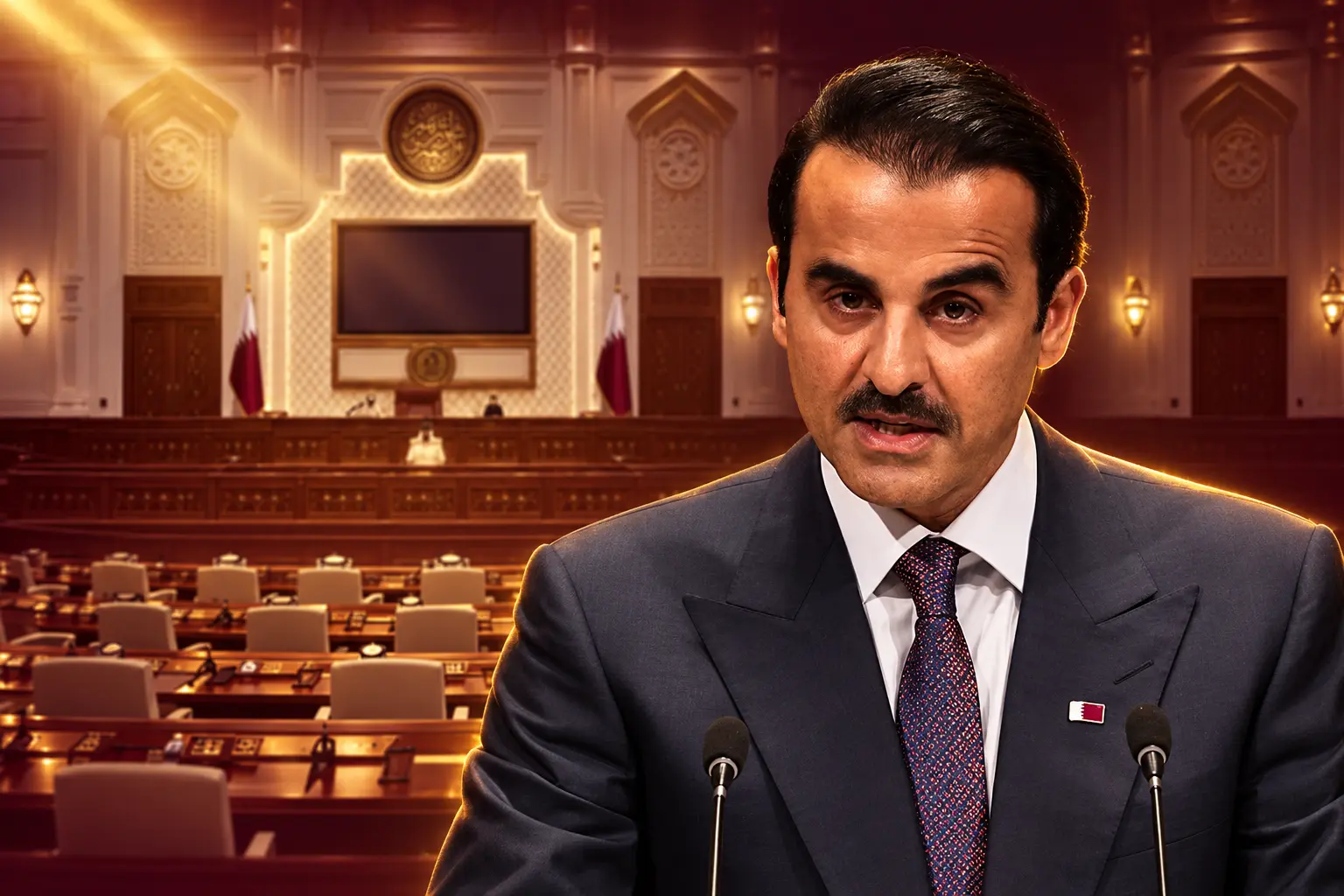
Qatar’s emir said state revenue fell 42 percent in the first half of 2026 after war closed the Strait of Hormuz and missiles hit Ras Laffan. Sheikh Tamim bin Hamad Al-Thani told the advisory Shura Council on Tuesday that public spending fell 14 percent in the same stretch, and that essential services were kept intact.
The same speech still treated liquefied natural gas as the way back. Qatar sells about one-fifth of the world’s LNG, and that concentration is what turned a war it did not join into a hole in the treasury.
The 42 Percent Hole in First-Half Revenue
On Tuesday in Doha, Tamim opened the 55th annual session of the Shura Council and put the fiscal cost in one line. “It is only natural that the crisis would have a negative impact on public finances, as the total revenues declined by 42% during the first half of the year, while public expenditure fell by 14%, without compromising essential services or development priorities,” he said.
He blamed two blows at once: the closure of the Strait of Hormuz, the only sea route for Qatari LNG, and “direct damage inflicted on some energy facilities in Ras Laffan Industrial City.” The International Monetary Fund’s October outlook now shows a 15.6 percent contraction this year, after a rebound of 18.8 percent in 2027, with 2026 output put at $203.04 billion. Kuwait, Iraq and Bahrain sit in the same double-digit group.
THE FIRST-HALF SHOCK
- State revenue: Down 42 percent in the first half of 2026, per the emir.
- Public spending: Down 14 percent, with salaries and core services protected.
- Hydrocarbon take: Down 56.1 percent, and near zero in the second quarter, per the World Bank.
- Cash gap: A net deficit of QR 31.5 billion, about 10 percent of GDP, against a near-balance in the first half of 2025.
That QR 31.5 billion first-half gap already overshoots the full-year deficit of QR 21.8 billion written into the 2026 budget. The state cut operational spending by as much as 30 percent and left wages and big capital items in place. Tamim said pre-crisis buffers, lower public debt, a cautious oil-price assumption and extra non-oil receipts “have enabled us to absorb the repercussions of this crisis thus far.”
Al-Kaabi Sets a Three-Year Repair Clock
The physical bill landed in March. Missile strikes on Ras Laffan on March 18 and 19, 2026, knocked out LNG Trains 4 and 6, a combined 12.8 million tons of annual output, about 17 percent of Qatar’s exports. Train 4 is held 66 percent by QatarEnergy and 34 percent by ExxonMobil; Train 6 is 70 percent QatarEnergy and 30 percent ExxonMobil. In March, Energy Minister Saad Sherida Al-Kaabi, who is also QatarEnergy’s president and chief executive, put lost sales at about $20 billion a year and said some long-term contracts would sit under force majeure for up to five years.
By September 21, speaking at the Qatar Economic Forum in New York, he tightened the clock. A damaged gas-to-liquids unit should be back in the first quarter of 2027. He said it would take three years for repairs on the two LNG trains. “Qatar is ready to resume normal operations within a few weeks of the reopening of the Strait of Hormuz,” he added. Even that restart would leave 17 percent of nameplate capacity missing.
THE CONTRACTS ON FORCE MAJEURE
- China: Long-term LNG volumes tied to the damaged trains.
- South Korea: The same force-majeure notice, for up to five years on some cargoes.
- Italy: European offtake sitting behind the Ras Laffan outage.
- Belgium: The fourth named buyer in Al-Kaabi’s March briefing.
The March slate went beyond methane. QatarEnergy also listed lost condensates of 18.6 million barrels, about 24 percent of those exports, plus LPG, naphtha and sulfur cuts. A separate blast and fire at the Barzan local gas plant on June 21, 2026, during a start-up, added another scar at the same industrial city. Al-Kaabi’s line on defaults was blunt: “Throughout our history, we have been a reliable producer and supplier with zero defaults on any shipment. But this is absolutely beyond our control.”
The problem is that LNG, our main export commodity, cannot be transported by pipelines. We will have to transport it by pipelines as gas and then liquify it at receiving terminals wherever that may be. This means we are building redundant facilities to the ones we are already building in Qatar as part of the North Field expansion project. This makes no economic sense.
Saad Sherida Al-Kaabi, Minister of State for Energy Affairs and QatarEnergy chief, Qatar Economic Forum, New York
Neighbors had offered land for a bypass line. He thanked them and still said no. The product that funds the state has to move as a cryogenic cargo through the same strait that has been fought over since late February.
Why Qatar Cannot Ship LNG Around Hormuz
Oil can reroute, sit in tanks, or move in a large global fleet. LNG cannot do those things cheaply. It needs cooled tanks, a smaller specialist fleet, and a loading chain that breaks if one piece is missing. Tamim said Qatar “supplies approximately one-fifth of the world’s liquefied natural gas trade, and any disruption affecting it is quickly reflected in markets and consumers everywhere.” That is a market fact and a fiscal trap at the same time.
Iran’s strikes and the Hormuz shutdown hit a producer that had just begun a huge capacity lift. The North Field East project was meant to take liquefaction from 77 million tons a year toward 110 million, in four trains of about 8 million tons each. Further phases were supposed to push later toward the top of the decade. Instead, undamaged kit sat behind a closed waterway, and the damaged trains sat behind a multi-year rebuild.
The World Bank’s October Qatar note records how fast the volume disappeared. Real GDP shrank 7.0 percent year on year in the first quarter, with hydrocarbon output down 25.8 percent as Ras Laffan was forced toward a halt. Non-oil GDP still rose 3.5 percent, led by construction up 6.2 percent and hotels and food service up 12.0 percent, while manufacturing fell 8.1 percent and transport and storage fell 13.8 percent. Goods exports dropped 29 percent in that quarter. From March through August, LNG exports fell by 96 percent. Crude oil, which is easier to store and to sail, had climbed back to about 70 percent of pre-war loadings by June.
Visitor arrivals were down 44.7 percent year on year in the second quarter, and hotel occupancy was down 26.4 percent. The non-oil private-sector purchasing managers’ index sank to 38.7 in March, then crawled to 47.6 in August, still in contraction. Consumer prices averaged 2.7 percent in the first half, but food rose 8.1 percent, a heavier load for lower-paid and migrant households. Tamim said 2025 had closed with 2.9 percent real growth and 0.5 percent inflation. The 2026 path is a different country.
Empty Tankers Off Ras Laffan
Ship-tracking firms have counted a dozen empty tankers owned or chartered by QatarEnergy waiting near the export terminals. Idle ships in ballast are a bet that the strait will be safe enough to load, not proof that it is. A handful of cargoes have already slipped out in early October, but Al-Kaabi has said the company is producing very little LNG until the waterway is open.
People familiar with QatarEnergy’s plans said the first North Field East train will be ready to start in November, with production in the first quarter of 2027. Al-Kaabi had already told the New York forum that first output should arrive in the first half of 2027, and that later trains still depend on equipment that has to come through Hormuz. A cold train on the beach does not fill a treasury if the cargo cannot sail.
THE WAR TIMELINE INSIDE QATAR’S GAS SYSTEM
- Late February 2026: The US-Israeli war with Iran begins, and shipping through Hormuz is squeezed.
- March 18-19, 2026: Missiles hit Ras Laffan, taking Trains 4 and 6 and a GTL unit offline.
- End of March 2026: LNG operations are largely halted and force majeure notices go out.
- June 21, 2026: An explosion and fire at Barzan during a start-up add a second incident at the same city.
- First half of 2026: State revenue falls 42 percent and hydrocarbon receipts collapse in the second quarter.
- September 21, 2026: Al-Kaabi sets a three-year repair clock and rejects a pipeline bypass.
- October 13, 2026: Tamim tells the Shura Council the fiscal cost and says North Field work is still on plan.
Lining up idle hulls is a wager on a passage Qatar does not control. The louder operational read is that Doha is trying to be ready for a reopening it cannot schedule, while 17 percent of the old plant will still be missing when that day comes.
The Treasury Still Runs on Gas
Tamim used diversification as the cushion. “The impact of these economic developments was primarily concentrated in the energy sector, while we ensured that the non-hydrocarbon sectors continued to grow, with their contribution reaching approximately 80% of real GDP,” he said. A shutdown of LNG mechanically lifts the non-oil share of a smaller pie. It does not replace the cash that used to arrive with each cargo.
Finance Minister Ali bin Ahmed Al Kuwari had already shown where the treasury sits. When the emir approved the 2026 budget in December 2025, planned revenue was QR 199 billion, including QR 155 billion from oil and gas and QR 44 billion from everything else, against spending of QR 220.8 billion. Oil was pencilled at $55 a barrel. That mix is 77.9 percent hydrocarbon cash. The World Bank, tracking the same structure, says successive development plans had already cut oil and gas to below 40 percent of GDP, while the budget and the export ledger stayed on methane.
GDP SHARE VERSUS STATE CASH
| Measure | Oil and gas | Everything else |
|---|---|---|
| 2026 budgeted revenue | QR 155 billion | QR 44 billion |
| First-half 2026 revenue change | Down 56.1 percent | Down 8.9 percent |
| Q1 2026 real output | Hydrocarbon GDP down 25.8 percent | Non-oil GDP up 3.5 percent |
Non-oil output did not collapse. It also did not pay the bills. Current-account surplus in the first quarter narrowed 38.4 percent to QR 19.9 billion, or 10.7 percent of GDP. The World Bank expects some offset from Golden Pass, the Texas joint venture of about 18 million tons a year that Tamim said has “made significant progress,” plus lower imports. That is a hedge in another country’s export plant, not a substitute for Ras Laffan in the Qatari budget.
A 221 Billion Riyal Bet After the Shock
Tamim refused to recast the investment list. “Our aim is not to return to the pre-crisis situation, but rather to use the recovery as a springboard to accelerate economic diversification and strengthen national capabilities,” he said. He put a portfolio of projects and investment chances at about QR 221 billion ($60.7 billion) over five years, spanning infrastructure, public-private partnerships, and private real estate and hotels. He asked the council for laws that give the private sector more room.
He also kept the gas build. “In the energy sector, work on the expansion of the North Field Gas project is progressing according to the set plans, with the aim of increasing the country’s LNG production capacity,” he said, alongside petrochemicals, solar plants and water security. The four jobs he listed for the crisis were to defend the country without being pulled into the war, keep services and supply chains up, push for a ceasefire and open waterways, and keep talks alive. “Qatar was attacked on its territory by Iran, in a blatant violation of its sovereignty,” he said, and still described diplomacy as the method.
That posture left the fiscal hit intact. The new train can be cold and ready in November. It still needs a strait that has not reopened, and two old trains that will not be back for three years. Until those two facts move, the state that sells a fifth of the world’s LNG is raising cash on a product it cannot load.

Ohtani Game 4 Logoman Card Sells for $3.24 Million

Cole Kmet’s Season Ends, and Chicago’s Tight End Plan Starts

NBA Seeks Soccer Money After EuroLeague Clubs Refused

Amazon’s First Bond Tests Leave the Broccoli Chair Empty

Tyrese Maxey Owns the Night Built for LeBron James

Warsh Rejects Rate Guidance and Still Moves Markets

Dana-Farber Exits an MGB Medicare Advantage Network Early

NASA Launches the Roman Space Telescope’s Cosmic Bet

OpenAI’s Cyber Letter Puts the Defense Bill on Governments

Russia Recycles Its Old Warning Over Storm Shadow Plants
-
 BUSINESS2 months ago
Warsh Rejects Rate Guidance and Still Moves Markets
-
 BUSINESS1 month ago
Dana-Farber Exits an MGB Medicare Advantage Network Early
-
 NEWS2 months ago
NASA Launches the Roman Space Telescope’s Cosmic Bet
-
 NEWS2 months ago
OpenAI’s Cyber Letter Puts the Defense Bill on Governments
-
 NEWS2 months ago
Russia Recycles Its Old Warning Over Storm Shadow Plants
-

 ENTERTAINMENT4 weeks ago
Primetime’s $2.7 Million Preview Tops Pitt’s Costlier Film
-

 BUSINESS2 months ago
Jet Drones Lock Down Kyiv and Strip Kherson of Heat
-
 ENTERTAINMENT2 months ago
Midnight Spider-Man Turns Peter Parker Into Oscorp’s Hybrid