
NEWS
Putin Calls Troop Talks a War as Drones Hit Ukraine
Putin told reporters in New Delhi that European troops in Ukraine would mean war, hours as Russian drones hit homes and a Moldova border post.

Russian President Vladimir Putin told reporters in New Delhi on Friday that sending European troops into Ukraine would mean war with Russia. He also said Moscow does not threaten European countries and never has.
Hours around those remarks, Russian drones and missiles killed three people in Zaporizhzhia and Kryvyi Rih and wounded 28 in the Odesa region, local officials said Saturday. The same week, Russian drones had already killed two people at a Ukraine-Moldova border post about 1 km from EU soil.
A House Came Down in Zaporizhzhia Overnight
Ivan Fedorov, co-chair of the Zaporizhzhia Oblast Defence Council, said a Russian drone hit a residential street in the city on the night of 11-12 September, set fires, and flattened one house. Rescuers pulled two people from the rubble. A 64-year-old woman and a 37-year-old man were dead. A 59-year-old woman was wounded.
In Kryvyi Rih, Oleksandr Vilkul, head of the city defence council, said ballistic missiles came in from several directions. Oleksandr Hanzha, head of the Dnipropetrovsk regional military administration, said the missiles struck an industrial site, killed one person, and wounded three. Vilkul said a 54-year-old man was in serious condition and another man was missing. Five apartment buildings, a primary health centre, and three schools were damaged, he said.
SATURDAY’S NAMED STRIKES
| Place | Weapon reported | Killed | Wounded |
|---|---|---|---|
| Zaporizhzhia | Drone on a house | 2 | 1 |
| Kryvyi Rih | Ballistic missiles on an industrial site | 1 | 3 |
| Odesa region | Combined missile and drone wave | 0 | 28 |
Oleh Kiper, head of the Odesa regional military administration, put the regional wounded total at 28, including a five-month-old baby and a 17-year-old. Fourteen people were taken to hospital, eight were treated at the scene, and six declined a bed after checks. He said one patient was in grave condition. The upper floors of a residential high-rise were destroyed, and a blast wave damaged nearby blocks and a low-pressure gas line.
Serhii Lysak, head of the Odesa city military administration, had earlier described a missile run on the city around 05:30 after Ukraine’s Air Force warned of cruise missiles coming off the Black Sea. Russia’s Defence Ministry, for its part, claimed hits on the Zaporizhstal steel plant, an Interpipe site in Dnipro, and iron-ore works in Kryvyi Rih.
Fedorov also counted 1,001 attacks on 45 settlements in Zaporizhzhia region over the previous 24 hours, a drumbeat of shelling that sat behind the single destroyed house in the regional capital.
WHAT UKRAINE’S AIR FORCE COUNTED
- Attack drones: 129 Shahed-type, S8000 Banderol, and decoy aircraft, about half of them jet-powered, from Kursk, Oryol, occupied Donetsk, and Hvardiiske in Crimea.
- Cruise missiles: 8 Kalibr missiles from the Black Sea and 6 Kh-59/69 missiles from airspace over the water.
- Ballistic missiles: Iskander-M/KN-23 launches from Voronezh, Rostov, and occupied Crimea, with no public count on the number fired.
- Intercepts by 08:30: 110 targets shot down or jammed, listed as 6 Kalibr missiles, 2 Kh-59/69 missiles, 1 S8000 Banderol, and 101 drones.
Hits were recorded at 20 locations, and wreckage from intercepted aircraft fell at four more, the Air Force said. Odesa region was the main aim of the wave, which began at 18:00 on 11 September and was still running when that tally was issued.
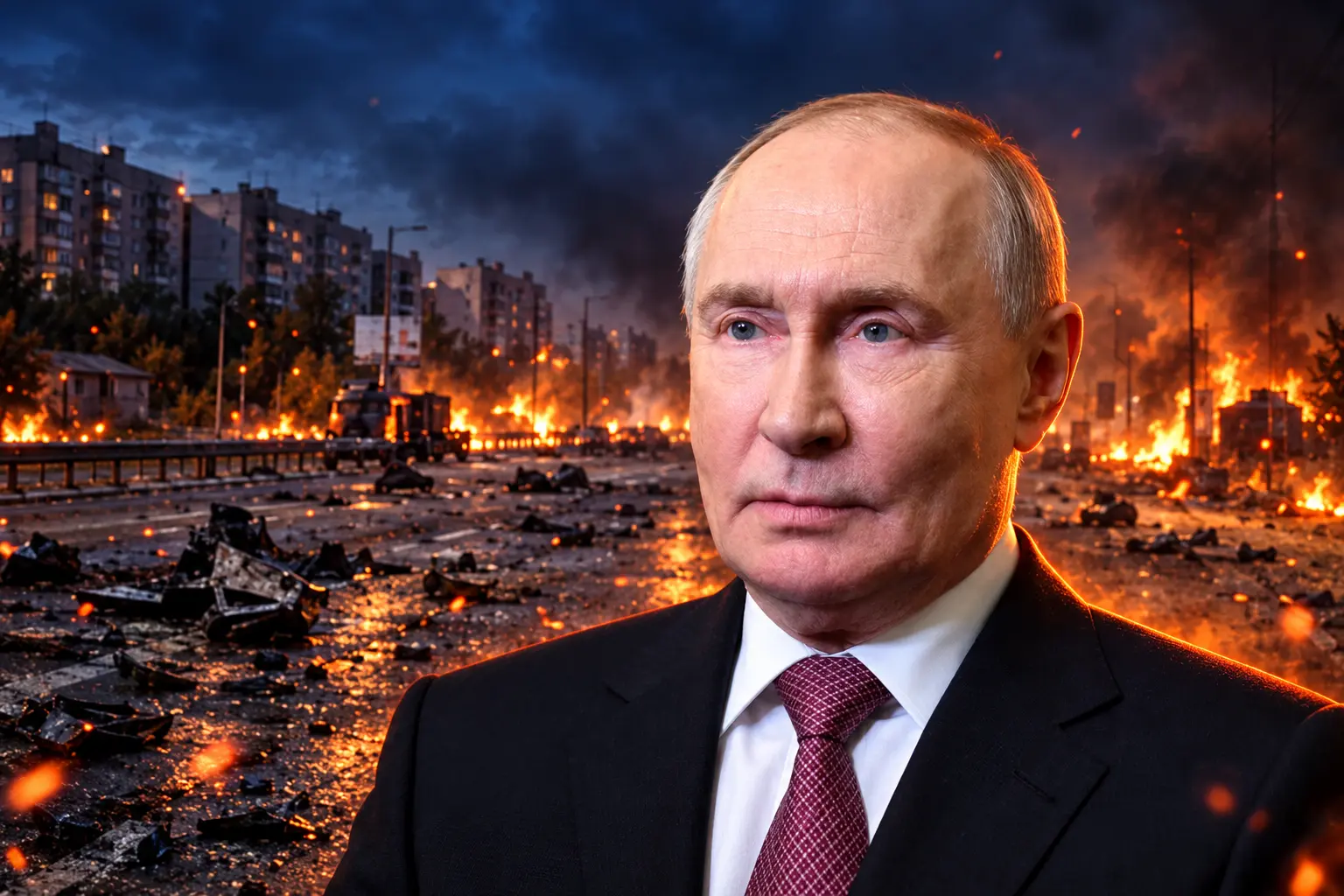
What Putin Said a European Force Would Mean
Putin was in New Delhi for the 18th BRICS Summit, which India is chairing, and had already met Prime Minister Narendra Modi. Speaking to reporters on the sidelines on 11 September, he folded a European debate about a future force in Ukraine into a single sentence.
Now, they say they are thinking of how to deploy troops to Ukraine. This would mean a war with Russia.
Vladimir Putin, President of Russia, to reporters in New Delhi
In the same exchange he said there was no threat to European countries, and never had been. “We are not threatening European countries, nor are we going to threaten them,” he said. He argued that Europe had no grounds for a conflict with Russia, that the settlement after the Second World War still bound the parties, and that later arrangements after the Soviet collapse had been made with Moscow’s consent.
The Kremlin has used that pairing before: a war warning aimed at any Western troops on Ukrainian soil, laid next to a claim that Russia is not threatening Europe. Moscow has already called European peacekeepers demonstrably unviable. Russian officials have also said personnel sent in that role would be treated as combat targets.
The move on Friday was to drop the ceasefire condition that European governments wrote into their own plan. He spoke of troops “on the territory of Ukraine” as if the live debate were an entry into the current war, not a force designed to arrive after fighting stops.
The Force on Paper Waits for a Ceasefire
The project Putin was answering is the Coalition of the Willing, led by Britain and France, and the Multinational Force for Ukraine that sits inside it. On 6 January 2026, Volodymyr Zelenskyy, Emmanuel Macron, and Keir Starmer signed a letter of intent on a post-war deployment. The Paris text that day said politically and legally binding security guarantees would switch on once a ceasefire entered into force, and that those guarantees would be defensive.
A later co-chairs’ statement from Paris, dated 13 July 2026, said the force is ready after a ceasefire to regenerate Ukrainian units and to offer reassurance on the ground, in the air, and at sea, at Ukraine’s request, “once a credible cessation of hostilities is in place.” Exercises, the statement said, would follow in the coming months to show that the force can act after the shooting stops.
That is a different object from a combat brigade marching into an active front. The July text also called for an immediate and complete ceasefire, for talks with Ukraine in the room, and for no deal on European security without Europeans. It is that paper force, not an invasion of Russia, that Putin priced as war.
Five Border Crossings and a Polish Near Miss
The week around the New Delhi remarks already had Russian drones on Ukraine’s western edge, far from the eastern front, on roads that feed trade into the European Union and Moldova.
Ukrainian border guards said Russia had struck five western crossings in recent weeks, four on the Moldova line and one on the Romanian line. Andriy Demchenko, a spokesperson for the State Border Guard Service, said the likely aim was to break logistics routes. As Black Sea ports have come under fire, land gates have carried more of Ukraine’s civilian traffic and exports.
THE WEEK AT THE BORDER
- 8-9 September: Russian drones hit the Starokozache international vehicle checkpoint on the Ukraine-Moldova line. Kiper said two civilians were killed and three were wounded. The post sits about 1 km from Moldovan territory. Traffic was halted. Ukraine’s State Emergency Service said a passenger bus and other vehicles burned. Russia’s Defence Ministry confirmed the strike and said the crossing had been used to move military cargo.
- 9-10 September: Polish Prime Minister Donald Tusk said a direct threat to a Polish-Ukrainian crossing was averted overnight through joint work by Polish and Ukrainian services.
- 10 September: Tusk, speaking in Bratislava after a meeting of central European leaders, said Russia had already chosen provocative attacks on border posts, “for example in Moldova,” and that Warsaw expected similar action against crossings with Ukraine, including in Poland.
- 11 September: Putin, in New Delhi, said European troops in Ukraine would mean war with Russia and that Moscow does not threaten Europe.
Moldova’s President Maia Sandu said the war was reaching her country’s border. Chisinau condemned the Starokozache attack and noted debris from a drone with Geran characteristics found on Moldovan ground the day before. A drone that crossed from Ukraine had earlier pushed Romanian authorities to scramble fighter jets on NATO air-policing duty before the aircraft came down in Moldova, with no casualties reported there.
On 20 August an explosion in a parking lot on the Ukrainian side, about 150 meters from Moldova’s Giurgiulesti crossing, started a fire that crossed onto Moldovan land. On 25 August Moldova suspended work at Vulcanesti after a Shahed struck the Ukrainian side. The Orlivka ferry on the Romanian border took hits in early September. Those sites handle cars, trade, and people, not trench lines.
Size and Fire Rules Are Still Blank in London
Even on Europe’s own terms, the force Putin described as a war trigger is still a sketch. A House of Commons Library briefing notes that size, duration and rules still unset include how many troops would go, what they would bring, how long they would stay, and whether they could answer a broken ceasefire or a Russian attack on themselves.
The UK government has said it wants discretion on those details until ceasefire terms are clear. Ukraine has said it is ready to issue an invitation and to sign status agreements when needed, modelled on the 1951 NATO Status of Forces Agreement that covers allied deployments. US backing, in the form discussed after August 2025, has been described as support without American boots on the ground.
Those blanks matter because Putin’s sentence does not wait for them. A force that exists as a letter of intent, a July statement, and a planned exercise calendar is already, in his telling, a war with Russia if it ever steps onto Ukrainian territory.
Patriots, Grain and the Winter Zelenskyy Described
Zelenskyy, interviewed on 11 September at Canadian Forces Base North Bay, spent less time on troop slogans and more on the missiles already in the air. He said Russia now produces 140 ballistic missiles a month. Under a NATO 1-to-2 intercept rule he cited, that would imply 280 interceptors a month to match them. “You will never have 280 missiles per month,” he said, “and between us, it’s a huge challenge to have even 100 missiles per month.”
THE WINTER MATH ZELENSKYY LAID OUT
- Russian output: 140 ballistic missiles produced a month, by Zelenskyy’s count.
- The ratio he cited: 280 interceptors a month if a 1-to-2 NATO rule is applied.
- What he asked for: 100 to 120 interceptors a month for the cold stretch.
- Grain: Ukraine’s grain exports down 76% year on year in August, under pressure on Black Sea shipping.
He said the United States had the political will to sell and to help, but that production was tight, so stocks were the live option. Germany had said it would send Patriots from national stocks without giving a number. Zelenskyy also said several European firms had agreed to work on a Ukrainian-led anti-missile system called Freya, with a first test phase hoped for by the end of December.
On talks, he told the same interview that energy and grain were “step number one,” a possible pause on strikes against power plants and on the shipping war that has throttled exports. He called visits to Kyiv by US envoys Steve Witkoff and Jared Kushner, after they had been to Moscow, a “good signal” and “respect to our people,” and said Ukraine was in a “good position for negotiations” because, in his telling, Russia was paying a high price for small gains at the front.
No Kremlin Answer on a Miami Meeting
Asked whether he would meet Putin at the Group of 20 leaders’ summit in Miami if both were invited, Zelenskyy did not hedge.
Yes, of course. We have to come. We have to meet, to speak and make decisions.
Volodymyr Zelenskyy, President of Ukraine, to Deutsche Welle
He added that the words in the room would matter less than what came out of it. “It’s not about words. What I will tell him or what he wants to tell me, it doesn’t matter. It doesn’t matter. Results matter. That’s it.” The two men have not met in person since Russia’s full-scale invasion in February 2022. Putin has not attended a G20 summit since 2019. The Miami meeting is set for 14-15 December.
Yuri Ushakov, Putin’s foreign policy adviser, said Saturday that expert-level work on summit papers was going ahead as usual, and that “the possibility of Putin travelling there, this issue has not even been discussed yet.” He said contacts with US officials continued in a “friendly and constructive” tone. Russia’s finance minister has already sat in a G20 session this year, and a Russian diplomat said Moscow would send officials to a G20 energy meeting in Houston.
A Miami handshake, if it happens, would sit on top of a force that exists on paper until a ceasefire, a war warning that treats that paper as a casus belli, and a drone campaign that is already chewing at apartment blocks and at the gates toward Poland and Moldova. By Saturday morning, rescuers in Zaporizhzhia had pulled a 64-year-old woman and a 37-year-old man from a house that was no longer standing.

Pixel Buds Firmware 6.144 Ties New Features to Pixel Gear

Eve Markoski-Wood Backs Her Mum as Wood Fights Bail

Trump Rejects an Iran Deal as Diesel Holds Near Records

Amazon Cuts the S26 Ultra to $979 After Samsung’s Hike

Ice Caves Land in Minecraft 26.4 Snapshot 3

Warsh Rejects Rate Guidance and Still Moves Markets

Dana-Farber Exits an MGB Medicare Advantage Network Early

NASA Launches the Roman Space Telescope’s Cosmic Bet

Russia Recycles Its Old Warning Over Storm Shadow Plants

Primetime’s $2.7 Million Preview Tops Pitt’s Costlier Film
-
 BUSINESS2 months ago
Warsh Rejects Rate Guidance and Still Moves Markets
-
 BUSINESS1 month ago
Dana-Farber Exits an MGB Medicare Advantage Network Early
-
 NEWS2 months ago
NASA Launches the Roman Space Telescope’s Cosmic Bet
-
 NEWS2 months ago
Russia Recycles Its Old Warning Over Storm Shadow Plants
-
 ENTERTAINMENT4 weeks ago
Primetime’s $2.7 Million Preview Tops Pitt’s Costlier Film
-
 BUSINESS2 months ago
Jet Drones Lock Down Kyiv and Strip Kherson of Heat
-

 NEWS2 months ago
OpenAI’s Cyber Letter Puts the Defense Bill on Governments
-
 NEWS2 months ago
Congo Starts Ervebo Vaccinations for a Different Ebola Virus