
BUSINESS
Modi Meets Pezeshkian at SCO to Keep Hormuz Open
Modi’s first meeting with Iran’s president since the February war, a Putin hug, and an SCO text on Iran strikes all point toward BRICS in New Delhi.

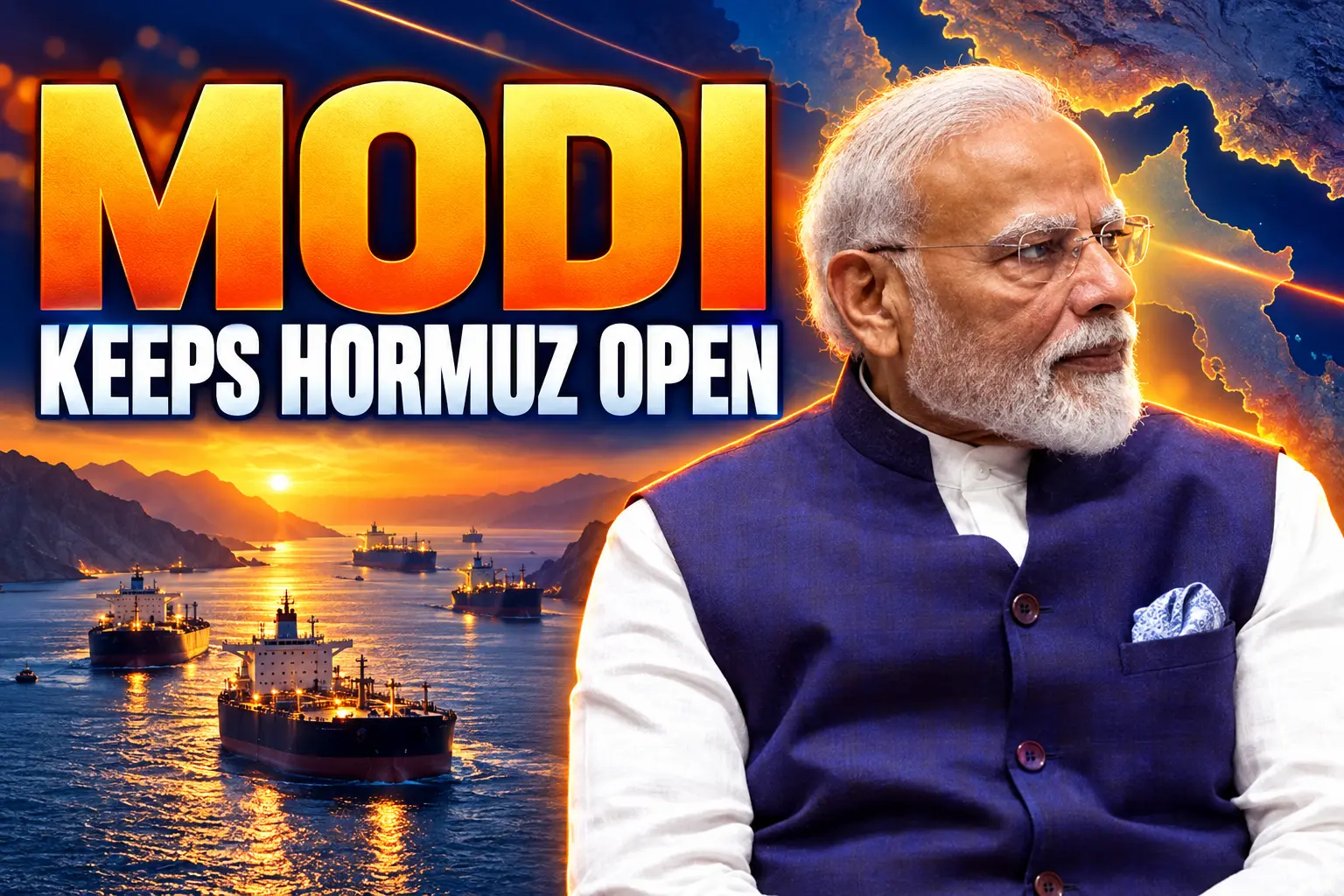
Prime Minister Narendra Modi sat with Iranian President Masoud Pezeshkian in Bishkek on August 31, 2026, their first meeting since the war on Iran began in February. He asked for peace in West Asia and for ships to pass the Strait of Hormuz. The United States had struck Iranian launchers the day before.
By September 1 he had also met Vladimir Putin, shaken hands with Xi Jinping, and signed the Bishkek Declaration of the 26th SCO Summit. The grouping marked 25 years. The useful product for New Delhi sits in those rooms, not in the anniversary speeches.
The First Face-to-Face Since the February War
Modi wrote after the Iran meeting that India wanted to expand and diversify its trade basket and would back efforts at lasting peace. The Ministry of External Affairs said he called for freedom of navigation and commerce, and that civilians, commercial shipping and seafarers must not be harmed under any circumstances.
The government has told Parliament that at least 16 Indian nationals, including 10 seafarers, have been killed in the conflict this year, with 75 others injured. That is the human file India carried into the room. Pezeshkian came with a different ask. He blamed Israel and the United States, and he requested that Modi use India’s extensive contacts with various parties to help a dialogue.
Despite the pressures and restrictions being imposed in an attempt to obstruct Iran’s relations with other countries, Tehran is ready to expand its cooperation with India across various fields.
Masoud Pezeshkian, President of Iran, Bishkek meeting with Narendra Modi
He also said Iran had kept its side of ceasefire understandings and that the American side had not, while adding that a longer war served neither country. The two men had already spoken by telephone at least twice since the fighting began. In June, Pezeshkian invited Modi to the funeral of Supreme Leader Ali Khamenei, who was killed in the February opening strikes; India sent Bihar Governor Lt. Gen. Syed Ata Hasnain (retd.) and Minister of State Pabitra Margherita.
Modi’s own post, in English and Persian, is the Indian public record of the hour.
Met President Masoud Pezeshkian in Bishkek. Reiterated our commitment to strengthening India’s long standing friendship with Iran across diverse sectors. We want to expand and diversify our trade basket in the times to come.
We had a discussion on the prevailing situation in… pic.twitter.com/qagQy5o108
— Narendra Modi (@narendramodi) August 31, 2026
He invited Pezeshkian to the BRICS summit in India. He did not name the United States, Israel, sanctions or Chabahar in that post. The Iranian readout did.
Chabahar Lives in Tehran’s Minutes
Iran recorded talks on transport and maritime affairs, the Strait of Hormuz, and the progress of cooperation at Chabahar Port. India’s detailed readout, issued by spokesperson Randhir Jaiswal, stayed on bilateral ties, West Asia, dialogue and the safety of shipping. The split is the policy.
WHAT EACH SIDE PUT ON PAPER
| File | India’s public line | Iran’s readout |
|---|---|---|
| Chabahar | Not named in Modi’s post or the Indian readout | Progress of cooperation at Chabahar Port |
| Hormuz and crews | Freedom of navigation; seafarers must not be harmed | Transportation, maritime affairs, the Strait of Hormuz |
| The war | Dialogue, diplomacy, lasting peace | Use India’s contacts; blame on the US and Israel |
| Trade | Expand and diversify the trade basket | Ready to expand cooperation across fields |
Chabahar is India’s sea door toward Afghanistan and Central Asia when Pakistan refuses overland transit. It is also a US sanctions object. India Ports Global Limited signed a ten-year contract on May 13, 2024 with Iran’s Ports and Maritime Organisation to equip and run the Shahid Beheshti Terminal. Minister of State Kirti Vardhan Singh told the Rajya Sabha that India has met its equipment pledge and has no further financial commitment on the port.
THE CHABAHAR SANCTIONS CLOCK
- May 13, 2024: India Ports Global Limited signs the ten-year Shahid Beheshti contract; India later says it has paid $120 million for equipment.
- September 16, 2025: The US State Department revokes the 2018 sanctions exception, effective September 29, 2025.
- October 28, 2025: After Indian talks, Washington issues a conditional waiver through April 26, 2026, described as time to wind the project down.
- April 26, 2026: The waiver expires. Officials had discussed parking the Indian subsidiary’s stake with a local Iranian company.
- April 27, 2026: Jaiswal says the file is under discussion with both Iran and the United States, and that the war is a complicating factor.
So the Bishkek hour let Tehran put the port back on a leaders’ page while New Delhi kept it off its own. Trade diversification is easier to print. A live terminal under US secondary-sanctions risk is not.
A Hug, Then an Invite to New Delhi
The Putin meeting, their first of 2026, was held in the Aksakal Meeting Room at the Ala Archa State Residence. They had last sat together at the 23rd Annual Summit in Delhi on December 4 and 5, 2025. The 27th Inter-Governmental Commission had just met in Moscow on August 24. S. Jaishankar had carried Modi’s message to the Kremlin days earlier.
Putin brought Foreign Minister Sergei Lavrov, the energy minister, the Rosatom chief, the military-technical cooperation director and the head of the Russian Direct Investment Fund. That is an energy, nuclear and arms room, not a protocol call. Modi told him India still backs peace efforts on Ukraine, then used the line that traveled farthest from Bishkek.
Every day that the war continues, humanity takes a step backwards; yet every step towards peace gives humanity real hope. We must move from endless war to the end of war, to the cessation of hostilities.
Narendra Modi, Prime Minister of India, meeting with Vladimir Putin, Bishkek
The peace formula is now a set piece in this pairing. It does not rewrite the rest of the ledger. The Prime Minister’s Office said the two men reviewed defence, energy, space and mobility, and that they also discussed the wars in West Asia and the Black Sea region because those fights have hit maritime trade and Indian crews. Putin, on the Kremlin transcript, said Russian-Indian trade had grown by 2.6 percent this year in the first six months after a slight decline last year.
RUSSIA NUMBERS PUTIN PUT ON THE TABLE
- Trade pulse: A slight fall last year, then 2.6 percent growth in the first half of 2026.
- Students: Almost 40,000 Indians in Russian universities, a sevenfold rise over ten years.
- Tourism: Travel between the two countries up 16 percent in 2025.
- Next date: The 80th year of diplomatic ties falls in 2027, with a cultural festival planned in India.
Modi told Putin that Indians are waiting for him. The PMO said the prime minister looks forward to welcoming him for the 18th BRICS Summit on 12-13 September 2026. They then went on to the opening of the 6th World Nomad Games. The hug was the picture. The September diary entry is the business.
What the Bishkek Declaration Says on Iran
On September 1, at the Yrys Ordo Congress Hall, the ten leaders adopted the Bishkek Declaration on the grouping’s 25th year. The text, carried as a Kremlin supplement, has member states reiterating the SCO’s position condemning military strikes on Iranian territory, which it says caused civilian deaths and heavy economic damage. It calls those actions a violation of international law and the UN Charter and a serious risk to peace.
It does not name the United States or Israel. Last year’s Tianjin Declaration did. The new text offers condolences for Khamenei, backs Iran’s sovereignty and territorial integrity, and says the conflict should be settled solely by political and diplomatic means. It also opposes unilateral coercive measures that run against the UN Charter, other international law and WTO rules and that harm the global economy.
WHAT THE SIGNED TEXT LOCKED IN
- Iran war: Condemns military strikes on Iranian territory; no perpetrator is named.
- Sanctions language: Opposes unilateral coercive measures contrary to the UN Charter and WTO rules.
- Palestine line: A comprehensive and just settlement of the Palestinian question, with far less Gaza detail than at Tianjin.
- Terrorism: Double standards are unacceptable; no named attack, unlike last year’s Pahalgam reference.
India signed it. So did China, Russia, Iran, Pakistan and the rest of the table. The day before, Modi’s public Iran message had been trade, navigation and peace, not an indictment. The declaration is the indictment, written in collective voice, which is how New Delhi often handles a line it will not speak alone into a microphone.
Chinese President Xi Jinping’s foreign ministry said leaders approved 28 outcome documents covering security, the economy, people-to-people work and the organisation itself. Pakistan takes the rotating chair for 2026-2027 and will host the next heads-of-state meeting. A proposed SCO Development Bank stayed among “interested” members and was not launched.
No Formal Bilateral Was Set With Xi
A separate Modi-Xi meeting was never put on the Bishkek grid. The two men still had to share a hall, a family photograph and a handshake. Xi arrived at Yrys Ordo with Putin. He put his hand out to Modi first. Modi took it and, in the same motion, took Putin’s other hand, so the three were briefly linked before they broke for the official picture.
That clip is what moved. It is a rerun, in a quieter register, of their huddle at Tianjin in 2025. It tells you the three still need to be seen in one frame. It does not tell you they closed a border, a visa, or a trade complaint. India again stayed out of the paragraph in which Belarus, Iran, Kazakhstan, Kyrgyzstan, Pakistan, Russia, Tajikistan and Uzbekistan reaffirmed support for China’s Belt and Road Initiative.
In the hall, Modi said connectivity that bypasses sovereignty loses both trust and meaning. That is the old Indian objection to the China-Pakistan corridor through territory New Delhi claims. Xi, on a separate track in Bishkek, signed a comprehensive strategic partnership and a friendship treaty with Kyrgyz President Sadyr Japarov and put the China-Kyrgyzstan-Uzbekistan railway at the centre of that economic talk. Central Asia is where China’s money is densest. India’s offer in the same city was language: security, connectivity, opportunity.
Modi Presses the Hall on Terror and Roads
Addressing the Council of Heads of State on September 1, with Pakistan Prime Minister Shehbaz Sharif in the room, Modi said a fight in one region no longer stays there. The West Asia war, he said, hits global energy security, maritime trade and supply chains, and the Global South takes the blow. Resolution, he said, is possible only through dialogue and diplomacy, not on the battlefield.
On terrorism he went further than the declaration’s unnamed prose. He said the SCO cannot live on an action-reaction cycle, and that the grouping should dismantle financing, recruitment, radicalisation and safe havens. He said there is no place for double standards, and that countries which use terrorism as an instrument of policy should hear that it is never a strategic asset.
Shehbaz, without matching that unnamed address, called terrorism one of the gravest regional threats and tied it to Afghanistan, saying terrorists still use Afghan soil against Pakistan. He said Pakistan had lost more than 90,000 lives and more than $150 billion. The declaration’s Afghanistan paragraph is short: an independent, neutral, peaceful state free of terrorism, war and drugs, and an inclusive government of all ethno-political groups.
The Ministry of External Affairs later listed 13 outcomes it wants remembered, including regulations for a Universal Centre for Countering Challenges and Threats to the Security of SCO Member States and for the executive committee of an SCO Anti-Narcotics Centre. India will host an SCO Civilisation Dialogue Forum later this year. English was written into the charter as an official and working language, beside Russian and Chinese.
The BRICS Summit Opens in New Delhi on 12 September
The two-day Kyrgyz stop also included a meeting with Japarov, talks with Armenian Prime Minister Nikol Pashinyan, a wreath at the Mahatma Gandhi statue Modi unveiled in 2015, and a round of Indian and Kyrgyz cultural groups. Those were the wrapping. The load-bearing sequence is narrower: Hormuz and seafarers with Pezeshkian, energy and Ukraine with Putin, a collective Iran paragraph the next morning, and a handshake with Xi that substitutes for a bilateral.
Putin and Pezeshkian now have diary dates in India. Xi is expected for the same BRICS meeting. Eleven days after the Bishkek plenary, the same arguments about oil, sanctions, shipping and who may be named in a joint sentence will sit in New Delhi rather than in a Kyrgyz hall. The SCO did not settle them. It moved them.
Frequently Asked Questions
Which countries are members of the SCO?
The Shanghai Cooperation Organisation has 10 members: Belarus, China, India, Iran, Kazakhstan, Kyrgyzstan, Pakistan, Russia, Tajikistan and Uzbekistan. It was founded in 2001 by China, Russia, Kazakhstan, Kyrgyzstan, Tajikistan and Uzbekistan as a security forum, and it also works with a wider set of dialogue partners who do not have a full vote in the heads-of-state council.
What changed in the SCO’s official languages at Bishkek?
Leaders approved a protocol amending the SCO Charter so that English is now an official and working language of the grouping. Until this summit the two official languages were Russian and Chinese, a long-running Indian complaint because it left Indian diplomats working through those two tongues in a club New Delhi joined as a full member.
Did India accept SCO language on Iran before Bishkek?
Yes, with a twist. India dissociated itself from an SCO statement during the 12-day Iran war in 2025 that condemned Israeli strikes on Iranian territory. About ten weeks later Modi signed the Tianjin Declaration, which named Israel and the United States and called their June 2025 strikes a gross violation of international law and an infringement on Iran’s sovereignty. Bishkek repeats the condemnation and drops those names.
What is India’s ten-year contract at Chabahar Port?
On May 13, 2024, India Ports Global Limited signed a ten-year deal with Iran’s Ports and Maritime Organisation to equip and operate the Shahid Beheshti Terminal, building on a relationship that dates to a 2003 port agreement. India says it has completed a $120 million equipment commitment and has no further financial obligation, even as US sanctions pressure has pushed New Delhi to discuss parking its local stake with an Iranian company.

Pixel Buds Firmware 6.144 Ties New Features to Pixel Gear

Eve Markoski-Wood Backs Her Mum as Wood Fights Bail

Trump Rejects an Iran Deal as Diesel Holds Near Records

Amazon Cuts the S26 Ultra to $979 After Samsung’s Hike

Ice Caves Land in Minecraft 26.4 Snapshot 3

Warsh Rejects Rate Guidance and Still Moves Markets

Dana-Farber Exits an MGB Medicare Advantage Network Early

NASA Launches the Roman Space Telescope’s Cosmic Bet

Russia Recycles Its Old Warning Over Storm Shadow Plants

Primetime’s $2.7 Million Preview Tops Pitt’s Costlier Film
-
 BUSINESS2 months ago
Warsh Rejects Rate Guidance and Still Moves Markets
-
 BUSINESS1 month ago
Dana-Farber Exits an MGB Medicare Advantage Network Early
-
 NEWS2 months ago
NASA Launches the Roman Space Telescope’s Cosmic Bet
-
 NEWS2 months ago
Russia Recycles Its Old Warning Over Storm Shadow Plants
-
 ENTERTAINMENT3 weeks ago
Primetime’s $2.7 Million Preview Tops Pitt’s Costlier Film
-
 BUSINESS2 months ago
Jet Drones Lock Down Kyiv and Strip Kherson of Heat
-

 NEWS2 months ago
Congo Starts Ervebo Vaccinations for a Different Ebola Virus
-
 ENTERTAINMENT2 months ago
Midnight Spider-Man Turns Peter Parker Into Oscorp’s Hybrid