
BUSINESS
Maple Leaf Foods Winds Down Two Plant Protein Factories
Maple Leaf Foods will shut Seattle and Turners Falls and run Lightlife, Field Roast and Yves from Indianapolis, writing down a factory bet the boom never filled.

Maple Leaf Foods will shut its Seattle and Turners Falls plant-protein factories and run the rest from Indianapolis. The Mississauga company said on September 22, 2026, that falling volumes had left three U.S. plants too empty to keep. Lightlife, Field Roast and the revived Yves Veggie Cuisine brand will all be made at one Indiana site by the fourth quarter of 2027.
President and CEO Curtis Frank put the move under the company’s Fuel for Growth plan. He said the category had changed, the network was underused, and three plants at those rates created costs the business could not carry for long.
Two U.S. Plants Will Wind Down by Late 2027
Maple Leaf will wind down production at two U.S. plants in Seattle, Washington, and Turners Falls, Massachusetts. Work moves to what the company calls a Plant Protein Centre of Excellence in Indianapolis. The shift is set to run in phases over about 12 to 18 months, with a target of the fourth quarter of 2027. Lines in Seattle and Turners Falls keep running until that handoff is done, so retailers are not left short.
Over the past several years, we have taken significant action to improve the performance of our Plant Protein business, and we have made meaningful progress. But the category has changed significantly, and declining volumes have left our manufacturing network substantially underutilized. Maintaining three facilities at these utilization levels creates structural costs that are not sustainable over the long term.
Curtis Frank, President and Chief Executive Officer, Maple Leaf Foods, September 22, 2026 statement
Frank said Indianapolis would improve the economics of the network and help build a plant-protein business that can make money. The company folded the expected benefits, costs and capital into its already published 2030 outlook and did not break out a job count, a savings figure or an Indianapolis cheque. It said it would invest in that site and add people as the extra work arrives, and that it would look at openings at other Maple Leaf plants for staff who lose their current roles.
WHAT WE KNOW
- The sites: Seattle and Turners Falls wind down; Indianapolis becomes the only U.S. plant-protein factory.
- The clock: Phased transfer over about 12 to 18 months, aimed at the fourth quarter of 2027.
- The brands: Lightlife, Field Roast and Yves Veggie Cuisine stay; only the factories change.
WHAT IS UNCONFIRMED
- Headcount: Maple Leaf has not said how many jobs go in Seattle or Turners Falls, or how many Indianapolis will add.
- The bill: Closure costs, capex and savings sit inside the 2030 outlook and have not been published on their own.
Frank told the two coastal crews the decision was not a verdict on their work. “Our colleagues in Seattle and Turners Falls have made important contributions to our business and have consistently demonstrated tremendous commitment to our customers, consumers and brands,” he said. “This decision is not a reflection of their performance or the quality of their work.”
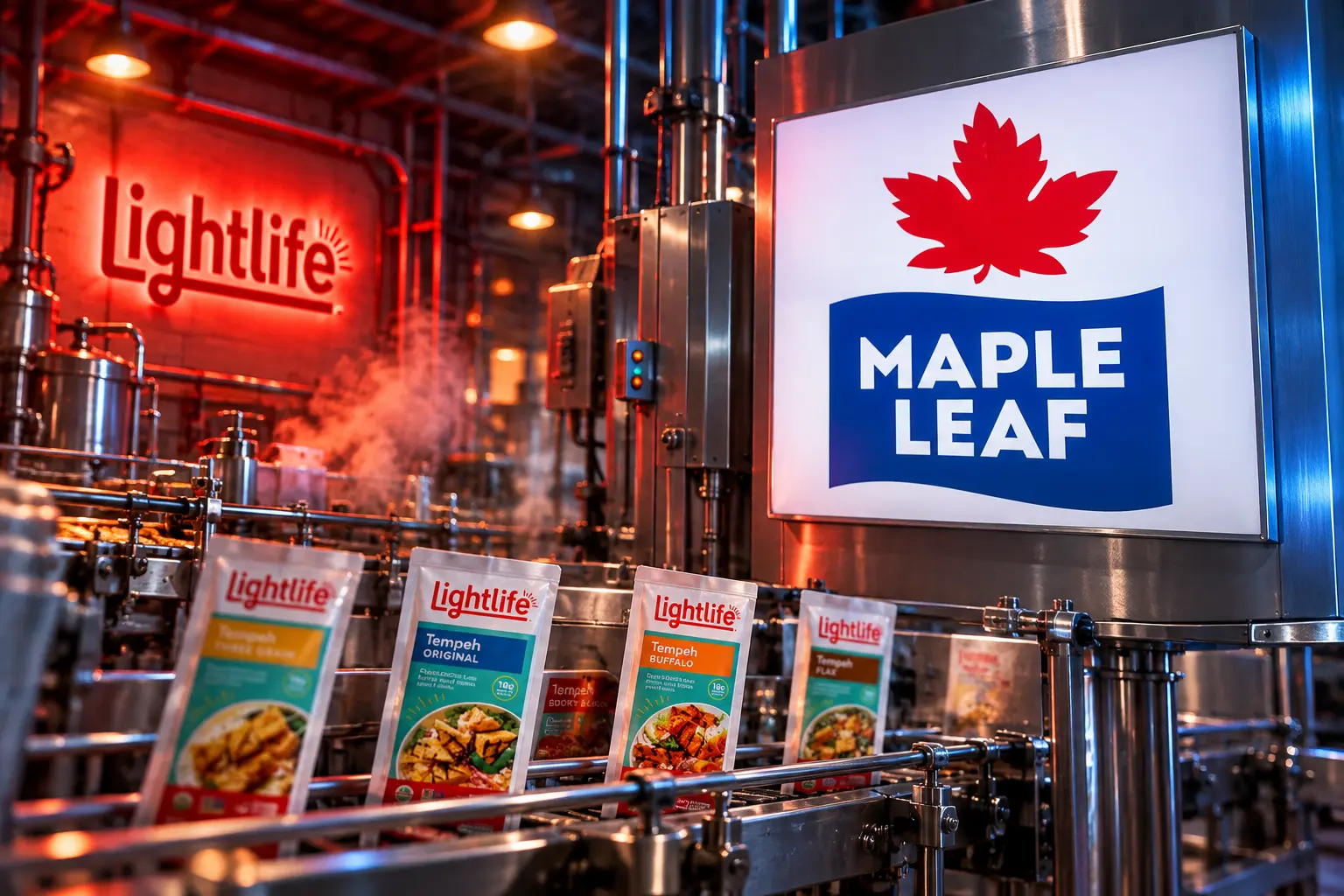
Why Maple Leaf Foods Is Shutting Seattle and Turners Falls
The company is not exiting plant protein. It is admitting that a three-plant map built for a bigger market is now a cost. Frank had told analysts in March 2025 that he still saw a pathway to profitable growth in the category and called it an upside opportunity. The September 22 notice is what that pathway looks like in steel and payroll: fewer roofs, more volume under one of them.
Every Maple Leaf plant-protein line already sits in the United States. Canadian grocery Lightlife, Field Roast and Yves come from those U.S. rooms and cross the border. Closing Seattle and Turners Falls does not move the work to Canada. It packs three U.S. sites into one. Analog meat factories have been shrinking while other plant-based aisles, dairy substitutes among them, still attract new lines. The consumer complaint under that split is blunt: people who wanted a burger still bought meat.
Prepared foods, the bucket that holds plant protein, is not the engine. Poultry is. That mix is why Maple Leaf can shut two protein plants and still repeat full-year guidance.
A $360 Million Bet on Three Factories
Maple Leaf spent about US$360 million getting into this network: US$140 million for Lightlife, USD$120 million for Field Roast, and about US$100 million to buy and fit the Indianapolis tempeh plant. A larger Shelbyville, Indiana, factory announced in 2019, later put at about US$310 million, was delayed during the pandemic and never became the main plant.
HOW THE PLANT PROTEIN NETWORK WAS BUILT
- March 10, 2017: Closes the Lightlife Foods deal for US$140 million, taking a Turners Falls, Massachusetts, plant and a brand that then held about 38% of U.S. refrigerated plant protein, with 2016 sales of about US$40 million and about 100 staff.
- November 30, 2017: Agrees to buy Field Roast Grain Meat Co. for USD$120 million. The Seattle company, founded in 1997, had sales of about USD$38 million and about 200 people in 75,000 sq ft of leased space.
- 2019: Announces a new plant-protein factory in Shelbyville, Indiana, later described as a roughly US$310 million project, then delays it as Covid-19 and higher build costs pile up.
- January 11, 2021: Greenleaf Foods, the Maple Leaf unit then holding Lightlife and Field Roast, says it will buy and convert a 118,000 sq ft Indianapolis plant for about US$100 million to add tempeh capacity of about 4.5 million kilograms and about 115 jobs, with production aimed at the first half of 2022.
- December 19, 2025: Yves Veggie Cuisine trademarks move from Hain Celestial to Maple Leaf, with the change registered the next month.
- September 14, 2026: Six Yves products begin reaching Canadian stores.
- September 22, 2026: Maple Leaf says Seattle and Turners Falls will wind down and Indianapolis will take the whole load.
The surviving factory is the one Maple Leaf bought as a stopgap. In 2021 it needed tempeh in a hurry because Lightlife demand was still rising and Shelbyville was stuck. Five years later that stopgap is the network.
Seattle and Turners Falls Still Run Until the Transfer Ends
The two plants being closed are the ones Maple Leaf actually bought with the brands. Seattle is the Field Roast house: grain-based sausages, deli slices, burgers and roasts, with some Lightlife work mixed in. Turners Falls is the Lightlife house, in place since 1998 for a brand founded in 1979, making tempeh, Smart Bacon, Smart Dogs and other refrigerated substitutes. Indianapolis, the newest of the three, was bought in 2021 and started up the next year as a tempeh plant for retail and foodservice. Maple Leaf has called it the largest tempeh site in the world. Its own listing more recently showed 54 people there, against the 115 jobs planned when the cheque was written.
THE THREE U.S. PLANT PROTEIN SITES
| Plant | How Maple Leaf got it | What it makes | After the plan |
|---|---|---|---|
| Seattle, Washington | Field Roast, deal in 2017, plant from 1997 | Sausages, deli slices, burgers, roasts | Winds down by Q4 2027 |
| Turners Falls, Massachusetts | Lightlife, closed March 10, 2017; production there since 1998 | Tempeh, Smart Bacon, Smart Dogs, other Lightlife SKUs | Winds down by Q4 2027 |
| Indianapolis, Indiana | Bought 2021, about US$100 million, 118,000 sq ft | Tempeh; named the Plant Protein Centre of Excellence | Takes all U.S. plant-protein output; company says it will add staff |
Maple Leaf has not published how many people work in Seattle or Turners Falls now. Field Roast had about 200 staff when it was bought. Lightlife had about 100. Those figures are nine years old and are not a layoff total. The company said only that it would treat the transition as an orderly transfer and look for seats elsewhere “where feasible,” a phrase that leaves the distance between Massachusetts, Washington and Indiana unsolved.
Poultry Is the Business That Can Still Grow
The factory decision landed six weeks after Maple Leaf posted a second quarter in which chicken did the lifting. For the period ended June 30, 2026, second-quarter sales of C$1,020.1 million were up 1.6% from C$1,004.2 million a year earlier (about $724 million). Adjusted EBITDA rose 4.8% to C$137.1 million from C$130.8 million. The margin moved 40 basis points to 13.4%. It was the seventh straight quarter of year-over-year sales growth from continuing operations.
Q2 2026 SNAPSHOT
- Poultry sales: Up 7.1%, on higher volume, a better channel mix and pricing, even after more trade spend.
- Prepared foods: Down 2.0%, on lower volume and heavier trade promotion; plant protein sits in this unit.
- Mix: Poultry is about 40% of sales; prepared foods about 60%.
- Full-year guide: Mid-single-digit sales growth and adjusted EBITDA of C$520 million to C$540 million, repeated after the quarter.
Frank tied the quarter to operating efficiency, a better mix and “continued strength in demand for our poultry products.” Year-to-date sales were C$1,983.0 million, up 3.8% from C$1,910.9 million. Poultry was up 9.3% in the first half. Prepared foods were only in line with the prior year, as pricing and mix cancelled out lower volume. Earnings from continuing operations in the quarter were C$40.8 million. Maple Leaf spun off its pork operations in the fourth quarter of 2025, so the company now reads as a poultry-and-prepared-foods group with a smaller plant-protein sidecar. That sidecar is what just lost two plants.
U.S. Plant-Based Meat Sales Fell 10% Last Year
The empty capacity Frank described is not a Maple Leaf-only problem. SPINS figures compiled by the Good Food Institute put U.S. retail plant-based meat and seafood sales fell 10% in 2025, to $1.0 billion, with unit sales down 11%. Conventional meat and seafood units rose 1% and dollars rose 5%, mostly on price. The plant-based meat and seafood aisle was $682 million in 2017, the year Maple Leaf bought Lightlife. It is larger than that now and still shrinking on both dollars and units after a decade of growth.
GFI’s 2025 read also put plant-based meat and seafood at about 1.4% of packaged meat dollar sales. Households did not abandon the wider plant-based set, but they did not fill the analog-meat factories built when that share was supposed to jump. Maple Leaf’s three-plant map was a bet on that jump. Closing two of the three is the company matching floor space to the aisle that actually exists.
Yves Came Back to Canadian Shelves Eight Days Earlier
Frank was careful to say the closures do not change Maple Leaf’s “commitment to the plant protein category.” He pointed to Yves as proof. Eight days before the plant notice, on September 14, 2026, the company said it was shipping six refrigerated Yves products to Canadian stores, with more retailers still to come. Hain Celestial had pulled the brand in August 2025. Maple Leaf took the trademarks that December and had talked in the spring about a Canada Day return, then arrived in mid-September instead.
Adam Grogan, Maple Leaf’s president and chief operating officer, treated Yves as a brand people had missed rather than a growth story. “Yves is one of those rare brands that people didn’t just buy – they built routines, recipes and traditions around it,” he said. “When Yves disappeared from shelves, Canadians made it very clear how much this brand meant to them.”
THE SIX YVES SKUS BACK IN STORES
- Ground: Yves Original Veggie Ground Round, a four-pack of the same, and Yves Mexican Veggie Ground Round.
- Deli: Yves Veggie Ham, Yves Veggie Bologna and Yves Veggie Turkey.
- Where they are made: At Maple Leaf’s existing U.S. plants, not in a new Canadian room.
Frank said Yves brings “a leading brand and additional volume” that should help the economics of the one remaining factory. That is the honest version of the relaunch. Yves is not a reason to keep three plants. It is extra volume for the plant that survives. The brand is 41 years old, founded in 1985, and Maple Leaf is bringing back a shorter list than Yves used to carry, aimed at people who already knew the recipes.
Indianapolis Takes the Whole Plant Protein Load
The leftover factory is a converted 118,000 sq ft plant Maple Leaf’s Greenleaf unit bought from a Caito Foods site and rebuilt for tempeh. The 2021 plan for a US$100 million Indianapolis tempeh plant promised about 4.5 million kilograms of capacity, about 115 jobs, and a possible second phase that could double output if demand held. Demand did not hold in the analog-meat aisle. The listing of 54 people on the company’s site is what that miss looks like in a headcount. Indianapolis will now also have to absorb sausages, deli slices, Smart Dogs and Yves ground round that were never the reason the building was purchased.
Frank still talks about a “structurally stronger and sustainably profitable” plant-protein business. The structure is one plant, more volume through it, and the coastal rooms gone. Production stays in Seattle and Turners Falls until that transfer is finished. After that, the 2017 brands, the 2026 Yves relaunch and the 2021 tempeh bet all run through the same Indiana door.
Disclaimer: This article is news reporting and analysis of Maple Leaf Foods’ plant-protein manufacturing plan and related financial results, and it is for information only. It is not investment advice, a recommendation to buy or sell Maple Leaf Foods shares (TSX: MFI), or a forecast of the company’s earnings, plant savings or job outcomes. Readers who may act on company guidance, adjusted EBITDA figures or the 2030 outlook should consult a registered financial adviser or other qualified professional who can consider their own situation. Sales, earnings, headcount, capex and plant timelines are those published by Maple Leaf Foods, the Good Food Institute and the other named sources on the dates cited, and those figures and plans can change.

Ohtani Game 4 Logoman Card Sells for $3.24 Million

Cole Kmet’s Season Ends, and Chicago’s Tight End Plan Starts

NBA Seeks Soccer Money After EuroLeague Clubs Refused

Amazon’s First Bond Tests Leave the Broccoli Chair Empty

Tyrese Maxey Owns the Night Built for LeBron James

Warsh Rejects Rate Guidance and Still Moves Markets

Dana-Farber Exits an MGB Medicare Advantage Network Early

NASA Launches the Roman Space Telescope’s Cosmic Bet

OpenAI’s Cyber Letter Puts the Defense Bill on Governments

Russia Recycles Its Old Warning Over Storm Shadow Plants
-
 BUSINESS2 months ago
Warsh Rejects Rate Guidance and Still Moves Markets
-
 BUSINESS1 month ago
Dana-Farber Exits an MGB Medicare Advantage Network Early
-
 NEWS2 months ago
NASA Launches the Roman Space Telescope’s Cosmic Bet
-
 NEWS2 months ago
OpenAI’s Cyber Letter Puts the Defense Bill on Governments
-
 NEWS2 months ago
Russia Recycles Its Old Warning Over Storm Shadow Plants
-

 ENTERTAINMENT4 weeks ago
Primetime’s $2.7 Million Preview Tops Pitt’s Costlier Film
-

 BUSINESS2 months ago
Jet Drones Lock Down Kyiv and Strip Kherson of Heat
-

 ENTERTAINMENT2 months ago
Midnight Spider-Man Turns Peter Parker Into Oscorp’s Hybrid