
BUSINESS
Bank Earnings Put the Market’s Yield Wager on Trial
Big banks open Q3 earnings as the S&P sits near a record at 5% yields. CPI and consumer commentary will test the bet the Fed skips October.

The S&P 500 starts earnings week at 7,811.54, just under its October 6 record, with the 10-year Treasury still above 5%. U.S. cash indexes are shut for Columbus Day, so Friday’s close is the last print. JPMorgan Chase, Goldman Sachs, Citigroup and Wells Fargo report Tuesday, and Wednesday’s inflation report lands before the Fed meets on October 27-28.
The wager already sits in the price. FactSet’s John Butters, a senior earnings analyst, has third-quarter S&P 500 profit growth at 29.6%. Traders have cut October hike odds to 22.1%. Bank stocks have not joined that calm: the S&P 500 banks index is down 7.5% over the past month.
A Record Close With the 10-Year Above 5%
On October 6 the S&P 500 closed at a record 7,818.93, with the 10-year at 5.27%. That was the first record close with the 10-year at 5% or more since July 19, 2007, and the highest yield on a record day since March 24, 2000. The Nasdaq Composite and the Nasdaq-100 printed records the same session. The rest of the tape did not.
The equal-weight S&P 500 finished 4.59% below its August 13 high. The Russell 2000 of small companies was 7.76% under its August 14 peak, and the Dow was 5.20% below its August 5 record. From August 13 to October 6, Apple, Nvidia, Meta Platforms, Advanced Micro Devices and Microsoft added about 184 points, while the other 495 stocks took away about 164, against a net index gain of 19.94 points.
Friday repaired some of the damage after the 10-year tagged 5.35% on October 7, its highest since 2002. The S&P 500 rose 0.59% to 7,811.54, up 14.11% year to date. The 10-year ended around 5.24%. Brent crude settled at $104.72 a barrel. Michael Reynolds, vice president of investment strategy at Glenmede, had already drawn the line the tape has so far refused to honor.
At some point, major indices are going to cry uncle on higher rates.
Michael Reynolds, vice president of investment strategy, Glenmede
The record is real. The participation is not, and that is the hole bank week has to fill or leave open.
THE TAPE INTO EARNINGS WEEK
- Last close: S&P 500 at 7,811.54 on October 9, 0.59% higher on the day and 14.11% higher in 2026.
- The record: 7,818.93 on October 6, the first close at a new high with the 10-year at 5% or more since 2007.
- The yield: 10-year around 5.24% on Friday after a 5.35% intraday high on October 7.
- The lag: S&P 500 banks index down 7.5% in the past month while the full index sat near a high.
Higher yields compete with stocks for cash and compress the multiple investors will pay for a dollar of earnings. A 5% 10-year used to be treated as the tripwire. The index walked through it anyway, which is why the next two sessions matter more than a victory lap.
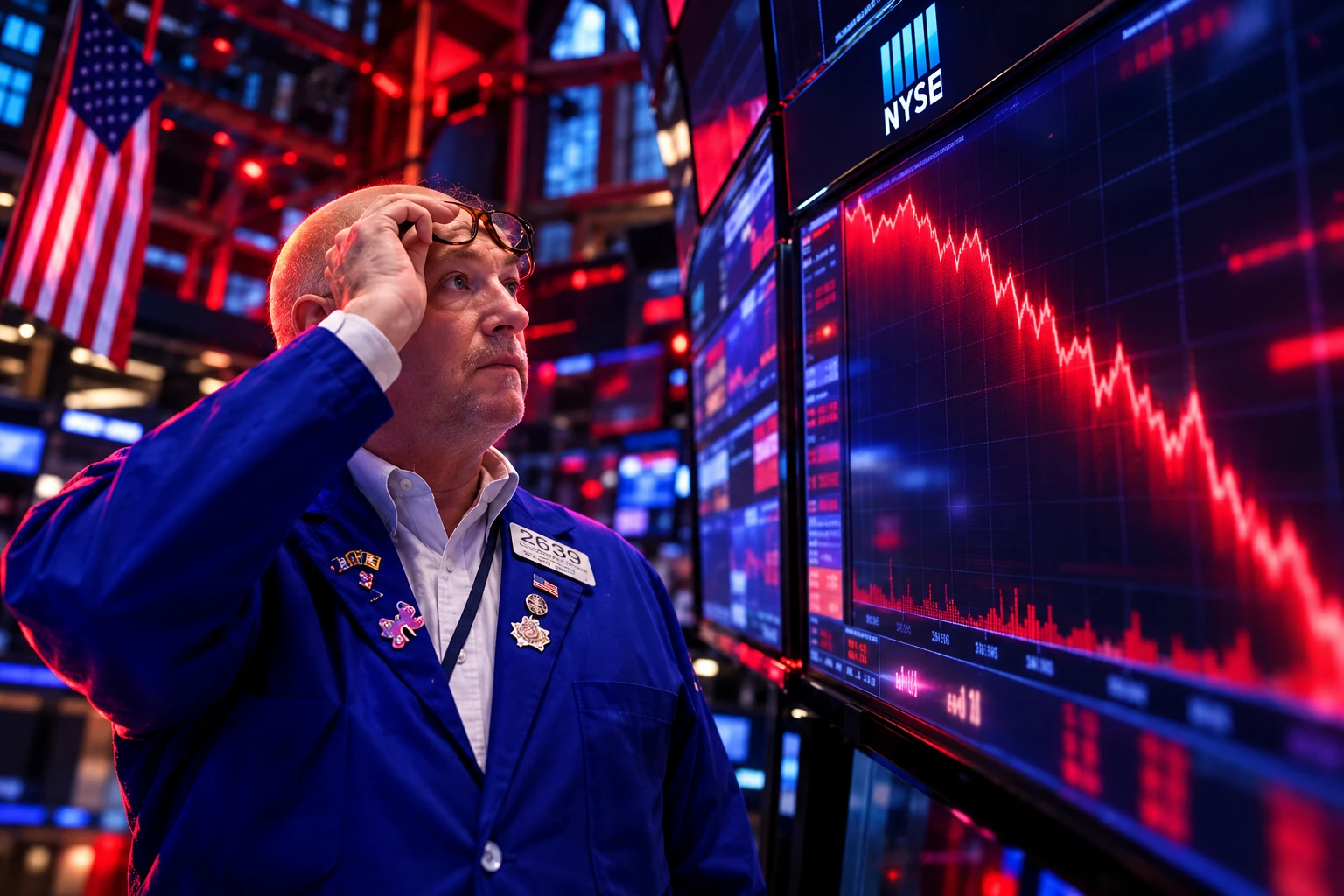
Bank Stocks Took Their Hit in Advance
Matthew Miskin, co-chief investment strategist at Manulife John Hancock Investments, put the tension in one question: is the market sniffing out something underneath the surface for these financial companies? He said there will be a sigh of relief if the banks come out with good results. The share prices have already voted the other way.
The selloff looks like a duration mark-down, not a 2023-style run. When the 10-year jumps, the bonds banks hold on the books lose market value even if they are still being held to maturity. That hit shows up in stock prices first. Deposit flight is a different animal, and nothing in the pre-released commentary describes one. The cheaper-money unwind is doing enough damage on its own: financials have been the sleeve that refused to confirm the S&P 500 high.
Matt Stucky, chief portfolio manager of equities at Northwestern Mutual Wealth Management, said he will watch how the backup in rates and energy costs is hitting the customer, not just the trading floor. “We’ve seen rates back up. We’ve seen energy costs back up,” he said. “And the question is, how is this impacting the consumer?”
HOW THE WAGER WAS PLACED
- September 16, 2026: The Federal Open Market Committee raises the funds target to 3.75% to 4.00% on a 12-0 vote, the first increase since 2023, and publishes a median year-end rate of 4.1%.
- October 2, 2026: The Labor Department prints September payrolls at 29,000 and the unemployment rate at 4.2%, cooling the case for a quick follow-up hike.
- October 3, 2026: CME FedWatch puts the chance of an October 28 hike at 22.1%, down from 64.2% on September 25, with a 77.9% chance of no change.
- October 6, 2026: The S&P 500 closes at 7,818.93 with the 10-year at 5.27%.
- October 13-14, 2026: The six largest U.S. banks report, then September CPI arrives at 8:30 a.m. Eastern on Wednesday.
That sequence is the bet in motion. Officials still pencil in another hike this year. The futures strip moved the live date to December. Bank equity already paid the 5% yield. Earnings and CPI now have to say whether that split was early or right.
What Tuesday Morning’s Bank Prints Need to Show
JPMorgan Chase will post results at about 7:00 a.m. Eastern on October 13, with the call at 8:30 a.m. Wells Fargo is due around 7:00 a.m. with a 10:00 a.m. call. Goldman Sachs and Citigroup report the same morning. Bank of America and Morgan Stanley follow on October 14. The six largest banks typically open the season, and their books still cut across lending, cards, deposits, deal fees and trading.
Largest-bank profits are expected to be up as much as 20% from a year earlier, a solid print that still trails the 29.6% estimate for the full S&P 500. The gap is the point. Index earnings are being pulled by technology and other growth names. Banks have to prove the 5% yield has not already slowed the customer and the deal calendar that sit underneath those headlines.
THE SIX-BANK CALENDAR
| Bank | Report | The line to hear |
|---|---|---|
| JPMorgan Chase | October 13, before the open | Investment-banking fees and trading revenue, guided mid-to-high teens by co-president Doug Petno |
| Goldman Sachs | October 13, before the open | Whether equities can offset a softer FICC book after CEO David Solomon flagged a muted quarter |
| Citigroup | October 13, before the open | Returns, expenses and the scale of buybacks against the bank’s profitability targets |
| Wells Fargo | October 13, about 7:00 a.m. ET | Loan growth and U.S. spending, which CFO Mike Santomassimo has called healthy |
| Bank of America | October 14, before the open | Investment-banking fees, which CEO Brian Moynihan said would drop at least 10%, with sales and trading flat |
| Morgan Stanley | October 14, before the open | Wealth and trading, the two engines that have to carry a slower deal tape |
Miskin’s test is simple. “Earnings have been incredible this year, and we’re just going to have to start to see with the banks how Q3 shaped up,” he said. A beat on trading will not settle the duration scare if management talks about slower card spend, thinner loan demand or rising charge-offs. A miss on fees will not sink the pause bet if credit stays clean and deposits hold.
UnitedHealth Group and Johnson & Johnson also report Tuesday morning, a second read on household budgets through medical costs. BlackRock reports Wednesday with Bank of America and Morgan Stanley. Those prints sit around the bank story; they do not replace the consumer language on the JPM and Wells calls.
Oil Looks Set to Lift Headline CPI to 3.7%
The Bureau of Labor Statistics has the September Consumer Price Index release at 8:30 a.m. Eastern on October 14, the same morning as Bank of America and Morgan Stanley. August CPI rose 0.4% on the month and 3.4% from a year earlier. Core CPI, which strips food and energy, rose 0.3% and 2.4%.
RBC’s U.S. desk, led by Mike Reid, forecasts headline CPI at 0.6% on the month, taking the annual rate to 3.7%. Core is seen at 0.2% on the month and 2.5% on the year. That split is the whole policy fight. Gasoline can shove the headline around without forcing Chair Kevin Warsh’s committee to move in two weeks, if the core holds near 2.5% and services do not reaccelerate.
Reynolds said he wants material progress on core services inflation before getting more confident the Fed can stay less aggressive than the market has, at times, priced. Stucky’s warning runs the other way. If inflation looks as if it will not come down without a full hiking cycle, he said, that is where equity markets can come under pressure.
THE REST OF THE DATA TAPE
- Wednesday, October 14: September CPI at 8:30 a.m. Eastern, with RBC at 3.7% headline and 2.5% core, against August’s 3.4% and 2.4%.
- Thursday, October 15: September producer prices, with RBC at 0.9% on the month and 0.4% for core, plus advance retail sales seen at 0.8%.
- Friday, October 16: Import and export prices, a check on whether the oil shock is leaking into goods that are not gasoline.
- October 27-28: The FOMC meeting, 13 days after the CPI print and the last scheduled decision before December 8-9.
RBC also flags a risk the CPI will not capture: supercore inflation at or above 3% since March, tariffs feeding into cars and parts, and freight PPIs that have already been ugly. The control group inside retail sales is the consumer tell after a strong August. High-income households can still spend. Middle-income households are the ones carrying higher interest bills.
Sixteen Officials Still Want Another Hike This Year
The September 15-16 projections are still the committee’s last written path. The median year-end funds rate of 4.1% sits a quarter point above the new 3.75% to 4.00% target. Twelve of 18 participants put the 2026 midpoint at 4.125%, four put it at 4.375%, and two left it at 3.875%, which is where policy is now. That is 16 of 18 officials with at least one more hike on the page.
Median PCE inflation for 2026 was marked up to 3.7% from 3.6% in June. Core PCE went to 3.4% from 3.3%. Unemployment was lowered to 4.1% from 4.3%. GDP was raised to 2.3%. The longer-run funds rate moved to 3.2% from 3.1%. The minutes, released October 7, said most participants saw another increase as likely appropriate by year end. They did not name October.
Michael Feroli, chief U.S. economist at J.P. Morgan, has been explicit about the calendar. “Inflation continues to look supply-shock driven, and as such we don’t foresee a protracted hiking cycle extending into next year,” he wrote after the meeting. The firm looks for one more hike in December, not this month, on the argument that it takes time to see the September move in the data. That is the same wager the futures strip is running: October as a hold, December as the live date.
Warsh said at the September press conference that he does not yet see a clear trend toward a timely return to 2%. The committee can still skip October and keep that sentence intact. A 3.7% headline driven by fuel, paired with a 2.5% core, would give them the room Feroli is counting on. A hot core, or bank chiefs talking about re-accelerating goods prices in the checkout line, would put October back on the table two weeks before the vote.
Trading Rooms and Credit Cards Tell Different Stories
Petno’s mid-to-high-teens guide for JPMorgan’s investment-bank fees and trading is the bull case for a higher-yield quarter: volatility pays the desk. Solomon’s warning of a muted Goldman quarter, with FICC softer and equities stronger, is the other side of the same tape. Moynihan already told investors Bank of America’s investment-banking fees would fall at least 10%. Those three sentences can all be true in one week, which is why a single “banks beat” headline will not settle the argument.
The consumer book is the sleeper in the same releases. Wells Fargo’s Santomassimo has pointed to better loan growth than the prior forecast and to healthy U.S. spending and credit. That claim now has to survive a 5% 10-year, a three-year high in mortgage rates, and gasoline prices that RBC says can jump enough to add three tenths to annual CPI. Charge-offs, card spend and deposit mix are the lines that will travel farther than a trading beat.
Stucky’s question is the one the calls have to answer in plain English. If the backup in rates and energy is still a market story, the pause bet holds. If it is already a household story, the 7.5% slide in bank stocks was the tell, and the S&P 500 record is a mega-cap event sitting on a softening base.
Five Stocks Carried the Index Back to a High
Butters’s October 9 note is the fundamental case for staying long the index anyway. The 29.6% growth estimate is up from 29.2% on September 30 and 26.7% on June 30. Of the 19 S&P 500 companies that had reported through October 9, 84% beat, and actual earnings exceeded estimates by 4.9%. Using the most conservative of his three surprise averages, FactSet says the index will likely report earnings growth above 35% for Q3. Analysts raised per-share estimates 1.4% from June 30 to September 30, against a five-year habit of cutting them 2.2%. Positive EPS guidance came from 72 of 116 companies, or 62%, against a 40% five-year average.
That strength is not evenly spread. Technology added 2.25 percentage points to the S&P 500’s return from August 13 to October 6. Financials subtracted 0.88 and industrials 0.67. ASML reports Wednesday and Taiwan Semiconductor reports Thursday, two more checks on the AI spend that has been carrying the cap-weighted index. If those prints hold up and the banks only confirm that credit is orderly, the 5% yield can keep living beside a new high. If the banks flinch on the consumer, the equal-weight gap becomes the story the record has been hiding.
The six calls, then Wednesday’s CPI, are the first hard marks on a rally that made a new high with the 10-year already through 5%.
Disclaimer: This article is news reporting and analysis of market prices, scheduled earnings, inflation data and Federal Reserve communications, and it is for information only. It is not investment advice, a recommendation to buy or sell any stock, bond, fund or derivative, or a forecast of what the Federal Open Market Committee will do on October 27-28. Readers should consult a licensed financial advisor or investment professional who can consider their own holdings, time horizon and risk tolerance before acting on any of these figures. Prices, estimates, FedWatch probabilities and economic forecasts reflect the cited sources as of the dates given and will change as companies report and as new data arrive.

Ohtani Game 4 Logoman Card Sells for $3.24 Million

Cole Kmet’s Season Ends, and Chicago’s Tight End Plan Starts

NBA Seeks Soccer Money After EuroLeague Clubs Refused

Amazon’s First Bond Tests Leave the Broccoli Chair Empty

Tyrese Maxey Owns the Night Built for LeBron James

Warsh Rejects Rate Guidance and Still Moves Markets

Dana-Farber Exits an MGB Medicare Advantage Network Early

NASA Launches the Roman Space Telescope’s Cosmic Bet

OpenAI’s Cyber Letter Puts the Defense Bill on Governments

Russia Recycles Its Old Warning Over Storm Shadow Plants
-
 BUSINESS2 months ago
Warsh Rejects Rate Guidance and Still Moves Markets
-
 BUSINESS1 month ago
Dana-Farber Exits an MGB Medicare Advantage Network Early
-
 NEWS2 months ago
NASA Launches the Roman Space Telescope’s Cosmic Bet
-
 NEWS2 months ago
OpenAI’s Cyber Letter Puts the Defense Bill on Governments
-
 NEWS2 months ago
Russia Recycles Its Old Warning Over Storm Shadow Plants
-

 ENTERTAINMENT4 weeks ago
Primetime’s $2.7 Million Preview Tops Pitt’s Costlier Film
-

 BUSINESS2 months ago
Jet Drones Lock Down Kyiv and Strip Kherson of Heat
-

 ENTERTAINMENT2 months ago
Midnight Spider-Man Turns Peter Parker Into Oscorp’s Hybrid