
NEWS
Foundational Turns Laser Ranging Into a Paid Network
Foundational raises £8.2 million to sell millimetre satellite laser ranging as a service, as low Earth orbit traffic makes coarse collision alerts unusable.

London space company Foundational has raised £8.2 million in pre-seed funding to sell millimetre satellite laser ranging as a commercial service. The round, disclosed on 1 October 2026, includes Inflection, BACKED, Final Frontier, Adjacent and Type One Ventures.
Hira Virdee and Dave Gooding spent years building the hardware at Lumi Space. Foundational is the vehicle that now tries to sell that measurement to constellation operators, insurers and governments.
The Collision Warnings Operators Already Ignore
Low Earth orbit is no longer a sparse research neighbourhood. Astronomer Jonathan McDowell’s catalogue, dated 30 September 2026, counts 16,913 active payloads in orbit, 11,143 of them Starlink spacecraft, and 34,758 catalogued objects in total.
The European Space Agency’s 2026 Space Environment Report, using data through the end of 2025, recorded more than 300 launches in 2025 and over 4,000 new payloads. About ten payloads now go up each day, while more than three intact satellites or rocket bodies reenter. ESA’s Space Environment Health Index, a single score of long-term strain against a 2014 sustainability benchmark, jumped from about 4 to 50 in a year.
LEO IN LATE 2026
- Active payloads: 16,913 in orbit as of 30 September 2026, in McDowell’s tally.
- Starlink share: 11,143 of those active spacecraft.
- 2025 traffic: more than 300 launches and over 4,000 new payloads, per ESA.
- Health Index: from about 4 to 50 in one year on ESA’s 2014 benchmark.
That crowding is why a millimetre laser measurement is being packaged as a product. A UK Research and Innovation grant abstract for Lumi Space put the operational mess in blunt terms: operators receive hundreds of thousands of collision warnings every day, with a 99.9 percent false positive rate blamed on imprecise data, and most of those warnings are ignored. The same abstract claimed Lumi’s platform tracks objects in low Earth orbit with 1,000x greater accuracy than current solutions. That figure is the company’s grant language, not an independent audit.
Coarse catalogues still produce alerts. They do not tell an operator, with much confidence, whether a burn is worth the fuel. Insurance desks and traffic managers sit on the same noisy feed.
Foundational Bought the Lab It Grew From
Virdee founded Lumi Space in 2018 with backing from the European Space Agency and the UK Space Agency, and he still describes satellite laser ranging as the gold standard of location in orbit. He holds a PhD in astrodynamics from University College London, work sponsored by the United States Air Force Research Laboratory, and has been a visiting fellow at Oxford on the commercialisation of engineering and physics research.
Dave Gooding, now chief technology officer, was on Lumi’s 2022 International Astronautical Congress paper with Virdee. That paper argued a network of 12 globally distributed stations could improve space traffic management for 10,000 satellites, at a time when SLR was still mostly limited to geodetic and GNSS spacecraft. Active payloads have already passed that 10,000 design point.
UKRI put £2,028,411 of grant money into Lumi’s SLR project, matching the stated project cost. Foundational Limited, company number 16515763, was incorporated on 13 June 2025 at 167-169 Great Portland Street, London, with Virdee, Gooding and David Balson as directors from day one. On 15 October 2025, Companies House recorded Foundational Limited as the 75 percent owner of Lumi Space, and Virdee ceased as Lumi’s person with significant control the same date. The lab did not vanish. It sits under a new holding company built to raise and sell.
FROM LUMI SPACE TO FOUNDATIONAL
- 23 November 2018: Lumi Space Limited is incorporated, with Dr Hira Virdee as director.
- 22 September 2022: Virdee, Gooding and colleagues present a 12-station SLR network sized for 10,000 satellites.
- 13 June 2025: Foundational Limited is incorporated in London with Virdee, Gooding and Balson as directors.
- 15 October 2025: Foundational Limited becomes 75 percent owner of Lumi Space Limited.
- 1 October 2026: Foundational discloses a £8.2 million pre-seed round and leaves stealth.
Inflection, a European hard-tech fund that writes first cheques between $0.5 million and $2 million, had already listed a 2025 stealth company for positioning data through space laser ranging. BACKED is a London seed firm. Final Frontier is a Copenhagen space and defence fund. Type One Ventures backs space hardware. Adjacent has put money into other space vehicles. None of them is buying a new law of physics. They are buying a path from a grant-funded lab to a billed network.
THE TWO COMPANIES ON THE FILING
| Company | Number | Incorporated | Control noted |
|---|---|---|---|
| Lumi Space Limited | 11693767 | 23 November 2018 | Foundational Limited, 75 percent, from 15 October 2025 |
| Foundational Limited | 16515763 | 13 June 2025 | Virdee as 75 percent owner from incorporation |
Lumi remains an active company. Foundational is the name on the raise, the website and the customer pitch.
How Satellite Laser Ranging Pins a Craft to Millimetres
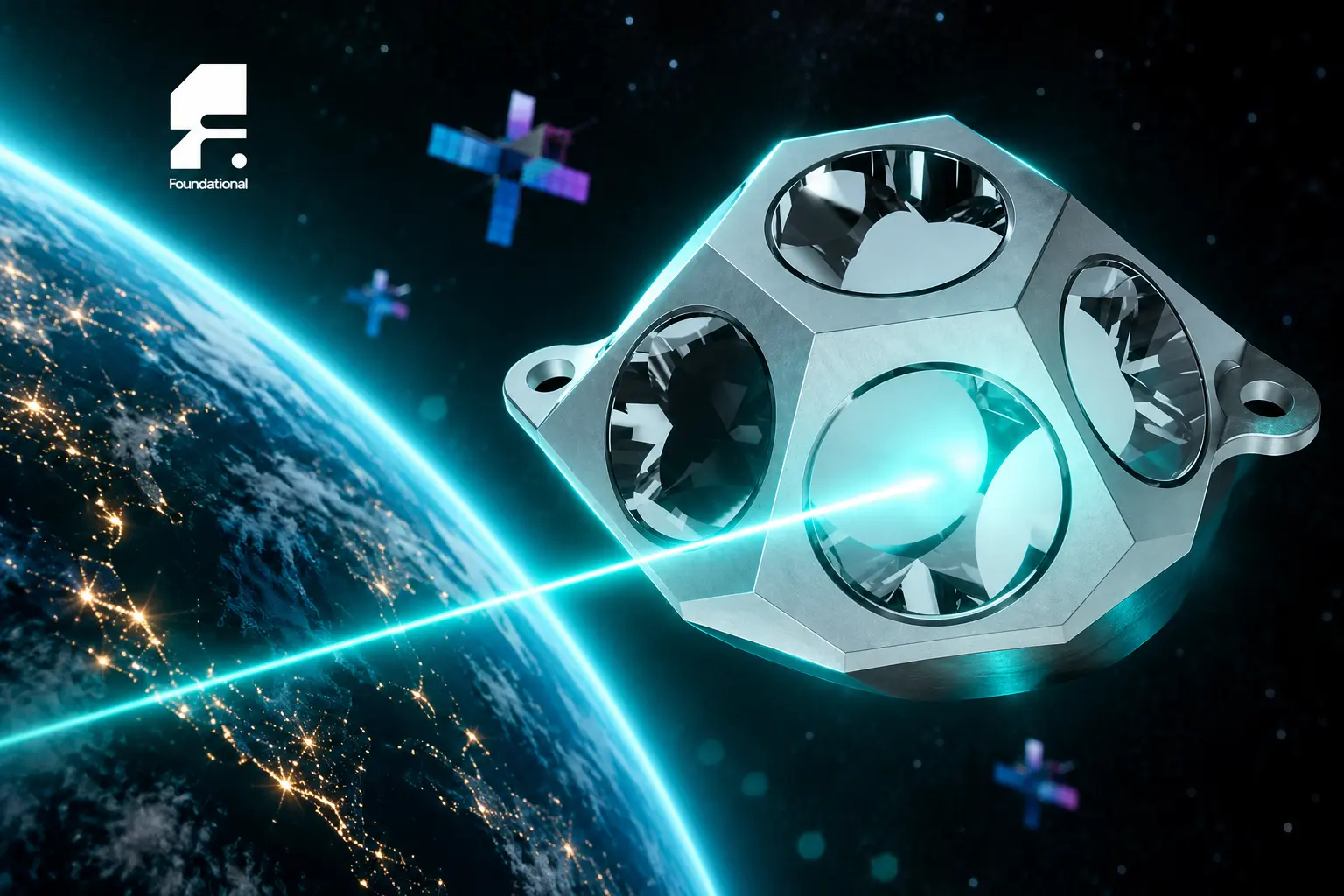
Satellite laser ranging times a laser pulse from a ground station to a retroreflector on a spacecraft and back. The round trip yields a range within millimetres per shot, which is why geodesists have used it for decades to pin stations, gravity and the terrestrial reference frame. Foundational’s public site sells that method as SLR-as-a-service for satellite operators, with the firm building the stations, running the network and feeding a software desk called Origin.
The space side is a passive cube-corner reflector. It needs no power, no electronics and no pointing, so a station can range a host from horizon to overhead through commissioning, safe mode and after the satellite dies. That last point matters for debris work: a dead bus with a reflector is still a cooperative target. A dead bus without one is a dim optical or radar smear.
THREE LAYERS ON THE PUBLIC SITE
- Ground: automated laser stations the company says it builds and operates, sold as SLR-as-a-service.
- Space: a line of three laser retroreflectors, Retro-1, Retro-2 and Retro-CS, with passive units listed as flight-proven at TRL-9.
- Data: Origin, which takes ranging points and is meant to yield orbits and ephemeris for a satellite or a whole constellation.
Raw ranging is listed as operational. Orbit products and validation are listed as in development. A uniquely identifiable reflector is also in development. The millimetre shot exists as a physical method. The always-on commercial picture of every customer’s fleet does not, yet.
Cubesat builders have already treated Lumi-class reflectors as a way to get laser ranges through the scientific service when GPS is a poor fit. Foundational’s bet is that operators will pay one vendor for the reflector, the automated station time and the file, instead of stitching a science network to a hardware shop.
£8.2 Million From Funds That Bet on Ground Stations
Virdee, chief executive and co-founder, put the commercial claim in one run-on sentence when the round was disclosed.
Satellite Laser Ranging is the gold standard, and is one of the most precise measurement tools humanity has built, capable of pinpointing a satellite to within millimetres, but until now it’s been too costly and too complex to use at scale. By bringing the hardware, ground network and data platform together under one roof, we’re rebuilding a critical layer of space infrastructure for the commercial era
Hira Virdee, CEO and co-founder, Foundational
Customers and partners named with the round include low Earth orbit constellation operators, ESA, UK government departments and agencies, aerospace manufacturers, research institutes and other commercial space firms. Named applications run through navigation and positioning, Earth observation and surveying, and maritime and aviation. Insurers and governments sit on the buyer list for the finished global network.
The science has been “gold standard” since the geodetic satellites of the 1970s. What changed is the customer. A 12-station paper sized for 10,000 satellites now faces 16,913 active payloads, and a health index that ESA says got an order of magnitude worse in a year. A pre-seed cheque that large for a 2025 company is a bet that someone will pay for fewer wasted avoidance burns, not for another white paper.
Clouds, Coverage and a 39-Station Science Network
Foundational is not inventing the ground segment from nothing. The International Laser Ranging Service already coordinates a ILRS network of ranging stations for science and engineering, with 39 tracking stations and more than 100 approved satellite targets, plus a long-standing split between dense coverage in Europe and thin coverage elsewhere. Those stations feed geodesy, the terrestrial reference frame and precise orbit checks on missions that fly reflectors. They are not a commercial operations desk with a service-level agreement.
Optical ranging also has weather in the way. Clear skies still govern who can shoot. Debris laser ranging, which relies on dim returns from whole objects rather than a cube corner, is a coarser tool, useful for tightening a prediction, not for millimetre geodesy. Foundational’s millimetre claim is for cooperative targets that carry its reflectors. Uncooperative debris remains a harder, less precise shot, which is why the company is pushing reflectors onto new buses and talking about ranging after end of life.
A commercial network still has to put stations in dry, well-placed sites, keep lasers on schedule, and deliver files fast enough that a constellation can act. The ILRS already shows how uneven that work is: a handful of stations do most of the passes. Automation is the part of Virdee’s pitch that the science network never had to productise.
The Round Pays for Stations, Reflectors and Data
Foundational says the £8.2 million will expand the ground-station network, bring space-hardware making in house, raise retroreflector output and push Origin further. The end state it describes is a global network selling positioning data to satellite operators, insurers and governments. ADS, the UK aerospace trade body, lists the firm at the Great Portland Street address with Balson as chief operating officer and a 2026 launch note.
WHERE THE PRE-SEED IS MEANT TO GO
- Ground stations: more automated laser sites, aimed at a global ranging net rather than a single observatory.
- Space hardware: in-house making of reflectors and related kit, with higher unit volume.
- Origin: the data platform that is supposed to turn shots into orbits operators can pull.
Origin is taking access requests and will show ILRS tracking data on a new account so a buyer can see what laser ranges look like before Foundational’s own stations fill the map. The company is hiring in software and hardware. Raw ranging is on the board. Full orbit products are not.
The raise does not make low Earth orbit less crowded. It tries to sell a cleaner number to the people who now live with a 99.9 percent false-positive warning pile, on a catalogue that already holds 16,913 working machines. Whether insurers and constellation desks pay for millimetre files will decide if the holding company was worth building on top of Lumi, or if SLR stays a science craft with a new logo.
Frequently Asked Questions
What data does Foundational’s Origin platform deliver?
Origin is built to let users pull normal points and full-rate laser ranging in TDM, CRD or JSON. Raw ranging is listed as operational, while orbit products and validation remain in development, and new accounts can be seeded with ILRS tracks so a buyer can inspect laser accuracy before Foundational’s own stations are everywhere.
Who sits on Foundational’s board besides the two co-founders?
Companies House lists three directors appointed on 13 June 2025: Hira Singh Virdee, David Jon Gooding and David Balson, who appears on the ADS member listing as chief operating officer. Virdee is the 75 percent owner of Foundational Limited from incorporation.
Is Lumi Space still a separate company after the raise?
Yes. Lumi Space Limited is still an active company, number 11693767, with its registered office at Cyberville, Copse Lane, Yateley, while Foundational Limited files from 167-169 Great Portland Street, London W1W 5PF. Foundational became Lumi’s 75 percent owner on 15 October 2025; Virdee remains a Lumi director.
Can satellite laser ranging work if the spacecraft has no power?
A passive laser retroreflector needs no power, no electronics and no pointing, so a ground station can range the host from horizon to overhead through safe mode and after the mission ends. Foundational also lists a uniquely identifiable reflector as in development, which would matter if many commercial buses start flying similar arrays.
How many satellites does the scientific SLR service already track?
The International Association of Geodesy’s ILRS profile counts 39 tracking stations and more than 100 artificial satellite targets across low Earth orbit, medium Earth orbit, GNSS and synchronous altitudes. That science roster is why Foundational is selling automation and a data desk, not the first laser on Earth that can time a pulse to a cube corner.

Ohtani Game 4 Logoman Card Sells for $3.24 Million

Cole Kmet’s Season Ends, and Chicago’s Tight End Plan Starts

NBA Seeks Soccer Money After EuroLeague Clubs Refused

Amazon’s First Bond Tests Leave the Broccoli Chair Empty

Tyrese Maxey Owns the Night Built for LeBron James

Warsh Rejects Rate Guidance and Still Moves Markets

Dana-Farber Exits an MGB Medicare Advantage Network Early

NASA Launches the Roman Space Telescope’s Cosmic Bet

OpenAI’s Cyber Letter Puts the Defense Bill on Governments

Russia Recycles Its Old Warning Over Storm Shadow Plants
-
 BUSINESS2 months ago
Warsh Rejects Rate Guidance and Still Moves Markets
-
 BUSINESS1 month ago
Dana-Farber Exits an MGB Medicare Advantage Network Early
-
 NEWS2 months ago
NASA Launches the Roman Space Telescope’s Cosmic Bet
-
 NEWS2 months ago
OpenAI’s Cyber Letter Puts the Defense Bill on Governments
-
 NEWS2 months ago
Russia Recycles Its Old Warning Over Storm Shadow Plants
-

 ENTERTAINMENT4 weeks ago
Primetime’s $2.7 Million Preview Tops Pitt’s Costlier Film
-

 BUSINESS2 months ago
Jet Drones Lock Down Kyiv and Strip Kherson of Heat
-

 NEWS2 months ago
Congo Starts Ervebo Vaccinations for a Different Ebola Virus