
NEWS
The FAA Can Mandate ADS-B In and Still Will Not
The FAA can mandate ADS-B In without Congress, yet still wants a law after the ROTOR Act died by one House vote.

The National Transportation Safety Board marked 11 of 33 FAA answers after the Potomac crash unacceptable, including any plan to require ADS-B In. The board’s own reconstruction timed a cockpit alert at 59 seconds for the jet and 48 seconds for the Army helicopter.
Chair Jennifer Homendy and relatives of the 67 people killed took that fight back to the Capitol on Sept. 15, 2026. FAA Administrator Bryan Bedford has said his agency can write the rule without a new statute and would rather have Congress order it. The Senate already did. The House then failed the bill by one vote after the Pentagon pulled its support.
59 Seconds of Warning, and Still No Rule
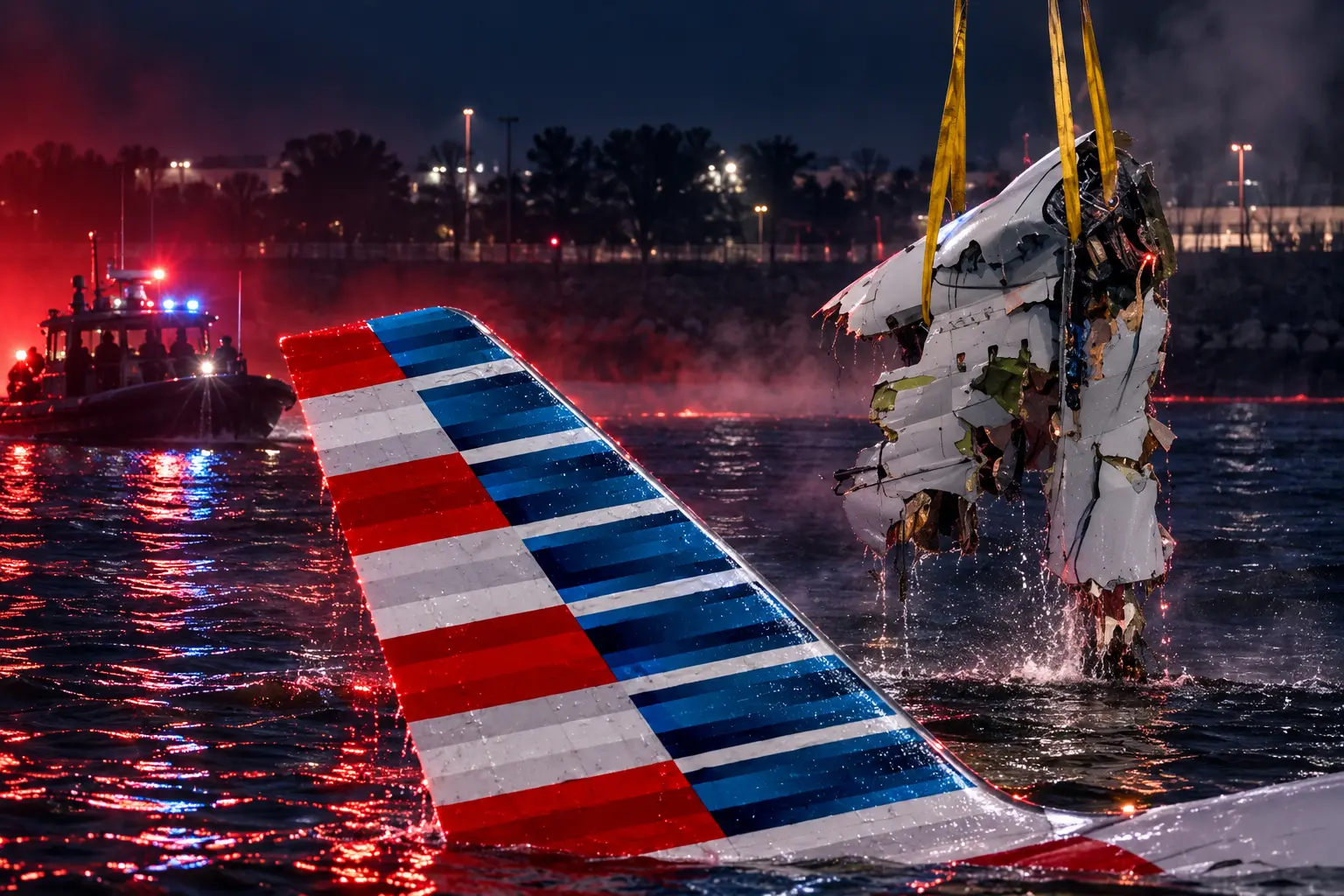
On the night of Jan. 29, 2025, PSA Airlines Flight 5342, flying as American Eagle from Wichita, Kansas, was circling to land on Runway 33 at Ronald Reagan Washington National Airport when it hit a U.S. Army UH-60L Black Hawk over the Potomac River. The regional jet, a CRJ700, carried 60 passengers and 4 crew. The helicopter, Priority Air Transport Flight 25, carried 3 soldiers. Nobody survived. It was the deadliest U.S. aviation disaster since 2001.
The board adopted its final report on Jan. 27, 2026, with 74 findings and 50 recommendations. In a Feb. 17 letter to Bedford, it asked the FAA to require ADS-B In with audible cockpit alerts on any aircraft that already must broadcast ADS-B Out. ADS-B Out, which sends GPS position to controllers and other receivers, has been required in most controlled U.S. airspace since 2020. ADS-B In is the other half of that pair: a cockpit traffic display plus an audible alert, so crews see who is nearby instead of only transmitting themselves.
Investigators ran that system against the crash. The jet’s existing TCAS II traffic advisory came 19 seconds before impact. An ADS-B In setup, in the board’s simulation, would have sounded 40 seconds earlier than that.
WARNING TIMES IN THE BOARD’S SIMULATION
| Crew | ADS-B In alert | What they had |
|---|---|---|
| American Eagle Flight 5342 | 59 seconds before impact | TCAS II advisory at 19 seconds |
| Army Black Hawk PAT25 | 48 seconds before impact | No equivalent integrated alert |
Homendy has not treated those seconds as a technical footnote. At the Sept. 15 news conference with Sen. Ted Cruz (R-Texas), Sen. Maria Cantwell (D-Wash.), and families from the flight, she said the missing box was the difference between the accident and a miss.
ADS-B In would have prevented this collision. It would have prevented it. We wouldn’t be here today.
Jennifer Homendy, NTSB chair, Sept. 15, 2026, Capitol news conference
She has asked the same question since the report came out: how many more decades have to go by before the board has to recommend the system again after a terrible tragedy. The NTSB first told the FAA, in 2008, that ADS-B In would make an immediate and substantial contribution to safety, especially around airports.
Which FAA Answers Failed the Board’s Test?
The safety board does not investigate and walk away. It grades the replies. A response is unacceptable if the agency rejects the ask, offers a substitute the board finds too weak, or fails to move in time. On Sept. 14, 2026, the board applied that label to 11 of the 33 items sent to the FAA. Homendy told the Capitol crowd the next day that the board had done so unanimously, and that every one of the 50 recommendations, including those to the Army and the Defense Department, was still open.
Eight of those 33 FAA items concern how towers are staffed, trained, classified, and tested after an event. Two ask for a public record of close encounters and a faster notice after near misses. The one Homendy keeps naming is A-26-31, the ADS-B In rule.
THE 11 OPEN FAA ANSWERS
| Item | What the board asked the FAA to do |
|---|---|
| A-26-8 | Set time-on-position limits for supervisory controllers, fitted to local staffing |
| A-26-9 | Give yearly instructor-led threat-and-error training on scanning, talk, and stress |
| A-26-10 | Build a risk tool so supervisors can spot and cut threats during a shift |
| A-26-15 | Write objective criteria for rating tower facility levels |
| A-26-16 | Recheck whether Reagan’s tower as a level 9 facility matches its complexity |
| A-26-22 | Let an on-site supervisor decide post-accident drug and alcohol tests without waiting |
| A-26-23 | Train that testing staff every year and test what they learned |
| A-26-31 | Require ADS-B In with a traffic display and audible alerts where ADS-B Out is already required |
| A-26-37 | Define a close-proximity encounter and publish a database of where they happen |
| A-26-38 | Notify crews after near-midair collisions or TCAS resolution advisories while the data still exist |
| A-26-40 | Log whenever control positions are combined, and why |
The FAA has not said it disagrees with A-26-31. In the letter the board reviewed in September, it also gave no sign that it intends to write the rule. That silence is the fight. Route work in other cities and a new separation order do not answer a cockpit-alert mandate, and the board said so.
Bedford Already Has Authority to Write the Rule
Bedford, who took the FAA job on July 10, 2025, has been plain about the legal point. He said in July 2026 that the agency can move on ADS-B In without a new law and would prefer direction from lawmakers. That preference now sits on top of a bill that already died, which is the bind families keep describing on the Hill.
He has also described a slower technical path. An ADS-B In box wired into the flight deck, he told senators, could take a decade once rulemaking and aircraft wiring are counted. He has pushed electronic flight bags as a faster way to put traffic on a screen while that work proceeds. The board’s recommendation is not a bag on the glareshield. It is a cockpit display configured to alert the crew out loud, on every aircraft that already must broadcast ADS-B Out, including military traffic in the same airspace.
In prepared Senate testimony on May 19, 2026, Bedford said the crash was not a missing-data problem. It was a failure to turn data the system already had into action. He listed what the FAA did at Reagan right after the collision: helicopter operations in the National Capital Region were restricted, mixed-traffic procedures that stacked risk were cut, and routes that added needless complexity were closed. The agency reduced the hourly arrival rate and daily operations, added support in the tower, and tightened ADS-B Out rules in the region. With Defense Department backing, it eliminated all non-essential military helicopter operations in that airspace.
Those are real changes at one airport. They are also the substitute the board refuses to accept for A-26-31. A local fix does not put 59 seconds of warning in a jet that is sharing a corridor with a helicopter on a check ride.
A Pentagon Statement and a One-Vote Margin
Cruz and Cantwell wrote the Rotorcraft Operations Transparency and Oversight Reform Act to turn the board’s ADS-B In ask into a statute. The Senate passed it 100-0 on Dec. 17, 2025. The text told the FAA to issue a final rule within two years requiring ADS-B In, with audible and visual advisories, on aircraft that already need ADS-B Out, and to have those aircraft equipped by Dec. 31, 2031. It also narrowed when military flights could go dark on the broadcast.
The House took the bill up on Feb. 24, 2026, under suspension of the rules, which needs a two-thirds vote. The tally was 264-133. Of the 397 members who voted, 265 were required. It failed by one. Thirty-five members did not vote. Cruz later said weather in the Northeast kept nearly 30 members from the floor, and that the vote was gaveled before some members had finished.
HOW THE BILLS MOVED
- Dec. 17, 2025: The Senate passes the ROTOR Act 100-0, with an ADS-B In mandate and a Dec. 31, 2031, equipage deadline.
- Feb. 23, 2026: The Pentagon withdraws support, citing budget and operational security, one day before the House vote.
- Feb. 24, 2026: The House fails the ROTOR Act 264-133 under fast-track rules, one vote short of two-thirds.
- Feb. 26, 2026: Homendy and three board members write that the House’s ALERT Act, as introduced, does not implement A-26-31.
- April 2026: The House passes the ALERT Act 396-10. The two chambers still have not sent a reconciled bill to the president.
The late objection came from the Defense Department. Pentagon spokesman Sean Parnell said the department shared the safety goal but that the Senate text, as drafted, would create unresolved budgetary burdens and operational security risks for national defense. House Armed Services Chair Mike Rogers (R-Ala.) read that sentence on the floor and voted no, as did the rest of GOP leadership. Rogers said ADS-B sends location, speed, and heading over open channels that hobby sites republish, and that a 2018 FAA-Pentagon memorandum already lets some military aircraft stay off the broadcast. The ROTOR Act, he said, would let the FAA, not commanders, decide which fighters, bombers, and classified jets must transmit.
Requiring our fighters, bombers, and highly classified assets to regularly broadcast their location puts our men and women in uniform at risk by exposing operational planning, aircraft details, and patterns of life to our adversaries.
Rep. Mike Rogers, House Armed Services chair, Feb. 23, 2026, floor remarks
Cruz and Cantwell answered that proficiency flights, like the one that killed 67 people, should broadcast in busy airspace the way other military and civil flights do. Rogers and the House transportation chairs offered the Airspace Location and Enhanced Risk Transparency Act as the substitute and said it would cover all 50 board items without handing the Pentagon’s exemptions to the FAA. The NTSB, in a Feb. 26 letter from Homendy and board members Michael Graham, Tom Chapman, and Todd Inman, said it cannot support the ALERT Act in its current form because requiring aircraft to be “capable” of receiving ADS-B In is not the same as requiring the system to be on and alerting. The House passed that bill 396-10 in April anyway. No conference product has become law.
Helicopter Routes Changed at Reagan, Not Nationwide
Reagan’s map is not the map from January 2025. The FAA closed the Route 4 segment between Hains Point and the Wilson Bridge, the stretch that crossed the Runway 33 approach. It restricted routine mixed helicopter and airplane operations, shifted helicopter zones, and strengthened ADS-B Out around the airport. Controllers were told to stop using see-and-avoid as the separation method that let the Black Hawk crew accept visual separation from a jet they then failed to keep in sight.
On March 18, 2026, Transportation Secretary Sean P. Duffy and Bedford announced a national follow-on. A general notice now suspends the use of visual separation between airplanes and helicopters in Class B airspace, Class C airspace, and Terminal Radar Service Areas. Where a helicopter crosses an arrival or departure path, controllers must use radar and hold defined lateral or vertical distances. Bedford later told the Senate the agency found a structural reliance on visual separation in places where eyesight is not enough, and that the notice was the system-wide correction.
WHAT CHANGED AT REAGAN NATIONAL
- Route 4 closure: The Hains Point to Wilson Bridge segment is shut, removing the published track that crossed the Runway 33 approach.
- Mixed traffic: Routine helicopter operations that shared arrival and departure paths were restricted, and non-essential military helicopter flights in that airspace were ended.
- See-and-avoid: Visual separation between helicopters and airplanes is suspended in Class B, Class C, and TRSA airspace; radar distance is required instead.
- ADS-B Out: Broadcast rules around Reagan were tightened, with limited exceptions, while ADS-B In remains unrequired.
The FAA’s September letter said helicopter-route reviews are finished in four cities and underway in six others. It did not name the ten. For a board that put “failure to regularly review and evaluate helicopter routes” in the probable cause, unnamed reviews are not a national redesign. The probable cause, as adopted, was the FAA’s placement of a helicopter route next to a runway approach, its failure to review those routes and the data they produced, its failure to act on earlier warnings, and an air traffic system that leaned on visual separation to keep traffic moving.
Other findings sat beside that sentence. The Black Hawk was flying above the published route altitude. Army altimeter tolerances had not been trained in a way that kept the crew on the correct height. The tower was combining positions under a heavy load, and traffic calls that should have been sharper were not. Those facts are why some pilots still argue the story is a helicopter that failed to hold altitude, or a controller who failed to point. The board listed those failures and still put the route, the unused data, and the missing cockpit alert in the cause. An altitude bust on a route drawn through an arrival corridor is how the geometry kills people.
Families Took the Fight Back to the Capitol
Doug Lane stood on the Capitol steps on Sept. 15 with other Flight 5342 families and said Christine and his son Spencer were gone. He told lawmakers to do the work that is theirs and finish it before another family is left holding the things that came home instead of the person who should have. In a second line that has followed the cost argument around the ROTOR Act, he said that if the price is too high, show the math, and say what a human life is worth.
Do the work that is yours and finish it before another family is left holding the things that came home instead of the person who should have.
Doug Lane, Flight 5342 family member, Sept. 15, 2026, Capitol steps
Airline pilots at the same event refused to pick ROTOR against ALERT as if the brand on the bill were the point. They said any final package has to keep the Senate’s integrated ADS-B In mandate, with the alert on the flight deck, not a capability that can sit switched off. Cruz said the collision did not have to happen and that he wants a bill by the end of the year, in the lame-duck session after the November 2026 elections. He also said false information about the Pentagon’s concerns helped produce the one-vote loss, and that talks with the House were still open.
Homendy told the same crowd the board cannot spend another moment looking those families in the eye and doing nothing. Bedford, in May, had already pledged to work with them and with Congress on safety legislation. The agency he runs can start that rule without the legislation. The families are still asking for the statute because the rule has not been started, and because the last time Congress tried to force it, the Defense Department’s security warning and a two-thirds procedure were enough to stop it.
A civilian case against American Airlines is set for a trial on fault and damages in April 2027. The 50 recommendations from the crash remain open. The cockpit alert the board timed at 59 seconds is still a recommendation, not a requirement.

Ohtani Game 4 Logoman Card Sells for $3.24 Million

Cole Kmet’s Season Ends, and Chicago’s Tight End Plan Starts

NBA Seeks Soccer Money After EuroLeague Clubs Refused

Amazon’s First Bond Tests Leave the Broccoli Chair Empty

Tyrese Maxey Owns the Night Built for LeBron James

Warsh Rejects Rate Guidance and Still Moves Markets

Dana-Farber Exits an MGB Medicare Advantage Network Early

NASA Launches the Roman Space Telescope’s Cosmic Bet

OpenAI’s Cyber Letter Puts the Defense Bill on Governments

Russia Recycles Its Old Warning Over Storm Shadow Plants
-
 BUSINESS2 months ago
Warsh Rejects Rate Guidance and Still Moves Markets
-
 BUSINESS1 month ago
Dana-Farber Exits an MGB Medicare Advantage Network Early
-
 NEWS2 months ago
NASA Launches the Roman Space Telescope’s Cosmic Bet
-
 NEWS2 months ago
OpenAI’s Cyber Letter Puts the Defense Bill on Governments
-
 NEWS2 months ago
Russia Recycles Its Old Warning Over Storm Shadow Plants
-

 ENTERTAINMENT4 weeks ago
Primetime’s $2.7 Million Preview Tops Pitt’s Costlier Film
-

 BUSINESS2 months ago
Jet Drones Lock Down Kyiv and Strip Kherson of Heat
-

 ENTERTAINMENT2 months ago
Midnight Spider-Man Turns Peter Parker Into Oscorp’s Hybrid