
NEWS
A Placed Rail Derails a Normandy TER and Injures 44
A 250-to-300 kilo rail on a Normandy TER injured 44 at Cleon, repeating France’s open-track sabotage pattern two years after the Olympic attacks.

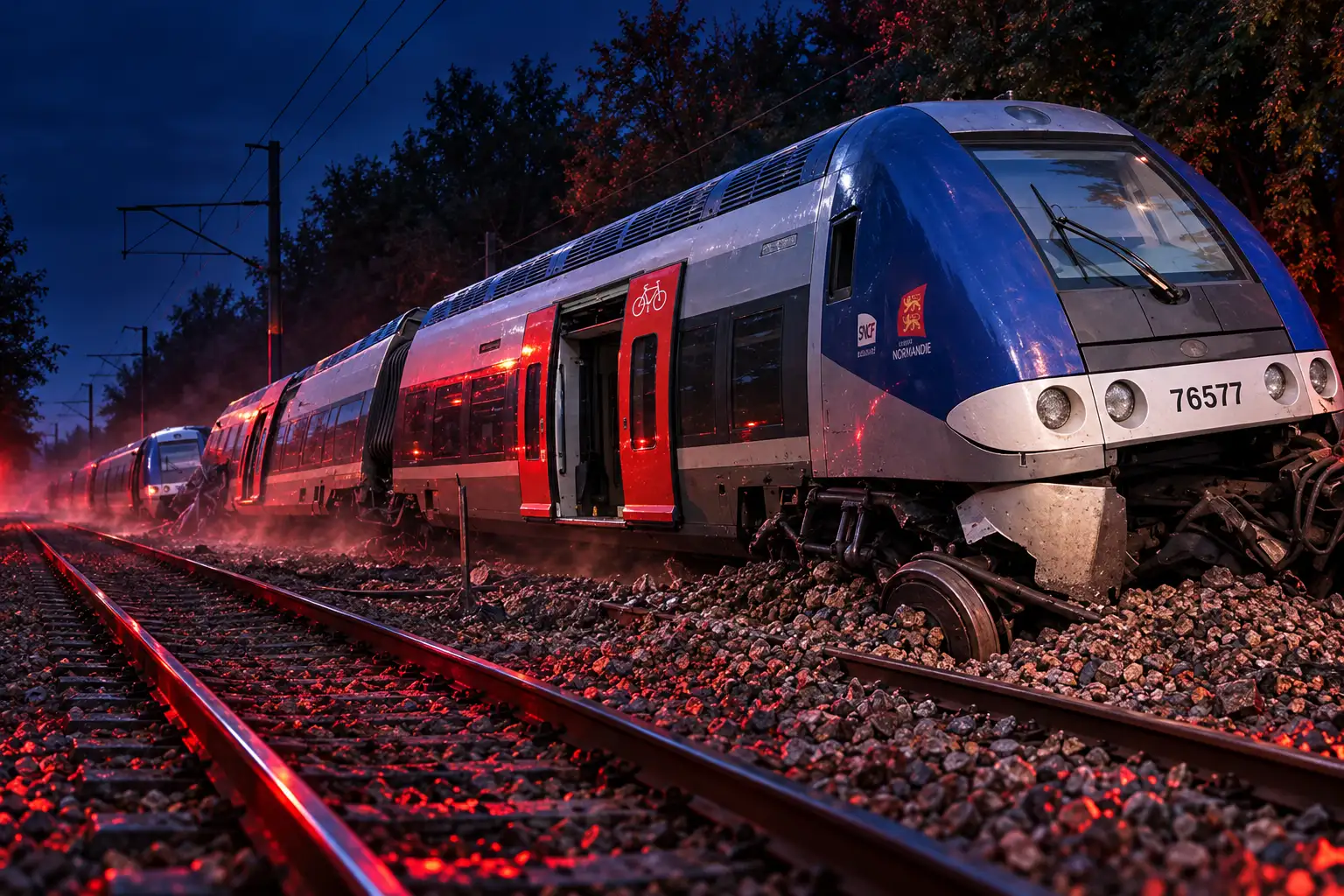
A Rouen-to-Caen TER struck a 250-to-300 kilogram piece of rail at Cléon on Friday evening, injuring 44 of the 186 passengers on board. One carriage rolled onto its side. Four others left the tracks. Police are treating a deliberate act as the main line of inquiry.
The method is familiar on French rails. Two years after arsonists walked onto high-speed lines on the eve of the Paris Games, a quieter Normandy track was still open enough for a heavy bar to appear after the previous train had passed clean.
The Train Hit a Rail at Cléon After Dusk
The regional train, two coupled sets on the Nomad service, left the rails about 19:45 on Friday, 11 September 2026, between Tourville and Elbeuf-Saint-Aubin, at Cléon in Seine-Maritime, close to Renault’s factory and a level crossing. A police source said it was doing 140 km/h when it hit a metal object on the line. Hervé Morin, president of the Normandy region, later said the authorised maximum on that stretch is 120 km/h.
The Seine-Maritime prefect activated the departmental operations centre at 20:00 and triggered the Orsec mass-casualty plan. Transport minister Philippe Tabarot posted a first alert from the transport minister while the prefect coordinated rescue teams and SNCF staff on the ground.
Un train de voyageurs assurant la liaison Rouen-Caen a déraillé ce soir vendredi 11 septembre vers 19h45, à hauteur des communes de Cléon et de Tourville-la-Rivière. Environ 200 passagers se trouvaient à bord.
Le préfet de la Seine-Maritime a activé le centre opérationnel… pic.twitter.com/JkRs6Ma5F0
— Préfet de Normandie et de la Seine-Maritime (@Prefet76) September 11, 2026
FRIDAY NIGHT AT CLÉON
- About 19:45, 11 September 2026: The TER leaves the rails at Cléon with 186 people on board.
- 20:00: The prefect opens the operations centre and launches the Orsec “numerous victims” plan.
- 20:30: Mayor Mélanie Delacour opens the La Traverse hall a few hundred metres from the wreck for uninjured passengers.
- 03:45, 12 September 2026: The last group, about 20 people, leaves by bus for Caen.
Rescuers sent 130 firefighters, five medical teams and 80 vehicles. Rouen University Hospital, about 20 km away, opened a sectoral white plan for its emergency ward. The train will stay on the ballast until Rouen prosecutor Sébastien Gallois releases the site for the lift.
Forty-Four Hurt, With Six Still in Hospital
Gallois put the toll at 44 injured: an 18-year-old woman flown out in absolute emergency, and 43 others treated as relative emergencies. On Saturday he said her life was no longer in danger. Tabarot, speaking the same day, said she had “particularly significant injuries” and that six people remained in hospital.
THE HUMAN TOLL
- On board: 186 passengers on the two-set TER.
- Injured: 44 people, including one woman, 18, flown to Rouen University Hospital.
- Still in hospital Saturday: 6, after 21 of 26 patients treated in four Rouen hospitals went home overnight.
- The driver: Alcohol and drug tests all negative, Gallois said.
Uninjured travellers were taken to La Traverse. Delacour said they arrived in shock, got psychological support, and that the town locked up bags left in the wreck for SNCF to collect on Saturday. Some passengers told her they would never take the train again. “It is a tragedy that could have turned into a disaster on a very large scale,” she said.
What Investigators Still Will Not Call Sabotage
Rouen’s judicial police have an inquiry for the causes of serious injuries. Deputy prosecutor Marie-Valérie Albert warned on Friday night that the work “will be long.” The train’s data recorder has been seized. A court-appointed expert is on the file. Gallois has not named a suspect and has not called the case sabotage.
WHAT WE KNOW
- The object: Investigators found a piece of rail on the track and treat its presence as the main working hypothesis for the derailment.
- The timing: Morin said another train ran the same stretch about an hour earlier and that there had been no works in between.
- The weight: He put the bar at 250 to 300 kilograms, too heavy to have been carried there casually.
WHAT IS UNCONFIRMED
- Who placed it: No one has been named. Gallois said the reasons for the rail’s presence “are unknown and will have to be determined by the investigation.”
- Motive: Police sources call a malicious act the privileged lead. That is a working theory, not a charge.
A national police spokeswoman, speaking on condition of anonymity under service rules, said the rail fragment was “probably” linked to the derailment. Photos of a cut rail segment circulated within hours; it is not established that those images show the object the train hit.
A Heavy Bar That Was Not There an Hour Earlier
Morin, who was at the site on Friday night, went further than the prosecutor. He told interviewers the shock was extreme, that a carriage went over, and that the power car turned so violently the end that had faced Caen ended up facing Rouen. He called the likely cause not merely malicious but criminal.
There was a bar of iron on the track, which we think is a rail, and which is extremely heavy, around 300 kg. The only thing I can tell you is that the rail did not get there by chance.
Hervé Morin, president of the Normandy region, to Ouest-France
That is the gap the inquiry has to close. A quarter-tonne of steel does not drift onto a running line. Calling it a “malicious act” is the official understatement; Morin already used a harder word. Until Gallois signs a charge, the legal file stays on the presence of the rail, not on a named author.
France Already Lived This Play on Faster Lines
French rails are an open system. SNCF Réseau, which runs most of the national network, counts about 28,000 kilometres of track. In its sabotage of a scale never seen review of 2024, the company described arson on the night of 25 to 26 July, on the eve of the Paris Games opening ceremony, that hit the Nord, Est and Atlantique high-speed lines. Staff stopped a fourth attempt on the Sud-Est line. About 800,000 travellers were caught in the disruption. No one was killed.
Those attacks burned signalling cables, not passenger trains. Cléon is a different tool on a slower line, and it put 44 people in the medical chain. The common fact is access. SNCF Réseau’s own security pages record several hundred object deposits a year, plus thousands of thefts and acts of damage. In 2024 the company said the count of malicious acts was only up 5 to 10 percent, but the hits were moving toward high intensity, with theft losses tripled since 2021 and minutes lost up 27 percent.
TRACK ATTACKS ON THE FRENCH NETWORK
| Date | Target | Method | Human toll |
|---|---|---|---|
| 2008 | High-speed Est line (Tarnac case) | Steel rods on overhead cables | Disruption; later acquittals |
| January 2023 | Near Paris-Est | Deliberate fire | Traffic stopped; no mass injuries reported |
| 25-26 July 2024 | LGV Nord, Est, Atlantique | Cable arson at junctions | About 800,000 travellers hit; none injured |
| 11 September 2026 | TER Rouen-Caen at Cléon | Rail, 250 to 300 kg, on the track | 44 injured |
The 2024 Olympic file pointed investigators toward far-left profiles. That frame is already being reused for Cléon, and it is running ahead of the evidence. No one has been charged here. Transport specialist Arnaud Aymé noted the practical limit: a TER at about 150 km/h needs almost a kilometre to stop, so a bar on the rail is seen too late. Inspection cars check classic lines every eight weeks. That cycle does not catch an object dumped between two evening trains.
Passengers Saw Glass, Stones and a Pivoting Car
Inside the train the first warning was vibration, then a lift, then glass. Delacour said windows in the cars that stayed upright shattered and that stones from the track flew in because of the speed.
FROM THE CARS THAT STAYED UPRIGHT
- Louis, 24, rear car: Shakes for two or three seconds, then he could not stay in his seat. Windows partly blew. Track stones came in. “It was really shocking, I’m still shaking.”
- Baptiste: After they got out they saw axles sitting on the rails and fencing smashed for 200 to 300 metres past the crossing. He said the lead car pivoted on impact and pulled the rest.
- Ilario Imbert, 15: The train lifted, glass broke, and the car ahead left the rails and rolled. His own car stayed on the rails and passed it.
Those accounts match the wreck the firefighters found: one car on its side, four others off the rails, and a line of torn fence after the crossing. SNCF said it would give the inquiry “full cooperation in complete transparency” and sent solidarity to the injured and to staff at the site.
No Train Moves Until the Wreck Comes Off
The Paris-Rouen and Rouen-Amiens axes, cut on Friday night, were running again by Saturday morning, an SNCF Réseau spokesman said. The Rouen-Caen line itself, which normally runs 10 return trips on weekdays and six at weekends, stayed closed. SNCF Voyageurs put substitution buses on the Nomad line and on Caen-Le Havre. At Paris Saint-Lazare on Friday night, four trains from Le Havre and Rouen were 2 hours 40 minutes to 3 hours late.
SNCF Réseau crews were around the wreck on Saturday, waiting for Gallois to hand the zone back so they can lift the sets, measure the damage, and rebuild the track. Until that happens, the 186 people who boarded at Rouen remain the last passengers to run that stretch at line speed, and the 250-to-300 kilogram bar remains the object the inquiry has to explain.

Pixel Buds Firmware 6.144 Ties New Features to Pixel Gear

Eve Markoski-Wood Backs Her Mum as Wood Fights Bail

Trump Rejects an Iran Deal as Diesel Holds Near Records

Amazon Cuts the S26 Ultra to $979 After Samsung’s Hike

Ice Caves Land in Minecraft 26.4 Snapshot 3

Warsh Rejects Rate Guidance and Still Moves Markets

Dana-Farber Exits an MGB Medicare Advantage Network Early

NASA Launches the Roman Space Telescope’s Cosmic Bet

Russia Recycles Its Old Warning Over Storm Shadow Plants

Primetime’s $2.7 Million Preview Tops Pitt’s Costlier Film
-
 BUSINESS2 months ago
Warsh Rejects Rate Guidance and Still Moves Markets
-
 BUSINESS1 month ago
Dana-Farber Exits an MGB Medicare Advantage Network Early
-
 NEWS2 months ago
NASA Launches the Roman Space Telescope’s Cosmic Bet
-
 NEWS2 months ago
Russia Recycles Its Old Warning Over Storm Shadow Plants
-
 ENTERTAINMENT4 weeks ago
Primetime’s $2.7 Million Preview Tops Pitt’s Costlier Film
-
 BUSINESS2 months ago
Jet Drones Lock Down Kyiv and Strip Kherson of Heat
-
 NEWS2 months ago
OpenAI’s Cyber Letter Puts the Defense Bill on Governments
-

 NEWS2 months ago
Congo Starts Ervebo Vaccinations for a Different Ebola Virus