
NEWS
CAMH Scans Fuel a Dopamine Drug Wager on Long COVID
Toronto PET scans found 16% to 20% less of a dopamine-terminal marker in long COVID, and CAMH now plans to test an MAO-B inhibitor on those symptoms.

PET scans of 24 adults with long COVID found 16% to 20% less of a dopamine-nerve marker in the striatum than in matched healthy people. The Toronto team that ran the scans is now preparing to test a Parkinson’s-class drug on the same symptoms the images tracked.
Graduate student Yuhan Karida Liu and senior author Dr. Jeffrey Meyer, a senior scientist at the Centre for Addiction and Mental Health Brain Health Imaging Centre, reported the work on July 10, 2026 in eBioMedicine. CAMH called it the first evidence of dopamine system injury in this patient group. There is still no approved treatment. The next move is a wager on medicines that already sit in Parkinson’s cabinets.
PET Scans Put a Number on the Missing Dopamine
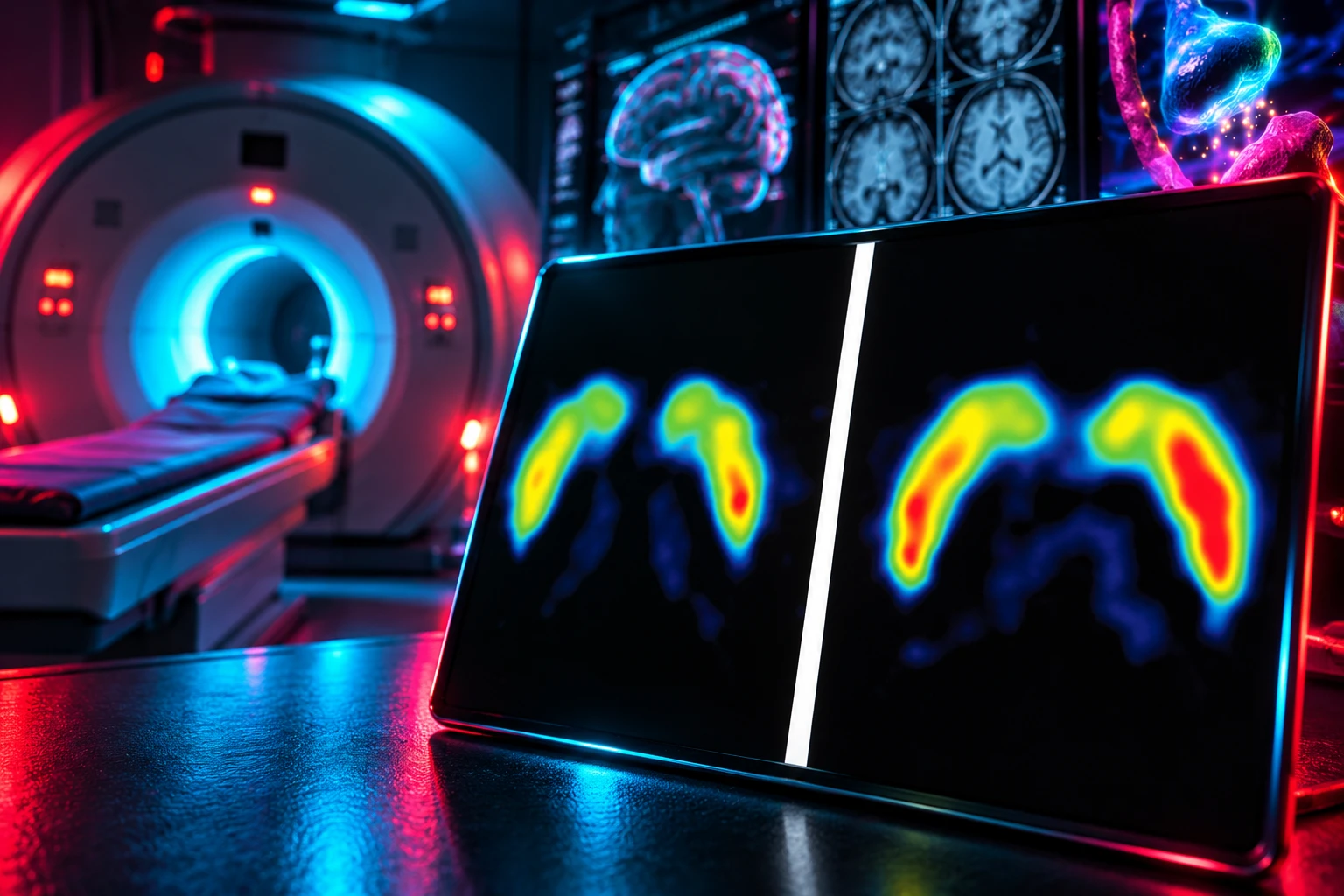
From August 2022 to April 2025, the group injected about 370 MBq of the tracer (+)[11C]DTBZ and scanned each person for 60 minutes. The tracer sticks to vesicular monoamine transporter 2, or VMAT2, a protein on dopamine nerve endings. About 95% of VMAT2 binding in the striatum sits inside dopamine-releasing neurons, so a weaker signal is read as fewer or thinner terminals.
Across the three striatal regions they measured, binding potential averaged 1.60 in long COVID and 1.91 in 24 age-matched healthy controls, a mean difference of -0.31 (95% CI -0.44 to -0.17, P = 4 × 10^-5). The gap held when the control pool grew to 43 people (P = 6 × 10^-4).
STRIATAL VMAT2 BINDING IN THE CAMH PET STUDY
| Region | Long COVID (n=24) | Healthy (n=24) | Difference |
|---|---|---|---|
| Ventral striatum | 1.21 | 1.47 | 20% lower (P = 0.0013) |
| Dorsal putamen | 1.90 | 2.23 | 16% lower (P = 3 × 10^-5) |
| Dorsal caudate | 1.71 | 2.03 | 17% lower (P = 6 × 10^-5) |
Meyer has described that regional pattern as a loss of about 18% of dopamine nerve terminals on average, the unweighted mean of the three percentages in the 16% to 20% lower VMAT2 binding table. People who had COVID-19 and recovered well looked like people who never caught it (1.83 versus 1.81, P = 0.77). Prior infection alone did not produce the deficit.
Why the Loss Maps Onto Apathy, Slowing and Memory
The anatomy lined up with the complaints. Lower ventral striatum binding tracked greater apathy on the Marin Apathy Evaluation Scale. Lower dorsal putamen binding tracked slower finger tapping. Lower dorsal caudate binding tracked worse delayed recall on the Hopkins Verbal Learning Test-Revised (r = 0.58, P = 0.0029). Those links sat in a band of |r| = 0.48 to 0.58 (P = 0.0029 to 0.018).
Brain fog, scored with the Cognitive Failures Questionnaire, moved with the ventral striatum (r = -0.52, P = 0.013). Depression scores on the Beck inventory did not. Time since the original infection, which ranged from 2 to 56 months and sat at a median of 22 months, also failed to explain the scan. The marker was not a simple clock of how long someone had been ill.
Meyer put the clinical reading in blunt language.
Our findings provide compelling evidence that long COVID involves the loss of dopamine-releasing neurons. This kind of injury is well known to produce symptoms like lack of motivation and motor slowing, and may contribute to memory difficulties in other neurological conditions.
Dr. Jeffrey Meyer, senior scientist, CAMH Brain Health Imaging Centre
Calling the syndrome fog undersells what the camera measured. The same pictures still cannot say the cells are gone, which is the fight that now sits under the treatment plan.
Inflammation Came First in the Same Circuits
The VMAT2 study was built on a 2023 CAMH PET paper in JAMA Psychiatry that scanned 20 people with new depression after mild or moderate COVID-19. That earlier work found a high TSPO signal, a marker of gliosis, and the excess sat in regions packed with dopamine neurons.
FROM INFLAMMATION SCANS TO A DRUG BET
- August 2022: Recruitment opens in Toronto for the VMAT2 PET case-control study (CAMH REB 201/2022, Health Canada CTA 138, NCT06086366).
- June 1, 2023: Meyer’s team publishes the TSPO inflammation scans in people with lasting mood and thinking symptoms after COVID-19.
- April 2025: VMAT2 scanning ends (24 patients, 43 controls in the expanded set).
- January 2026: Meyer files a patent on rasagiline and a tyramine-based dopamine precursor for long COVID.
- July 10, 2026: The VMAT2 paper appears in eBioMedicine, funded by Canadian Institutes of Health Research grant 191851.
Meyer has said dopamine neurons carry a high density of ACE2 receptors, the door SARS-CoV-2 uses, and that gliosis can injure those cells. The new scans supply the missing step: the dopamine-terminal marker is lower in the same neighbourhoods, and the loss lines up with symptoms. Lab work in other groups has shown the virus can hit dopamine neurons and push them toward a senescence-like state, which is a separate line of evidence, not a result from this PET cohort.
The Wager Is an MAO-B Inhibitor
Most long COVID brain trials have chased inflammation, leftover virus, or rehab. Almost none have aimed at dopamine terminals. Meyer now wants to flip that.
These results indicate that long COVID is, at least in part, a disorder of the brain’s dopamine system. This suggests that repurposing medications that augment the function of dopamine-releasing neurons, including dopamine precursors and inhibitors of dopamine metabolism, could be a promising approach.
Dr. Jeffrey Meyer, senior scientist, CAMH, in the hospital news release
Funding, he said, lets the group chase one path first. That path is a monoamine oxidase B inhibitor, the class named in the January 2026 patent alongside a tyramine precursor. The hospital holds the filing; Meyer is the inventor. The patent was still pending as of May 19, 2026.
He was explicit about what patients should not do with that news. He said he is not advising anyone to start an MAO-B inhibitor or a dopamine precursor outside a trial, because a trial is how benefit and harm get measured. He also told another group running a dopamine-2 agonist study in depression to record whether volunteers have long COVID, so that dataset is not wasted.
The bet has a practical catch inside the clinic even if the scan is right. Many people with long COVID also live with racing autonomic systems, wrecked sleep and a hair-trigger stress response. Pushing dopamine in that mix can theoretically lift drive while making the wired state worse. A single-drug bet is simple. The bodies in the waiting room are not.
Guedj Calls for Scans That Follow Patients Over Time
Eric Guedj, a nuclear medicine researcher at Aix Marseille University, and Danielle Beckman of Helmholtz Munich wrote the invited commentary on the striatal PET findings. Their opening line is the patient complaint in scientific dress.
What cannot be seen is too often considered uncertain. Long COVID illustrates this difficulty.
Eric Guedj, nuclear medicine, Aix Marseille University, eBioMedicine
They compared the problem to Parkinson’s disease, which often looks normal on routine MRI even while molecular scans show a dopamine deficit. They also drew a hard limit around what VMAT2 can prove. Reduced binding, they wrote, does not necessarily imply irreversible neuronal loss. It may reflect altered vesicular storage, a change in transporter levels, or an adaptive tweak at the synapse. Only repeat scans, and the right disease-control groups, can sort dead terminals from quiet ones.
Guedj’s other caution is wider than one nucleus. Apathy, slow movement and fuzzy memory run through nigrostriatal, mesolimbic and mesocortical loops, and through glia that feed those loops. Older FDG PET work has already shown low brain glucose use in long COVID. In that frame, a low VMAT2 number is one downstream reading of a body-wide injury, not a complete diagnosis and not a license to call the whole illness a dopamine disease.
The 24 Patients Were Young and Newly Symptomatic
The clarity of the dopamine signal comes from a narrow door. That door also caps how far the number should travel.
WHO GOT INTO THE SCANNER
- The patients: 24 adults, mean age 32.2 years, 12 of them women, all from the Greater Toronto Area.
- The illness rule: New brain and mood symptoms within 3 months of PCR- or antigen-confirmed mild or moderate COVID-19, lasting at least 3 months, with no prior neurological disease.
- The symptom bar: Every patient had apathy and at least five features of a major depressive episode on a structured DSM-5 interview.
- The exclusions: No current substance use disorder, no moderate or severe lifetime substance use disorder, and no cigarettes or other substances in the previous 2 months.
- The controls: 24 people matched within 5 years of age, then 19 more, including 24 who had COVID-19 and got well and 19 who never had it.
Meyer wrote that keeping the sample young, non-smoking and previously well made the group effect easier to read, and that this is a trade-off. The mean age is lower than the long COVID population at large. Older, medicated, smoking, or neurologically complicated patients were not in the comparison. The paper itself flags the work as an interim look at a grant that had aimed at about 45 patients so subgroups could be split. Blood tests for dopamine metabolites and neurofilament light did not track the brain signal in this set.
The World Health Organization says about 6 in 100 people who have COVID-19 later meet criteria for post COVID-19 condition. Statistics Canada, in a June 2023 survey with the Public Health Agency of Canada, counted 2.1 million Canadian adults still affected by longer-term symptoms, out of 3.5 million who had ever had them. Those counts are larger and older than 24 PET volunteers. They are the reason a small, clean scan still has a long line behind it.
A Two-Site Pilot Still Has to Be Run
CAMH said in July 2026 that a trial targeting dopamine function would open within a couple of months, with University Health Network, to test memory, motivation and fatigue. Meyer later described a two-site, blinded pilot that randomly assigns people to drug or placebo, with only the research pharmacy unblinded, and a hope of finishing in 2 to 3 years. If money allows, non-responders would be offered open-label drug as a second step. He wants companies to license the patent if the pilot looks decent. His fastest sketch of a full regulatory path was 2 years per trial and three trials, with a chance governments might accept fewer given the lack of options.
As of the latest public materials around that plan, the only ClinicalTrials.gov number attached to this program is NCT06086366, the imaging protocol, not a treatment study.
WHAT WE KNOW
- The scan: VMAT2 binding is 16% to 20% lower across ventral striatum, dorsal putamen and dorsal caudate in this 24-person long COVID group.
- The map: Those regional losses line up with apathy, slower movement and weaker delayed recall.
- The recovered: People who had COVID-19 and got well do not show the same deficit.
WHAT IS UNCONFIRMED
- Cell death: A low VMAT2 signal may be storage change or adaptation rather than missing neurons.
- The drug: No completed trial shows that an MAO-B inhibitor or a dopamine precursor helps long COVID.
- The reach: It is unknown whether older, smoking or already medicated patients carry the same 16% to 20% gap.
Susan Deuville, a lived-experience advisor to Meyer who got COVID-19 in 2021, said the work validates a loss she has been trying to name for five years. Meyer’s own instruction sits beside that hope: do not start the candidate drugs off-label and wait for the blinded pilot to say whether raising dopamine function moves memory, motivation and fatigue.
Disclaimer: This article is news reporting on a published imaging study and on a treatment trial that has been described but not yet shown to work. It is informational only and is not medical advice, a diagnosis, or a recommendation to start, stop, or switch any medicine, including MAO-B inhibitors, dopamine precursors, or other drugs used in Parkinson’s disease or depression. People living with long COVID should talk with a physician who knows this condition, and with a pharmacist if a dopamine-acting drug is being considered, because those medicines have interactions, diet limits, and side effects that this report does not cover. The scan numbers, patent status, and trial plans come from the papers and statements cited here and can change when larger studies and the planned pilot report results.

Ohtani Game 4 Logoman Card Sells for $3.24 Million

Cole Kmet’s Season Ends, and Chicago’s Tight End Plan Starts

NBA Seeks Soccer Money After EuroLeague Clubs Refused

Amazon’s First Bond Tests Leave the Broccoli Chair Empty

Tyrese Maxey Owns the Night Built for LeBron James

Warsh Rejects Rate Guidance and Still Moves Markets

Dana-Farber Exits an MGB Medicare Advantage Network Early

NASA Launches the Roman Space Telescope’s Cosmic Bet

OpenAI’s Cyber Letter Puts the Defense Bill on Governments

Russia Recycles Its Old Warning Over Storm Shadow Plants
-
 BUSINESS2 months ago
Warsh Rejects Rate Guidance and Still Moves Markets
-
 BUSINESS1 month ago
Dana-Farber Exits an MGB Medicare Advantage Network Early
-
 NEWS2 months ago
NASA Launches the Roman Space Telescope’s Cosmic Bet
-
 NEWS2 months ago
OpenAI’s Cyber Letter Puts the Defense Bill on Governments
-
 NEWS2 months ago
Russia Recycles Its Old Warning Over Storm Shadow Plants
-

 ENTERTAINMENT4 weeks ago
Primetime’s $2.7 Million Preview Tops Pitt’s Costlier Film
-

 BUSINESS2 months ago
Jet Drones Lock Down Kyiv and Strip Kherson of Heat
-

 ENTERTAINMENT2 months ago
Midnight Spider-Man Turns Peter Parker Into Oscorp’s Hybrid