
BUSINESS
Core Inflation Hit 3.0 Percent, and Spending Still Surged
August core PCE printed 3.0 percent, below forecast, but a BEA rewrite and a 0.9 percent spending jump keep a late-year Fed hike in play.

The Federal Reserve’s preferred inflation gauge rose 3.0 percent in the year to August, a cooler core PCE reading than economists had built into an October rate hike. The Commerce Department’s Bureau of Economic Analysis, in data released Wednesday at 8:30 a.m. EDT, also showed headline prices up 3.4 percent from a year earlier, against forecasts of 3.7 percent.
The same file showed households lifting spending far faster than pay, and it landed on the day BEA rewrote the accounts back to 2021. Futures bounced and Treasury yields slipped. Traders still have a late-year hike to price.
A 3.0 Percent Core, With July Cut to Match
The personal consumption expenditures price index rose 0.3 percent in August after a 0.1 percent gain in July. Strip out food and energy and the core index rose 0.2 percent, after 0.1 percent. From a year earlier, headline PCE was up 3.4 percent and core was up 3.0 percent.
Economists had expected a 0.3 percent monthly rise in both the headline and core indexes, a 3.7 percent 12-month headline rate, and a 3.3 percent core rate. The misses look larger than the month itself. BEA’s annual update of the National Economic Accounts, published with this release, recast monthly figures from January 2021. July’s previously published 12-month core reading of 3.3 percent was marked down to 3.0 percent, and the old 3.7 percent headline rate was marked down to 3.4 percent, each a 0.3 percentage point cut.
On the new ruler, August did not slow core inflation so much as hold it at the rewritten July pace. Both annual rates remain a full percentage point or more above the Fed’s 2 percent goal.
AUGUST PCE AGAINST JULY AND THE FORECAST
| Measure | July | August | August forecast |
|---|---|---|---|
| PCE prices, month to month | 0.1% | 0.3% | 0.3% |
| Core PCE, month to month | 0.1% | 0.2% | 0.3% |
| PCE prices, year to year | 3.4% (was 3.7%) | 3.4% | 3.7% |
| Core PCE, year to year | 3.0% (was 3.3%) | 3.0% | 3.3% |
Energy did the extra work on the headline monthly rise. Gasoline jumped 4.4 percent, energy goods and services climbed 2.3 percent, and transportation services accelerated 1.4 percent. Goods prices and services prices each rose 0.3 percent.
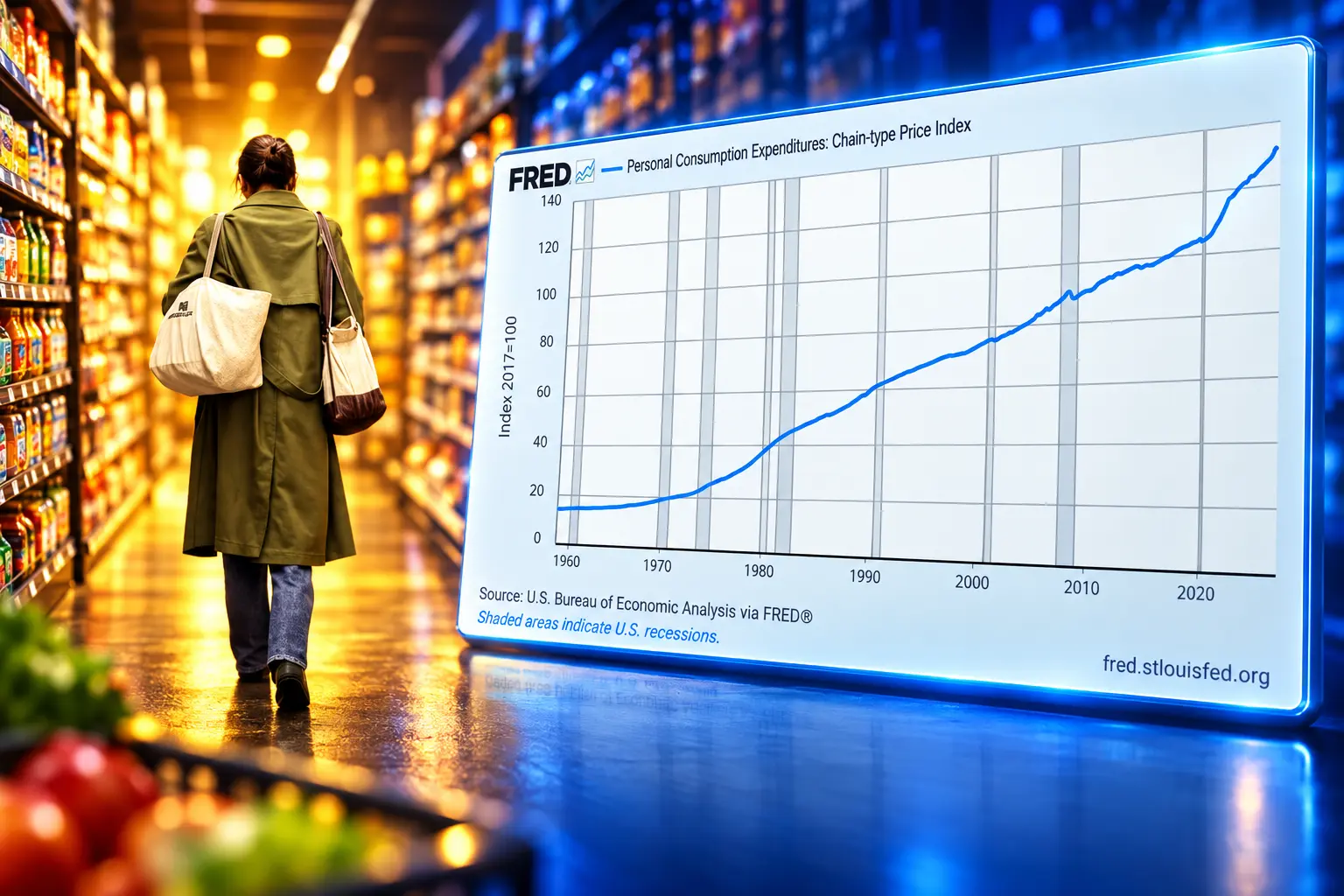
Households Spent Faster Than Their Incomes Grew
Pay barely moved. Personal income increased $66.6 billion, or 0.2 percent, after 0.3 percent in July, short of the 0.4 percent rise economists had penciled in. Disposable income, after taxes, rose $68.6 billion, or 0.3 percent. After prices, real disposable income was unchanged, at 0.0 percent, following a 0.3 percent gain in July.
Spending did not wait. BEA said personal consumption expenditures increased 0.9 percent, or $190.8 billion, after 0.1 percent in July, against a 0.8 percent forecast. In real terms, volume rose 0.6 percent, or $92.8 billion, after 0.1 percent.
Goods took $114.1 billion of that current-dollar rise and services took $76.7 billion. Personal outlays rose $190.7 billion. The leftover was thin: personal saving was $990.2 billion and the saving rate was 4.1 percent of disposable income. Compensation and government social benefits, led by private wages, Medicare, and Social Security, accounted for most of the income gain. They did not keep up with the cart.
INCOME, SPENDING, AND WHAT WAS LEFT
- Pay: Current-dollar income rose 0.2 percent, and real disposable income was flat at 0.0 percent.
- The bill: Nominal spending jumped 0.9 percent, and real spending rose 0.6 percent.
- The mix: Goods accounted for $114.1 billion of the $190.8 billion rise in spending, services $76.7 billion.
- The residual: Saving stood at $990.2 billion, 4.1 percent of disposable income.
A one-month burst can reverse. A 0.9 percent rise against a 0.0 percent real pay reading is still the demand the Fed has been trying to cool, and it arrived in the same release as the friendlier inflation rate.
What the BEA Changed in the Price Gauge
Wednesday was the first time BEA issued its national, industry, and regional annual updates on the same morning. The open window for the national accounts ran from the first quarter of 2021 through the first quarter of 2026. The agency said it changed how it computes several pieces of the PCE index; the published 0.3 percentage point markdown in July’s annual core rate is the combined result of new source data and those recipes, not a single switch.
RBC Economics, in a note issued before the release, had already flagged three changes to the methodology and warned against reading a soft Wednesday print as fresh disinflation. The firm put the method-only effect near 18 basis points on the annual core pace, which would have taken July’s old 3.3 percent core rate to about 3.1 percent. The published July core rate came down a full 0.3 percentage point, to 3.0 percent, so other annual-update source data moved the series too.
THE THREE PRICE RECIPES BEA REWROTE
- Portfolio management: The old deflator treated rising advisory bills as inflation when asset values rose, even if the fee rate did not. BEA now builds the quantity side from employment and hours data instead of that price path.
- Computer software: The category keeps a price deflator, but it is now a composite of producer and consumer indexes rather than the consumer software index alone.
- Legal services: The consumer legal-services index had been suppressed as unreliable; a new deflator replaces it.
Portfolio management had been adding about 0.28 percentage point to annual core PCE since November 2025, on RBC’s figures, with a 1.7 percent weight in core and an old deflator averaging 14.1 percent year over year against about 12.3 percent on the new implied index. Software is a small slice of the consumer price basket and a much larger slice of core PCE, which is why a deflator change there moves the Fed’s gauge more than the CPI. The 3.0 percent core rate is the official series. It is also a series whose recent history was just recast.
Williams Takes the October Meeting Off the Clock
New York Fed President John C. Williams, speaking Tuesday at the University at Buffalo, had already told markets not to treat the next meeting as automatic. He is vice chair of the Federal Open Market Committee, and his line sits close to the middle of the table. On September 16 the FOMC target range of 3.75 percent to 4 percent was set by a quarter-point rise, a 12-0 vote and the first increase since 2023.
With the policy action we took at our September meeting, there is no need for urgency, and we have time to gather more information.
John C. Williams, President, Federal Reserve Bank of New York, University at Buffalo, September 29, 2026
If the economy tracks his forecast, he said, “one further upward adjustment of the federal funds target range may be appropriate late this year.” He also said that is only a forecast, and that “time, and the totality of the data, will tell.” Fed Governor Michael Barr, speaking the same day, said further policy adjustments were still likely to be needed.
Williams was still citing 3.7 percent inflation on Tuesday, the July headline rate then on the books. By Wednesday morning that July headline rate was 3.4 percent and core was 3.0 percent. CME FedWatch had put the chance of another quarter-point move at the October 27 and 28 meeting near 70 percent before he spoke, then near 50 percent after the speech. Interest-rate swaps on Wednesday priced about a 36 percent chance of an October hike, down from roughly even money before the report.
David Russell, global head of market strategy at TradeStation, said the print was “good news for investors worried about the recent surge in bond yields, and it bolsters the case for not hiking in October.” He added that it is “relatively old data at this point that doesn’t reflect this month’s surge in diesel prices.”
Second-Quarter Demand Was Marked Up to 4.6 Percent
The inflation file was not the only rewrite. Real GDP rose at an annual rate of 2.2 percent in the second quarter, the third estimate, up 0.7 percentage point from the 1.5 percent second estimate and the 1.5 percent advance. First-quarter growth was revised to 2.5 percent. Consumer spending, investment, and exports lifted the second quarter; imports, which subtract from GDP, also rose.
Fed officials watch real final sales to private domestic purchasers, consumer spending plus private fixed investment, to strip out trade, inventories, and government. That measure rose 4.6 percent, revised up 0.4 percentage point from 4.2 percent and up from a 3.9 percent advance reading. Real gross domestic income rose 2.6 percent. Current-dollar GDP rose 8.5 percent.
The annual update also cut the second-quarter price story. The PCE price index rose 5.0 percent, 0.3 percentage point below the 5.3 percent second estimate. Core PCE rose 3.3 percent, 0.3 percentage point below 3.6 percent.
HOW THE SECOND-QUARTER VINTAGES MOVED
| Measure (annual rate) | Advance | Second | Third |
|---|---|---|---|
| Real GDP | 1.5% | 1.5% | 2.2% |
| Real final sales to private domestic purchasers | 3.9% | 4.2% | 4.6% |
| PCE price index | 5.1% | 5.3% | 5.0% |
| Core PCE price index | 3.4% | 3.6% | 3.3% |
Williams, a day earlier, had described real GDP as growing at about 2 percent over the past year and said momentum was “solid and even showing signs of strengthening.” He put this year’s and next year’s growth at about 2.25 percent, a touch above his longer-run trend, with the jobless rate edging down toward 4 percent. A 4.6 percent private-demand reading is the part of Wednesday’s GDP file that matches that description, and it sits poorly next to a victory lap on prices.
August Missed September’s Diesel Jump
Williams named three forces behind the past year and a half of higher inflation: tariffs on imported goods, supply shocks and energy costs from conflicts in the Middle East, and heavy demand for goods tied to the AI buildout. Tariffs, he said, are no longer adding to goods-price inflation, though new levies could change that. The other two are still in the price path.
Refining capacity is tight, he said, and that is lifting not only crude but the spread of gasoline and diesel over oil. AI demand, in his account, is still beating available supply in a handful of goods that feed into other consumer and business prices. Housing services have slowed, the labor market is not adding to inflation on his read, and survey and market measures of inflation expectations remain anchored. He said he has not seen those shocks spill into broader, lasting inflation, and he now expects “somewhat larger and longer-lasting effects from energy prices.”
That is why Russell’s diesel warning sits on the same page as the 3.0 percent core. August’s 4.4 percent gasoline jump is already in the headline index. September’s diesel move is not. Core PCE is built to look through energy, which is why a 3.0 percent core can print while pump prices and household food bills feel like a different country. Food is outside core by design. The cooler gauge does not say groceries got cheaper.
Williams expects overall inflation at 3.5 percent this year, then just above 2 percent next year, and 2 percent in 2028, as tariff effects fade, energy prices settle, and AI-related supply catches demand. He also said the inflationary impact of the AI demand shock is “increasingly salient.” A 3.0 percent core in August, on a rewritten series, does not settle that argument. It buys time, which is what he asked for.
A Late-Year Hike Remains in the Forecast
The committee meets next on October 27 and 28, then on December 8 and 9. BEA will publish September personal income and outlays on October 29 at 8:30 a.m. EDT, a day after the October decision, so that meeting will not have a fresh PCE reading in hand. December will.
Williams’s own test is whether the economy evolves in line with a forecast that still includes one more increase “late this year” to bring inflation back to 2 percent on a faster path. Wednesday’s 3.0 percent core, 0.2 percent monthly core, and 36 percent October odds give him the pause he wanted. Wednesday’s 0.9 percent spending rise, 0.0 percent real disposable income, and 4.6 percent second-quarter private demand are the figures that keep that late-year adjustment from dropping out of the forecast.
The 3.0 percent core is now the official year-ago rate. It is also a rate that matches a rewritten July, in a month when households spent faster than they earned, while diesel and AI hardware sit in the next prints. That is the file the Fed will carry into December.
Disclaimer: This article is news reporting and analysis of Bureau of Economic Analysis figures and Federal Reserve remarks, and it is for information only. It is not investment advice, a recommendation to buy or sell bonds, stocks, or other securities, or a forecast you should trade on. Readers who are making decisions about loans, deposits, or portfolios should consult a licensed financial adviser or investment professional who can consider their own circumstances. Inflation rates, growth figures, and policy odds are those published by the named sources on September 30, 2026, and they will change as later data and meetings arrive.

Ohtani Game 4 Logoman Card Sells for $3.24 Million

Cole Kmet’s Season Ends, and Chicago’s Tight End Plan Starts

NBA Seeks Soccer Money After EuroLeague Clubs Refused

Amazon’s First Bond Tests Leave the Broccoli Chair Empty

Tyrese Maxey Owns the Night Built for LeBron James

Warsh Rejects Rate Guidance and Still Moves Markets

Dana-Farber Exits an MGB Medicare Advantage Network Early

NASA Launches the Roman Space Telescope’s Cosmic Bet

OpenAI’s Cyber Letter Puts the Defense Bill on Governments

Russia Recycles Its Old Warning Over Storm Shadow Plants
-
 BUSINESS2 months ago
Warsh Rejects Rate Guidance and Still Moves Markets
-
 BUSINESS1 month ago
Dana-Farber Exits an MGB Medicare Advantage Network Early
-
 NEWS2 months ago
NASA Launches the Roman Space Telescope’s Cosmic Bet
-
 NEWS2 months ago
OpenAI’s Cyber Letter Puts the Defense Bill on Governments
-
 NEWS2 months ago
Russia Recycles Its Old Warning Over Storm Shadow Plants
-

 ENTERTAINMENT4 weeks ago
Primetime’s $2.7 Million Preview Tops Pitt’s Costlier Film
-

 BUSINESS2 months ago
Jet Drones Lock Down Kyiv and Strip Kherson of Heat
-

 NEWS2 months ago
Congo Starts Ervebo Vaccinations for a Different Ebola Virus