
BUSINESS
Tanker Strikes Off Qatar Put the Bypass in Range
Strikes off Qatar, Fujairah and the UAE hit the oil and LNG routes still working after Hormuz closed in February.

A tanker was hit by multiple projectiles 51 nautical miles (94 km) north of Qatar on 7 October, with casualties, the United Kingdom Maritime Trade Operations centre said. A Marshall Islands-flagged very large crude carrier burned about 40 kilometres off Fujairah the next day, and on 9 October UKMTO recorded another projectile strike off the UAE. All three sites sit outside the Strait of Hormuz, which has not been a normal commercial lane since 28 February.
The leftover oil pipes, the Fujairah loading port and Qatar’s gas, which has no other way out, now sit in that wider ring.
Multiple Projectiles, Casualties and a Ship Off Qatar
UKMTO timed the Qatar attack at 1900 UTC on 7 October and issued its Warning 158-26 attack notice from a tanker that reported being struck by several projectiles. Casualties were reported. The agency gave no number of dead or injured and did not name the ship or the attacker. Authorities were investigating, and other vessels were told to transit with caution.
UKMTO WARNING 158-26
Click here to view the full product⤵️ https://t.co/eljQkk03bG#MaritimeSecurity #MarSec pic.twitter.com/4u3X6rEHaB
— UKMTO Operations Centre (@UK_MTO) October 7, 2026
Maritime intelligence firm Vanguard identified the ship as Acers, an oil and chemical tanker flagged in Antigua and Barbuda, carrying cargo and heading toward Hormuz. The position is inside Qatar’s exclusive economic zone, off Madinat ash Shamal. Qatar had not commented. It was the first reported attack in that part of the Gulf in more than six months.
The Qatar hit is not a shot across a strait convoy. It is a strike on a laden tanker well inside the Gulf, far from the contested lane at Musandam.
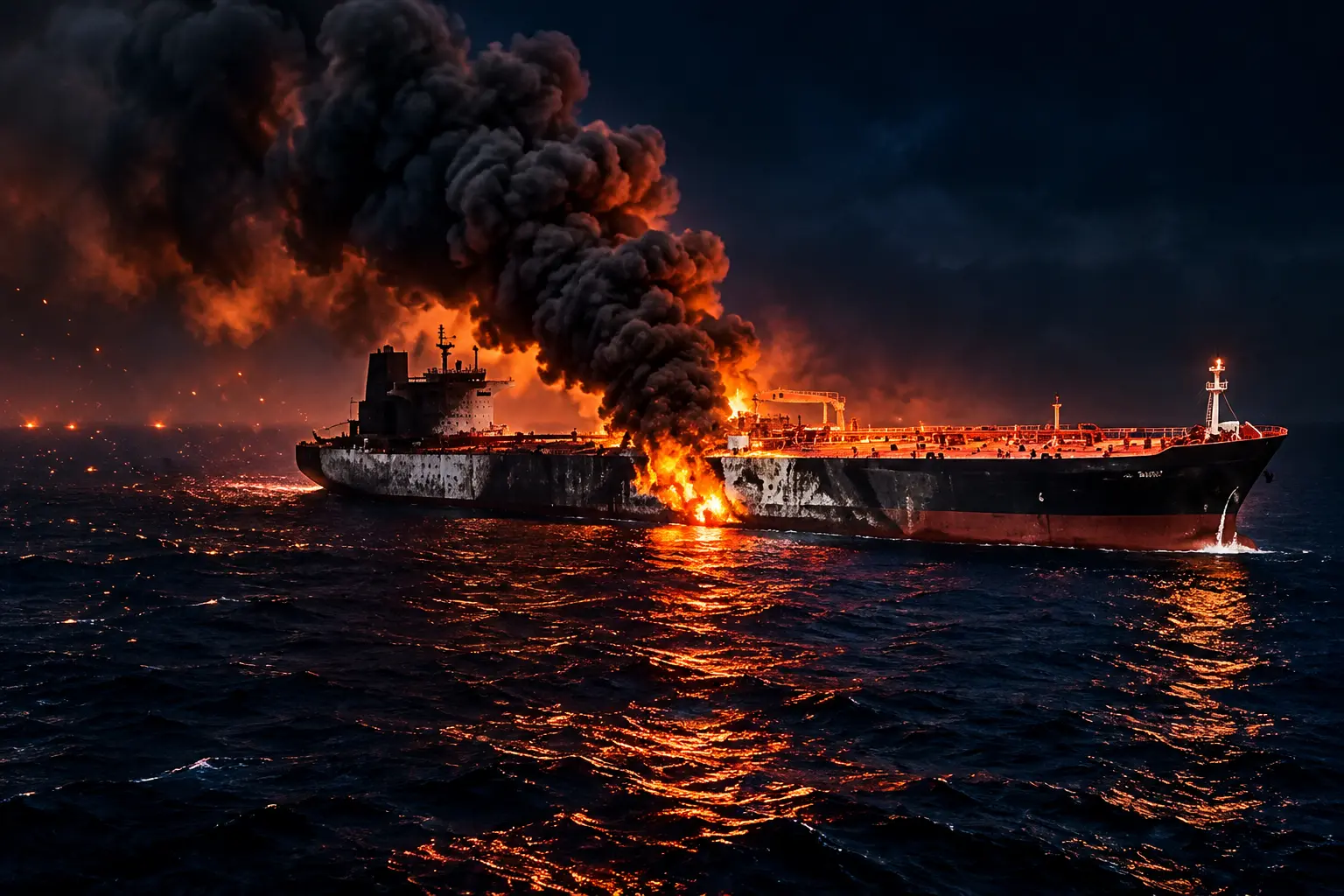
A Fire Off Fujairah Hits the Oil Workaround
Trackers using NASA’s Fire Information for Resource Management System flagged a blaze on a Marshall Islands-flagged VLCC off Fujairah, in the Gulf of Oman, on 8 October. AIS and Marine Traffic listings matched the hull to Dhalkut. UKMTO had not posted a matching incident when the fire was first seen. The cause was not immediately clear. Iran’s armed forces and media tied to the Islamic Revolutionary Guard Corps did not claim it.
US military aircraft were over the area at the time, including two KC-46 tankers, a KC-135, a P-8A maritime patrol aircraft and several helicopters. Brett Erickson, managing principal at Obsidian Risk Advisors, warned that a fire that close to the Gulf of Oman ship-to-ship transfer patch would threaten the network that has been used to move crude around the closed strait. Other trackers placed Dhalkut on the transit lane rather than on the transfer grounds. The hull still burned next to the UAE’s one Indian Ocean oil outlet.
WHAT WE KNOW
- The hull: Dhalkut is a Marshall Islands-flagged VLCC, identified from AIS and fire-detection passes off Fujairah.
- The watchers: NASA FIRMS recorded the fire; UKMTO did not log a matching attack in its public list that day.
- The air picture: US tankers, a P-8A and helicopters were overhead while the ship burned.
WHAT IS UNCONFIRMED
- The weapon: No public notice has named a projectile, a mine or an onboard accident as the cause.
- The crew: No official count of dead, missing or injured has been issued for Dhalkut.
- The claim: Tehran has not formally taken responsibility for the Fujairah fire or the Qatar strike.
Fujairah is where Abu Dhabi loads crude that has already skipped Hormuz through the Habshan-Fujairah pipeline. A burning VLCC off that coast is a problem for the workaround, not for a strait that was already barely used as a civilian highway.
Why Qatar’s LNG Has Nowhere Else to Go
The Qatar attack also sits on a gas problem that oil pipelines cannot fix. Ras Laffan, north of the same coast, is built to send liquefied natural gas out through Hormuz. There is no east-coast LNG pipe equivalent of Fujairah. Saad Sherida Al-Kaabi, Qatar’s minister of state for energy affairs and chief executive of QatarEnergy, told the Qatar Economic Forum on 21 September that neighbours had offered land for a bypass and that Doha had turned it down.
The problem is that LNG, our main export commodity, cannot be transported by pipelines. We will have to transport it by pipelines as gas and then liquify it at receiving terminals wherever that may be. This means we are building redundant facilities to the ones we are already building in Qatar as part of the North Field expansion project. This makes no economic sense.
Saad Sherida Al-Kaabi, Minister of State for Energy Affairs and QatarEnergy CEO, Qatar Economic Forum, 21 September 2026
Al-Kaabi said attacks on Ras Laffan had damaged two LNG trains and a gas-to-liquids plant. He put GTL repairs in the first quarter of 2027 and said the two LNG trains would take three years. Undamaged kit, he said, could return to normal within a few weeks if Hormuz reopened. Until then, a projectile 51 nautical miles north of Madinat ash Shamal is a strike in the water that Qatari gas still has to cross.
WHAT BLOCKS QATAR’S GAS FROM LEAVING
- No LNG pipe: Liquefied gas cannot ride the same bypass lines that move crude to Fujairah or Yanbu.
- Plant damage: Two LNG trains and a GTL unit at Ras Laffan were hit earlier in the war.
- Repair time: Al-Kaabi put GTL back in the first quarter of 2027 and the LNG trains on a three-year clock.
- Policy choice: QatarEnergy rejected a neighbour-hosted gas pipe because it would copy liquefaction kit already being built at home.
Oil can be walked around the strait, at a cost. Qatari LNG still needs the water.
Friday Adds a Strike 13 Miles Off the UAE
On 9 October UKMTO posted a further attack, this one 13 nautical miles (24 km) west of Al Jazeera in the UAE. Multiple sources told the centre a vessel had been struck by an unknown projectile, starting a fire that was later put out. Crew status, damage and any pollution were unknown. The agency again advised caution and said authorities were investigating.
Iran’s IRGC Navy said it had hit an LPG carrier it named NV Sunshine on an unauthorised route south of Hormuz, with a fire in the engine room and propulsion. UKMTO did not name the ship and did not assign blame. The IRGC line, if it holds as policy, tries to turn “approved lanes” into a permission slip for any hull in the wider Gulf and Gulf of Oman.
THE WEEK OUTSIDE HORMUZ
| Date | Place | What was logged |
|---|---|---|
| 7 October | 51 NM north of Madinat ash Shamal, Qatar | Tanker hit by multiple projectiles; casualties; Vanguard names Acers |
| 8 October | About 40 km off Fujairah, Gulf of Oman | Fire on Marshall Islands VLCC Dhalkut; FIRMS detection; no UKMTO file that day |
| 9 October | 13 NM west of Al Jazeera, UAE | Unknown projectile; fire extinguished; crew and damage unknown |
UKMTO’s recent incidents log still shows most October files inside Hormuz, on 1, 2, 3, 4, 5 and 6 October, before the Qatar and UAE reports. The new files are the ones that change the map for anyone still loading at Fujairah or sitting in Qatari waters.
Tehran Now Names the Indian Ocean
Brigadier General Majid Ibn al-Reza, Iran’s acting defence minister, wrote on 8 October that the battlefield, not speeches, would settle the range of the war. He was answering US threats, and he tied the Sea of Oman to waters much farther out.
Our missiles determine the distance between you and us. Yesterday the Sea of Oman, today the Indian Ocean, and tomorrow the Bay of Pigs. Make a mistake, and you will see a new map being drawn.
Brigadier General Majid Ibn al-Reza, acting defence minister, social media post, 8 October 2026
He mocked Washington for “sketching war in the Pentagon’s kindergarten.” Yahya Rahim Safavi, a senior military adviser to Ayatollah Mojtaba Khamenei, had already said that if the United States or Israel attacked again, Tehran could push the war “as far as the Indian Ocean or other places.” Iran’s army spokesman said forces were ready for pre-emptive operations to stop what he called enemy aggression.
Ibn al-Reza took the job after Aziz Nasirzadeh, the defence minister, was killed on 28 February, the first day of the war. President Masoud Pezeshkian has nominated Mehrdad Akhlaqi as a permanent replacement, with a parliamentary confidence vote due on 18 October. IRGC-linked outlets, without a formal claim on Acers or Dhalkut, had already suggested that operations against ships accused of breaking Iranian rules now ran beyond the strait.
How Much Oil the Bypass Routes Still Move
The International Energy Agency, in an 18 September note by Toril Bosoni, head of the oil industry and markets division, put August flows of 7.6 million barrels a day through Hormuz, 13.1 million barrels a day below pre-war levels. Cumulative export losses on that waterway were approaching 2.8 billion barrels. Some oil still moves with US military support. That is residual traffic, not the old commercial stream.
Saudi and UAE barrels that skipped the strait rose from 4.1 million barrels a day in February, out of Yanbu on the Red Sea and Fujairah on the Gulf of Oman, to a high of 7.8 million in June. Houthi attacks in the Red Sea then cut those combined flows to 5.5 million in August. The IEA said the bypass had offset more than 500 million barrels, or 2.8 million barrels a day, of Hormuz losses. Attacks on the Saudi East-West pipeline then shut that line in early September, taking Yanbu down further and leaving Fujairah as the main Indian Ocean tap.
WHERE THE BARRELS WENT AFTER FEBRUARY
| Route | IEA figure | Status |
|---|---|---|
| Hormuz seaborne oil, August | 7.6 million barrels a day | 13.1 million below pre-war; some escorted residual flow |
| Yanbu plus Fujairah bypass | 4.1 million in February, 7.8 million in June, 5.5 million in August | Red Sea attacks, then East-West shutdown in early September |
| Bypass offset since February | More than 500 million barrels, 2.8 million barrels a day | Cannot replace Qatari LNG |
| Observed oil stocks | 507 million barrels lower than at the start of the war | Draws at 2.8 million barrels a day over six months |
IEA member countries had released more than 300 million barrels of emergency stocks from 11 March. Even then, Bosoni wrote, buffers were thinning and any further hit to production or exports would show up in prices and demand. Ship counts tell the same story in a sharper drop: research for the Sasakawa Peace Foundation recorded that daily transits fell from 95 ships to 4 between 27 February and 2 March.
Iraq, Kuwait, Qatar, Bahrain and Iran have no pipeline that walks crude around Hormuz. The UAE’s Fujairah line and Saudi Arabia’s Red Sea line were the hedge. One of those hedges is already damaged. The other is now a fire zone.
Trump Calls the War a Small Price
At a midterm campaign rally in Nebraska, US President Donald Trump defended the decision to go to war with Iran. “This is a small price to pay for keeping the world and our country safe. They can destroy a city. Let them destroy it. Let them destroy Los Angeles, let them destroy San Diego,” he said. After criticism, he told a Texas rally on 8 October, “We protect our own cities. We will not allow such a thing to happen.”
War-risk cover for a ship sitting off Fujairah or north of Qatar is no longer priced as a quiet waiting area behind a closed strait. Captains have already turned back after IRGC radio orders, even on routes that had US air cover. Ibn al-Reza’s list now runs from the Sea of Oman to the Indian Ocean. The 9 October fire off the UAE was put out; the crew’s status had not been issued, and parliament still has to vote on a permanent defence minister on 18 October.

Ohtani Game 4 Logoman Card Sells for $3.24 Million

Cole Kmet’s Season Ends, and Chicago’s Tight End Plan Starts

NBA Seeks Soccer Money After EuroLeague Clubs Refused

Amazon’s First Bond Tests Leave the Broccoli Chair Empty

Tyrese Maxey Owns the Night Built for LeBron James

Warsh Rejects Rate Guidance and Still Moves Markets

Dana-Farber Exits an MGB Medicare Advantage Network Early

NASA Launches the Roman Space Telescope’s Cosmic Bet

OpenAI’s Cyber Letter Puts the Defense Bill on Governments

Russia Recycles Its Old Warning Over Storm Shadow Plants
-
 BUSINESS2 months ago
Warsh Rejects Rate Guidance and Still Moves Markets
-
 BUSINESS1 month ago
Dana-Farber Exits an MGB Medicare Advantage Network Early
-
 NEWS2 months ago
NASA Launches the Roman Space Telescope’s Cosmic Bet
-
 NEWS2 months ago
OpenAI’s Cyber Letter Puts the Defense Bill on Governments
-
 NEWS2 months ago
Russia Recycles Its Old Warning Over Storm Shadow Plants
-

 ENTERTAINMENT4 weeks ago
Primetime’s $2.7 Million Preview Tops Pitt’s Costlier Film
-

 BUSINESS2 months ago
Jet Drones Lock Down Kyiv and Strip Kherson of Heat
-

 ENTERTAINMENT2 months ago
Midnight Spider-Man Turns Peter Parker Into Oscorp’s Hybrid