
NEWS
The Ceasefire That Packed Gaza Behind a Yellow Line
Islamic Relief says a Palestinian in Gaza is killed or wounded every 90 minutes, as the Yellow Line now holds 65 percent of the Strip.

Islamic Relief says Israeli attacks have killed or injured one Palestinian every 90 minutes in Gaza since the October 2025 ceasefire. The UK-based charity, in a statement dated October 8, 2026, counted at least 1,454 Palestinians killed and more than 5,000 wounded over the year, including 320 children.
Those figures arrived with a map the ceasefire was supposed to freeze. Islamic Relief says Israel used the Yellow Line to push Palestinians out of 65 percent of Gaza, crowding 2.1 million people into the remaining 35 percent.
How Many Palestinians Have Been Killed Since the Ceasefire?
Islamic Relief’s ceasefire-year toll is 1,454 killed and more than 5,000 wounded, a rate it puts at one casualty at least every 90 minutes, with a child killed almost every day. The charity’s count runs from the ceasefire announcement through October 8, 2026. Gaza’s Health Ministry, compiled by the Israeli rights group Gisha through October 7, lists a similar year of attacks, and Gisha’s war-long ledger stands at 74,250 Palestinians killed since October 2023 and 175,278 wounded, in a population of 2.1 million.
THE CEASEFIRE YEAR IN NUMBERS
| Metric | Figure | Source |
|---|---|---|
| Killed since the ceasefire | 1,454 | Islamic Relief, October 8, 2026 |
| Wounded since the ceasefire | more than 5,000 | Islamic Relief, October 8, 2026 |
| Children among those killed | 320 | Islamic Relief, October 8, 2026 |
| Killed since October 2023 | 74,250 | Gisha, October 8, 2026 |
| Wounded since October 2023 | 175,278 | Gisha, October 8, 2026 |
On October 9, 2026, more than 100 aid and rights groups said Israeli strikes, shootings and raids had killed more than 1,400 Palestinians over the year, including at least 327 children by the Health Ministry’s count in their notes, and that rescue crews had pulled more than 630 bodies from rubble, often by hand. The joint letter also cited the UN human rights office on people still buried in ground under Israeli military control.
An Islamic Relief aid worker in Gaza, named withheld for safety, described the year in the October 8 release.
There is no ceasefire in reality. They target displacement camps and crowded areas, so there is still a lot of fear. We are scared to even leave our homes, and of the noise of the drones above us. Even our homes themselves are unsafe. It’s hard to think you could be next. The killing is non-stop and we cannot live our lives normally.
Islamic Relief aid worker in Gaza, name withheld, October 8, 2026 statement
A year of that tempo is being treated, in public argument, as the background cost of an unfinished pullback rather than a break in the war. Israel says it fires on militants who probe the line. Hamas remains armed in the west of the Strip, which is the condition Jerusalem now sets for any further withdrawal.
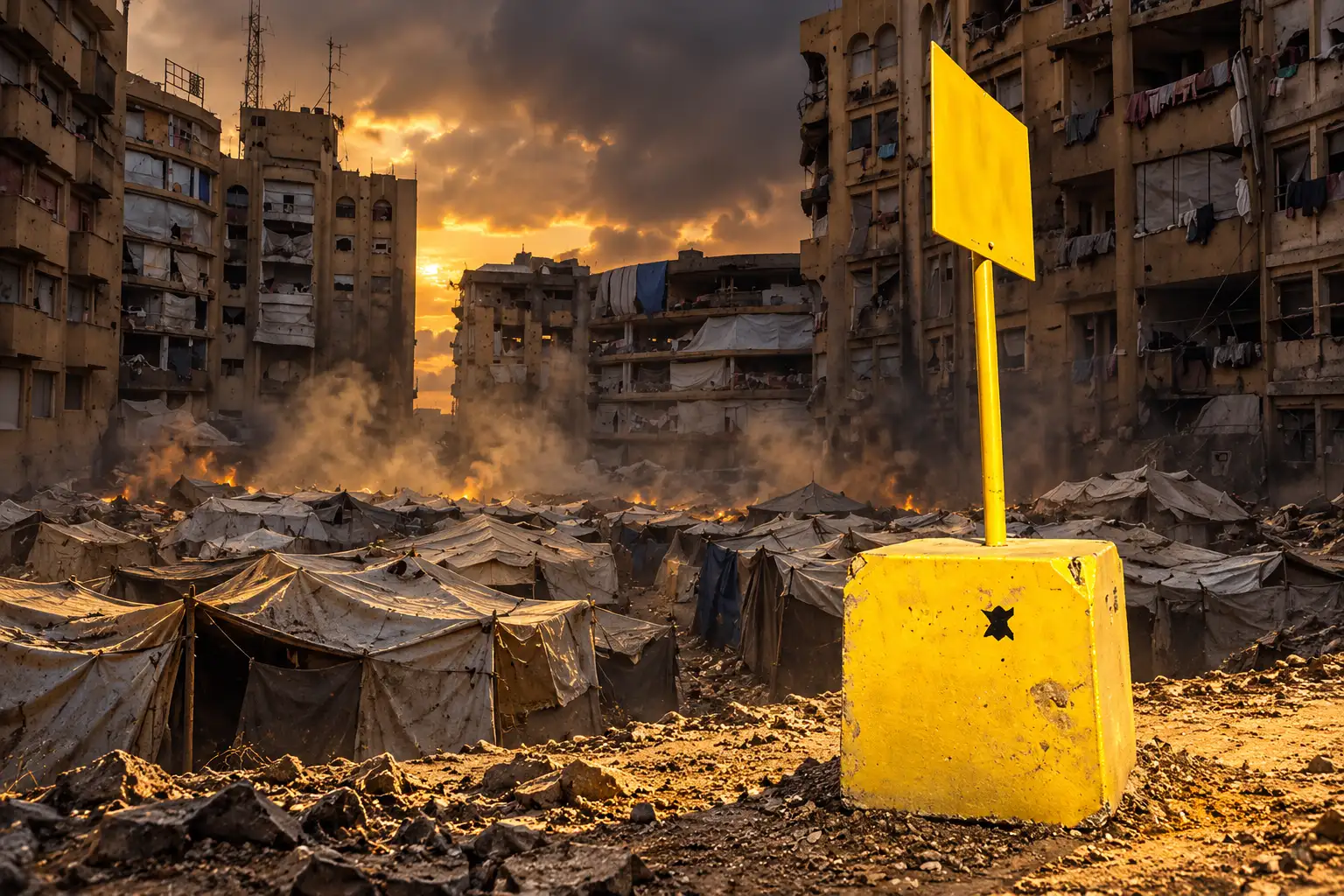
The Yellow Line Now Holds 65 Percent of Gaza
Israel and Hamas signed the first phase of a US-backed deal in Sharm el-Sheikh on October 9, 2025. The ceasefire took effect at noon on October 10, 2025, after Israel’s cabinet approved it. Israeli forces pulled back to an agreed Yellow Line that left them in control of about 53 percent of the Strip, with Hamas in de facto control of the rest, and living hostages were handed over in the days that followed.
The line was marked with painted concrete blocks, berms and towers. It was sold as a temporary deployment, the first of staged withdrawals on a White House map. A year later the blocks have been moved west, an Orange Line of extra permits has been laid over more ground, and Islamic Relief says Palestinians have been forced out of 65 percent of Gaza.
FROM A WITHDRAWAL LINE TO A HOLDING LINE
- October 9, 2025: Israel and Hamas sign first-phase terms in Sharm el-Sheikh, with a map for a staged Israeli pullback.
- October 10, 2025: Ceasefire takes effect at noon. Israeli forces withdraw to the Yellow Line, about 53 percent of the Strip.
- May 2026: Prime Minister Benjamin Netanyahu says Israel controls 60 percent of Gaza and directs the army toward 70 percent. Zikim Crossing, used for goods into the north, closes on May 24.
- December 2025: Lt. Gen. Eyal Zamir, Israel’s military chief of staff, calls the Yellow Line a new border line, a forward defensive line for Israeli communities and a line of operational activity.
- September 12, 2026: UN staff report that Israeli forces have pushed the line inwards through Gaza and that Palestinians now live in less than 40 percent of the land.
- October 8, 2026: Islamic Relief says 65 percent of Gaza is closed to Palestinians and 2.1 million people are crowded into about 35 percent.
Jake Godin, a senior researcher at Bellingcat, has counted 32 Israeli outposts on satellite imagery along the line, sitting roughly 1 to 3 miles inside Gaza from the boundary with Israel. The Israeli military has said it establishes bases in Gaza according to its defense concept, operational needs and the ceasefire agreement. Soldiers have told visiting reporters that they are clearing tunnels on the Israeli-controlled side and removing almost every structure they find there.
Netanyahu, speaking near the line in September 2026, put the hold in plain terms. “We are not withdrawing. We are staying on this line. We control 60% of the Strip,” he said, adding that more would come. In May he had already told an audience that the army’s next mark was 70 percent. The original 53 percent share is the figure in the first-phase maps. The 65 percent figure is Islamic Relief’s count of land Palestinians have been pushed off. Netanyahu’s 60 percent and 70 percent are his own claims about control, not a third survey of the same map.
Families Prepare for a Third or Fourth Winter in Camps
Almost the entire population of the Strip is displaced inside the western zone, the UN has said. Families in Al-Tuffah and Zeitoun have stayed next to the painted blocks because they have nowhere else to go. Ibtisam Malika, a Zeitoun resident, told UN staff that her household is forced to move every two to three months and leave belongings behind. Safaa Mushtaha, in Al-Tuffah, said the daily question is where they could even go.
Islamic Relief says displaced families live in overcrowded sites infested with rodents that bite children as they sleep and contaminate water. Many are preparing for a third or fourth winter in damaged tents or buildings without walls. On September 16, 2026, a war-damaged building in Gaza City collapsed, killing 21 people, including 12 children, while they sheltered inside.
LIFE INSIDE THE 35 PERCENT
- Housing stock: Around 82 percent of structures in Gaza are damaged or destroyed, Islamic Relief says, and rebuilding has barely begun a year after the ceasefire announcement.
- Schools: 93 percent of schools are damaged or destroyed, leaving an entire school-age cohort with few safe classrooms.
- Shelter need: 1.98 million people, 94 percent of the population, need shelter aid, and 84 percent of families live in tents or rooms that do not keep out weather, according to UN assessments.
- Camps: Gaza’s Ministry of Social Development has said 1.2 to 1.5 million people live in tent encampments, with 70 to 80 percent of tents worn out, and that 200,000 tents and 300,000 tarps are needed before winter.
- Flood risk: More than 400 displacement camps, home to about 235,000 people, sit at heightened flood risk, the Site Management Cluster has estimated.
- Food: 1.4 million people are forecast to face crisis-level hunger by winter unless farmers can reach land east of the Yellow Line and more aid is let in.
Most of what used to be Gaza’s farmland now sits east of the line, under Israeli military control, which blocks any serious restart of local food production. Gisha has also warned that Israel changes both the Yellow Line and the Orange Line often enough that families near the blocks have to move again, and that aid routes shift with them.
Hospitals Run on Rationed Fuel and Missing Parts
The October 9 joint letter said not one of Gaza’s 36 hospitals is fully functioning. Islamic Relief, a day earlier, said more than half of all health services have shut down, and that field clinics regularly close or cut hours because fuel and supplies are short. Medicine for diabetes is scarce, the charity’s staff reported, and cancer patients and people with chronic disease are going without treatment.
THE HEALTH SYSTEM AFTER THE TRUCE YEAR
- Hospitals: None of Gaza’s 36 hospitals is fully functioning, the October 9 letter said.
- Patients blocked: More than 20,000 severely ill patients remain blocked from leaving Gaza for treatment, Islamic Relief said.
- Deaths waiting: Over 1,000 patients have died waiting for evacuation, according to the joint letter.
- Power and parts: Engine oil and spare-part shortages have forced hospitals to ration power, and ambulances have been grounded, OCHA has reported in the groups’ notes.
Israel has barred patients from leaving for the West Bank or Israel since October 2023. A petition to overturn that policy reached a High Court hearing on July 19, 2026. The justices declined to order a change and told the state to file an update by December 21, 2026. The state’s May filing argued that because some patients can leave for third countries, there is no basis to require treatment in Israel or the West Bank. Gisha, which brought the case, says the number who get out still falls far short of need. Between February 2 and September 5, 2026, the EU mission at Rafah counted 2,224 patients among 5,977 people who exited through that crossing.
Israel Calls the Yellow Line a New Border
Israel’s public case is that Hamas has not disarmed, so the army will not roll the line back. On August 9, 2026, Netanyahu rejected a Board of Peace plan that tied decommissioning of weapons to a civilian transition, saying Israel would not withdraw until Hamas was disarmed of heavy weapons, lighter weapons, all weaponry. The Board of Peace had announced a move toward phase two of the US plan on January 14, 2026, and a six-month recovery outline on September 23, but Gisha notes that no reconstruction has taken place and that Israel still conditions progress on political steps.
Zamir’s December description of the Yellow Line as a new border line is the military version of that hold. It treats the first-phase withdrawal mark as a defensive perimeter, not a pause on the way out. People who approach the blocks, even by accident, can be met with live fire. The army says Hamas sends militants to test the line. UN human rights staff have recorded killings near it that include civilians.
We are not withdrawing. We are staying on this line. We control 60% of the Strip. And there is still more to come, because we are eliminating the terrorists who threaten us.
Benjamin Netanyahu, Prime Minister of Israel, remarks near the Yellow Line, September 2026
That is the bargain the ceasefire has settled into. Hamas still holds guns and a governing presence west of the blocks. Israel still holds the east, and has used the year to pour berms, outposts and an Orange permit belt over more of the map. The 90-minute casualty rate is what the western side of that bargain looks like in a camp, a damaged building, or a street under a drone.
Groups Call the Gaza Ceasefire a Name Only
Islamic Relief’s October 8 release asked governments to end attacks on civilians, open enough aid, block permanent transfer off the land, and back a reconstruction process led by Palestinians. A day later the larger coalition put the same demand in harder language: the killing and deprivation must not be normalised under the cover of a ceasefire, and a paper truce is not a reason for inaction.
We've joined 100+ organisations to say: The ceasefire in Gaza exists in name only
In the last year, 1400 Palestinians have been killed and vital aid is still being blockedhttps://t.co/5Xv8AufcO4
— Islamic Relief Worldwide (@IRWorldwide) October 9, 2026
The aid math never matched the first-phase promise. The prior ceasefire that this deal was modelled on called for 600 trucks a day, or 4,200 a week. Gisha says COGAT treated 600 trucks as a five-day week, or 3,000 a week, and later began counting 12 pallets as one truck instead of the roughly 20 pallets an actual truck carried, a change that can cut the real volume by about 40 percent without changing the headline truck count. COGAT still says 600 trucks a day have been allowed since the ceasefire. Gisha calls those figures misleading and notes that COGAT stopped publishing a breakdown of what the trucks carry. Zikim has been closed since May 24, leaving Kerem Shalom as the only goods crossing. Israel continues to block shelter materials, fuel and medical supplies, Islamic Relief said.
Inger Ashing, chief executive of Save the Children, tied the year’s child deaths to that stalled recovery.
A ceasefire is meaningless if children are still being killed and families are still unable to rebuild their lives. Since the ceasefire was announced, nearly one child has been killed every day. Families remain trapped in a devastating cycle of loss and deprivation, unable to recover. Governments that backed this agreement must use their influence to stop the killing and ensure children can access food, healthcare, shelter and education.
Inger Ashing, CEO, Save the Children, October 9, 2026 joint statement
Jan Egeland, secretary general of the Norwegian Refugee Council, said families are still choosing between damaged buildings that can fall and tents that cannot take winter, because equipment and materials needed to rebuild are still blocked. Funding for the 2026 aid response was under 40 percent as of July, the groups’ notes said, citing OCHA. More than nine in 10 households face water insecurity. Nearly one in four households is now headed by a woman, about double the pre-war rate, according to UN Women.
Winter is the next date on the calendar the ceasefire did not clear. Four hundred camps already sit on flood ground. Tents are worn through. Twenty-one people died in September when a damaged building came down on them. The Yellow Line still has 2.1 million people on one side of the blocks, and Islamic Relief’s clock is still running on the other side of a truce that took effect at noon on October 10, 2025.

Ohtani Game 4 Logoman Card Sells for $3.24 Million

Cole Kmet’s Season Ends, and Chicago’s Tight End Plan Starts

NBA Seeks Soccer Money After EuroLeague Clubs Refused

Amazon’s First Bond Tests Leave the Broccoli Chair Empty

Tyrese Maxey Owns the Night Built for LeBron James

Warsh Rejects Rate Guidance and Still Moves Markets

Dana-Farber Exits an MGB Medicare Advantage Network Early

NASA Launches the Roman Space Telescope’s Cosmic Bet

OpenAI’s Cyber Letter Puts the Defense Bill on Governments

Russia Recycles Its Old Warning Over Storm Shadow Plants
-
 BUSINESS2 months ago
Warsh Rejects Rate Guidance and Still Moves Markets
-
 BUSINESS1 month ago
Dana-Farber Exits an MGB Medicare Advantage Network Early
-
 NEWS2 months ago
NASA Launches the Roman Space Telescope’s Cosmic Bet
-
 NEWS2 months ago
OpenAI’s Cyber Letter Puts the Defense Bill on Governments
-
 NEWS2 months ago
Russia Recycles Its Old Warning Over Storm Shadow Plants
-

 ENTERTAINMENT4 weeks ago
Primetime’s $2.7 Million Preview Tops Pitt’s Costlier Film
-

 BUSINESS2 months ago
Jet Drones Lock Down Kyiv and Strip Kherson of Heat
-

 ENTERTAINMENT2 months ago
Midnight Spider-Man Turns Peter Parker Into Oscorp’s Hybrid