
BUSINESS
Collins Backs the Rate Hike as Inflation Stays High
Boston Fed President Susan Collins backed last week’s quarter-point hike after her August inflation test failed, and a firmer jobs market is the opening.

Boston Fed President Susan Collins said Tuesday she backed last week’s quarter-point rate increase and now sees a higher chance inflation stays notably above 2 percent. She is not a voter on the Federal Open Market Committee this year, but she sits in the room and had already told New England that missing progress would force a tighter stance.
The hike is the first since July 2023, and it lands after Collins spent her 2025 voting year supporting late-year cuts. A firmer jobs market is what she says now lets policy concentrate on prices.
The Vote to Lift Rates Was Unanimous
On September 16 the FOMC voted 12 to 0 to raise the funds rate by 1/4 percentage point to a range of 3.75% to 4%. The statement said activity is expanding at a solid pace, spending has been resilient, and inflation remains elevated. It also said the move will support a timelier return to the 2 percent goal.
The Board set interest on reserve balances at 3.90%, effective September 17. The effective federal funds rate was 3.88% on September 21, a separate market reading inside that new target range.
Hawks had already lost patience. On July 29 the Committee held the range at 3.50% to 3.75% on a 9 to 3 vote, with Beth Hammack, Neel Kashkari, and Lorie Logan preferring a quarter-point increase then. Seven weeks later the holdouts were gone and the vote was clean.
Chairman Kevin Warsh called the September action a removal of a “dose of accommodation.” He abstained again from submitting rate forecasts, a habit that leaves the published dots without the chair’s name on them.
Collins wrote on LinkedIn the next Tuesday that a somewhat more restrictive federal funds rate will help inflation return to target in a lasting way. She did not, in that post, call for another increase.
Given all the available information, I now see an increased likelihood of future scenarios in which inflation remains notably above 2 percent.
Susan Collins, President, Federal Reserve Bank of Boston, LinkedIn
She added that upside risks to inflation have increased, that labor market conditions seem a bit stronger overall, and that the unemployment rate remains low.
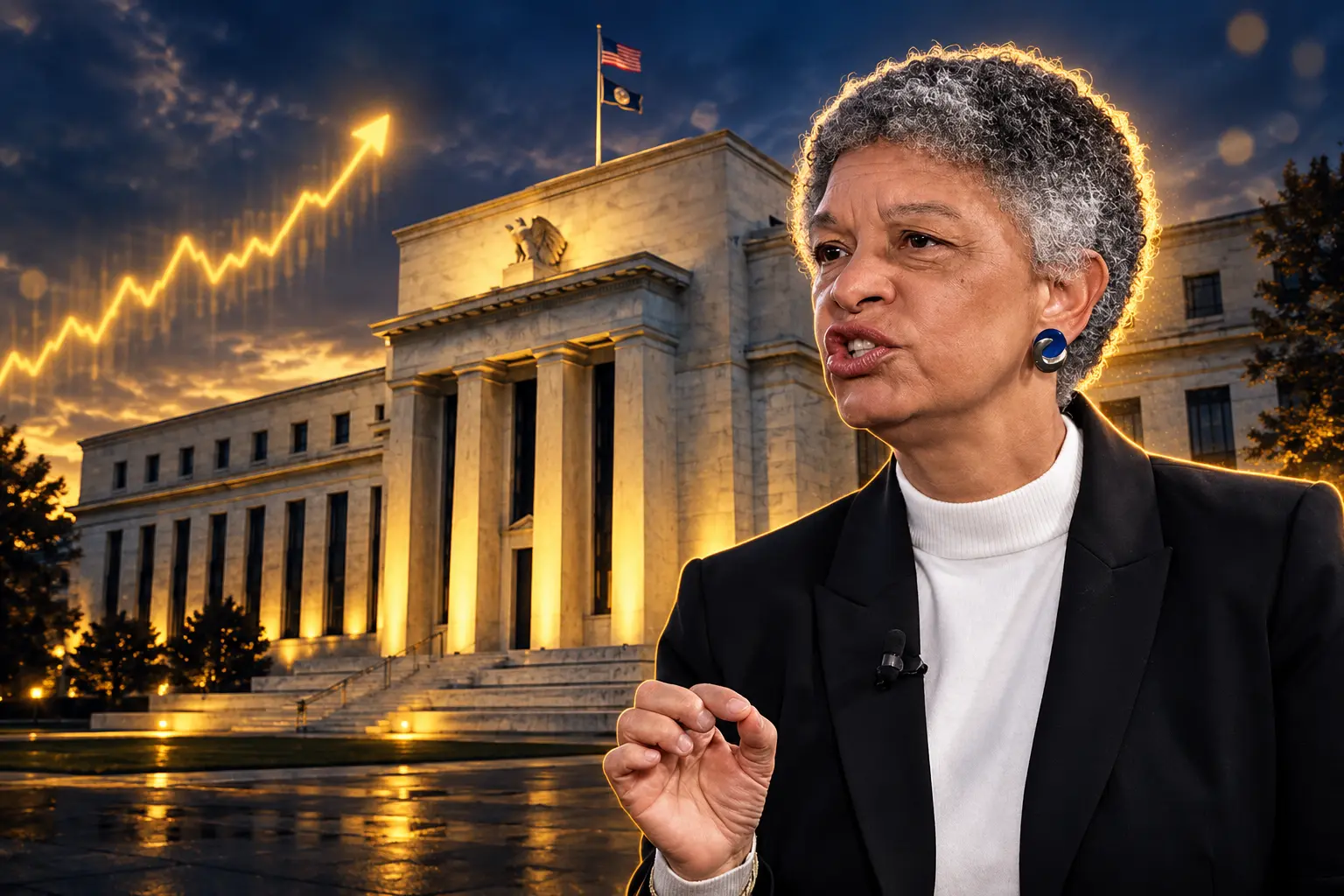
Collins Had Already Drawn a Line in August
Three weeks before the meeting she had told contacts across New England what would change her mind. In tighten policy soon if progress failed remarks dated August 25, she said she was comfortable with July’s hold, but only if incoming prices kept improving.
Should evidence of sustained inflation progress not materialize, I believe it will be appropriate to tighten policy soon to ensure we deliver price stability in a reasonable time frame.
Susan M. Collins, President and CEO, Federal Reserve Bank of Boston, August 25 remarks
She was watching two things closely: limited extra tariff increases, and some reopening of the Strait of Hormuz. Her baseline assumed earlier tariff pass-through had largely played out and that high energy costs would start to fade. Less kind paths were “quite plausible,” including more supply shocks and stronger demand. She also said the AI build-out appeared to be lifting core goods inflation.
On Monday, in an interview, she said the test had not been met. “I did not see the inflation progress I was hoping to see,” Collins said. Geopolitical developments, she added, suggest more pressure on the energy side. She agreed with the quarter-point increase and penciled in a second move later this year, with rates then unchanged through 2027.
That Monday forecast is more specific than Tuesday’s LinkedIn note. One is an interview about the path. The other is a written defense of the decision already taken.
THE PATH BACK TO A HIKE
- December 10, 2025: The FOMC cuts the funds rate to 3.50% to 3.75%. Collins, then a voter, supports the move.
- July 29, 2026: The Committee holds that range on a 9 to 3 vote after three presidents prefer an immediate increase.
- August 25, 2026: Collins says a hold requires evidence that inflation is coming down, and that missing it would justify tightening soon.
- September 16, 2026: The Committee raises the range to 3.75% to 4% by a 12 to 0 vote, the first increase since July 2023.
- September 21, 2026: Collins says she wants one more increase this year and a hold next year.
- September 22, 2026: She publishes the LinkedIn note warning that inflation may stay notably above 2 percent.
She will not vote again until 2028. Chicago Fed President Austan Goolsbee, who also spoke Monday, votes in 2027. Non-voters still shape the discussion, and both used the days after the meeting to explain why the hold broke.
Prices Have Run Hot for Five and a Half Years
Collins’s own phrase is the clock. “With the labor market on a better footing, monetary policy can focus on a timely return to price stability, especially after five and a half years of too high inflation,” she wrote. In August she had already called high prices a fixture of her New England visits, including households taking on more than one job.
THE LATEST PRICE AND JOBS READINGS
- Headline PCE: The price index the Fed targets rose 0.2% in July and 3.7% over 12 months, the Bureau of Economic Analysis said on August 26, matching June’s yearly rate.
- Core PCE: Excluding food and energy, prices also rose 0.2% in July and 3.3% from a year earlier.
- Unemployment: The jobless rate was 4.1% in August, with payrolls up 162,000.
- Next PCE print: August figures are due September 30, the last major inflation reading before the October meeting.
Those yearly rates are still the gap she is talking about. Officials’ new forecasts for 2026 as a whole sit in the same neighborhood: 3.7% headline PCE on a fourth-quarter over fourth-quarter basis, and 3.4% for core, both a tenth higher than in June. The 3.7% forecast is a year-end projection. The 3.7% July figure is a 12-month actual. They match by accident of rounding and timing, and they are not the same series.
Warsh told reporters the Committee’s standard is confidence that underlying inflation is moving to the goal, clearly and at sufficient speed. “Today, the FOMC decided that this standard has not been satisfied,” he said after the vote.
Stronger Hiring Gave the Fed Room to Move
Collins has been explicit that jobs are why she is willing to lean on prices. Hiring has picked up relative to late 2025 and broadened some across industries, she said in August, even as the unemployment rate stayed just above 4 percent. Risks run both ways, including a stock-market hit if AI returns disappoint, but she saw labor demand matching a smaller labor force as immigration slows and the population ages.
By Monday that firmer backdrop was part of the hike case. Solid job gains, she said, can be a sign the economy can take higher rates. Firms in her district, which covers Massachusetts, Connecticut, Maine, Rhode Island, and Vermont, still complain about high costs and say they may pass them on, which would keep measured inflation up.
WHAT COLLINS CITED FOR THE HIKE
- Missed progress: She did not see the decline in inflation she had been looking for after the July hold.
- Energy and the war: Renewed fighting in the Middle East in August, and a closed Strait of Hormuz, keep pressure on oil and on household budgets.
- Hiring: Stronger job gains, in her view, mean the expansion can absorb tighter policy.
- Pass-through: New England companies are signaling that cost increases may move into consumer prices.
That list is also a map of what could still go wrong. If hiring rolls over, the jobs permission she is using disappears. If firms do not pass costs through, the inflation case thins. If Hormuz reopens, the energy leg of the argument weakens, which is why she named that reopening as a condition of her August baseline.
Why a Rate Rise Does Not Add a Barrel of Oil
A large share of the latest price impulse is a supply shock. Tighter money can cool spending. It cannot open a strait or put crude into tanks. Collins said in August that oil inventories had dropped to historically low levels while Hormuz stayed closed, and that another rise in inflation, after such a long overshoot, could unmoor longer-term expectations.
If core inflation cools while the headline rate is still being driven by energy, the case for a second increase gets thinner fast. That is the practical split inside the forecast. Officials can treat the shock as something to look through, or they can treat repeated shocks as a reason to keep demand lower for longer.
Philip R. Lane, the ECB’s chief economist, made the parallel case on the same Tuesday. Europe, he said, had a first wave of energy-price increases in March and April, then a burst of optimism after the United States and Iran signed a June 17 memorandum to end the fighting. The war continued. Oil and gas rose again.
We think that because of this second wave of rising energy prices, inflation is likely to be higher for longer, before falling back towards our target from mid-2027 onwards.
Philip R. Lane, Member of the ECB Executive Board, interview with Le Temps
Lane said the second wave of rising energy prices should put upward pressure on food, on energy more broadly including electricity, and on goods, while pressure on services stays contained. The futures curve, in the ECB’s baseline, still points to some improvement later this year, with a lot of uncertainty around that path. If the shock is larger this autumn, he said, it will hold back the eurozone economy.
Collins is working from the same energy map with a different labor market. The United States, in her telling, has enough jobs strength to aim policy at prices. Europe is warning that a deeper energy shock will slow growth. Neither central bank can drill the oil.
Warsh and Goolsbee Split on Labor Pain
The Committee can agree on a 12 to 0 hike and still disagree on what the next one costs. Warsh said last Wednesday he does not believe the Fed needs to do harm to the labor market to hit its inflation goal. Goolsbee, speaking Monday, said persistent supply shocks have left the Fed little choice but to raise rates and narrow the gap between supply and demand.
WHERE OFFICIALS DISAGREE
- Warsh: The September increase removed a dose of accommodation. He argues price stability can be restored without damaging jobs, a view he said was widely shared around the table.
- Goolsbee: Forcing inflation back to 2 percent in the short run means pushing employment below target. “It’s going to be painful,” he told reporters. “It would necessarily be painful.”
- How many more moves: Goolsbee said one more increase this year could be enough if inflation is mostly a supply story, and likely not enough if demand is also running hot, including from AI data-center spending.
Collins sits closer to Warsh on the jobs side and closer to Goolsbee on the idea that the shocks are not fading on their own. She wants the second 2026 increase and then a hold. She has not adopted Goolsbee’s language about necessary pain. The disagreement is not about whether September was right. It is about whether October and December have to purchase disinflation with unemployment.
October Hike Odds Sit at 53.1 Percent
The next meeting is October 27-28. The last scheduled meeting of the year is December 8-9. In the Summary of Economic Projections released with the September decision, the median year-end funds rate of 4.1 percent implies one more quarter-point increase in 2026, and the same 4.1% in 2027. That 2026 median is 0.3 point above June’s 3.8%. The 2027 median is 0.5 point above June’s 3.6%.
SEPTEMBER FORECASTS VERSUS JUNE
| Measure | June 2026 median | September 2026 median |
|---|---|---|
| 2026 real GDP | 2.2% | 2.3% |
| 2026 unemployment (Q4) | 4.3% | 4.1% |
| 2026 PCE inflation | 3.6% | 3.7% |
| 2026 core PCE inflation | 3.3% | 3.4% |
| Year-end federal funds rate | 3.8% | 4.1% |
| 2027 federal funds rate | 3.6% | 4.1% |
Sixteen of 18 participants who submitted forecasts expect at least one more increase this year. Four of them expect two more. Eight officials forecast another increase in 2027. Longer-run funds rate estimates ticked up to 3.2% from 3.1%. Warsh is not in those counts.
Traders are less certain than the median dot. CME Group’s FedWatch tool, which publishes probabilities drawn from fed funds futures, put the chance of another quarter-point increase in October at 53.1%. Goldman Sachs, after the September meeting, switched to an October hike as its base case and described a two-hike path for 2026.
Collins’s Tuesday post does not settle that. Her Monday interview does more to lock in the extra 2026 move, and then a pause. The August PCE report on September 30 is the next hard number that can move those odds. Until then the Committee has a unanimous hike on the books, a chair who will not bless the dots, and a Boston president who already spent her warning shot.
The rate they left behind is the same 3.50% to 3.75% range Collins voted to enter in December 2025. The range they entered last week is the one she now says must stay somewhat restrictive until prices actually come down.
Disclaimer: This article is news reporting and analysis of Federal Reserve policy, inflation data, and market-implied rate odds. It is informational only and is not investment, trading, or financial-planning advice. It does not recommend buying or selling any security, futures contract, or loan product, and it does not tell readers how to set mortgage, savings, or business-credit terms. Readers should consult a qualified financial advisor or licensed investment professional before acting on interest-rate or inflation forecasts. Figures, votes, and probabilities reflect the official statements, data releases, and market tools cited here and can change at the next print or the next FOMC meeting.

Ohtani Game 4 Logoman Card Sells for $3.24 Million

Cole Kmet’s Season Ends, and Chicago’s Tight End Plan Starts

NBA Seeks Soccer Money After EuroLeague Clubs Refused

Amazon’s First Bond Tests Leave the Broccoli Chair Empty

Tyrese Maxey Owns the Night Built for LeBron James

Warsh Rejects Rate Guidance and Still Moves Markets

Dana-Farber Exits an MGB Medicare Advantage Network Early

NASA Launches the Roman Space Telescope’s Cosmic Bet

OpenAI’s Cyber Letter Puts the Defense Bill on Governments

Russia Recycles Its Old Warning Over Storm Shadow Plants
-
 BUSINESS2 months ago
Warsh Rejects Rate Guidance and Still Moves Markets
-
 BUSINESS1 month ago
Dana-Farber Exits an MGB Medicare Advantage Network Early
-
 NEWS2 months ago
NASA Launches the Roman Space Telescope’s Cosmic Bet
-
 NEWS2 months ago
OpenAI’s Cyber Letter Puts the Defense Bill on Governments
-
 NEWS2 months ago
Russia Recycles Its Old Warning Over Storm Shadow Plants
-

 ENTERTAINMENT4 weeks ago
Primetime’s $2.7 Million Preview Tops Pitt’s Costlier Film
-

 BUSINESS2 months ago
Jet Drones Lock Down Kyiv and Strip Kherson of Heat
-

 ENTERTAINMENT2 months ago
Midnight Spider-Man Turns Peter Parker Into Oscorp’s Hybrid