
NEWS
CDC Still Omits Four Pennsylvania Measles Deaths
Pennsylvania has four measles-linked deaths and 792 cases, but the CDC dashboard still shows zero while hospitals treat congenital measles.

The CDC measles dashboard still lists zero U.S. deaths for 2026, after Pennsylvania confirmed four measles-linked deaths and 792 cases. The agency now waits for death certificates that name measles as the underlying cause, a slower filter than the state reports it used for last year’s three deaths.
On the wards the gap is already clinical. Doctors are treating newborns infected in the womb, a Philadelphia NICU had a probable exposure, and 155 of those 792 Pennsylvania patients have been hospitalized.
The Asterisk Where Four Deaths Should Sit
The CDC page, updated September 18 with counts as of September 17, shows 3,471 confirmed measles cases in 47 jurisdictions plus 17 infections in international visitors. Ninety-five percent of people with a known status were unvaccinated or had unknown shots. Children and teens ages 5 to 19 make up 1,519 cases, or 44 percent, and 301 of the 3,471 patients, 9 percent, have been hospitalized.
Under deaths, the 2026 cell is an asterisk. The note says the National Center for Health Statistics does not currently have any 2026 death records that indicate measles is the underlying cause. The same page records three measles deaths for all of 2025, when the country logged 2,289 cases.
Emily Hilliard, a spokesperson for the Department of Health and Human Services, said the CDC will report measles deaths if and when NCHS lists measles as the underlying cause based on records states submit. The agency is also working with the Council of State and Territorial Epidemiologists on a common death definition, and says it will update the dashboard after those reviews.
Until this year, measles deaths in an outbreak moved through the National Notifiable Diseases Surveillance System, the same state-to-federal pipe that still carries case counts. NCHS reads death certificates. Those forms are issued locally, then coded, and measles has to sit in the underlying-cause slot, the disease that started the chain, before it lands in the national death cell.
Debra Houry, a former CDC chief medical officer, called the delay curious even after the switch. She said it takes one to two days for NCHS to receive updated data after states finish death investigations, and that Pennsylvania had already closed the first two. “Pennsylvania concluded the investigation on the first two deaths, so CDC would have these records by now,” Houry said.
Pennsylvania Already Uses the 30-Day Rule
The CDC has long had a measles case definition. For deaths it had leaned on the World Health Organization, which already wrote a short rule for outbreak work.
A measles-related death is a death in an individual with confirmed (clinically, laboratory or epidemiologically) measles in which death occurs within 30 days of rash onset and is not due to other unrelated causes, e.g., a trauma.
World Health Organization, Measles Outbreak Toolbox
That death within 30 days of rash onset is the same shape Pennsylvania put in writing while CSTE still drafts a U.S. version. The state’s measles-associated death case definition counts a death within 30 days of symptom onset in a person with clinical measles and a positive lab test, and not from an unrelated cause such as a motor vehicle crash. Health officials said they modeled it on existing CSTE rules for flu and RSV deaths, because the outbreak was growing faster than the national process.
HOW A MEASLES DEATH GETS COUNTED
| System | What it requires | 2026 result |
|---|---|---|
| WHO outbreak rule | Confirmed measles, death within 30 days of rash, not trauma | The template Pennsylvania copied |
| Pennsylvania Department of Health | Clinical illness, positive lab, death within 30 days, not an unrelated cause | 4 measles-associated deaths |
| CDC dashboard via NCHS | Measles listed as the underlying cause on a state-submitted death record | 0 records so far |
Houry noted that when deaths were rare, nobody needed a tighter U.S. definition. There were none for a decade before this outbreak. Measles usually kills through what it causes, most often pneumonia, encephalitis, a secondary bacterial infection, or a pregnancy complication, so the top line on a certificate may read pneumonia even when measles started the chain.
CDC Director Erica Schwartz, confirmed on August 5, has denied that deaths are being miscounted for political reasons and pointed to the definition work. “If someone got hit by a bus, and they happened to have Covid, often that was called a Covid-related death,” she said. Houry said Pennsylvania’s rule already excludes that kind of unrelated death, and that Schwartz’s comparison feeds confusion rather than clearing it.
Who Died, and What the Coroners Wrote
Pennsylvania announced its first two measles-associated deaths on August 25, the state’s first in 35 years, then confirmed two more in mid-September. All four people were unvaccinated. County coroners later filled in ages, places, and immediate causes, and those details are what the national argument keeps chewing.
THE FOUR PENNSYLVANIA DEATHS
- Newborn, Lancaster County: Died August 14 at a birthing center in Strasburg Township after testing positive for measles; Coroner Stephen Diamantoni said the immediate cause was a lacerated spleen, while the state still counts the death because measles can enlarge the spleen.
- Six-week-old, Lancaster County: Diamantoni later said this infant died of measles and also had Amish lethal microcephaly, a rare genetic condition; the child was too young for a routine MMR shot.
- 40-year-old woman, Jefferson County: Unvaccinated, with COPD and asthma, she died of respiratory failure with an active measles infection, Coroner Greg Furlong said.
- 18-year-old, Mifflin County: Unvaccinated, died of acute disseminated encephalomyelitis, a rare brain inflammation that can follow measles, Coroner Andrea Alcalde said.
The spleen finding is the opening that Health Secretary Robert F. Kennedy Jr. and local critics have used to say the first death was with measles, not from it. Measles is known to swell the spleen, which makes a rupture more likely, and that is why the state kept the case in its measles-associated column. The six-week-old is the harder case for that argument. Diamantoni said measles caused that death. Jake Scott, an infectious diseases physician at Stanford, wrote that she was too young for MMR, so her protection was the people around her.
Kennedy’s public line is that CDC is waiting for NCHS, that the first infant died of a lacerated spleen, and that the second infant had a condition in which babies often live only about six months. He had earlier said the first announcements might have been fabricated. Governor Josh Shapiro accused him of directing the CDC not to acknowledge the deaths and of sowing conspiracy theories around the families.
A Visitor Walked Through CHOP’s NICU
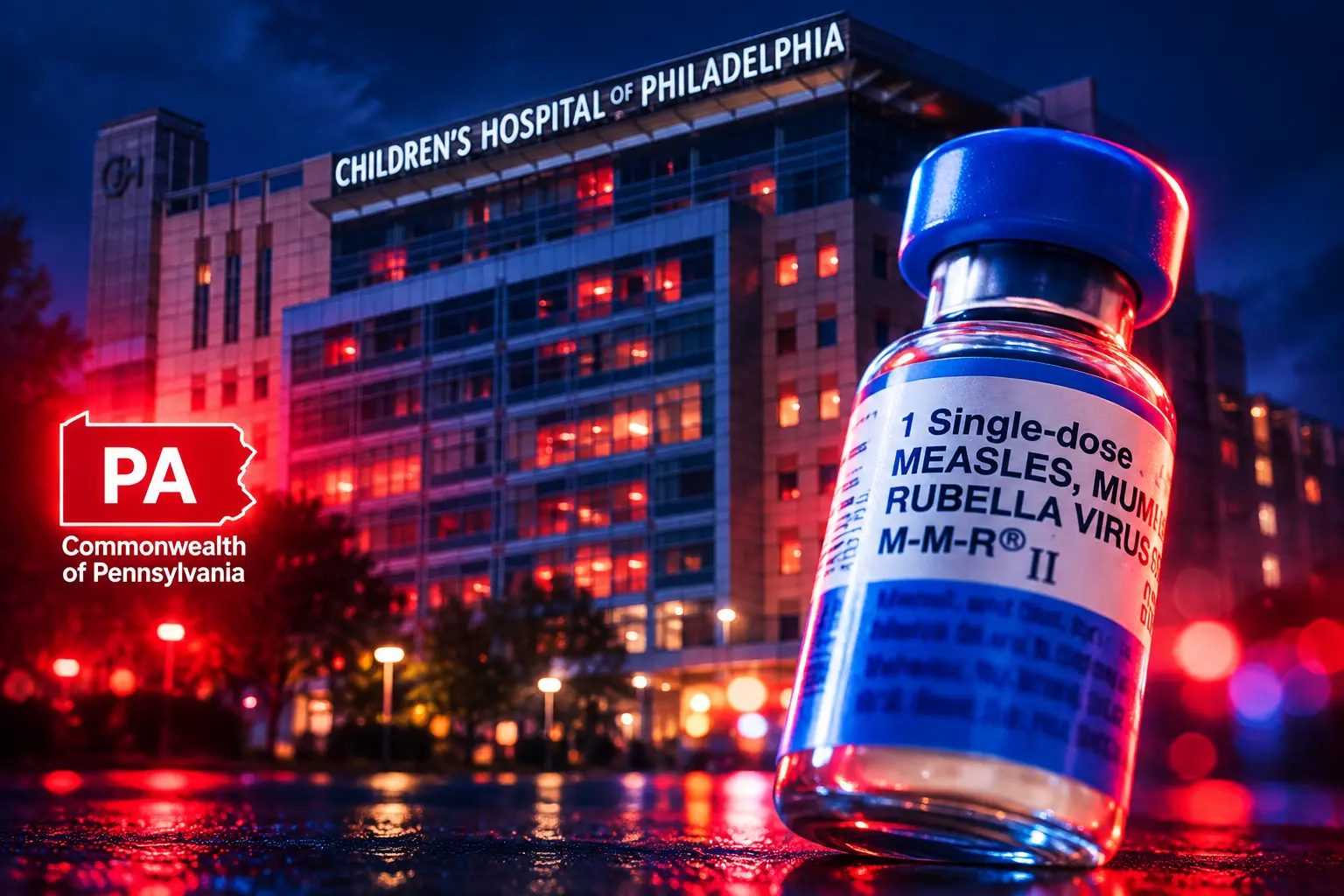
The death-count fight is a paper lag. The clinical lag showed up on September 11 at Children’s Hospital of Philadelphia, 3401 Civic Center Boulevard, when the city health department later posted a probable measles exposure at CHOP.
People in NICU West, the NICU West family lounge, and the atrium from 9:30 a.m. to 4:15 p.m., and in the main cafeteria from 12:05 p.m. to 2:45 p.m., may have been exposed. CHOP, the state health department, and the city are giving potentially exposed infants a preventive antibody product. Anyone not immune is asked to watch for fever, cough, runny nose, red eyes, and rash through October 2.
Infants under 12 months are not on the routine MMR schedule, which starts at 12 to 15 months. City Health Commissioner Dr. Palak Raval-Nelson said the hospital visit was not a broad risk to a city that is mostly vaccinated, and that people who are not up to date should get MMR, including to protect those who cannot. Philadelphia is already recommending an extra early dose for infants 6 to 11 months before travel into Lancaster, Lebanon, Berks, Dauphin, Northumberland, and York counties.
Because of this, we’re literally seeing new forms of measles. We don’t have a lot of information about what happens with it.
Dr. John Goldman, infectious disease specialist, University of Pittsburgh Medical Center
Goldman said clinicians are treating congenital measles, infection in newborns who got the virus in the womb or at birth, which used to be exceedingly rare because almost all pregnant people were immune from shots or from measles in childhood. Before this outbreak he had seen measles twice, in 1988 and 1992, then not once through 2026. He is now seeing at least one case every day.
One in Five Pennsylvania Patients Landed in a Hospital
The state health department’s September 21 update put the outbreak at 792 measles cases across 39 counties, 25 of them since September 18, with 155 hospitalizations and four confirmed measles-associated deaths. Four patients, less than 1 percent, were vaccinated. The CDC map as of September 17 still showed 745 Pennsylvania cases, a lag of days plus the usual delay in state-to-federal notification.
TWO COUNTS, FOUR DAYS APART
| Measure | CDC (as of Sept. 17) | Pennsylvania (Sept. 21) |
|---|---|---|
| Confirmed cases | 3,471 in the U.S.; 745 in Pennsylvania | 792 in 39 counties |
| Hospitalized | 301 of 3,471 (9 percent) | 155 of 792 (nearly 20 percent) |
| Deaths | 0 in NCHS underlying-cause records | 4 measles-associated deaths |
| Vaccinated share | 3 percent with two MMR doses nationally | 4 vaccinated cases, less than 1 percent |
Pennsylvania’s own briefing language says nearly 20 percent of people who get measles are hospitalized and that death, though rare, occurs in 1 to 3 patients per 1,000 cases. The state’s 155 hospital stays among 792 confirmed infections sit on that 20 percent line. Four deaths among 792 cases sit above the usual 1-to-3-per-1,000 range, which at this caseload would have predicted roughly one or two deaths.
Houry said the current deaths and admissions are not what the old ratios would lead anyone to expect, and she believes the official numbers are a large undercount. Goldman said patients who reach a hospital often mention sick people at home who were never tested. Those household cases never enter the 792, which means contact tracing and isolation start late. Under-testing does not show up as a dashboard dispute. It shows up as the next NICU notice.
Harrisburg Tied Outbreak Aid to the Death Count
Pennsylvania Secretary of Health Dr. Debra Bogen wrote to Schwartz in mid-September that the state had started a request for a CDC Epi-Aid, the short on-site epidemiology team used in fast outbreaks, and would pull the request if the four deaths stayed off the national count. “The CDC’s choice not to publicly recognize the deaths undermines our response,” Bogen wrote.
House Energy and Commerce Democrats, including ranking member Frank Pallone Jr. of New Jersey, have asked the CDC for a staff briefing by September 28 on how measles deaths are being reported. Kennedy, in a post on September 4, said the facts showed why CDC waited and that NCHS still had no 2026 records with measles as the underlying cause.
The facts emerging now demonstrate why CDC waited for the evidence rather than allowing political grandstanding to dictate its reporting. Governor Shapiro, by contrast, politicized these two tragic deaths before the underlying causes had been established.
The Lancaster County… https://t.co/VnXuAoMM3C
— Secretary Kennedy (@SecKennedy) September 4, 2026
HOW THE DEATHS LEFT THE NATIONAL TALLY
- August 25, 2026: Pennsylvania announces two measles-associated deaths in unvaccinated Lancaster County residents, the state’s first in 35 years.
- August 30, 2026: CDC delays its weekly update, then posts an asterisk instead of the two deaths, saying available information does not establish whether measles caused or contributed to them.
- September 4, 2026: The dashboard note shifts to NCHS, which has no 2026 records with measles as the underlying cause; Diamantoni says the six-week-old died of measles.
- September 11, 2026: Probable measles exposure in CHOP’s NICU West, family lounge, atrium, and cafeteria.
- September 15, 2026: Pennsylvania confirms two more measles-associated deaths, in Jefferson and Mifflin counties, bringing the state total to four.
- September 17, 2026: CDC’s national case count reaches 3,471 with the death cell still blank; Philadelphia posts the CHOP notice.
- September 21, 2026: Pennsylvania reports 792 cases, 155 hospitalizations, and four deaths, and lawmakers press for a briefing by September 28.
The political fight is loud because it is simple to argue about a spleen, a genetic diagnosis, and a dashboard zero. The operational fight is slower. An Epi-Aid is extra federal field staff. Holding it until the death cell changes means the argument over certificates is now attached to surge help the state says it wants.
State Clinics Have Given Thousands of MMR Doses
While the federal death cell stays empty, Pennsylvania has been running clinics. State health officials have given more than 4,800 MMR shots at 148 pop-up sites in affected communities since the outbreak began in late April, and state health center staff have given more than 6,900 MMR doses in 2026. Providers usually give about 25,000 MMR doses in a month in Pennsylvania; in August they gave more than 46,000, and they gave more than 25,000 in the first two weeks of September. Two documented MMR doses provide 97 percent lifetime protection, the state says, and people with both doses do not need another.
A no-cost clinic is scheduled at the Bloomsburg Fair in Columbia County from September 26 through October 3, with no insurance screening. Goldman has praised the state health department’s 24-hour test turnaround and said the undercount is not a lab failure. People stayed home sick and never sought care. Houry said health systems and clinicians across the state are pushing vaccine into their own communities even as the federal count stalls.
Goldman is preparing for three to six more months of daily measles. He does not expect a break until most people in most communities are immune by vaccine or by infection. He also said measles may be the warning for whooping cough, diphtheria, and polio, diseases U.S. clinicians of his generation were not supposed to see again.
CSTE can still write a death definition, and NCHS can still code certificates that have not yet posted. The infants who cannot get MMR, and the NICU that already had to hang antibody, are on a faster clock than that paperwork.
Disclaimer: This article is news reporting on public health data, outbreak notices, and statements by named officials. It is informational only and is not medical advice, a diagnosis, or a recommendation about vaccination, isolation, or treatment for any person. Readers who may have been exposed to measles, who are pregnant, who care for an infant, or who have a weakened immune system should consult a physician or their local health department before acting. Case counts, death classifications, hospital figures, and exposure windows reflect the cited agencies as of the dates given above and can change as investigations and death records are updated.

Ohtani Game 4 Logoman Card Sells for $3.24 Million

Cole Kmet’s Season Ends, and Chicago’s Tight End Plan Starts

NBA Seeks Soccer Money After EuroLeague Clubs Refused

Amazon’s First Bond Tests Leave the Broccoli Chair Empty

Tyrese Maxey Owns the Night Built for LeBron James

Warsh Rejects Rate Guidance and Still Moves Markets

Dana-Farber Exits an MGB Medicare Advantage Network Early

NASA Launches the Roman Space Telescope’s Cosmic Bet

OpenAI’s Cyber Letter Puts the Defense Bill on Governments

Russia Recycles Its Old Warning Over Storm Shadow Plants
-
 BUSINESS2 months ago
Warsh Rejects Rate Guidance and Still Moves Markets
-
 BUSINESS1 month ago
Dana-Farber Exits an MGB Medicare Advantage Network Early
-
 NEWS2 months ago
NASA Launches the Roman Space Telescope’s Cosmic Bet
-
 NEWS2 months ago
OpenAI’s Cyber Letter Puts the Defense Bill on Governments
-
 NEWS2 months ago
Russia Recycles Its Old Warning Over Storm Shadow Plants
-

 ENTERTAINMENT4 weeks ago
Primetime’s $2.7 Million Preview Tops Pitt’s Costlier Film
-

 BUSINESS2 months ago
Jet Drones Lock Down Kyiv and Strip Kherson of Heat
-

 ENTERTAINMENT2 months ago
Midnight Spider-Man Turns Peter Parker Into Oscorp’s Hybrid