
BUSINESS
American Bets on Slower 2027 Growth After Fuel Shock
American Airlines will grow more slowly in 2027 after a $1 billion fourth-quarter fuel bill, while Flagship Suites take a larger share of revenue.

American Airlines will slow 2027 growth if jet fuel stays this high, CEO Robert Isom said on Sept. 16. The warning followed a roughly $1 billion jump in fourth-quarter fuel costs, not a collapse in demand.
CFO Devon May said the airline is still adding flights this fall and will “touch up December.” About 30% of seats already bring in about 50% of revenue, and that mix is the hedge American is underwriting while it flies less than it planned.
Fuel Just Added $1 Billion to the Quarter
Isom and May spoke at Morgan Stanley’s 14th Annual Laguna Conference, a fireside chat the carrier had flagged on Sept. 9. Isom said he likes the revenue, capacity, and unit-cost guides. He does not like the fuel tape.
“What I don’t feel good about is the price of fuel, which has seen tremendous volatility,” Isom said. July and August tracked the plan American set on July 21, when it budgeted about $3.75 a gallon for the third quarter. The last four weeks did not.
The U.S. Energy Information Administration’s Gulf Coast jet fuel at $4.705 a gallon on Sept. 15 sat about a dollar above that July plan. May’s rule of thumb is that every penny of fuel is worth about $10 million in a quarter, which is how a one-dollar move becomes a billion-dollar fourth-quarter bill. He also said the crack spread, the gap between crude and jet, has tripled against old norms, so crude is only part of the pain.
That spike sits on top of a year already warped by fighting around the Strait of Hormuz. In the second quarter American posted record $16.7 billion second-quarter revenue, up 16.3% from a year earlier, and still recouped only about half of a $2.2 billion year-over-year fuel increase. Full-year adjusted earnings were guided on July 23 to a range of a $0.65 loss to a $0.65 profit, breakeven at the midpoint, against a fuel headwind Isom put near $6 billion.
HOW THE FUEL BILL GREW IN 2026
- July 21, 2026: American plans on about $3.75 a gallon for the third quarter and $1.7 billion more in fuel expense than a year earlier.
- July 23, 2026: The airline reports $16.7 billion in quarterly revenue, $11 billion-plus in liquidity, and a full-year adjusted range of ($0.65) to $0.65 a share.
- Early September 2026: Spot jet fuel jumps about a dollar a gallon in four weeks, May told investors.
- Sept. 15, 2026: EIA Gulf Coast jet prints $4.705 a gallon.
- Sept. 16, 2026: Isom says 2027 capacity will have to be adjusted if prices stay here.
May still called the third-quarter operation “great” on everything the airline can control. Unit revenue minus those controllable costs is, he said, landing where the company told investors it would three months ago. Fuel is the line that will not sit still, and the company will not reset full-year numbers until the tape calms down.
THE THIRD-QUARTER GUIDE AMERICAN STILL LIKES
- Capacity: Available seat miles up 3.0% to 5.0% from a year earlier, about two points lower at the midpoint than the original plan.
- Revenue: Total revenue up 16.0% to 19.0%, a range Isom said on Sept. 16 he still likes.
- Costs: CASM excluding special items, fuel, and profit sharing up 2.5% to 4.5%.
- Earnings: Adjusted earnings (loss) of ($0.70) to ($0.10) a share for the quarter.
Isom went further on the demand side than the fuel math. He said he has not seen year-over-year revenue improvement like this outside the recoveries after the pandemic and 9/11, and that the gains run across corporate, leisure, domestic, international, the front cabin, and coach. Managed corporate revenue rose 26% in the second quarter. Premium buy-ups are up about 5 percentage points. Fourth-quarter bookings were about 25% complete when he spoke, with holidays looking busy.
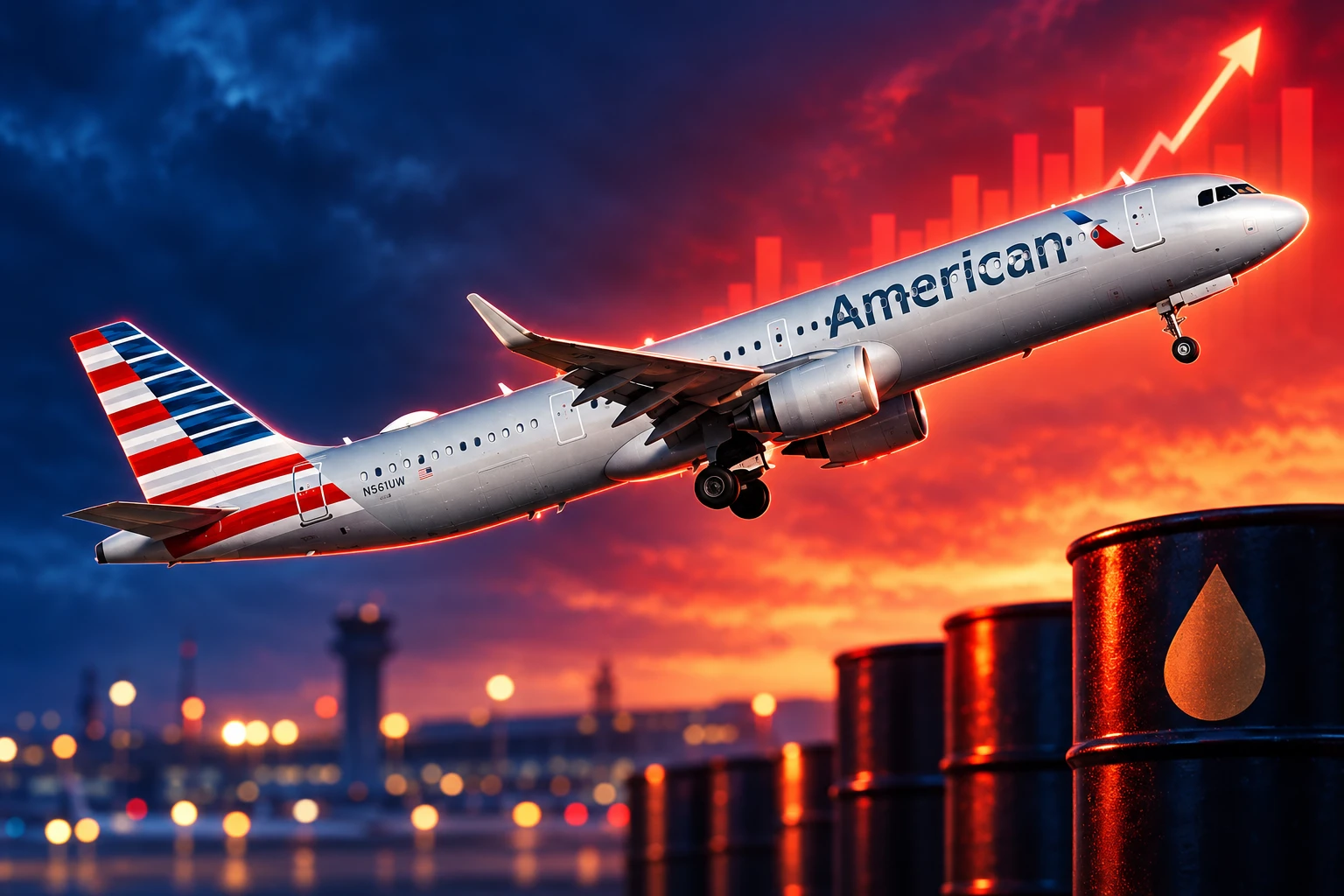
The First Trim Lands in December
“If fuel prices remain as high as they are right now, I think that’s going to require some adjustments in terms of our capacity planning as we take a look out into the future,” Isom said. That is the line that traveled. The actual flying plan is narrower.
May said American is still growing capacity in the fourth quarter because a competitive schedule needs metal in the market. The near-term lever is late in the quarter. “We’ll go ahead and touch up December because of that,” he said. Growth in 2027 will be lower than management expected three or six months ago. It is a slower climb, not a year-on-year retreat from the 3.0% to 5.0% still on the books for this quarter.
We’ll see where fuel ends up over the next handful of weeks, but yes, it’s moved a dollar, and every penny is worth about $10 million in a quarter, so that’s the roughly billion-dollar run-up we’re seeing in the fourth quarter alone.
Devon May, CFO, Morgan Stanley Laguna Conference
Isom said the airline has already made “great trade-offs,” taking a modest hit to load factor in return for stronger revenue. He is planning for high fuel “for longer than it would like,” and he does not treat the present volatility as a permanent law. If fuel settles, he said, American should produce much improved margins and free cash flow, with mid- to higher-single-digit pretax margins and mid-teen EBITDA margins in a normal year. Debt is down from a peak of $54 billion toward a $35 billion to $36 billion target, and May said liquidity is better than it has been in more than a decade.
Until that tape turns, December is the first place the plan gets smaller, because that is the flying that can still be pulled without blowing up the fall schedule.
A Tighter Schedule at Delta and United
American is not the first major to flinch. It is the one that kept more of its growth into the fall, then had to explain a new fuel bill in mid-September.
Delta Air Lines, on its July 10 earnings call, put third-quarter capacity up 1 percent and fourth-quarter flying up 2% to 3%, in line with economic growth. CEO Ed Bastian called a tight schedule the obvious answer to a fuel spike and said it was too early to sketch 2027.
United Airlines spent the spring taking metal out. In June it targeted third- and fourth-quarter capacity flat to up about 2%, several points under earlier plans, after a 5% cut aimed at off-peak and overnight flying. By July 15 it told investors it was prepared to further moderate near-term capacity with fuel still elevated. At the same Laguna conference, CFO Mike Leskinen said that if fuel stays high, United will “make some adjustments into the first quarter and beyond into 2027,” and that some December flights it thought it would fly will not operate. “We are not flying to maximize market share, we’re flying to maximize profitability and free cash generation,” he said.
HOW THREE CARRIERS ARE FLYING THE SPIKE
| Airline | Near-term capacity | Fuel response | 2027 signal |
|---|---|---|---|
| American | Q3 available seat miles +3.0% to +5.0% | Still growing in Q4; trim December after a ~$1 billion fuel run-up | Growth lower than the plan from 3 to 6 months ago |
| Delta | Q3 +1%; Q4 +2% to +3% (July call) | Muted flying after the spring spike | No 2027 guide yet |
| United | Q3/Q4 targeted flat to +2% in June | Some December flights will not operate | Adjust 1Q and 2027 if fuel stays high |
American’s remaining growth is the tell. Delta is already close to flat. United spent months pulling red-eyes and weak midweek frequencies. American is still putting more seats into the air than a year ago, then promising to grow less next year if the gallon stays expensive. The wager is that it can afford that sequence because the extra seat it used to chase is no longer the point of the airline.
Seventy Suites Replace First Class
Two weeks before Laguna, American put its first retrofitted Boeing 777-300ER into service, from New York Kennedy to Buenos Aires on Sept. 2. Chief commercial officer Nat Pieper called the jet “the next evolution of premium travel at American.” The carrier’s 20-strong 777-300ER fleet flies the long-haul routes that actually print money: London, Tokyo, Sao Paulo, Buenos Aires, and Sydney.
The new cabin is built to sell the front, not to preserve an old first-class label. American will stop selling Flagship First on the 777-300ER for travel beginning Nov. 19, 2026, and on transcontinental routes beginning March 28, 2027, as more Airbus A321XLRs arrive. In its place is a larger Flagship Suite cabin and the biggest Premium Economy section American has put on an airplane.
WHAT THE RETROFITTED 777-300ER NOW SELLS
- Flagship Suite: 70 Flagship Suite seats with privacy doors, including 8 larger Flagship Suite Preferred seats, in a chaise-lounge layout.
- Premium Economy: 44 seats with sculpted headrests, calf and foot rests, wireless charging, and USB-C.
- Main Cabin Extra: 30 extra-legroom seats.
- Premium total: 144 premium seats on one airplane, which American says is more business and Premium Economy than any other U.S. carrier offers on a single jet.
That layout is the physical form of the 30/50 split Isom cited. In the second quarter, lie-flat and Premium Economy capacity grew nearly twice as fast as the main cabin, Pieper told analysts. At Laguna, management said premium seating should rise about 50% by the end of the decade, with A319 and A320 cabin work coming online, A321XLR deliveries filling transatlantic and secondary Europe routes, and 777-200ER modifications next. Starlink high-speed Wi-Fi is slated to start on about 500 narrowbody jets in 2027. Seatback video is coming back over several years. More lounges are planned than the airline has opened in decades.
Isom said the fleet is already close to what that plan needs, so the company is not staring at a fresh mountain of capital spending. Customer scores have moved with the product: total net promoter score rose 5 points year over year in the second quarter. The bet is that those cabins, not another two points of raw capacity, are what pay for a $4.705 gallon.
Coach Is the Seat That Disappears
The public argument that followed Laguna treated “capacity cuts” as a nationwide grounding. That is not the schedule May described. Fourth-quarter flying is still going up. The inventory that comes out is the cheap, off-peak, late-year seat that no longer covers fuel, the same class of flight United has been parking since spring.
Coach demand is not dead. Isom said it is holding up with the front cabin, and that real airfares are still below 2019. The mix is still the story. When a gallon costs what it costs today, a full main-cabin airplane can lose money on the same route where 70 suites and 44 Premium Economy seats still earn. American recaptured only about half of its second-quarter fuel shock through fares. The rest has to come from flying fewer of the seats that were never going to cover $4.705 a gallon.
That is why December is first. Holiday coach is easy to thin without touching the Tuesday morning Dallas-LaGuardia business bank. It is also why a slower 2027 is not a retreat from DFW or Miami. The airline is choosing which cabin, and which day of week, still gets a departure. Once that flying is gone, ticket prices on the remaining seats do not snap back to the old fare. The 2008 playbook, when fuel spikes were used to lock in new fees and smaller schedules, is the memory hanging over this round even if no one in Laguna used the word “surcharge.”
Southwest was pulled into the same week’s roundup for the same reason: less profitable frequencies are the first to go. The industry is not short of passengers. It is short of gallons at a price that makes a 186-seat coach cabin worth launching at 6 a.m. on a Wednesday in January.
Dallas Still Wants the World’s Biggest Hub
Isom spent as much time on hubs as on fuel, because the long-term network plan is the other half of the wager. He said 2026 is the first year American can fully line up pilots, deliveries, and gates. Dallas Fort Worth, Charlotte, Miami, Philadelphia, Phoenix, and Chicago have been restored to “more appropriate” size. Miami is on the largest schedule in the airline’s history. Chicago is due five new gates by year-end. Reagan National is back to a top-performing hub after a prior-year disruption. Philadelphia has been grown hard. Phoenix is stable with modest growth ahead. Los Angeles is meant to regain the carrier’s largest footprint by 2028 as Terminals 4 and 5 are rebuilt.
DFW is the monument. A 13-bank schedule is already cutting misconnects, down nearly 25% year over year in the second quarter, with DFW unit revenue about 4 points better than the system. A new F terminal and satellite work on A and C are meant to support what management called a path to the world’s largest single-carrier hub by 2030. That is not the language of an airline that thinks it is getting smaller. It is the language of an airline that wants fewer weak frequencies and more connecting premium traffic over Texas.
A321XLRs are supposed to become a backbone of transatlantic and secondary Europe flying. Inbound transatlantic traffic is the gap Isom still wants; outbound U.S.-to-Europe is already strong, and Heathrow is working through the British Airways joint venture. Labor contracts, aircraft delivery queues, and airport gates are, he argued, structural walls that keep rivals from flooding the same markets if American does pull a little metal.
The 2027 plan will be smaller than the one written when fuel was cheaper. The fourth quarter will still grow. December will be tighter. The 777 that left Kennedy on Sept. 2 will keep selling 70 suites. If the gallon stays near $4.705, those are the seats American is willing to fly.

Ohtani Game 4 Logoman Card Sells for $3.24 Million

Cole Kmet’s Season Ends, and Chicago’s Tight End Plan Starts

NBA Seeks Soccer Money After EuroLeague Clubs Refused

Amazon’s First Bond Tests Leave the Broccoli Chair Empty

Tyrese Maxey Owns the Night Built for LeBron James

Warsh Rejects Rate Guidance and Still Moves Markets

Dana-Farber Exits an MGB Medicare Advantage Network Early

NASA Launches the Roman Space Telescope’s Cosmic Bet

OpenAI’s Cyber Letter Puts the Defense Bill on Governments

Russia Recycles Its Old Warning Over Storm Shadow Plants
-
 BUSINESS2 months ago
Warsh Rejects Rate Guidance and Still Moves Markets
-
 BUSINESS1 month ago
Dana-Farber Exits an MGB Medicare Advantage Network Early
-
 NEWS2 months ago
NASA Launches the Roman Space Telescope’s Cosmic Bet
-
 NEWS2 months ago
OpenAI’s Cyber Letter Puts the Defense Bill on Governments
-
 NEWS2 months ago
Russia Recycles Its Old Warning Over Storm Shadow Plants
-

 ENTERTAINMENT4 weeks ago
Primetime’s $2.7 Million Preview Tops Pitt’s Costlier Film
-

 BUSINESS2 months ago
Jet Drones Lock Down Kyiv and Strip Kherson of Heat
-

 ENTERTAINMENT2 months ago
Midnight Spider-Man Turns Peter Parker Into Oscorp’s Hybrid