
NEWS
Pentagon Weighs Europe Cuts That Hit Germany, Not Poland
Pentagon planners are weighing a 25,000-troop Europe cut aimed at Germany and Spain, even as Poland is offered a new Army base.

The Pentagon is weighing cuts of 25,000 to 40,000 U.S. troops in Europe, plus planes, ships and weapons. About 80,000 American service members are stationed there now, and no final decision has been made.
On Thursday, President Donald Trump said Washington was close to a new U.S. Army base in Poland, the host that would be spared if the review lands on Germany, Italy and Spain.
The Review Puts 25,000 to 40,000 Troops on the Table
Seven current and former U.S. and Western officials described the live options as a cut of about a third of the force, or about 25,000 troops, and a steeper path of as much as half, or 40,000. Either choice would be the largest scaling-back of the American footprint on the continent since the 1990s drawdown after the Cold War.
Air Force Gen. Alexus Grynkewich, who heads U.S. European Command and serves as NATO’s Supreme Allied Commander Europe, is due to walk Secretary of War Pete Hegseth through an initial set of choices on Friday, Sept. 18. Officials said the packet is expected to include four courses of action that mix personnel cuts with possible moves of some units toward NATO’s eastern flank. Hegseth is due a fuller recommendation on Nov. 6 before any plan goes to Trump.
THE FORCE ON THE TABLE
- Current presence: About 80,000 U.S. troops in Europe, down from more than 100,000 after Russia’s 2022 invasion of Ukraine and back near that lower level by the end of 2024.
- Cut options: About 25,000 troops, or as many as 40,000, plus aircraft, ships and other weapons.
- Calendar: Grynkewich briefs Hegseth on Sept. 18; a recommendation is due Nov. 6; no decision is locked.
- Legal brake: Congress already wrote a 76,000-troop floor into last year’s defense policy law, and both cut options would land well below it.
Hegseth announced a six-month review of U.S. force posture on June 18 in Brussels and branded it the path to “NATO 3.0,” with Europe in the lead for conventional defense and the United States as the nuclear backstop. Under Secretary of War for Policy Elbridge Colby is driving the policy work beside Grynkewich. A Center for Strategic and International Studies assessment of that model says the United States would act as nuclear guarantor while Europe provides most conventional military capabilities.
Make no mistake about it, this will be a real review. It will be designed to ensure that NATO is moving fast and irreversibly toward Europe, stepping up to take primary responsibility for the defense of Europe, stepping up to ensure our forces are postured for America’s global needs, and stepping up to make sure our access, basing, and overflight are clearly delineated and assured.
Pete Hegseth, Secretary of War, NATO Defense Ministerial, Brussels, June 18, 2026
He told allies the United States cannot care for or pay more for Europe’s defense than they do, and he tied future NATO common funds and member dues to whether other countries hit their spending targets. U.S. officials have said the shift is meant to free capacity for the Pacific as well as to push Europe to carry its own front line.
Germany, Italy and Spain Carry the Iran Bill
The people describing the options said the likely personnel cuts fall on Germany, Italy and Spain, the three hosts that already hold the bulk of the American force in Europe and that have fought with Trump over the Iran war. Access, basing and overflight rights are written into the review as a test, not a side note.
When the United States sought European bases and airspace for flights and warship moves against Iran, “too many of our allies said no,” Hegseth said in Brussels. Others, he said, tried to drown Washington in legal arguments or criticized the war in public. “It was shameful,” he said, arguing those refusals put American troops at risk.
Spain, which hosts a U.S. Navy base at Rota and American destroyers, has been called out for refusing to let its territory be used as a launch pad. Britain did allow U.S. bombers to fly from its soil, and RAF Fairford later held around 20 B-1 and B-52 aircraft, the largest overseas American bomber deployment in recent years. Italy has been criticized in the same argument. Germany, still the largest American hub on the continent at about 36,000 troops, is already in the middle of a 5,000-person reduction announced in the spring.
WHERE THE TROOPS SIT, AND WHO IS IN THE GUNSIGHTS
| Host country | U.S. presence | In the review |
|---|---|---|
| Germany | About 36,000 troops | Already losing 5,000; among likely further cuts |
| Italy | About 12,000 troops | Among likely cuts after the Iran-war clash |
| Spain | Rota naval station and U.S. destroyers | Among likely cuts; denied Iran-war access |
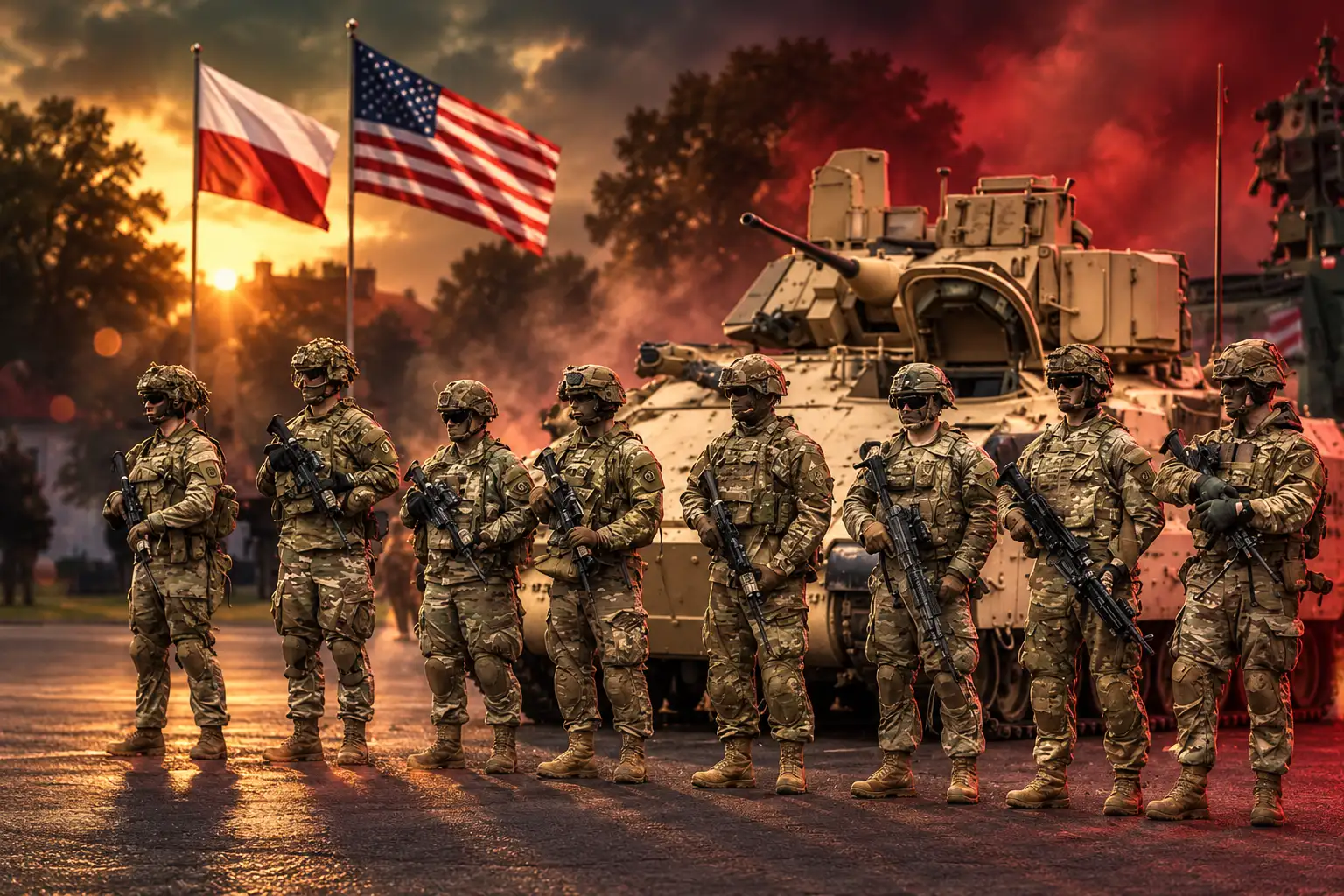
| Poland | About 10,000 troops, mostly rotational | New permanent Army base under discussion |
The loud public argument treats the story as a full retreat from NATO or a gift to Moscow. That fight skips the sorting rule Hegseth put on the table in June: countries that blocked American access during the Iran war are the ones now staring at empty barracks, while a loyal host on the Russian border is being offered concrete and families.
Poland Is Being Offered a Permanent Army Base
Trump said Thursday that “major progress is being made toward establishing a U.S. Army base in Poland,” crediting Polish President Karol Nawrocki, and that a location would be announced “very soon” if the deal holds. He called it a historic step for the U.S.-Polish alliance. The base is not built. It is a political offer running on a parallel track to the cut list.
Nawrocki said Warsaw is ready to keep deepening defense ties and “will do its utmost to provide the best possible location for the US Army base.”
Thank you, Mr. President @realDonaldTrump, for your kind words, our friendship and your strong commitment to the Polish-US partnership.
We are ready to continue our efforts to strengthen our defense cooperation: seriously, responsibly, and always together.
I can assure you…
— Karol Nawrocki (@NawrockiKn) September 17, 2026
U.S. defense officials have been in Poland in recent weeks scouting sites. The Army already keeps a small permanent garrison in Poznan and uses harsher camps for rotating units. A base that could hold several thousand more troops with families would need schools and the rest of garrison life, and Poland has said it is prepared to spend around $4 billion to make that possible.
That favoritism is not a blank check for every eastern ally. The United States has already dropped its presence in Estonia from about 500 to 700 troops to fewer than 100 while the posture review proceeds, and it pulled about 700 personnel from Romania. Poland is the exception being courted, not proof that the whole eastern flank is being reinforced.
What the Pentagon Has Already Pulled This Year
The 25,000-to-40,000 options would come on top of cuts and cancellations that have already changed the map in 2026. Pentagon spokesman Sean Parnell said a spring reduction returned Army brigade-combat-team levels in Europe to roughly their 2021 shape: two permanently based brigades, the 2nd Cavalry Regiment in Vilseck, Germany, and the 173rd Airborne in Vicenza, Italy, plus a third brigade that still rotates, mostly through Poland.
THE 2026 DRAWDOWN CLOCK
- April-May 2026: The Pentagon announces plans to remove 5,000 personnel from Germany and halts a roughly 4,000-soldier armored brigade rotation from Fort Hood, Texas, that had started moving toward Poland.
- May 2026: Washington tells NATO it will assign fewer U.S. strategic bombers, fighters, drones, submarines and warships to alliance crisis plans, including a reported drop in fighters from about 150 to 100, the withdrawal of eight tankers, and a cut in maritime reconnaissance aircraft from 26 to 15.
- May 2026: Trump then says the United States will send an additional 5,000 troops to Poland, leaving the net Poland number unsettled after the halted rotation.
- June 18, 2026: Hegseth launches the six-month Europe posture review in Brussels and warns that NATO dues will fall if allies miss spending targets.
- Sept. 16, 2026: The International Institute for Strategic Studies publishes a dossier warning that European land forces still cannot carry NATO’s plans.
- Sept. 17, 2026: Officials describe the 25,000 and 40,000 options; Trump says a permanent Army base in Poland is close.
- Nov. 6, 2026: Hegseth is due a recommendation before any plan goes to the president.
NATO Secretary General Mark Rutte said in June that the U.S. cut to those crisis-plan forces was immediate, still large, and already being backfilled by Europeans, with some of the work done and some still in progress. Grynkewich later said allies had largely filled those planning gaps. Filling a slot on a NATO spreadsheet is not the same as having the guns, shells and air defenses a land war would burn through.
European Armies Cannot Close the Gap Before 2030
The IISS dossier, released Sept. 16, is blunt about the lag. NATO’s new defense plans want forward defense, fast reinforcement and a long continental fight, and European combat power still trails those demands. Poland is the clear exception, with people, armor and artillery all growing. Most other armies have rebuilt plans and headquarters faster than they have built units that can fight.
European land forces are not yet the conventional backbone NATO needs.
International Institute for Strategic Studies, The Defence of Europe in a New Era, Sept. 16, 2026
The institute’s own chapter on land forces says those armies are not yet the conventional backbone NATO needs, and that the central risk is a capability-time mismatch: plans assume European land power that may not arrive in time for the threat window. German Defense Minister Boris Pistorius made the same timing point in June, saying it is difficult and dangerous to pull U.S. kit quickly before it is clear when replacements will exist, and that factories in Europe and the United States both have production limits.
THE SHORTFALLS IISS SAYS LAST PAST THIS REVIEW
- People and readiness: European armies still lack the personnel and ready units NATO’s forward-defense plans assume.
- Guns and air defense: Artillery and air-defense inventories remain thin relative to a high-intensity fight.
- Ammunition and sustainment: Shell stocks and the logistics to keep a continental campaign fed are not where the plans need them.
- The clock: Those gaps are unlikely to close before 2030, even as Washington wants Europe to take the lead now.
The money is moving faster than the units. At The Hague in 2025, allies pledged to invest 5 percent of GDP in defense by 2035, including 3.5 percent on core forces and up to 1.5 percent on broader security outlays. NATO says European allies and Canada posted a nearly 20 percent real-terms rise in 2025. Rutte said in July that, one year into that 10-year project, those allies were already putting around 4 percent of GDP into defense and security. Spending can jump in a budget year. Crewed brigades, magazines and air defenses do not.
A 76,000-Troop Floor Sits in Congress
Even a 25,000-person cut would take the U.S. presence far below the 76,000-troop floor Congress wrote into the fiscal 2026 defense policy law, which blocks the use of certain funds to hold Europe troop numbers under that line without extra assessments and sign-off. The House Armed Services Committee’s draft of the next annual bill would keep that floor and add a requirement that the Pentagon study whether troops can be sent to the eastern flank before they are brought home, plus a review of whether two armored brigades rotating through Poland should be made permanent.
Senate Armed Services Chairman Roger Wicker, a Mississippi Republican, said in June there is nothing wrong with reviewing posture and that it was a relief no new drawdown was announced at that Brussels meeting. Lawmakers from both parties had already complained they were not consulted on earlier cuts. Sen. Jeanne Shaheen of New Hampshire, the top Democrat on the Senate Foreign Relations Committee, wrote to Secretary of State Marco Rubio on Sept. 17 asking that U.S. diplomats, including ambassadors in the affected countries, be brought into a Pentagon-led process she said has kept them out.
Hegseth promised consultations with Congress and with allies. The floor is still a statute, not a suggestion, and any path to 55,000 or 40,000 troops in Europe has to go through it or around it with rotations that defense officials have hinted could blur headcounts. Grynkewich’s packet to Hegseth on Sept. 18 is the first detailed look at how far the building wants to push that fight.
Hegseth is due a recommendation on Nov. 6. Trump decides after that. Congress can still stop a drop below 76,000 troops, and the armies that would have to fill a 25,000-person hole are, on the IISS reading, years from being ready.

Ohtani Game 4 Logoman Card Sells for $3.24 Million

Cole Kmet’s Season Ends, and Chicago’s Tight End Plan Starts

NBA Seeks Soccer Money After EuroLeague Clubs Refused

Amazon’s First Bond Tests Leave the Broccoli Chair Empty

Tyrese Maxey Owns the Night Built for LeBron James

Warsh Rejects Rate Guidance and Still Moves Markets

Dana-Farber Exits an MGB Medicare Advantage Network Early

NASA Launches the Roman Space Telescope’s Cosmic Bet

OpenAI’s Cyber Letter Puts the Defense Bill on Governments

Russia Recycles Its Old Warning Over Storm Shadow Plants
-
 BUSINESS2 months ago
Warsh Rejects Rate Guidance and Still Moves Markets
-
 BUSINESS1 month ago
Dana-Farber Exits an MGB Medicare Advantage Network Early
-
 NEWS2 months ago
NASA Launches the Roman Space Telescope’s Cosmic Bet
-
 NEWS2 months ago
OpenAI’s Cyber Letter Puts the Defense Bill on Governments
-
 NEWS2 months ago
Russia Recycles Its Old Warning Over Storm Shadow Plants
-

 ENTERTAINMENT4 weeks ago
Primetime’s $2.7 Million Preview Tops Pitt’s Costlier Film
-

 BUSINESS2 months ago
Jet Drones Lock Down Kyiv and Strip Kherson of Heat
-

 NEWS2 months ago
Congo Starts Ervebo Vaccinations for a Different Ebola Virus