
NEWS
UN Mission Finds Reckless US Strikes May Be War Crimes
A UN mission found reasonable grounds for US war crimes at a Minab school, after Pentagon cuts to civilian-harm staff and a walkout from the rights council.

A United Nations fact-finding mission found reasonable grounds to believe two US strikes in Iran on February 28 were war crimes, including a primary school in Minab. The paper, dated September 14, goes to the Human Rights Council on September 21. The State Department said on September 17 that the United States had formally ended its membership and participation in that council.
The same report also finds crimes against humanity in Iran’s crackdown on protests that began on December 28, 2025. Washington is already pointing at that half of the file. The Minab and Lamerd chapters are the part it still will not publish in its own name.
Two Strikes on the First Morning of the War
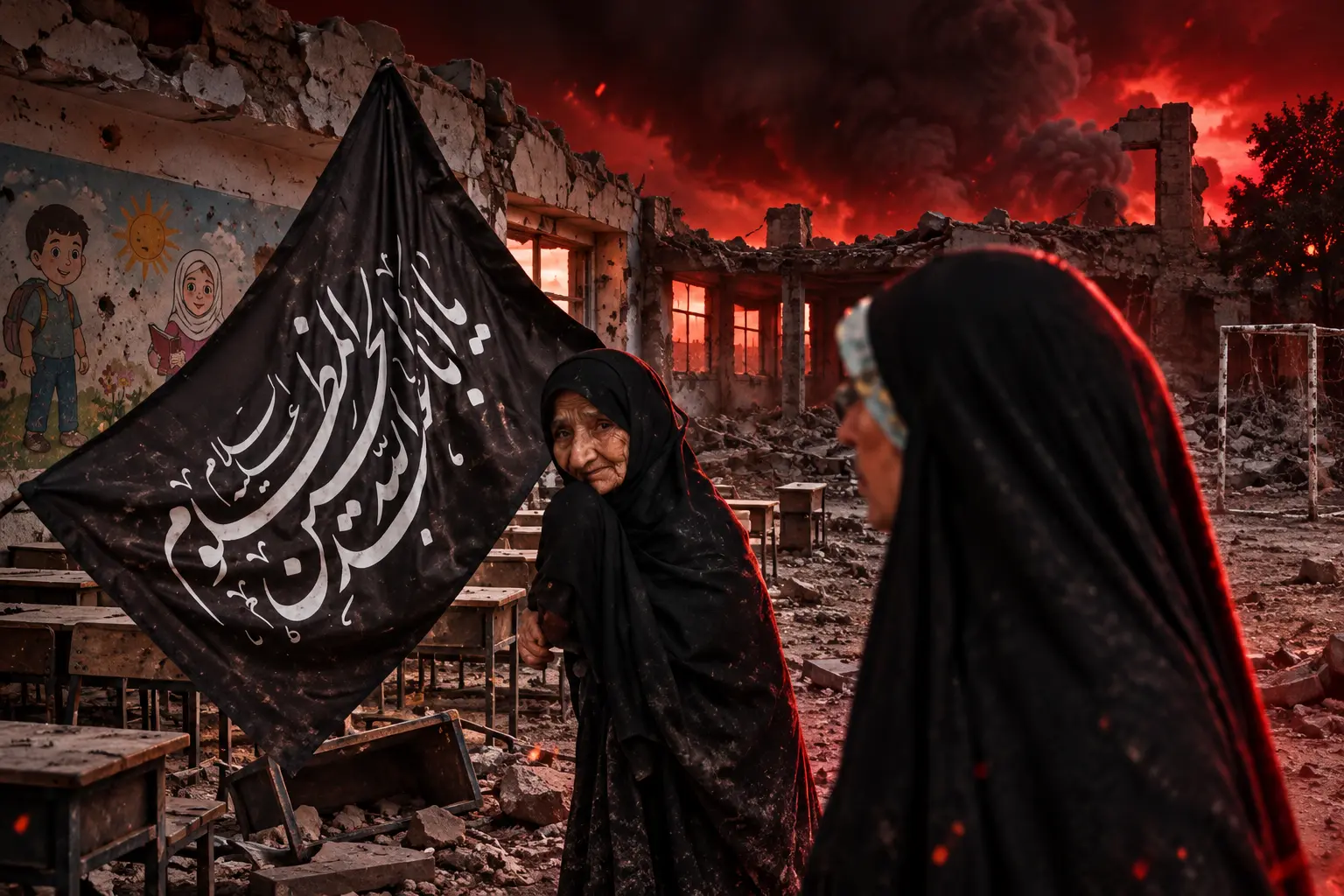
The Independent International Fact-Finding Mission on the Islamic Republic of Iran wrote that the Shajareh Tayyebeh Primary School, for girls and boys aged 6 to 13, was hit in Minab, Hormozgan province, between about 10:30 a.m. and 11:30 a.m. local time on February 28, the opening hours of the US-Israeli assault known as Operation Epic Fury. A first munition struck the lower floor. As staff moved children to a prayer room upstairs, a second hit the upper floor and killed many of them. Teachers and the principal, all women, died there too.
On April 9, Minab Prosecutor Ebrahim Taheri announced a death toll of 156. His list included 120 schoolchildren (73 boys and 47 girls), 26 women educators, seven parents, a school bus driver, and a pharmacy technician from next door. The mission recorded that tally. It also recorded that the school sat near an Islamic Revolutionary Guard Corps naval compound, separated by a wall, with its own gate, a playground, and children’s murals, and that it was visible as a working school.
That afternoon, about 5:10 p.m. local time, a strike hit the Shahid Haj Khalil Naimi Cultural and Sports Complex in Lamerd, Fars province. Local officials reported 22 dead, including four children, and more than 100 injured. An adjacent school was damaged. The mission said the sports site had no military use.
THE TWO FEBRUARY 28 STRIKES
| Place | Time (local) | Site | Deaths reported |
|---|---|---|---|
| Minab, Hormozgan | 10:30-11:30 a.m. | Shajareh Tayyebeh Primary School | 156 (Taheri, April 9), including 120 children |
| Lamerd, Fars | about 5:10 p.m. | Shahid Haj Khalil Naimi sports complex | 22, including four children; 100+ injured |
The mission interviewed 73 people, used satellite images, verified video, and weapons analysis, and received no replies to June information requests sent to the United States and Israel. Iran has never granted the mission access. A nationwide internet blackout that began on January 8, then tightened again on February 28, lasted in broad form until May 27, which the investigators said blocked witnesses and timely warning as the bombs fell.
The Mission Says the School Was the Aim Point
The investigators did not treat Minab as a stray round that clipped a classroom while aiming at the Guard compound. In reasonable grounds to believe the United States committed the war crime of launching an indiscriminate attack, they wrote that the school building was the intended point of impact and that the damage did not come from an errant strike or from splash off the neighboring base.
The Mission concludes that the building of the school was the intended point of impact and that the damage did not result from an errant strike or collateral damage from the attack on the adjacent IRGC compound.
Independent International Fact-Finding Mission on the Islamic Republic of Iran, A/HRC/63/61
Fragments at the site were identified as a US Tomahawk Land Attack Missile, a weapon Iran does not field. After that identification, Washington stopped disputing that US forces were involved. It has not released the inquiry. President Donald Trump said in June that “nobody” purposefully attacked the school.
The legal hook is not a claim that crews set out to kill a class of 6-to-13-year-olds. Reed Brody, a human rights lawyer with the International Commission of Jurists, said a war crime still needs a mental element, and that no one is alleging the United States meant to hit a school. The standard the mission used is recklessness: knowing there was a substantial risk of an unlawful result and going ahead. It described that as dolus eventualis, enough, in its reading of humanitarian law, for the war crime of an indiscriminate attack.
The report’s own line is harsher than a missed grid square. It said the United States directed strikes at the school building while aware of a substantial risk of hitting a civilian object, and that the failure to update targeting data “went beyond mere negligence.” UN experts condemned the Minab strike in March as a grave assault on children and on education, and called for an independent inquiry. Six months later the fact-finding mission supplied the legal label those experts did not yet pin on a named state.
What Recklessness Means for a War-Crime Charge?
Parties to an armed conflict must tell military objects from civilian ones and take all feasible precautions before firing. The customary definition of indiscriminate attacks covers strikes not aimed at a specific military objective, and methods whose effects cannot be limited as the law requires, so that they hit military and civilian things without distinction. That is the box the mission put around Minab and Lamerd.
White House Deputy Press Secretary Anna Kelly rejected the paper in full. “The UN Human Rights Council has accomplished nothing for human rights, spouting unserious nonsense for decades,” she said. “The only party in this conflict that has committed war crimes is the Iranian regime, which has murdered thousands of its own people, killed Americans overseas, executed acts of terrorism in the Strait of Hormuz, and launched indiscriminate attacks against its neighbours in the region.” She added that the president is “courageously ensuring that such an evil country never possesses a nuclear weapon.”
Iranian officials, including Taheri and the Lamerd County sports office, have published their own counts and called both strikes proof of indiscriminate attacks on civilians. Deputy Foreign Minister Kazem Gharibabadi said the United States cannot escape accountability by leaving the Human Rights Council. The mission’s Iran chapters sit beside that argument: a nationwide shutdown, lethal force against protests, at least 29 men executed after summary trials in the protest file, and more than 70 people still at risk of execution when the report closed. Those findings are real, and they do not cancel the two February 28 aim points.
Cooper’s Missile-Base Claim and the Playground Wall
Adm. Brad Cooper, who heads US Central Command, told the House Armed Services Committee on May 19 that a preliminary Pentagon review “correlated” the Minab strike with US forces. He would not accept public blame. “The school itself is located on an active IRGC cruise missile base,” he said. “It’s more complex than the average strike. As soon as we’re complete, I’m fully committed to transparency.”
Rep. Adam Smith, the committee’s ranking Democrat, said past US mistakes of this kind had been acknowledged quickly even while an inquiry ran. When Cooper stayed on the probe, Smith answered, “So that’s a ‘no.’ We will not take responsibility for something we very obviously did.”
People briefed on the early military inquiry have said target coordinates came from outdated Defense Intelligence Agency data that still treated the school grounds as part of the Guard naval site, a compound the school had once belonged to. A later account said warnings that intelligence on Iranian targets was badly out of date were bypassed as crews rushed to refresh thousands of records after the decision to open the war. The mission, working without US files, found no evidence the school was in military use, and called its civilian character apparent.
The unpublished inquiry is now the American half of this story. Cooper told lawmakers the work had been elevated. It still has not been made public. The UN paper notes that absence and proceeds anyway, on imagery, video, munitions, and Iranian and independent witnesses.
16 Civilian-Harm Posts Cut to One at Central Command
The recklessness finding did not land on a fully staffed targeting system. After taking office in 2025, Defense Secretary Pete Hegseth polled top commanders on cutting Civilian Harm Mitigation and Response, the post-Iraq and Afghanistan effort that put people inside regional commands to map civilian life before strikes. Current and former defense officials said he expected them to treat the work as “woke” and at odds with “maximum lethality.” Every commander rebuffed a kill order.
HOW THE HARM-REDUCTION SHOP WAS STRIPPED
- The poll: Hegseth offered three choices in early 2025: cut 65% of staff and keep the work running, shrink to a small office in Washington, or eliminate the program.
- The votes: Nine commanders picked the first option, to save as much of the shop as they could. Two commands, nuclear and cyber, rejected all three cuts and asked to keep the full program.
- CENTCOM’s warning: The command that runs the Middle East asked to keep all 16 of its civilian-harm posts. A memo said cuts would raise the risk of target misidentification and reduce battlespace awareness, and would make lethal operations less efficient, not more.
- What was left: By the time the Iran war opened, the enterprise had gone from a little under 200 people to around two dozen, some part time. Central Command, which had said it needed at least nine of those 16 posts to function, was left with one person.
Hegseth told a gathering of generals and admirals, “No more politically correct and overbearing rules of engagement.” On September 5, 2025, when the department was renamed, he put the same idea in a tighter couplet: “Maximum lethality, not tepid legality.” The Civilian Protection Center of Excellence could not be closed outright because Congress had written it into law. It was drained of people and money instead. A Pentagon inspector general later found the department no longer had the staff, tools, or systems two statutes require for a working civilian-casualty policy.
THE STAFFING LEDGER
- Peak civilian-harm staff: A little under 200 people across the department.
- On the eve of the Iran war: Around two dozen, some part time.
- Central Command: 16 posts, a stated minimum of nine, one person left.
- The April reboot memo: Under Secretary Elbridge Colby proposed 70 full-time posts, described as 35% of the old enterprise, still awaiting a final signature in late August.
CENTCOM’s own paper had said the harm-reduction work “enhanced our precision and accuracy, making us more lethal.” Retired Gen. Erik Kurilla, then the command’s chief, and other officers who actually fight had asked Hegseth to keep it. That request was overridden. In April, 11 senators told Hegseth the school strike, and other deadly hits on civilians in Iran, reflected “the administration’s broader disregard for the strategic, legal, and moral imperative to minimize civilian harm.” Democratic senators asked whether the staffing cuts themselves had helped produce Minab. The department said it would answer Congress, not the press.
Washington Still Rejects the Lamerd Strike
Minab is a fight over mental state and precautions. Lamerd is still a fight over who fired. The mission said US forces carried that strike too, and again found an indiscriminate attack that meets the war-crime threshold. Central Command says it did not.
On March 31, Capt. Tim Hawkins, a CENTCOM spokesman, said, “U.S. forces did not launch any strikes at any time into the city of Lamerd or anywhere within 30 miles during the opening day of Operation Epic Fury.” He said video did not show a Precision Strike Missile. “A PrSM is 13 feet in length. The munition depicted in the video appears to be twice as long, consistent with the dimensions and silhouette of an Iranian Hoveyzeh cruise missile.”
Weapons specialists who studied authenticated, geolocated video rejected the Hoveyzeh identification, citing engine shape and burst pattern, and pointed to a US Army PrSM, a weapon the United States had publicly confirmed using in Iran for the first time. Days after the war opened, Central Command had celebrated that “historic first” without naming Lamerd. Cooper later told Congress the command was investigating only one case of US fire killing civilians, the Minab school. The UN mission is the first official international body to put both towns in the same finding.
WHERE THE LAMERD ACCOUNTS DIVERGE
- CENTCOM: No US fire into Lamerd or within 30 miles on February 28; damage said to match an Iranian Hoveyzeh cruise missile; PrSM combat debut acknowledged elsewhere, not in that town.
- The UN mission: Reasonable grounds that the United States carried an indiscriminate strike on a civilian sports complex and nearby homes, a war crime; Hoveyzeh identification rejected on expert weapons analysis.
- Open-source specialists: Munition and air-burst pattern match a PrSM, a system Iran is not known to field; Israel said it did not strike that far south that day.
Iran has rejected the Hoveyzeh story and called the missile American. For the mission, Lamerd matters because the weapon’s wide air burst, in its telling, could not be directed at a specific military objective. That is a separate path into the same legal box as Minab’s failure to verify a school.
The Council Set to Hear the Report on Monday
The Human Rights Council’s sixty-third session opened on September 7 and runs through October 9. States are due to discuss A/HRC/63/61 on September 21. The State Department said on September 17 that the United States had formally ended its membership and participation, accusing the council of anti-American rhetoric and of going easy on repressive governments. That step completed a pullback Trump had already ordered, including a January memorandum directing withdrawal from 66 international organizations and an earlier executive order leaving the council.
The finding still has no automatic courtroom. The United States withdrew from the International Court of Justice’s general jurisdiction after Nicaragua’s 1980s case over mined harbors. Iran is unlikely to join the International Criminal Court, which tries people, not states, and would open its own record to prosecutors. Brody has said UN papers can still feed later cases, as they have in other disputes, and that the practical lever inside the United States is political: Congress, midterms, and a demand that the Pentagon’s Minab file be released. “It gives them a hook,” he said.
The mission asked for an end to the hostilities, reparations for victims, and a diplomatic path. Cooper’s inquiry remains closed to the public. The school in Minab is still a ruin. On September 21 the council will hear a finding that the ruin was the aim point. The government named in that sentence says it is no longer in the room.

Ohtani Game 4 Logoman Card Sells for $3.24 Million

Cole Kmet’s Season Ends, and Chicago’s Tight End Plan Starts

NBA Seeks Soccer Money After EuroLeague Clubs Refused

Amazon’s First Bond Tests Leave the Broccoli Chair Empty

Tyrese Maxey Owns the Night Built for LeBron James

Warsh Rejects Rate Guidance and Still Moves Markets

Dana-Farber Exits an MGB Medicare Advantage Network Early

NASA Launches the Roman Space Telescope’s Cosmic Bet

OpenAI’s Cyber Letter Puts the Defense Bill on Governments

Russia Recycles Its Old Warning Over Storm Shadow Plants
-
 BUSINESS2 months ago
Warsh Rejects Rate Guidance and Still Moves Markets
-
 BUSINESS1 month ago
Dana-Farber Exits an MGB Medicare Advantage Network Early
-
 NEWS2 months ago
NASA Launches the Roman Space Telescope’s Cosmic Bet
-
 NEWS2 months ago
OpenAI’s Cyber Letter Puts the Defense Bill on Governments
-
 NEWS2 months ago
Russia Recycles Its Old Warning Over Storm Shadow Plants
-

 ENTERTAINMENT4 weeks ago
Primetime’s $2.7 Million Preview Tops Pitt’s Costlier Film
-

 BUSINESS2 months ago
Jet Drones Lock Down Kyiv and Strip Kherson of Heat
-

 NEWS2 months ago
Congo Starts Ervebo Vaccinations for a Different Ebola Virus