
NEWS
Iran’s Fairford Scare Already Sent the Bombers Home
MI5 says Iran has moved onto UK military sites after a Fairford scare sent 12 US B-1 bombers home, with nobody charged.

MI5 chief Sir Ken McCallum said on 13 October that Iran has shifted toward British military sites, after a scare emptied RAF Fairford of 12 US B-1 bombers. The planes left on 4 October. Nobody arrested over the vans at the Gloucestershire base has been charged.
Prime Minister Andy Burnham told the Commons on 12 October that the Fairford incident was highly likely coordinated in Iran and almost certainly directed by the Islamic Revolutionary Guard Corps. McCallum would not discuss that live file, and then placed it inside a wider change in what Tehran is willing to try on British soil.
McCallum Warns After the Bombers Have Already Gone
Speaking to an invited audience at Thames House, McCallum said Iran has, since 2022, hired criminals in Britain to lean on dissidents, Iranian media offices and Israeli sites. He said 2026 was different. The Guard was still using that method, he said, and it was also reaching for sites that are supposed to be hard to touch.
The other major shift this year has been Iranian ambitions to come at harder targets, like military sites. You will appreciate that, with live investigations ongoing and the need to avoid prejudicing future prosecutions, there are things I can’t say. What I can say is that those who seek to cause mayhem on British streets, whether hired thugs here or their paymasters overseas, will meet an unflinching response.
Sir Ken McCallum, Director General of MI5, annual threat update at Thames House, 13 October 2026
In the prepared text he said Iran-linked work had produced more than fifty Iran-linked arrests in the United Kingdom over the previous 12 months. Much of that pressure, he said, had been aimed at British Jewish communities. Two Iranian nationals were recently charged with terrorism offences over an alleged plot against the Jewish community in Manchester. A spring wave of arson and sabotage against synagogues, ambulances and businesses was claimed by a group calling itself the Islamic Movement of the Companions of the Right; McCallum said members of the IRGC sat behind that front, and that both had been designated under the National Security Act.
In questions after the speech he said the Fairford incident was “not unique,” with other examples in Britain and abroad, “including more specifically in Iran’s own region.” He also said MI5 is now putting more effort into state threats than it did in the Cold War, and that the state-threats caseload has quadrupled in a decade. Terrorism work and state-threats work, he said, are now “pretty much of equal scale.” Russia remains “aggressor number one.”
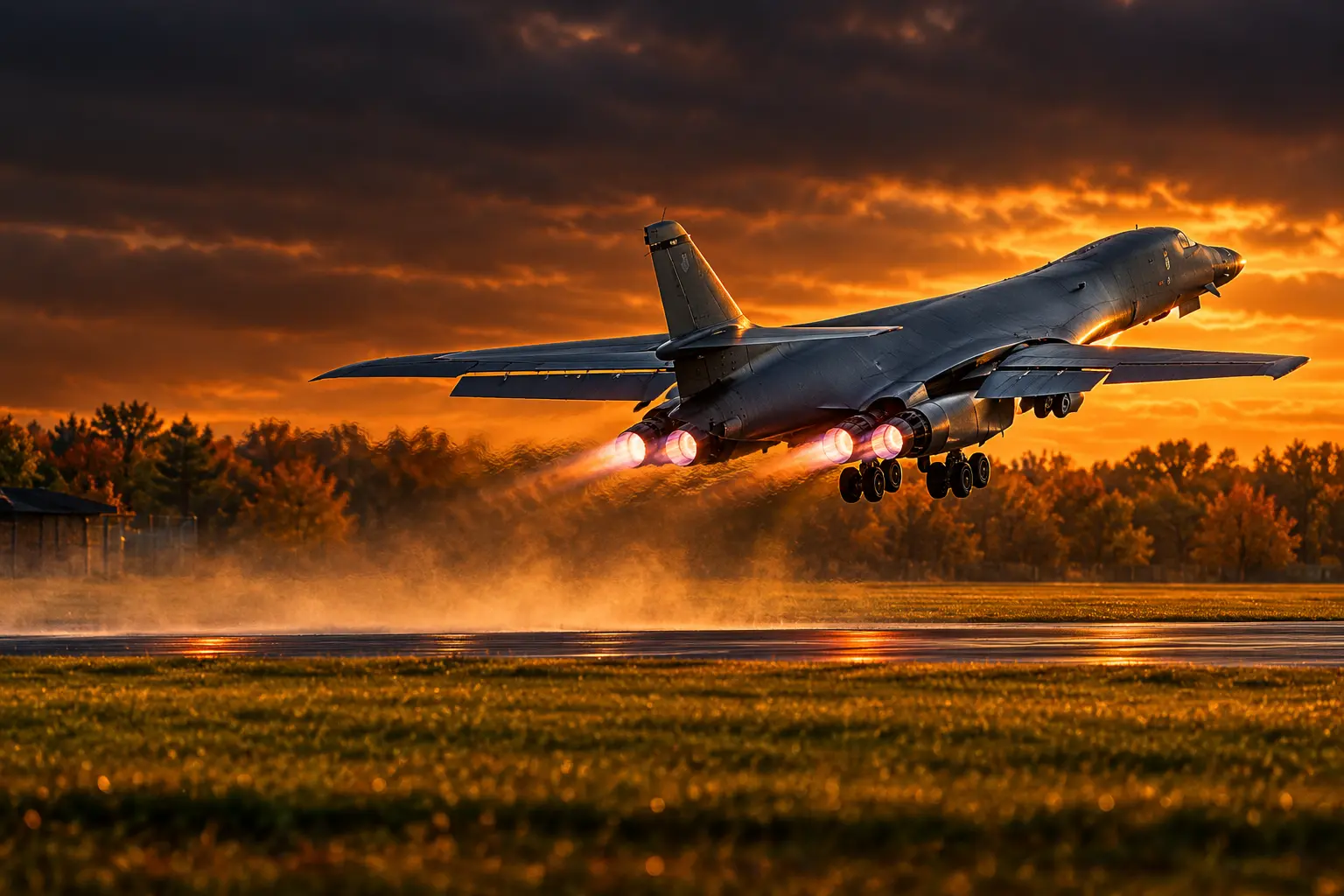
Twelve B-1 Lancers Left Fairford in a Day
The operational cost showed up before McCallum reached the lectern. On 4 October, all 12 B-1B Lancers then at RAF Fairford flew back to home stations in the United States, aircraft spotters tracking a full-day departure. The Pentagon and US European Command said every US bomber deployed to the base had gone.
US BOMBERS AT RAF FAIRFORD
| Period | Aircraft on the ramp | What they were doing |
|---|---|---|
| Peak, March 2026 | About 18 B-1B and 6 B-52H (around 24 in all) | Strikes under Operation Epic Fury |
| After the April ceasefire | B-52s gone; B-1s stayed | Mostly training sorties |
| 4 October 2026 | 12 B-1B leave in a day | No US bombers left at Fairford |
The open-source group Military Air Tracking Alliance recorded 29 separate bombers at Fairford at different points in the conflict. Fairford has no permanently assigned US combat aircraft, but it is the main US bomber site in Europe, backed by the 501st Combat Support Wing. One of the 12 Lancers that left on 4 October had arrived only the week before as a replacement.
President Donald Trump said there had been threats and that the jets were moved because of them, adding that US officials “actually know the people who made the threat.” Vice President JD Vance called it an abundance of caution to “protect our guys.” Secretary of State Marco Rubio would not tie the redeployment directly to the Fairford arrests and described movements of this kind as routine. The Pentagon stressed that B-1s, B-2s and B-52s can still strike from the continental United States “anywhere, anytime.” Stationing them in Gloucestershire had cut the flying time to Iran. That advantage is gone.
What the Vans Near Whelford Carried
The scare that emptied the ramp began in the first hours of 27 September. Five British men in their 20s drove three white vans to Whelford, the village beside the base. Police declared a major incident. Army bomb-disposal teams moved in, and scores of residents were taken from their homes. Officers later said they had found petrol in the vans and no viable explosives.
The five were arrested on suspicion of explosives and terrorism offences and released on bail. Two more men, including a British-Iranian national, were arrested later and also released. Seven men in all have been bailed over Fairford. None has been charged.
FROM THE VANS TO THE ATTRIBUTION
- 27 September 2026: Three vans are stopped near RAF Fairford; five men from London are arrested and later bailed.
- 4 October 2026: All 12 remaining US B-1B bombers leave the base for home stations.
- 10 October 2026: Two Latvian men are arrested for trespassing at RAF Molesworth, a US and NATO intelligence site, and released on bail.
- 12 October 2026: Burnham tells MPs the Fairford events were highly likely coordinated in Iran and almost certainly directed by the IRGC; two Iranians are sanctioned and Iran’s ambassador is summoned.
- 13 October 2026: McCallum delivers the Thames House update; Tehran calls the British file a clumsy false-flag operation.
The Molesworth arrests sit beside Fairford, not inside it. Both sites host US missions. Both produced bail, not charges. Burnham’s 12 October statement was still the firmest public attribution Britain has offered on the bomber-base scare, and it arrived after the aircraft had already gone.
Fairford Became a Launch Pad in March
That sequence is the part the arrest tally does not capture. The United States and Israel opened operations against Iran on 28 February. Britain first refused the use of its bases. On 1 March, after an Iranian drone struck the British air base at Akrotiri in Cyprus, then-prime minister Keir Starmer agreed that US aircraft could fly “defensive” missions from British soil. The Ministry of Defence said US heavy bombers had, from 1 March, been taking off from Fairford “for defensive missions to destroy Iran’s missile capabilities.”
The first B-1B arrived on 6 March. Three B-52Hs followed on 9 March. At the height of the deployment the ramp held around two dozen bombers. A shaky ceasefire in April stood down the wartime surge, the B-52s left in the months that followed, and the remaining Lancers shifted to training. They were still there when the vans appeared in Whelford, which is why a local scare became a US force-protection problem.
Fairford is a British station used by US Global Strike Command because it is one of the few European fields that can handle B-1, B-2 and B-52 operations. Hosting those jets made the base part of the war Tehran is still fighting, even under a ceasefire that has not put the aircraft debate to rest. A crude approach to the perimeter did not have to succeed as an attack in order to change what sat on the concrete.
An IRGC Officer and a Gang Fixer Are Now Listed
London’s first public reply, once Burnham had named the Guard, was a sanctions package and a summons, not a charging decision. Foreign Secretary Ed Miliband said Iran’s use of criminal networks, proxy groups and state-backed activity against Britain and its partners was unacceptable, and that “Britain will not tolerate threats on our soil.” He instructed his department to summon Ambassador Seyed Ali Mousavi. Burnham said Britain would go after the networks and their money, and that further sanctions on Iran and the IRGC would follow.
THE 12 OCTOBER DESIGNATIONS
| Name | Role London assigned | Measures | List ID |
|---|---|---|---|
| Ruhollah Bazghandi | Head of IRGC counterespionage operations | Asset freeze, travel ban, director disqualification | IRN0282 |
| Shahram Ali Reza Tamarzadeh Jakki | Facilitator for the Zindashti criminal network | Same three measures | IRN0283 |
The UK statement of reasons says there are reasonable grounds to suspect Bazghandi of planning or conducting espionage for the Iranian government, and of threatening, planning or conducting attacks against people and assets in Britain or another country. He now faces an asset freeze, travel ban and director ban under the Iran (Sanctions) Regulations 2023. A Foreign Office notice the same day recorded two additions under the Iran regulations, the second of them Jakki, also listed as Farhad Ali Tamarzadeh, born 31 May 1972.
Jakki’s statement of reasons is narrower: support or assistance for threats, plans or attacks against people in a country other than Iran. US Treasury action in 2024 had already described him as Naji Sharifi Zindashti’s brother-in-law, a man who handled logistics and money with a Ministry of Intelligence handler. Britain sanctioned the Zindashti network itself in May. The Fairford designations fold an IRGC security officer and a gang fixer into the same day’s list, which is the method McCallum has been describing since 2022: the state pays criminals to do the work, and the people stopped at the scene may never see the paymaster.
Britain also joined a 29-country statement, including the United States, condemning Iranian state-backed activity abroad. That is the diplomatic layer. It does not fill a charge sheet in Gloucestershire.
Why Tehran Calls the File a False Flag
Iran’s Foreign Ministry answered Burnham the same evening. It called the British claims an “ugly conspiracy” meant to push an anti-Iran campaign and to dodge accountability for Britain’s role in US-Israeli military action against Iran. It said phrases such as “highly likely” and “almost certainly” were a way to sound sure without producing evidence. It held London, and “the architects and perpetrators of this clumsy false-flag operation,” responsible for the consequences.
Mousavi, summoned in London, rejected any Iranian role and said Tehran was willing to help the British inquiry if London produced documents. Iran then summoned British ambassador Hugo Shorter in Tehran. The embassy in London posted the ministry text in full.
Iranian Foreign Ministry statement condemning Britains baseless accusations Against Iran
The Ministry of Foreign Affairs of the Islamic Republic of Iran strongly condemns the claims made by British officials attributing the alleged security incident at RAF Fairford to Iran,… pic.twitter.com/WRj9WTm9oM
— Iran (I.R.of) Embassy in UK (@Iran_in_UK) October 13, 2026
The denial is not a side note. Fairford’s value to Washington was the shorter run into Iran. Britain’s political choice in March, after Akrotiri was hit, was to let that run start from Gloucestershire. Tehran’s reading is that London helped bomb Iran and is now dressing up a local scare as a Guard plot. McCallum’s reading is that the Guard has spent 2026 widening a hybrid campaign that already used criminals against Jews, dissidents and Israeli sites, and that military bases are the new mark. Those two accounts will not be reconciled by a sanctions notice.
Hired Hands, Not Guided Drones
Asked whether Iran could mount a complex attack in Britain, perhaps with explosive drones, McCallum would not inflate what his officers have actually seen. The people Tehran uses on the ground here, he said, have not shown that skill.
WHAT MI5 SAYS IT HAS SEEN IN BRITAIN
- The method: Iran in the UK is “principally using a modus operandi of hiring criminals to do their bidding,” McCallum told journalists after the speech.
- The ceiling so far: “Given what we’ve actually seen in practice in the UK in recent years, that has not been anywhere near [that] level of capability.”
- The contrast: Closer to Iran, he said, the IRGC has “quite deep experience of using more conventional and hybrid technology in a more aggressive and sophisticated way.”
- The legal tool: The National Security Act has produced dozens of arrests in three years, with charges, prosecutions and convictions tied to Russia, Iran and China.
That is a narrower claim than a drone swarm on a bomber ramp, and it still leaves a problem for anyone trying to keep US jets in Europe. A van with petrol is a poor match for a guarded airfield. It was still enough, once Washington had a fresh threat warning, to send the Lancers home. McCallum told firms that run critical kit to use the National Protective Security Authority’s guidance on sabotage and hostile drones “the day before, not the morning after.” Fairford’s morning after was an empty parking row.
The 12 Lancers are back at home stations, able to fly the long route if the ceasefire breaks. Seven men from the Fairford vans remain on bail. McCallum’s own test is whether hired crews in Britain ever catch up with the skill the Guard already shows closer to home.

Ohtani Game 4 Logoman Card Sells for $3.24 Million

Cole Kmet’s Season Ends, and Chicago’s Tight End Plan Starts

NBA Seeks Soccer Money After EuroLeague Clubs Refused

Amazon’s First Bond Tests Leave the Broccoli Chair Empty

Tyrese Maxey Owns the Night Built for LeBron James

Warsh Rejects Rate Guidance and Still Moves Markets

Dana-Farber Exits an MGB Medicare Advantage Network Early

NASA Launches the Roman Space Telescope’s Cosmic Bet

OpenAI’s Cyber Letter Puts the Defense Bill on Governments

Russia Recycles Its Old Warning Over Storm Shadow Plants
-
 BUSINESS2 months ago
Warsh Rejects Rate Guidance and Still Moves Markets
-
 BUSINESS1 month ago
Dana-Farber Exits an MGB Medicare Advantage Network Early
-
 NEWS2 months ago
NASA Launches the Roman Space Telescope’s Cosmic Bet
-
 NEWS2 months ago
OpenAI’s Cyber Letter Puts the Defense Bill on Governments
-
 NEWS2 months ago
Russia Recycles Its Old Warning Over Storm Shadow Plants
-

 ENTERTAINMENT4 weeks ago
Primetime’s $2.7 Million Preview Tops Pitt’s Costlier Film
-

 BUSINESS2 months ago
Jet Drones Lock Down Kyiv and Strip Kherson of Heat
-

 ENTERTAINMENT2 months ago
Midnight Spider-Man Turns Peter Parker Into Oscorp’s Hybrid