
NEWS
Budhi Gandaki Flood Hits Gorkha as Dashain Begins
A landslide-dam burst on Nepal’s Budhi Gandaki River swept hydropower camps and bridges in Gorkha on Dashain morning, leaving five herders missing.

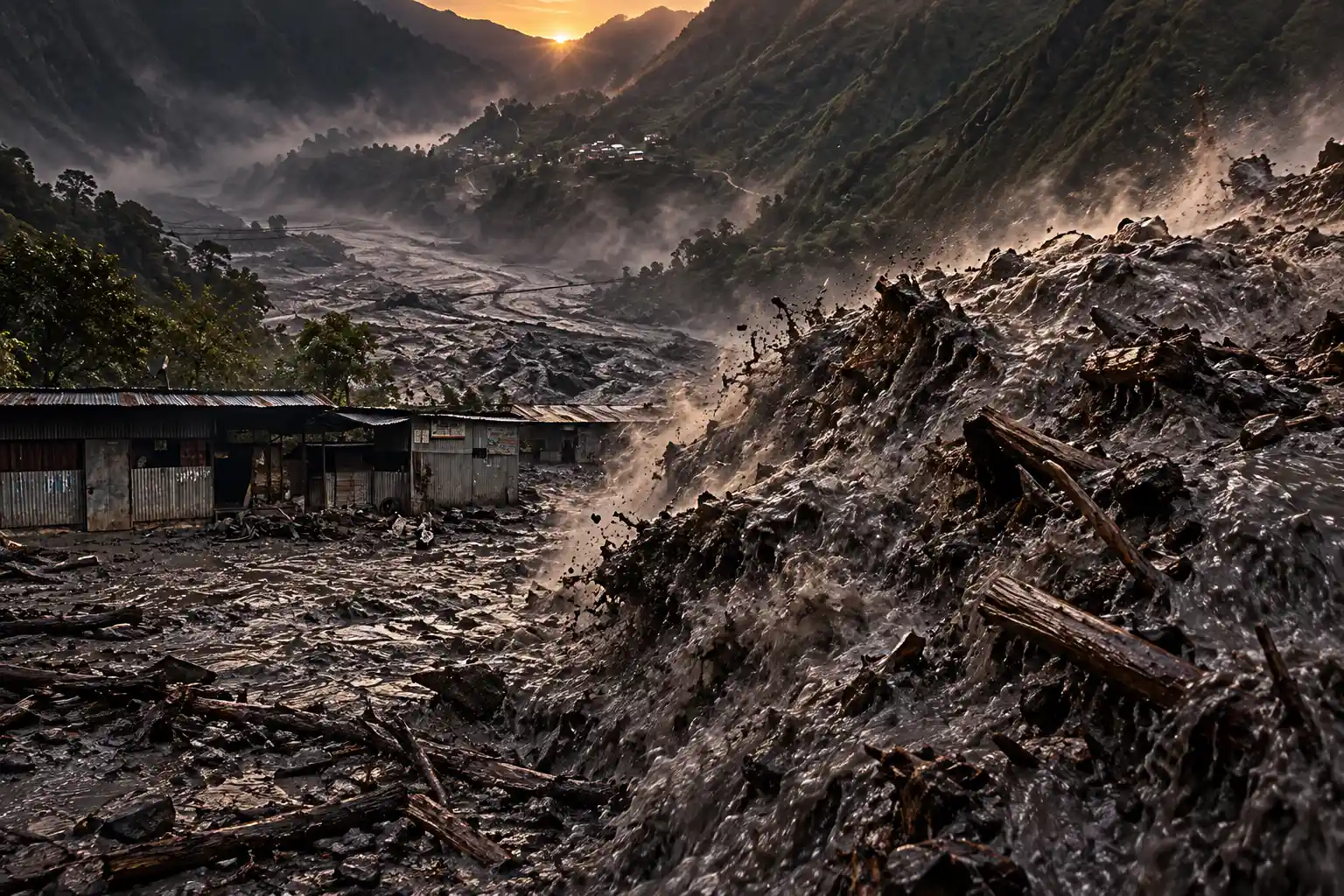
A landslide-dam burst sent mud and debris down Nepal’s Budhi Gandaki River at about 4 a.m. on October 11, the first morning of Dashain. The National Disaster Risk Reduction and Management Authority said five people remain missing and 47 were rescued by army helicopter in Gorkha district.
No deaths were confirmed. The same surge tore out bridges and the camp of a 341-megawatt hydropower project, 46 days after a glacier collapse on the connected Trishuli system left 1,377 recovered dead.
Five Herders Are Missing After the 4 a.m. Surge
In a Sunday press note, the authority said a landslide between Lokpa and Chumling in Chumnubri Rural Municipality-6 blocked the river and then released a flood of mud and debris. The missing are two women and three men who had been staying at a sheepfold in Ungiling, Chumchet, in that municipality.
Four Nepal Army helicopters lifted 47 people to safety. The authority put the ground force at 437: 127 from the army, including three Special Force units, 133 from Nepal Police and 177 from the Armed Police Force, with another 50 police on standby. Twelve staff at the Salleri works site were moved out, and 25 officers from the Arughat area police office were sent to pull people off the banks.
SUNDAY MORNING ON THE BUDHI GANDAKI
- About 4 a.m., October 11: Flooding begins, carrying mud, sediment and debris down the Budhi Gandaki corridor, according to a preliminary reading by the International Centre for Integrated Mountain Development.
- 6 a.m.: The flood alert reaches the Hydrology and Water Resources Research Centre’s Flood Forecasting Division, which warns residents from Gorkha and Dhading down to Benighat in Chitwan.
- 6:15 a.m.: An army reconnaissance team leaves the Bangsing post of the Rudradhwaj Battalion and later reports a dry landslide in the Philim area of Chumnubri-3.
- 6:30 a.m.: The authority’s monsoon command post begins continuous meetings; SMS alerts go to 221 emergency responders in Gorkha, Dhading, Tanahun, Chitwan and both Nawalparasi districts.
Floodwater entered the lower settlement of Machhikhola and left 20 to 22 houses at risk. Two telephone towers and 50 electricity poles were damaged. Binod Parajuli, a government meteorologist, said the hydrological station at one gauge was swept away, so readings from that spot stopped. Officials said the river at one location rose from 2 metres to nearly 8.5 metres, above a 5-metre danger mark.
A Dry Landslide Dammed the River, Then Gave Way
The army’s first read is a classic mountain sequence. A dry slide at Philim blocked the Budhi Gandaki; the plug then failed and a silt-laden surge ran downstream. ICIMOD, reviewing government accounts, placed the likely blockage near Chumchet and timed the flood at around 4 a.m. Nepal time.
Qianggong Zhang, ICIMOD’s strategic lead on climate and environmental risks, said the early analysis points to the failure of a temporary landslide blockage that released a heavily sediment-laden flood. Locals upstream had also spoken of an ice avalanche, and that account has not been ruled out. A three-member team of drone operators and geologists was sent to pin down the trigger.
WHAT WE KNOW
- The timing: The surge struck before dawn on October 11 and prompted warnings on the Budhi Gandaki, Trishuli and Narayani systems as levels jumped.
- The army recon: A dry landslide at Philim is the working field report for how the river was blocked.
- The missing: Five people from the Ungiling sheepfold had not been found when the authority issued its Sunday note.
WHAT IS UNCONFIRMED
- Exact blockage point: NDRRMA cites Lokpa-Chumling; the army cites Philim; ICIMOD cites Chumchet. Those names sit in the same upper corridor, but the dam site is not mapped.
- Ice versus rock: An ice avalanche remains a local report, not a closed finding.
- Full house loss: Early local counts of dozens of homes have not been locked into the authority’s Sunday tally.
The Budhi Gandaki feeds the Trishuli, which is the same trunk that carried the August disaster out of Rasuwa. Downstream towns were told to stay off the banks through Sunday evening, and teams from the Department of Roads began looking at Bailey spans to replace what the water took.
Four Hydropower Projects Sat in the Debris Path
The Independent Power Producers’ Association, Nepal, said the flood hit four plants still being built in Gorkha, with a combined planned capacity of 412.09 megawatts. The largest is the 341-megawatt Budhi Gandaki project, which Times Energy Pvt Ltd is developing at Salleri. Him Pathak, the firm’s chairman, said the camp was empty when the water arrived.
The flood swept away our camp, road and bridge.
Him Pathak, chairman, Times Energy Pvt Ltd
THE PROJECTS IN THE FLOOD PATH
| Project | Planned MW | Developer | Reported damage |
|---|---|---|---|
| Budhi Gandaki | 341 | Times Energy Pvt Ltd | Main camp, equipment, road and bridges |
| Dobhan Khola | 24.5 | Dobhan Khola Hydropower Limited | Camp houses and a Bailey bridge |
| Yaru Khola | 30.59 | Yaru Hydropower Pvt Ltd | Bailey bridge, materials and equipment |
| Machha Khola | 16 | Water Energy Development Pvt Ltd | Access road and the bridge to the site |
Pathak said both motorable and suspension bridges on the approach were washed out. The authority separately recorded seven to eight houses washed away around the under-construction Salleri site. That is the pattern that keeps repeating on this river: the works camp, the access road and the span that ties a village to the next ward all sit in the same bed of sand.
Manaslu Already Sent Water Down This Valley
Sunday’s flood is the second sudden pulse on the Budhi Gandaki in two years. On April 21, 2024, an ice avalanche from the Manaslu Glacier dropped into Birendra Tal and shoved lake water into the same river in Gorkha. Manaslu stands 8,163 metres. ICIMOD’s 2024 Budhi Gandaki flood assessment found that event was not a classic glacial-lake outburst, because the moraine dam did not breach, and it warned that later pulses from ice, debris or the adjacent valley could hit harder.
Pema Gyamtsho, ICIMOD’s director general, tied Sunday’s surge to the August disaster on the next corridor over.
Coming so soon after the Gyirong-Rasuwa disaster, this event is another reminder of how exposed mountain communities and river corridors remain to sudden, cascading hazards.
Pema Gyamtsho, director general, ICIMOD
Houses, trekking paths and power camps occupy the only flat ground the valley offers. Older settlement practice kept dwellings on higher shelves and used the river flats for fields; the bazaars at Salleri and Jagat, and the 341-megawatt camp, sit where a debris flood has a clear run. That siting choice, not a new monsoon, is what turned a blocked tributary into a bill for bridges and turbines.
August’s Missing List Has Not Closed
On August 26 a glacier collapse high on the Nepal-Tibet side of the range sent ice, rock and mud down the Bhotekoshi and Trishuli. Dharma Raj Upreti, chief executive of NDRRMA, later described the cascading impacts experienced in Rasuwa and Gyirong as a lesson in hazards that chain together rather than arrive one at a time.
The authority’s Rapid Damage and Needs Assessment, using figures as of 6 p.m. on September 10, recorded 1,377 recovered bodies and 5,130 missing, with 13,676 people rescued. Hydropower and energy was the hardest-hit sector in that accounting, at NPR 15,104.45 crore ($997.13 million) in damage and loss.
NDRRMA COUNT AS OF SEPTEMBER 10
- Recovered dead: 1,377 bodies and human remains on the August flood corridor.
- Still missing: 5,130 people, a list that remained open when Gorkha flooded again.
- Rescued then: 13,676 people taken off the Trishuli-Bhotekoshi system.
- Power losses: NPR 15,104.45 crore in hydropower and energy damage from that disaster alone.
Sunday’s flood was smaller and slower than August’s wall of ice and mud, according to specialists who compared the two. It still found a construction camp, a sheepfold and the Gorkha-Dhading link. The August list had not been closed. The new missing names are five herders, not hundreds of pilgrims and tunnel crews, and that gap is the only mercy in the comparison.
Ghatasthapana Began After the River Rose
Dashain, Nepal’s main 15-day festival, began on October 11 with Ghatasthapana. The Nepal Panchanga Nirnayak Bikas Samiti set the auspicious hour at 11:47 a.m., more than seven hours after the Budhi Gandaki jumped its banks. Vijaya Dashami, the tika day, falls on October 21. Phulpati, on October 17, is the day sacred plants are brought into Kathmandu from Gorkha, the same district whose northern wards lost their river spans on Sunday.
SPANS THE WATER TOOK
- Nyakchet to Sirdibas: The old suspension bridge in Chumnubri-3 was swept away, and one house went with it.
- Machhikhola to Kerauja: The suspension bridge in Dharche-5 is gone.
- Naya Pul: The Gorkha-side section of the three-part bridge linking Gorkha and Dhading was washed out.
- Soti: The bridge connecting wards 2 and 3 of Arughat Rural Municipality went down, the same crossing later filmed collapsing in seconds.
Families across Nepal were sowing barley for jamara while Gorkha’s northern wards were counting lost decks. Route permits for festival travel had been opened from Ghatasthapana through the full moon, a routine step for a country that empties toward home districts this fortnight. Several of those roads now dead-end at a missing span. Medical teams in Gorkha, Lamjung and Tanahun were placed on standby, and the authority told riverside residents to stay on high ground, skip damaged bridges and wait for local instructions.
The five people from the Ungiling sheepfold remain missing. Drone operators and geologists were still trying to mark the point where the river was blocked, and the 341-megawatt camp at Salleri is a smear of mud where a works yard stood at dusk on October 10.

Ohtani Game 4 Logoman Card Sells for $3.24 Million

Cole Kmet’s Season Ends, and Chicago’s Tight End Plan Starts

NBA Seeks Soccer Money After EuroLeague Clubs Refused

Amazon’s First Bond Tests Leave the Broccoli Chair Empty

Tyrese Maxey Owns the Night Built for LeBron James

Warsh Rejects Rate Guidance and Still Moves Markets

Dana-Farber Exits an MGB Medicare Advantage Network Early

NASA Launches the Roman Space Telescope’s Cosmic Bet

OpenAI’s Cyber Letter Puts the Defense Bill on Governments

Russia Recycles Its Old Warning Over Storm Shadow Plants
-
 BUSINESS2 months ago
Warsh Rejects Rate Guidance and Still Moves Markets
-
 BUSINESS1 month ago
Dana-Farber Exits an MGB Medicare Advantage Network Early
-
 NEWS2 months ago
NASA Launches the Roman Space Telescope’s Cosmic Bet
-
 NEWS2 months ago
OpenAI’s Cyber Letter Puts the Defense Bill on Governments
-
 NEWS2 months ago
Russia Recycles Its Old Warning Over Storm Shadow Plants
-

 ENTERTAINMENT4 weeks ago
Primetime’s $2.7 Million Preview Tops Pitt’s Costlier Film
-

 BUSINESS2 months ago
Jet Drones Lock Down Kyiv and Strip Kherson of Heat
-

 ENTERTAINMENT2 months ago
Midnight Spider-Man Turns Peter Parker Into Oscorp’s Hybrid