
BUSINESS
Houthi Strikes Kill a Saudia Pilot at Riyadh Airport
A Houthi attack on Riyadh’s King Khalid Airport killed a Saudia captain as Washington paused Iran strikes until after November 3.

Three Saudi citizens were killed in two attacks on Riyadh’s King Khalid International Airport on Thursday, the General Authority of Civil Aviation said. One of the dead was Saudia Captain Hamoud Ali Alkalthami. A parked Saudia jet was hit with no passengers on board.
Airport buildings took the first strike. The airliner took the second. Operations later reopened, even as President Donald Trump said the United States would not attack Iran before the November 3 midterms and oil futures slipped on talk of talks.
Two Strikes Hit King Khalid International Airport
GACA said Friday that two attacks targeted airport facilities and a Saudia aircraft the day before. Three Saudi citizens were killed. Saudi citizens and residents of several nationalities were hurt, from minor wounds to critical ones, and all of the injured were taken to hospital. The authority also reported property damage.
The Houthis claimed the strikes. Military spokesman Yahya Saree said a ballistic missile hit King Khalid airport and, in separate remarks, said two cruise missiles were used. The Saudi-led coalition said it intercepted two ballistic missiles headed toward Riyadh and a third toward Khamis Mushait, near a major airbase. Smoke rose over the field. Loud blasts were heard across the capital. Staff in the King Abdullah Financial District were told to work from home. Diplomats and international schools took shelter.
THE WEEK THE AIRPORTS WERE HIT
- September 18, 2026: Coalition forces intercept a suspected Houthi ballistic missile fired toward King Khalid airport.
- September 19, 2026: An explosion is heard near the airport and black smoke rises from a fuel storage area.
- October 6-7, 2026: Attacks on Abha and King Khalid airports kill three foreign nationals, an Egyptian and an Algerian at Abha and a Sudanese national at Riyadh, and injure 36 people.
- October 8, 2026: Two attacks hit King Khalid airport again, killing three Saudi citizens and damaging a parked Saudia aircraft.
- October 9, 2026: GACA and Saudia confirm the deaths, the coalition says it destroyed three rocket launch platforms, and air traffic is described as back to normal even as foreign airlines stay out.
Saree also claimed a strike on Najran airport and fire at the Khamis Mushait airbase, claims Riyadh has not confirmed in the same terms. The group told airlines to stay out of Saudi airspace except over Mecca and Medina, calling the rest a theater for its missile forces.
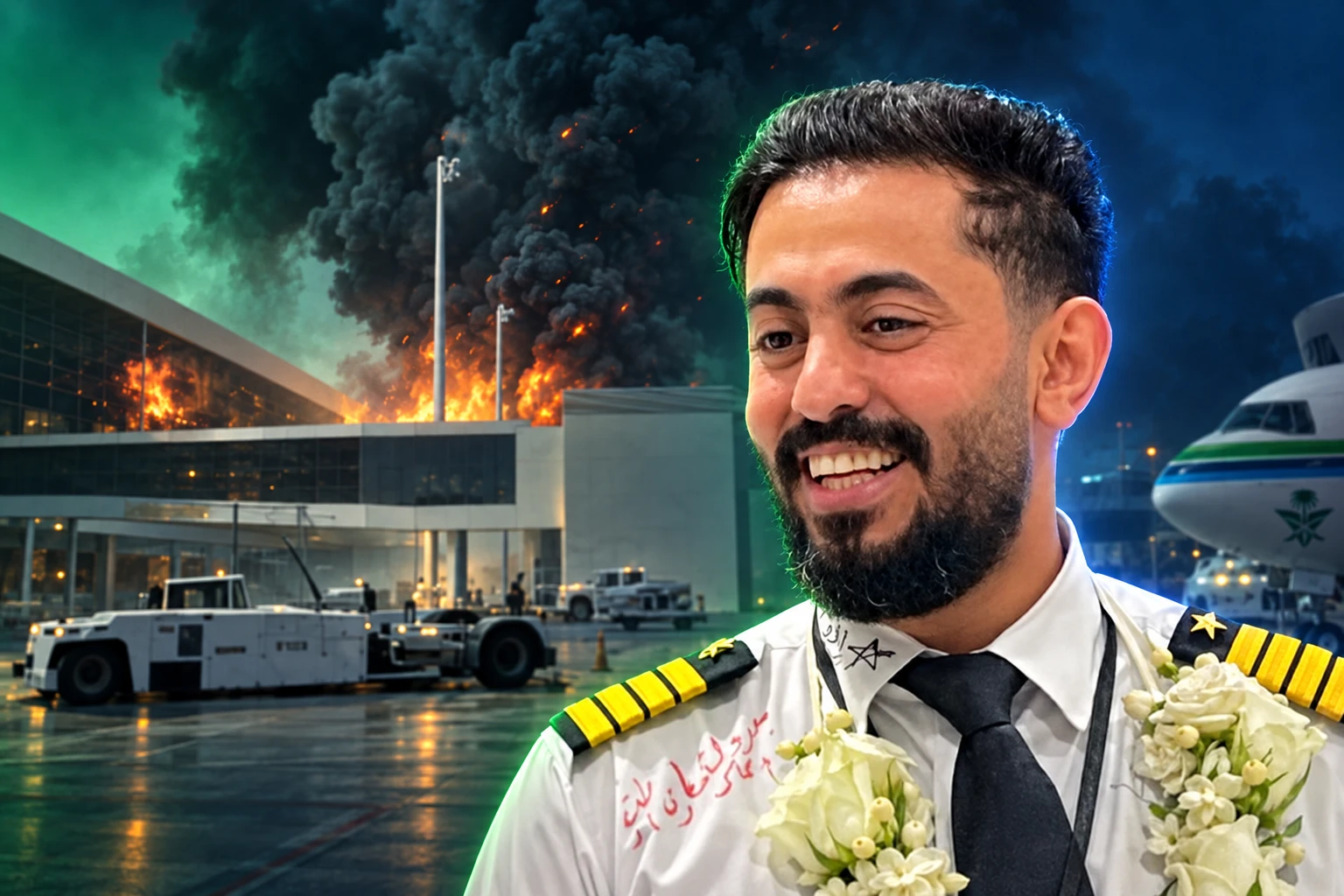
Captain Alkalthami Died Beside a Parked Saudia Jet
Saudia named the dead crew member on Friday and said the aircraft was damaged while it sat on the ground. No passengers were aboard. The other two Saudi victims have not been publicly named.
It is with profound sadness that Saudia announces the passing of Captain Hamoud Ali Alkalthami, who lost his life on Thursday, October 8, 2026, in the incident at King Khalid International Airport in Riyadh.
Saudia Group, official obituary, October 9, 2026
Obituary pic.twitter.com/rQHVaVsCx9
— Saudia Group | مجموعة السعودية (@SaudiaGroup) October 9, 2026
The airline said it activated emergency procedures, was monitoring those affected, and had restored its own flights and operations at the airport as of 6:00 PM on Thursday, October 8. GACA said airport operations had resumed and air traffic had returned to normal. That describes an open field and a flag carrier back on the schedule. It does not describe a normal day for everyone else.
Nearly Half of Thursday’s Departures Never Left
Cirium counted 169 of 378 scheduled departures from King Khalid cancelled or listed as no-fly on Thursday, and 124 of 369 scheduled arrivals. Taken together, 293 of 747 flights due to use the airport were disrupted. King Khalid handled 37 million passengers in 2024. On Thursday it was a hub that could not be trusted to launch.
CIRIUM COUNT AT RIYADH ON OCTOBER 8
| Carrier | Scheduled departures | Cancelled or no-fly |
|---|---|---|
| Saudia | 140 | 97 |
| Flynas | 91 | 30 |
| flyadeal | 54 | 20 |
| Riyadh Air | 15 | 2 |
| Turkish Airlines | 4 | 4 |
| All carriers | 378 | 169 |
Saudia, flynas and flyadeal accounted for 147 of the 169 cancelled departures. Saudia also dropped 87 of 136 scheduled arrivals. Air India Express, SriLankan Airlines, Philippine Airlines, Yemenia and AJet each lost their listed Riyadh departures in the Cirium file. Qatar Airways cancelled three of eight departures. EgyptAir cancelled two of four. Lufthansa Group airlines said they were suspending Riyadh flights through October 16. Singapore Airlines postponed a planned Riyadh launch until March 28.
Flight tracking on Friday morning still showed 44 cancellations and 63 delays at Riyadh since midnight, against 167 cancellations and 164 delays on Thursday. The airport was open. Large parts of the foreign schedule were not.
The Mecca Pact Has Not Stopped the Missiles
Saudi Arabia, Pakistan and Turkey signed a joint defence agreement in Mecca on August 7. An attack on one is treated as an attack on all. On October 5, after an emergency meeting in Riyadh, the pact’s top committee said it would move at once to deploy the agreed forces and capabilities in the kingdom. Coalition spokesman Major General Turki al-Malki said 100 fighter jets were supporting a Yemeni government counteroffensive to retake ground the Houthis seized along the Red Sea in September.
The combat, as described by the people who would have to fight it, is still a Saudi fight.
WHO IS DOING WHAT UNDER THE PACT
- Saudi forces: Pakistan Defence Minister Khawaja Asif said from Riyadh on October 5 that combat is being conducted by Saudi forces, who are the ones retaking ground.
- Pakistan: Asif said Pakistani and Turkish units are in a supporting role, including reconnaissance. A Foreign Office spokesman said Friday the country now has a substantial number of forces and resources in Riyadh and would not cross the border to attack the Houthis.
- Turkey: Officials have described the contribution as defensive and technical, including air defence. Ankara has not publicly confirmed a standing combat deployment, and sending troops abroad still needs parliament under Article 92 of its constitution.
- The coalition response: Al-Malki said Friday that three rocket launch platforms used by the Houthis had been destroyed and that attacks on civilians and civilian infrastructure “will be met with a firm response.” Earlier in the week the coalition said it carried out 97 targeting operations on the Tor al-Baha and Taiz axes.
Dania Thafer, executive director of the Gulf International Forum, said Riyadh is trying to turn the pact from a political declaration into a deterrent, mainly by showing that another attack is no longer only a Saudi-Houthi matter. A Foundation for Defense of Democracies note published on October 7, before Thursday’s strikes, argued that activating the mechanism has not so far deterred the Houthis. A parked airliner burning on the Riyadh tarmac the next afternoon is the simplest test of that claim.
Yanbu Still Waits on a French Deployment
The airport is not the prize. The Red Sea oil outlet is. Yanbu is the western end of the East-West Pipeline, a line more than 1,200 kilometres long with capacity of up to 7 million barrels a day, the route Saudi crude uses when the Strait of Hormuz is a war zone. President Emmanuel Macron said on September 24 that France would send soldiers, radars and defence systems to protect the site, “not to get us involved in any conflicts, but to protect this site.”
On October 8, Armed Forces Chief of Staff General Fabien Mandon told a parliamentary hearing the work was still in a study phase with Saudi Arabia. France, he said, has already put around 2,000 troops in the region to help protect Gulf allies, including Qatar and Kuwait. The gap between a televised pledge and a posted battery is the gap the Houthis keep using.
Yemeni government forces said on October 6 they had retaken the Red Sea port of Mokha. Saudi Arabia’s ambassador to Yemen said Friday that Bab el-Mandeb had been cleared of Houthis. That claim has not been independently verified, and Houthi forces remain in Mocha, a short way up the coast, with fighting in the hills above the strait. The group has also cut a road into Taiz, a city of more than half a million people.
Why the Houthis Keep Hitting Civilian Airports
Airports are where a missile becomes a television picture. A terminal full of civilians, a parked jet with a national tail, a cancelled bank of departures, those are costs Riyadh cannot hide, and they do not require holding a beach on the Red Sea. After the Houthis took a wide stretch of Yemen’s Red Sea coast and islands in the Bab el-Mandeb in September, they turned that reach into a campaign against Saudi aviation, first at Abha and the southern fields, then at the capital.
The European Union Aviation Safety Agency, in conflict-zone bulletin CZIB-2026-09-R1 first issued on September 30 and revised on Friday, said recent attacks showed the Houthis’ ability and intent to strike deeper inside Saudi territory, including the capital, and widened its Saudi airspace warning into a further area in the north-west. Recurrent missile and drone fire, plus air-defence activity, it said, raises the risk of misidentifying a civil aircraft and of falling debris. Aviation risk group OPSGROUP advised against flying over the kingdom at all. The US embassy in the United Arab Emirates told Americans to exercise increased vigilance.
On Friday, Saree said humanitarian flights to and from Riyadh would be allowed if they were authorized by a Humanitarian Operations Coordination Center in Sanaa. That is not a ceasefire. It is an attempt to sit in the booking path of the same airport the group set on fire.
Oil Workers Got the Next Warning
Thursday’s fire at King Khalid landed in a window Washington has now named. Trump wrote on Truth Social that the United States was having “productive discussions” with Iran and “will not be attacking Iran at any time prior to the midterm elections to be held in the United States on November 3rd.” He also said the blockade on Iran remains in force and that 22 million barrels of oil had moved through Hormuz the previous night, none of it Iranian. Foreign Minister Abbas Araghchi said Tehran was reviewing a US proposal and would reply in the next few days. The war itself began on February 28, when US and Israeli strikes hit Iran.
The pause is a calendar, not a settlement. It follows a stretch in which he rejected an earlier Iran deal path and kept the option of later strikes. Deutsche Bank’s Jim Reid wrote Friday that both sides had acknowledged talks, which took some pressure off oil into the close, and that investors were still pricing a longer stretch of disruption into next year. Front-month Brent was last seen at $102.94 a barrel, down 1.3 percent. West Texas Intermediate was at $90.51, down 1 percent.
THE MARKET AND THE MEETING
- Brent: Front-month futures $102.94 a barrel on Friday morning, down 1.3 percent.
- WTI: $90.51 a barrel, down 1 percent.
- Hormuz flow: Trump said 22 million barrels moved the previous night, none from or to Iran.
- Riyadh meeting: The WPC Energy Congress, a gathering of oil ministers and company chiefs, is still listed from Sunday, October 11, in a city whose main airport was burning on Thursday.
The Houthis told workers at Saudi oil plants to stay away, saying those sites would be targets too, including plants that have not been hit before. That warning sits on the same week as Saudi crude covering barrels Iran cannot sell through the Red Sea route the missiles are now walking toward. Italian energy minister Gilberto Pichetto Fratin said he would join the Riyadh congress by video. The airport is open. The people who ship the oil are already voting with their itineraries.

Ohtani Game 4 Logoman Card Sells for $3.24 Million

Cole Kmet’s Season Ends, and Chicago’s Tight End Plan Starts

NBA Seeks Soccer Money After EuroLeague Clubs Refused

Amazon’s First Bond Tests Leave the Broccoli Chair Empty

Tyrese Maxey Owns the Night Built for LeBron James

Warsh Rejects Rate Guidance and Still Moves Markets

Dana-Farber Exits an MGB Medicare Advantage Network Early

NASA Launches the Roman Space Telescope’s Cosmic Bet

OpenAI’s Cyber Letter Puts the Defense Bill on Governments

Russia Recycles Its Old Warning Over Storm Shadow Plants
-
 BUSINESS2 months ago
Warsh Rejects Rate Guidance and Still Moves Markets
-
 BUSINESS1 month ago
Dana-Farber Exits an MGB Medicare Advantage Network Early
-
 NEWS2 months ago
NASA Launches the Roman Space Telescope’s Cosmic Bet
-
 NEWS2 months ago
OpenAI’s Cyber Letter Puts the Defense Bill on Governments
-
 NEWS2 months ago
Russia Recycles Its Old Warning Over Storm Shadow Plants
-

 ENTERTAINMENT4 weeks ago
Primetime’s $2.7 Million Preview Tops Pitt’s Costlier Film
-

 BUSINESS2 months ago
Jet Drones Lock Down Kyiv and Strip Kherson of Heat
-

 ENTERTAINMENT2 months ago
Midnight Spider-Man Turns Peter Parker Into Oscorp’s Hybrid