
NEWS
NASA Powers Up Roman’s 300-Megapixel Camera in Flight
NASA has turned on Roman’s 300-megapixel camera during the cruise to L2, catching first starlight while the detectors still cool toward science focus.

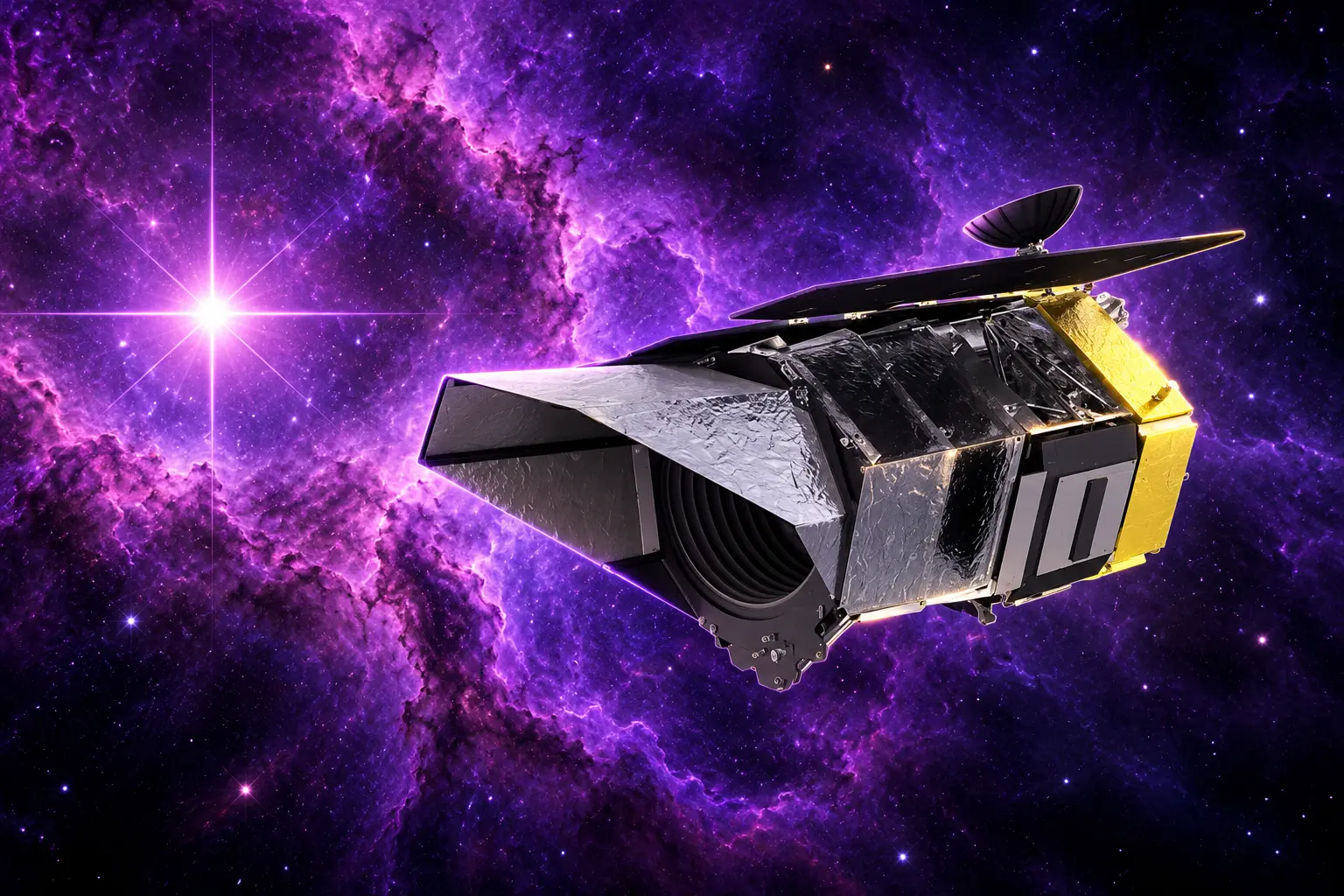
NASA has powered up the Nancy Grace Roman Space Telescope’s 300-megapixel Wide Field Instrument, a camera that just recorded its first starlight while still far from focus. The observatory left Earth on August 30, 2026, aboard a SpaceX Falcon Heavy, and it is still on a three-month cruise of about one million miles to a halo orbit around the Sun-Earth L2 point.
Engineers turned the camera on after a 10-day dry-out, then started cooling its 18 infrared detectors toward about minus 300 degrees Fahrenheit. NASA still plans to release the first science images in early 2027.
Roman Is Still a Million Miles From Home
The Falcon Heavy lifted off at 7:26 a.m. EDT from Launch Complex 39A at NASA’s Kennedy Space Center. Goddard Space Flight Center in Greenbelt, Maryland, had telemetry within seven minutes, and the observatory separated from the rocket 31 minutes into the flight.
Solar panels and the lower instrument sun shade opened one hour and 23 minutes after launch. About 70 minutes in, NASA’s Deep Space Network took over through Canberra, then Madrid, then Goldstone, so the spacecraft stayed in contact as it left near-Earth tracking behind.
L2 sits about one million miles from Earth, on the night side, where the Sun, Earth, and Moon stay in roughly the same direction. That geometry keeps stray light and heat more stable than low Earth orbit, which is why NASA also flies the James Webb Space Telescope in a halo around the same region. Roman will not sit still on the point. It will loop around L2 and fire small station-keeping burns about every 28 days.
NASA’s budget planning put the lifecycle cost at about $4.3 billion, covering development, launch, and operations. Administrator Jared Isaacman said the mission was delivered ahead of schedule and on budget. Science still waits on the checkout now under way during the cruise, not on the launch itself.
Ten Days of Heat, Then a Plunge to Minus 225
Infrared detectors have to be dry and cold or they see their own heat. Before anyone could switch the Wide Field Instrument on, teams left it idle for 10 days so water and trace chemicals could leave the hardware, with the detectors held at a relatively warm minus 85 degrees Fahrenheit (minus 65 Celsius).
On the morning of September 11, they shut off the instrument heater and let the camera fall to minus 225 degrees Fahrenheit (minus 143 Celsius). At that point they could turn on the 18 detectors, which together have a light-sensitive area about the size of a laptop screen. Each chip is about the size of a saltine cracker. NASA’s own spec sheet sets the detectors’ operating point at 89.5 K, the same deep freeze the team described in flight as about minus 300 degrees Fahrenheit (minus 183 Celsius).
THE WFI WAKE-UP SEQUENCE
- August 30, 2026: Lifts off on a Falcon Heavy from Kennedy Space Center and begins the cruise to L2.
- August 31, 2026: Fires its first mid-course correction with more than 99% accuracy.
- Early September 2026: Wakes the Coronagraph Instrument for a first round of digital, electronic, and mechanical checks.
- September 11, 2026: Turns off the Wide Field Instrument heater, cools the camera to minus 225 degrees Fahrenheit, and activates the 18 infrared detectors, then the calibration system that night.
- September 12, 2026: Sends test data through the camera to the ground, then runs the element wheel in weightlessness for the first time.
- September 13, 2026: Checks the focus mechanism while the detectors keep cooling toward about minus 300 degrees Fahrenheit.
Josh Schlieder, the Wide Field Instrument scientist at Goddard, tied the power-up to the companies that built the camera’s core hardware, BAE Systems, Inc. and Teledyne, along with NASA’s science centers.
After years of effort to build and test the instrument on the ground, we now have confirmation that it is operational in space. This is a huge milestone for the team at Goddard, our industry teams at BAE Systems, Inc. and Teledyne, and our science centers. There is much to do, but we are on our way to groundbreaking science.
Josh Schlieder, Wide Field Instrument scientist, NASA Goddard Space Flight Center
The Filter Wheel Moves in Zero Gravity
The Wide Field Instrument is not a single lens sitting in front of a chip. Light from Roman’s optics first hits the Element Wheel Assembly, a rotating wheel of filters, a prism, and a grism that choose which wavelengths reach the detectors and can spread an object’s light into color. NASA’s technical sheet lists eight imaging filters from 0.48 to 2.3 microns, plus prism and grism spectroscopy from 0.75 to 1.93 microns.
Saturday evening, September 12, was the first time that wheel had to move without gravity. Ground tests cannot copy that load. A jam or a miscount in space would lock the camera into one bandpass, so the zero-g run is a checkout the clean room could not finish.
Sunday morning, September 13, the team turned to the Alignment Compensation Mechanism, a hexapod that can shift the whole 18-chip mosaic into best focus. NASA said that mechanism will be used to focus the hundreds of thousands of images the camera is expected to take. While those tests ran, the detectors kept cooling toward their final temperature. All of the checks came back as expected.
Fine guidance is still ahead. NASA said the team will soon turn on the system that lets Roman lock onto targets, then shrink each star from a broad donut into a crisp point. The camera is alive. It is not yet a survey machine.
A Sea of Donut Stars, Far From Best Focus
The first public frame is a performance test, not a pretty picture. NASA said it captures the very first photons of starlight to reach the Wide Field Instrument, taken with the detector array still stowed as it was for launch, far from best focus. The camera has opened its eyes, the agency wrote, on a sea of out-of-focus stars, each spread over many thousands of pixels. Insets zoom into one detector, then into a single star, as a baseline for aligning the optics.
The mission account put the same point in plainer words: the instrument just woke up, and its eyes still need a minute to focus.
Sometimes your eyes need a minute to focus when you wake up. Roman's Wide Field Instrument just woke up for the first time EVER, and scientists have started adjusting its "eyes" so they can focus on the bigger picture.
Check out its first test image below https://t.co/lkv3LFMyMR pic.twitter.com/AnI6XU1MAm
— Nancy Grace Roman Space Telescope (@NASARoman) September 15, 2026
Those donut-like features are what the present configuration should show. The six spikes that cut across the brightest stars already match the struts that hold Roman’s secondary mirror, the same kind of signature Hubble and Webb images carry on bright point sources. Once the array is unstowed and the focus mechanism has done its work, each of those rings is supposed to collapse into a sharp core. NASA said the science images due in early 2027 will be much sharper.
How Wide Is Roman’s View Compared With Hubble?
A single Wide Field Instrument frame covers a patch of sky larger than the apparent size of a full moon, with the kind of sharpness people associate with Hubble. NASA designed the telescope to survey the universe a thousand times faster than Hubble, and Julie McEnery, Roman’s senior project scientist at Goddard, said astronomers have never had eyes like these.
The focal plane is 18 Teledyne H4RG-10 chips, each 4096 by 4096 pixels, with 10-micron pixels sampled at 0.11 arcsec per pixel. NASA’s WFI sheet gives an active field of 0.281 square degrees of sky, about 0.8 by 0.4 degrees once detector gaps are excluded, and about 200 times the field of Hubble’s WFC3-IR camera at similar sampling.
ROMAN WFI NEXT TO HUBBLE
| Feature | Roman Wide Field Instrument | Hubble comparison |
|---|---|---|
| Field of view | 0.281 square degrees, larger than a full moon | WFC3-IR about 200 times smaller |
| Detectors | 18 Teledyne H4RG-10 chips, 4096 by 4096 each | Much smaller infrared arrays on WFC3-IR |
| Sampling | 0.11 arcsec per pixel | Comparable near-infrared sampling on WFC3-IR |
| Survey speed | A thousand times faster than Hubble, per NASA | Hubble baseline for the claim |
| Daily data | 1.4 terabytes | Highest rate of any NASA astrophysics mission so far |
Hubble and Webb still win on tiny, deep fields. Roman is built to take Hubble-like sharpness across a moon-wide patch, then do that again, which is how a dark-energy and microlensing survey actually gets done. The price of that width is a data firehose. The launch team said Roman will send back 1.4 terabytes of data every day, and that machine learning, other software tools, and citizen scientists will help flag what is worth a closer look. All of that data is planned as public, with no exclusive-access period.
The Planet Imager Gets a Warm Checkout
The Wide Field Instrument is the survey camera. Riding along is the Coronagraph Instrument, a tech demo meant to block a star’s glare so a giant planet’s reflected light can be seen. NASA said it is among the most advanced systems ever flown for that job, using optics, masks, self-flexing mirrors, and sensors. Future concepts such as the Habitable Worlds Observatory would need even stronger suppression to photograph Earth-like worlds; Roman’s version is built to try the hardware on Jupiter-like planets first.
After the coronagraph woke up in early September, staff at the Coronagraph Commanding Center at Caltech/IPAC in Pasadena, California, checked that they could talk to every major part of the instrument from the ground.
CORONAGRAPH SYSTEMS CHECKED FROM THE GROUND
- Software and avionics: Operators confirmed they can command the instrument and the electronics that run it.
- Thermal control: The system can warm the hardware to 72 degrees Fahrenheit (22 Celsius), the near-room-temperature set point used for everything except the detectors.
- Mechanisms: Movable mounts that position masks, color filters, lenses, and prisms responded as designed.
- Cameras: The imaging chain that will record the suppressed starlight is in the loop.
Keeping most of the coronagraph near room temperature makes ground testing easier and protects the material properties of those deformable mirrors. The detectors are a different story. They still need a long bake.
Now that this test is complete, we’ve been decontaminating: sitting idle with our detectors warm so anything that’s stuck to the surface, such as water or trace chemicals, will tend to leave it. This will continue for 30 days, with occasional stops to do other early calibration activities.
Eric Cady, optical engineer leading Roman Coronagraph commissioning, NASA Jet Propulsion Laboratory
Fuel for 22 Years, Sharp Pictures in 2027
The camera checkout and the fuel ledger are moving on separate clocks. On September 14, a day before NASA posted the first-light frame, Goddard Center Director Jamie Dunn said a precise launch and a thrifty first burn have given Roman fuel for at least 22 years of potential science operations.
Roman was designed for a five-year primary mission plus a five-year extension, a 10-year fuel budget in total. The first mid-course correction on August 31 ran with more than 99% accuracy and used about 40 pounds (18 kilograms) of propellant, less than 10% of the 441 pounds (200 kilograms) set aside for that burn. NASA credited that save with about four extra years.
WHERE THE EXTRA YEARS COME FROM
- First burn: About four years, from using about 40 pounds of a 441-pound allocation.
- Bonus fuel at launch: About four years, after the observatory flew at 17,760 pounds (8,056 kilograms) instead of the 21,605-pound (9,800-kilogram) mass used to size the tanks.
- Upcoming burns: About four years expected from a smaller second mid-course correction, planned in September 2026, and from a cheaper insertion into the L2 halo.
Alison Rao, Roman’s propulsion lead at Goddard, said the team sizes propellant against a conservative maximum mass so it will not come up short, then fills the tanks to capacity when the real spacecraft comes in light. Fuel is still only the consumable. Detectors, mechanisms, and the telescope’s alignment have to last if those extra years are going to mean extra surveys.
Arrival at L2 is still about 100 days after launch, in early December. The second course correction was expected to be small enough that teams could wait later into September to fire it. Until the array is unstowed, the focus is tuned, and the coronagraph finishes its 30-day clean-out, the 300-megapixel camera’s job is to prove it can take the pictures NASA already scheduled for early 2027.
McEnery said at launch there is no telling what more will be known a year on. The first photons are in hand, spread into donuts on a still-stowed mosaic, while the spacecraft keeps falling toward L2 with decades of hydrazine in the tanks if the hardware holds.

Ohtani Game 4 Logoman Card Sells for $3.24 Million

Cole Kmet’s Season Ends, and Chicago’s Tight End Plan Starts

NBA Seeks Soccer Money After EuroLeague Clubs Refused

Amazon’s First Bond Tests Leave the Broccoli Chair Empty

Tyrese Maxey Owns the Night Built for LeBron James

Warsh Rejects Rate Guidance and Still Moves Markets

Dana-Farber Exits an MGB Medicare Advantage Network Early

NASA Launches the Roman Space Telescope’s Cosmic Bet

OpenAI’s Cyber Letter Puts the Defense Bill on Governments

Russia Recycles Its Old Warning Over Storm Shadow Plants
-
 BUSINESS2 months ago
Warsh Rejects Rate Guidance and Still Moves Markets
-
 BUSINESS1 month ago
Dana-Farber Exits an MGB Medicare Advantage Network Early
-
 NEWS2 months ago
NASA Launches the Roman Space Telescope’s Cosmic Bet
-
 NEWS2 months ago
OpenAI’s Cyber Letter Puts the Defense Bill on Governments
-
 NEWS2 months ago
Russia Recycles Its Old Warning Over Storm Shadow Plants
-

 ENTERTAINMENT4 weeks ago
Primetime’s $2.7 Million Preview Tops Pitt’s Costlier Film
-

 BUSINESS2 months ago
Jet Drones Lock Down Kyiv and Strip Kherson of Heat
-

 ENTERTAINMENT2 months ago
Midnight Spider-Man Turns Peter Parker Into Oscorp’s Hybrid