
NEWS
Apple Watch Series 12 Puts Five-Second Heart Rate in Ceramic
Ceramic Apple Watch Series 12 starts at $899, but every model now reads heart rate every five seconds and scores daily readiness from 0 to 10.

Apple Watch Series 12 is back in ceramic from $899, and every model now reads heart rate every five seconds. Apple announced the watch on September 9, 2026, and stores began selling it on September 18. The Pearl White and Night Blue cases are the first ceramic Apple Watch since Series 5 in 2019, yet the sensor stack that feeds Readiness sits in aluminum and titanium too, and in Apple Watch Ultra 4.
That split is the launch. You pay for zirconia if you want the sheen. You get the denser heart stream if you buy any Series 12.
Ceramic Returns Seven Years After Series 5
Apple last sold a ceramic Watch on Series 5, then pulled the material when Series 6 arrived in 2020. Series 2 and Series 3 had already used white and later gray ceramic after the company dropped its 18-karat gold Edition. Series 4 skipped ceramic entirely. Series 5 brought it back as an Edition piece from $1,299. Six years off the shelf is long enough that used white cases still trade as objects, not leftover inventory.
THE CERAMIC LINE
- 2015: Gold Edition lasts one year, then leaves the price list.
- 2016 to 2017: Ceramic replaces gold on Series 2 and Series 3.
- 2018: Series 4 ships without a ceramic case.
- 2019: Series 5 Edition ceramic returns from $1,299.
- 2020: Series 6 drops ceramic; aluminum, stainless steel, and titanium remain.
- September 9, 2026: Series 12 lists Pearl White and Night Blue ceramic from $899.
The new case is $400 below that Series 5 opener, and Apple did not revive the Edition name. Sand and navy Sport Bands arrive with a ceramic pin-and-tuck closure so the hardware matches the shell. Early buyers treated the finish as the reason to order, including people who wanted a case that is not metal against the skin. The Night Blue ceramic Apple Watch Series 12 readiness score still has to wait seven nights of wear, same as the $399 aluminum watch.
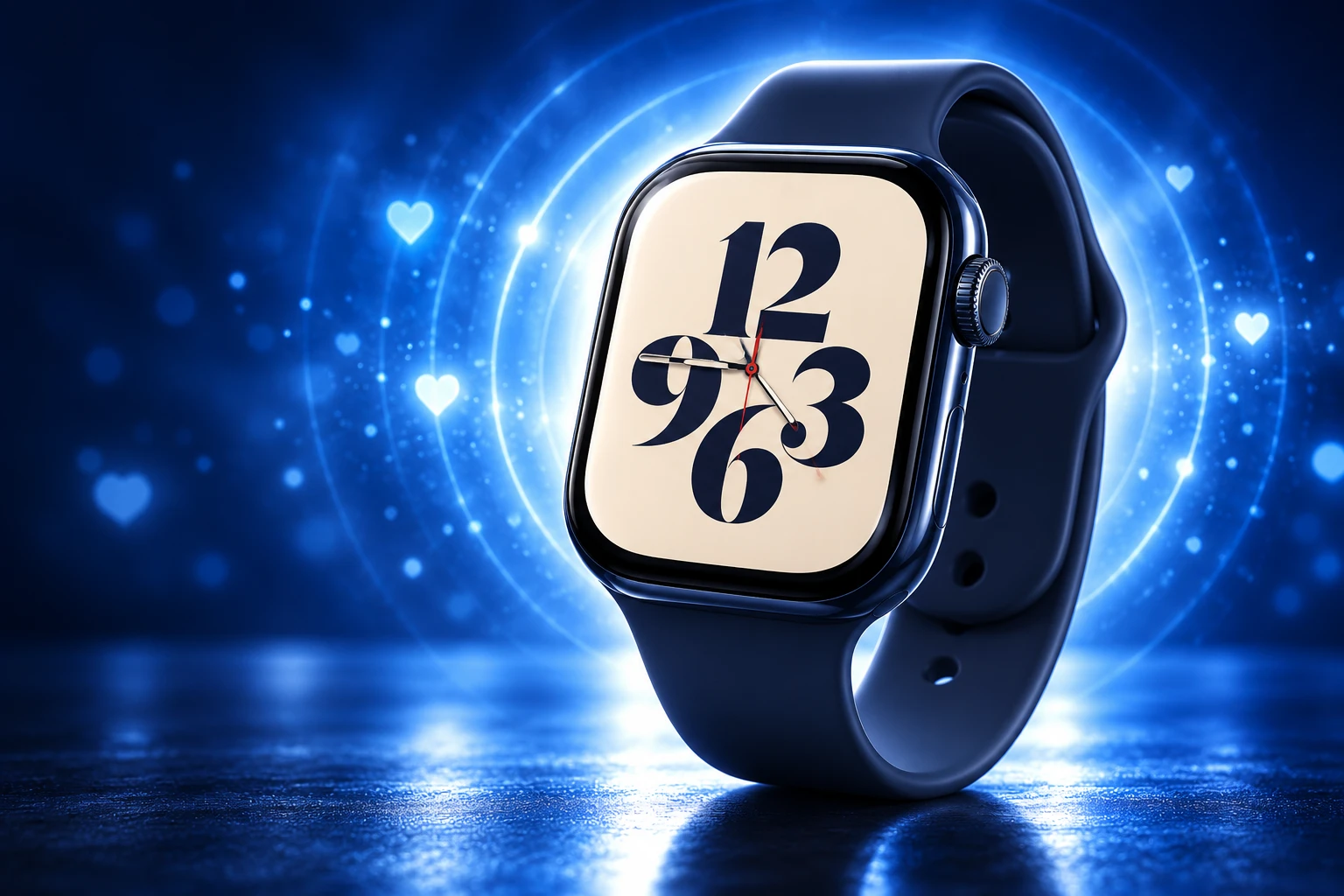
The Case Starts as Pink or Gray Powder
Apple begins with zirconia powder, pink for Pearl White and gray for Night Blue, pressed into a mold while the blank is still soft enough to cut band slots, the side button, and the Digital Crown opening. Three heat soaks follow, then diamond-tipped tools and a six-step polish. Apple says the extra firing is why this generation shows a pearl sheen Series 5 never quite had.
THREE HEAT SOAKS
- First soak: About 700°C burns off binders and shrinks the blank toward its final size. Apple calls this the low-temperature stage.
- Second soak: About 1,400°C at more than 21,000 psi drives out impurities, hardens the ceramic, and strips oxygen until the color shifts.
- Third soak: About 1,100°C puts oxygen back in so Pearl White and Night Blue land on the intended hues.
Once the ceramic is that hard, ordinary cutters will not finish it. Diamond-encrusted tools shape the case, and the polish is what you actually see on the wrist. Glass on all Series 12 models now drops farther down the flanks, so less case shows from above than on the old ceramic Watch. In the 46mm class the ceramic shell is 47mm tall, 41mm wide, and 9.85mm thick, against 46mm by 40mm by 9.7mm for aluminum and titanium. That is 0.15mm extra depth and a millimetre extra in height and width, sold in the same 42mm and 46mm band columns.
Night Blue is the quieter of the two. In ordinary rooms it leans on whatever sits next to it, a navy band pulling it toward true blue and a black band taking it darker. Bright light opens the surface and shows depth the old white Edition did not. Pearl White is the one that reads as a watch from across a table. Both are heavier than the watch most people will actually compare them with.
Heart Rate Now Lands Every Five Seconds
Flip the watch over and the argument changes. Apple rebuilt the new Health Sensing System with a second-generation electrical heart sensor and an always-on optical sensor, then tied both to the S11 chip. Background heart rate is now a reading every five seconds, all day, which Apple states as 60 times more often than Series 11. That math holds if the old background cadence was once every five minutes. Heart rate variability, the shifting gap between beats, can land as often as every five minutes, which Apple states as 24 times more often than Series 11.
THE SENSOR JUMP
- Heart rate: A user-facing value every five seconds in complications and workouts, 60 times the Series 11 background rate.
- HRV: As often as every five minutes, split into Recovery HRV for daily strain and overall HRV for longer trends.
- Electrical ring: Electrodes for an ECG go from two to 32 and cover about 24% more of the wrist.
- Optical window: Larger green LEDs sit in their own opening; four square photodiodes give way to a ring of eight, under a zirconia cover fired in the same high-pressure chamber as the cases.
The five-second stream runs on the chip’s always-on processor, so a short burst of chores can now count toward Exercise and Move rings instead of vanishing between samples. Kaiann Drance, Apple’s vice president of Worldwide Apple Watch Product Marketing, put the health pitch on the case as well as the sensors.
Apple Watch Series 12 is the most advanced health and fitness companion we’ve ever created. With our new Health Sensing System and S11 chip, Apple Watch Series 12 gives you meaningful insights, like readiness, so you can better understand how to take on your day and care for your health, plus intelligence features that make everyday life easier. And it’s all wrapped in a beautifully thin, light design you’ll love wearing all day and night.
Kaiann Drance, vice president of Worldwide Apple Watch Product Marketing, Apple newsroom
Everyday battery life stays up to 24 hours. Outdoor workout runtime rises to 10 hours, 25% more than the previous model, and 15 minutes on the charger is rated for up to 12 hours of use, 50% more than before. Aluminum faces use Ceramic Shield 2, which Apple says is 60% tougher than the Ion-X glass on last year’s aluminum Watch. Titanium and ceramic keep sapphire. Peak brightness is 2000 nits. Water resistance remains 50 metres, with IP6X dust resistance.
A 0 to 10 Score That Updates After Lunch
Readiness is the product that five-second sampling was built to feed. The watch turns recent activity, training load, vitals, and sleep into a single 0 to 10 figure and one of four labels: Recover, Pace Yourself, Ready, or Go For It. The number moves during the day when a hard workout or a swing in daytime vitals lands. Apple says the scoring work used data from the Apple Heart and Movement Study, with exercise scientists and physicians at the company. It needs seven nights of overnight data, and it is exclusive to Series 12 and Ultra 4 even though watchOS 27 itself installed on September 14 for Series 9 and later, SE 3, and Ultra 2 and later.
WHOOP still sells Recovery as a 0 to 100 figure that generally holds after sleep. Oura still sells a 0 to 100 Readiness figure built from overnight samples. Apple’s version lives on a screen people already glance at for messages, and it does not add a second membership on top of the watch. That is why the score is being read as a recovery-band feature folded into hardware that starts at $399. It is also why the number is easy to over-trust. A 0 to 10 label is a guide for the day, not a clinic visit, and independent physicians have been blunt that composite readiness scores across the category are still thinly checked against actual health outcomes.
HOW THE SCORES COMPARE
| Score | Range | What it uses | When it moves |
|---|---|---|---|
| Apple Watch Series 12 Readiness | 0 to 10 | Recent activity, training load, vitals, sleep | Through the day |
| WHOOP Recovery | 0 to 100 | Overnight HRV, resting heart rate, breathing, sleep versus need | After sleep, generally then holds |
| Oura Readiness | 0 to 100 | Overnight HRV samples, temperature, sleep, activity balance | From the night just ended |
Each brand samples a different site and a different window. A 2025 comparison of nocturnal heart rate and HRV from Garmin, Oura, Polar, and WHOOP against a chest-strap ECG found Oura closest on overnight HRV in that dataset, with WHOOP in a middle band. That paper did not test Series 12. Treat each score as a trend inside one device, not a number to match across brands. The useful question on the new Watch is which input moved the figure, sleep, load, or a daytime vital, not whether a 7 out of 10 equals someone else’s 70.
Apple Lined Its Watch Up Against Whoop and Oura
Apple’s accuracy claim is not a slogan on a keynote slide. The company ran a head-to-head heart rate study in July and August 2026 with a Polar H10 chest strap as the reference. It enrolled 1,460 adults at five sites in Cupertino, San Diego, Austin, and Selangor, with two sites near headquarters, and put 1,254 of them into paired Apple-versus-comparator analysis. Twenty percent of that analyzed group had Fitzpatrick skin tones V or VI, 35% were female, mean age was 39, and mean BMI was 26. Wrist assignment was randomized. Comparators were Garmin Forerunner 970, Google Pixel Watch 4, Huawei Watch 5, Samsung Galaxy Watch 8, WHOOP 5, and Oura Ring 5.
Workouts included outdoor runs, indoor intervals, cycling, HIIT, and strength work, plus a daily-living block of rest, desk work, cooking, and walking. Across 159 activity-by-measure comparisons, Apple Watch showed better accuracy at the 99% confidence level in 139, 18 were indeterminate, and the other device was ahead in 2. Pixel Watch 4 was ahead on rest, by less than 0.5 bpm. Apple Watch reported a single heart-rate value every five seconds to the user; HealthKit still stores background points every 30 seconds to save memory, which is why a dump from the phone can look coarser than the complication on the face.
The study is Apple’s own paper, with Apple ethics boards and a contract research group at two sites. It is large, and it names the rival hardware. It is not an outside lab. Read it as the best evidence Apple has published for this sensor, and as a document that still needs someone else to rerun the protocol.
The $899 Shell Does Not Buy Extra Sensors
U.S. pricing keeps aluminum at last year’s floor and parks ceramic in cellular-only slots. Titanium sits in the middle. Ultra 4, which uses the same new sensors in a titanium case, still starts at $799.
CASE, WEIGHT AND U.S. PRICE
| Case | 42mm from | 46mm from | 46mm weight |
|---|---|---|---|
| Aluminum GPS | $399 | $449 | 39.5 grams |
| Aluminum GPS + Cellular | $499 | $549 | 38.6 grams |
| Titanium (cellular) | $699 | $749 | 44.9 grams |
| Pearl White ceramic (cellular) | $899 | $949 | 51.3 grams |
| Night Blue ceramic (cellular) | $899 | $949 | 52.9 grams |
The 46mm Pearl White ceramic watch is 11.8 grams heavier than the aluminum GPS model. Night Blue is 52.9 grams. In 42mm, Pearl White is 41.7 grams and Night Blue is 42.8 grams, against 32.2 grams for aluminum GPS. Ceramic and titanium include cellular, so there is no GPS-only ceramic SKU that would let you shave $100. Aluminum still offers that choice. The Health Sensing System, Readiness, Recovery HRV, and the five-second stream do not change when the case is ceramic. You are buying color, hardness, and a matching pin, not a second sensor pack.
S11 is a 64-bit dual-core chip with a 4-core Neural Engine and 64GB of storage. Series 12 needs iPhone 11 or later, including second-generation iPhone SE, running iOS 27. Fast charge is rated to about 80% in 30 minutes. Low Power Mode is rated up to 38 hours. Those figures are the same whether the shell is aluminum or zirconia.
Health Age Waits Until Late 2026
The redesigned Health app, with an Insights tab that reshuffles the day’s tiles and a Longevity tab that rates heart, metabolic, mental, hearing, sleep, nutrition, and mobility, is dated for late 2026 in U.S. English. Health Age sits in that drop. Apple says it will compare chronological age with a figure drawn from resting heart rate, VO2 max, steps, and exercise minutes, and it will take lab values such as A1c and LDL if you add them. Users in the U.S. will also be able to buy lab panels with over 50 biomarkers for $119 at about 2,000 Quest Diagnostics sites, booked from the phone. Audio Intelligence features such as Live Rewind and Siri Recap are on the same late-2026 beta clock, and they need a supported iPhone.
Until that software lands, the Watch you can buy now is a five-second heart-rate instrument with a 0 to 10 readiness score and, if you spend $899, a ceramic case fired three times. The score will tell some people to ease off after a bad night. The case will scratch less than aluminum. Neither one is a diagnosis, and the denser stream is already on the $399 model if the pearl sheen is not the point.
Frequently Asked Questions
Does the ceramic Apple Watch Series 12 have different health sensors?
No. Pearl White and Night Blue use the same Health Sensing System as aluminum and titanium Series 12, and Apple Watch Ultra 4 carries that stack in titanium. Ceramic changes weight, size, finish, and the band pin, not the five-second heart-rate path or Readiness.
Can you buy a GPS-only ceramic Series 12?
No. Ceramic and titanium are GPS + Cellular configurations in both sizes, which is why the 42mm ceramic opens at $899 instead of taking a $100 cellular adder on a GPS SKU. Aluminum is the only Series 12 case that still offers GPS-only, at $399 for 42mm and $449 for 46mm.
When did Apple last sell a ceramic Apple Watch?
Series 5 in 2019 was the last ceramic model, priced from $1,299, and Series 6 dropped the material in 2020. Ceramic had already appeared on Series 2 and Series 3 after Apple ended the gold Edition, and Series 4 skipped it for a year before that 2019 return.
Will older Apple Watches get the Readiness score in watchOS 27?
No. watchOS 27 installed on September 14, 2026, for Apple Watch Series 9 and later, SE 3, and Ultra 2 and later, but Readiness is tied to the new sensor hardware on Series 12 and Ultra 4. Older watches keep sleep, vitals, and ECG features they already had; they do not gain the 0 to 10 score.
Is Apple Watch Readiness a medical test?
No. Apple lists Readiness and the Vitals app for wellness, not diagnosis or treatment, and the ECG app remains a single-lead recording for people 22 and older in supported regions. A Recover or Go For It label is a prompt from your recent load and sleep, and a clinician should still read any symptom that worries you.
Disclaimer: This article is news reporting and analysis of Apple Watch Series 12 hardware, software, and published studies, and it is for information only. It is not medical advice, a diagnosis, a treatment plan, or a recommendation to buy, skip, or replace any wearable, lab panel, or prescription. Talk with a licensed physician or other qualified clinician before you change sleep, training, medication, or care based on a readiness score, heart-rate alert, Health Age figure, or any other watch metric. Prices, features, clearances, and software dates reflect Apple and study materials around the September 2026 launch and may change by region and over time.

Ohtani Game 4 Logoman Card Sells for $3.24 Million

Cole Kmet’s Season Ends, and Chicago’s Tight End Plan Starts

NBA Seeks Soccer Money After EuroLeague Clubs Refused

Amazon’s First Bond Tests Leave the Broccoli Chair Empty

Tyrese Maxey Owns the Night Built for LeBron James

Warsh Rejects Rate Guidance and Still Moves Markets

Dana-Farber Exits an MGB Medicare Advantage Network Early

NASA Launches the Roman Space Telescope’s Cosmic Bet

OpenAI’s Cyber Letter Puts the Defense Bill on Governments

Russia Recycles Its Old Warning Over Storm Shadow Plants
-
 BUSINESS2 months ago
Warsh Rejects Rate Guidance and Still Moves Markets
-
 BUSINESS1 month ago
Dana-Farber Exits an MGB Medicare Advantage Network Early
-
 NEWS2 months ago
NASA Launches the Roman Space Telescope’s Cosmic Bet
-
 NEWS2 months ago
OpenAI’s Cyber Letter Puts the Defense Bill on Governments
-
 NEWS2 months ago
Russia Recycles Its Old Warning Over Storm Shadow Plants
-

 ENTERTAINMENT4 weeks ago
Primetime’s $2.7 Million Preview Tops Pitt’s Costlier Film
-

 BUSINESS2 months ago
Jet Drones Lock Down Kyiv and Strip Kherson of Heat
-

 ENTERTAINMENT2 months ago
Midnight Spider-Man Turns Peter Parker Into Oscorp’s Hybrid