
NEWS
The EU Kids Act Puts Parents Between Teens and Feeds
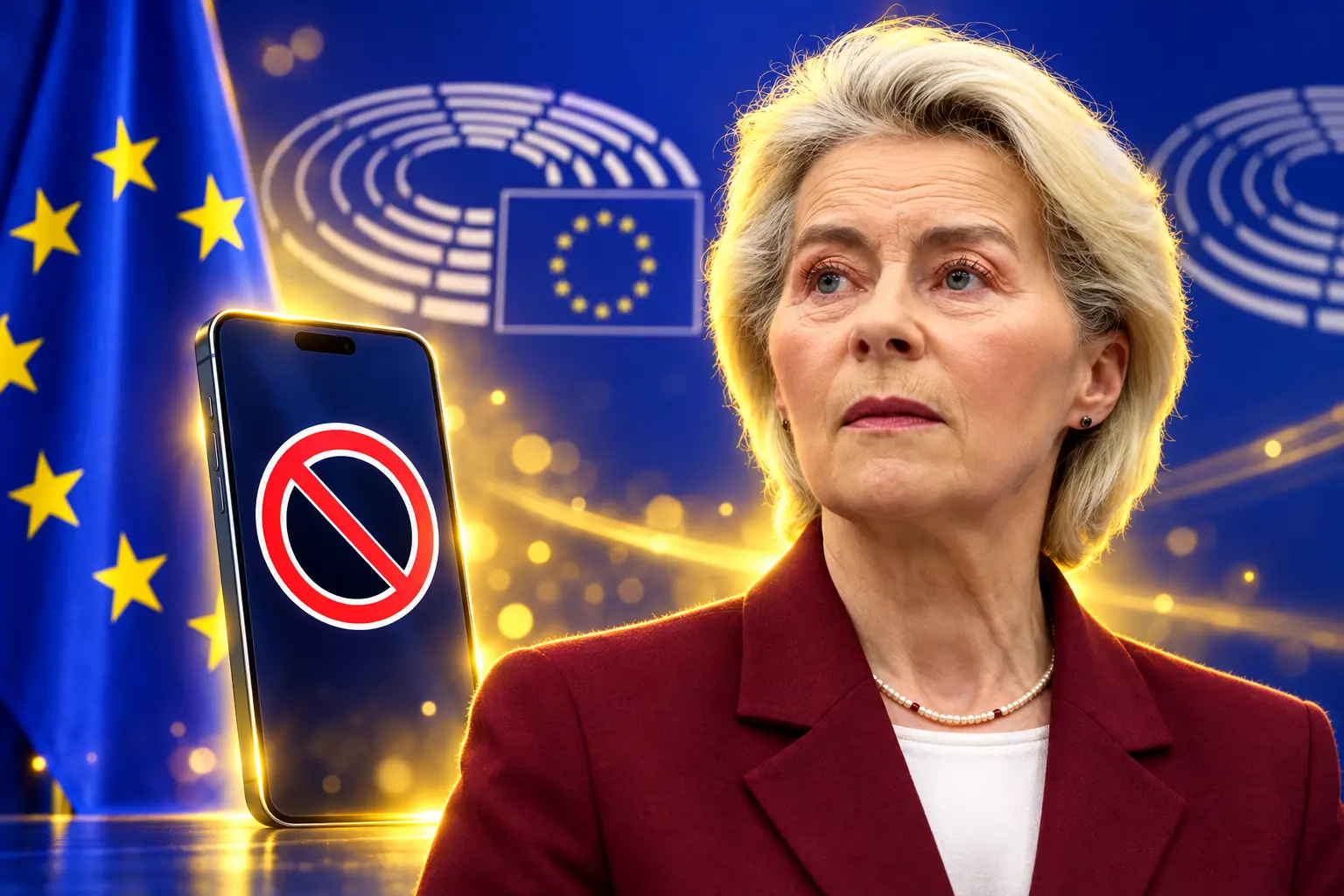
The EU Kids Act bars social media under 13 and limits ages 13 and 14 to one parental hour after France blocked a harder ban.

The European Commission on 17 September 2026 proposed the EU KIDS Act, barring social media accounts for children under 13 across the 27-country bloc. Teenagers aged 13 and 14 would get a parent-run mini account capped at one hour a day. Independent accounts would start at 15.
Ursula von der Leyen, the Commission president, framed the plan in her 16 September State of the Union speech as a fight with Big Tech over children’s attention. The legal text that followed is a staircase with parental keys, written 34 days after France’s constitutional court tore down a flatter ban.
A Staircase of Ages and a One-Hour Cap
The official name is EU Keeping Internet Digital Spaces Accountable and Trustworthy. The sales line is simpler. Von der Leyen said Europe, not the platforms, would set the rules. The proposal applies to social networks and video-sharing services that carry listed risk features, and it layers extra duties on games, app stores, AI companions and chatbots used by anyone under 18.
In a mini account managed by a parent or guardian, a 13- or 14-year-old would sit behind the adult’s account, with limited contacts and the one-hour cap. Under-13s would have no social media account at all. A parent could still park a younger child on a child-friendly video service through the adult’s device, with personalised feeds and search off and the same one-hour ceiling, until the child turns 13.
THE AGE STAIRCASE IN THE KIDS ACT
| Age | Account | Time cap | Who is in control |
|---|---|---|---|
| Under 13 | No social account; child-friendly video only through a guardian | Up to one hour a day | Parent or guardian |
| 13 and 14 | Mini account reached through the guardian’s account | Up to one hour a day | Guardian; parental tools always on |
| From 15 | Own account on services that must be safe by design until 18 | No Kids Act time cap | The young person, with default safety settings |
Henna Virkkunen, the executive vice-president for tech sovereignty, security and democracy, said the aim is to let children learn and stay connected while forcing platforms to prove the product does not harm them. That proof sits on the largest services before they are supposed to touch children under the new rules.
Today, our children are engaging with the most sophisticated technologies ever created. Technology that was never created with their wellbeing in mind. Our KIDS Act is reversing the burden of proof. It is for platforms to show they are safe by design. And we put parents back in the driving seat, giving them the tools to help their children navigate a safer online world.
Ursula von der Leyen, President of the European Commission, 17 September 2026 press conference
What Happens to Accounts Teens Already Hold?
Within six months of the rules applying, platforms would have to check whether existing account holders are under 15 and disable accounts that belong to those children, or to users whose age cannot be established. Where a service can already tell with high confidence that someone is an adult, no new check is required. The Commission says most adults would notice nothing.
France’s Court Already Struck Down a Harder Ban
On 14 August 2026, the Conseil constitutionnel, in decision 2026-911 DC, censored Article 1 of a French law that would have barred under-15s from online social networks. The court accepted that protecting children and public order can justify limits. It then held that a general cutoff, with no regard for the child or the risks of each service, was a disproportionate limit on free expression and communication.
The judges also flagged privacy. A ban on under-15s, they said, implies that every person, including adults, must prove their age before logging in. France had not written the legal limits on how that proof would work. President Emmanuel Macron asked Prime Minister Sébastien Lecornu for a new draft aimed at 2027.
Read the Kids Act against that ruling and the staircase looks less like a flourish. There is no single cutoff at 15. Parents can open the gate at 13. Duties turn on listed risk features rather than every service with a comment box. Age checks are supposed to run through certified tools that spit out a yes-or-no answer, not a photocopy of a passport. Brussels is trying to pass a test Paris just failed.
Seventeen Capitals Were Writing Their Own Age Cuts
The Commission’s other audience is its own map. Seventeen of the 27 member states were already negotiating or preparing national drafts on a minimum age. France had gone for 15. Spain has pushed toward 16. Greece has set curbs for under-15s to start on 1 January 2027. Estonia has argued for regulating the product instead of locking the door, on the ground that children will walk around a ban.
The FAQ published with the proposal is blunt about why this is an EU regulation. The internet does not stop at borders, and a patchwork would protect a child in one country and not the next. One text, enforced directly at European level for the largest platforms, is also a single rulebook for the companies that would otherwise staff 17 compliance teams.
FROM THE EXPERT PANEL TO THE PROPOSAL
- March 2026: Von der Leyen convenes a Special Panel on Child Safety Online of more than 60 experts, including youth representatives, parents, psychiatrists and public-health specialists.
- July 2026: Co-chairs Dr Maria Melchior, a French epidemiologist, and Prof. Dr Jörg M. Fegert, a German child and adolescent psychiatrist, deliver their report after three meetings, backing a staged delay.
- 14 August 2026: France’s Conseil constitutionnel strikes down the national under-15 ban.
- 16 September 2026: The State of the Union speech in Strasbourg promises no social media under 13 and no personal account under 15.
- 17 September 2026: The Commission adopts the proposal and sends it to the European Parliament and the Council.
A Special Eurobarometer on the Digital Decade 2026 found that 92% of Europeans rank stronger protection of children and young people online as a top policy priority. That number measures appetite for action. It does not measure how much a cutoff cuts harm, which is the hole critics keep poking.
New Accounts Will Need a Certified Age Proof
The lasting piece of machinery is not the hour on the clock. It is the gate. Under the proposal, self-declared age on a signup screen would no longer count as compliance. Social media and video-sharing services would have to run certified age verification when a new account is opened. App stores would have to carry the same tools and age-rate every app, including games.
The Commission’s preferred kit is already on the shelf. A blueprint for an prove they are over 18 without sharing other personal data went out on 14 July 2025. The age-verification solution was marked feature-ready on 15 April 2026. Officials call it a mini wallet. It is built on the same technical specs as the European Digital Identity Wallets that member states are supposed to roll out by the end of 2026, and it can be retuned for 13+ as easily as 18+.
ZERO-KNOWLEDGE AGE CHECK
- The output: The tool tells a platform only whether the user sits above or below the age line, yes or no.
- The ban on extras: The proposal requires technology that cannot identify, locate, track or profile the person.
- The free option: Every member state must offer at least one free way to prove age, including for people with no digital ID.
- The first seven: Cyprus, Denmark, France, Greece, Ireland, Italy and Spain are the frontrunners for the app.
Existing accounts would be aged with proxies such as account creation date or credit-card details. That is the Commission’s answer to the French privacy holding: do not force every adult through a new scan. Industry groups still say family relationships would have to be verified for the mini-account model, and that adults would hand over sensitive personal information to stay in digital life. The objection is the same one the Conseil raised, just aimed at a softer lock.
Von der Leyen put the political version on her own account the morning the proposal landed.
Every day our children are engaging with some of the most sophisticated technology ever created.
Technology that was not created with their wellbeing in mind.
We need to set clear boundaries in the digital world.
This is what our KIDS Act will do ↓ https://t.co/OfR5rYdwvT
— Ursula von der Leyen (@vonderleyen) September 17, 2026
Mini Accounts Hand Parents the Contact List
The proposal says it never shifts the burden onto parents. The tools are meant to sit on top of duties the platforms already owe. On accounts for 13- and 14-year-olds those tools would be always on: screen time, approval of contacts, settings, and the right to report harmful content on the child’s behalf. Every member state would have to give parents a free, privacy-preserving way to prove they are the parent.
That still puts an adult in the room. A 14-year-old’s contacts would need a parent’s nod. The feed, the clock and the mute list would run through a guardian account. Arnav Joshi, a technology lawyer at Ashurst Perkins Coie who advises global platforms on children’s safety, has warned that deep, always-on parental access can chill how a child uses a service and collide with the child’s own right to privacy.
Leïla Chaibi, a French member of the European Parliament, called the plan the end of an internet accessible to all. The sharper version of that complaint is quieter. If the only legal way for a 14-year-old to keep a public account is to sit inside a parent’s login, the children with the least supervision at home lose the most cover, and the children whose parents want the feed will still have a key.
Australia’s Under-16s Are Still on the Apps
Australia switched on a national minimum age of 16 on 10 December 2025 for holding accounts on designated platforms, including TikTok, Instagram and Snapchat. The law puts the duty on the companies, not the children. It does not punish a teenager for using a VPN, and it leaves messaging, education and many games outside the fence.
Three months in, an observational study of 408 adolescents published in The BMJ found more than 85 percent still using the apps covered by the Act, mostly on their own accounts. Two-thirds of those users said they had met some form of age check, often a typed birthday or a selfie. Daily use among 12- and 13-year-olds barely moved.
WHAT THE AUSTRALIAN STUDY MEASURED
- The sample: 408 adolescents, followed from before the 10 December 2025 start date to a three-month check-in.
- The headline: More than 85% of those under 16 were still on restricted platforms at follow-up.
- The usual gate: Self-declared age or a selfie, not a hard ID check, was what most of those users said they faced.
- The leak: Fake accounts and private browsers showed up as workarounds; VPNs barely did.
Brussels says that is exactly the hole this law closes, because self-declared age is not enough and underage accounts must be easy to report. Australia’s record is still the live experiment. Teenagers there kept the feed when the check was a birthday box or a camera. Europe’s bet is that a certified yes-or-no token, plus a parent sitting on the 13- and 14-year-old account, is a different lock. It is the same door.
Very Large Platforms Must Prove Safety First
The age bands are the poster. Most of the pages are about how the product is built. For users under 18, services in scope would have to drop designs that push compulsive use, turn off profiling-based recommenders that drag minors into rabbit holes, and keep profiles private by default, with geolocation, camera and microphone off. AI companions and chatbots would be off by default, barred from simulating a relationship that creates emotional dependency, and barred from carrying a child’s earlier chats into the next session. Under-13s could use them only through parental controls.
The Commission has already used the Digital Services Act against the same tricks. It issued preliminary findings that TikTok’s addictive design breached the DSA on 6 February 2026, and that Instagram and Facebook did the same on 10 July 2026, citing infinite scroll, autoplay, push alerts and highly personalised recommenders. A separate Digital Fairness Act is still queued to hit dark patterns for every consumer, not only children. The Kids Act would put names on the techniques for minors and reverse who has to prove what.
DESIGN TRICKS THE PROPOSAL TURNS OFF FOR MINORS
- Endless motion: Autoplay and infinite scrolling without real breaks would be barred.
- The tug back: Notifications designed to pull a child in, unrelated to anything the child did, would be out, including alerts in sleeping hours.
- Streaks and prizes: Rewards for posting or streaming to mass audiences, and streak mechanics that punish a missed day, would be prohibited.
- Stranger contact: Nobody could message a child without pre-approval; minors would not appear in contact suggestions and could not livestream by default.
- The feed: What a child chose to follow would come first, tracking-based personalisation would be off by default, and at least one option with no profiling would always be available.
Platforms with 45 million or more monthly users in the EU would have to file a compliance plan, paid for by the company and checked by independent auditors the Commission can reject, before their services come into contact with children under the new regime. Fines can reach 6% of total worldwide annual turnover. For services the Commission already supervises, preliminary findings are meant within 30 days and a final decision within 90 days.
The proposal is now in front of the European Parliament and the Council. Until they vote, the age of a first social account in Europe is still whatever a signup box will take.

Ohtani Game 4 Logoman Card Sells for $3.24 Million

Cole Kmet’s Season Ends, and Chicago’s Tight End Plan Starts

NBA Seeks Soccer Money After EuroLeague Clubs Refused

Amazon’s First Bond Tests Leave the Broccoli Chair Empty

Tyrese Maxey Owns the Night Built for LeBron James

Warsh Rejects Rate Guidance and Still Moves Markets

Dana-Farber Exits an MGB Medicare Advantage Network Early

NASA Launches the Roman Space Telescope’s Cosmic Bet

OpenAI’s Cyber Letter Puts the Defense Bill on Governments

Russia Recycles Its Old Warning Over Storm Shadow Plants
-
 BUSINESS2 months ago
Warsh Rejects Rate Guidance and Still Moves Markets
-
 BUSINESS1 month ago
Dana-Farber Exits an MGB Medicare Advantage Network Early
-
 NEWS2 months ago
NASA Launches the Roman Space Telescope’s Cosmic Bet
-
 NEWS2 months ago
OpenAI’s Cyber Letter Puts the Defense Bill on Governments
-
 NEWS2 months ago
Russia Recycles Its Old Warning Over Storm Shadow Plants
-

 ENTERTAINMENT4 weeks ago
Primetime’s $2.7 Million Preview Tops Pitt’s Costlier Film
-

 BUSINESS2 months ago
Jet Drones Lock Down Kyiv and Strip Kherson of Heat
-

 NEWS2 months ago
Congo Starts Ervebo Vaccinations for a Different Ebola Virus