
NEWS
SK Hynix Talks With Intel Put U.S. Memory Years Away
SK hynix and Intel are exploring an Ohio lease or cloud joint venture, but the first plant is still due in 2031 and Indiana only packages Korean wafers.

SK hynix is in exploratory talks with Intel to make memory chips in the United States for the first time, according to three people familiar with the discussions. One path would lease space at Intel’s unfinished Ohio campus. Another would create a joint venture with Intel and large cloud companies that want locked memory supply.
SK hynix said the same day that nothing has been finalized. On September 18, people familiar with a separate review said its Solidigm unit is weighing a NAND plant in upstate New York, also unsigned.
Two Structures and Zero Signatures
The people described the Intel talks as early and said SK hynix could still pick another structure. They did not say which memory would run in Ohio. The company’s lineup spans DRAM for servers and phones, NAND flash for storage, and high-bandwidth memory used in AI accelerators, and any of those could be in play.
Intel shares rose 5.5% at the open on September 16, and SK hynix closed 4.1% higher in Seoul. Intel declined to comment on what it called speculation and said work to ready the Ohio site continues.
In a statement posted that day, SK hynix said it is exploring options to strengthen its global standing, but that no specific plans or arrangements have been finalized. It added that no decision has been made on the two scenarios in the report, and that nothing is set on working with the named companies or on making memory chips in the United States.
WHAT WE KNOW
- The talks: Three people said SK hynix and Intel are exploring U.S. memory production, with a lease of part of the Ohio campus as one path.
- The second path: Two of those people said a joint venture could include Intel and major cloud firms that want locked supply.
- The company line: SK hynix says nothing is finalized on either structure or on U.S. memory production.
- Seoul’s test: South Korea’s trade ministry said the choice is the company’s, unless the work involves a national core technology, which would face review.
WHAT IS UNCONFIRMED
- The product: No one has said whether Ohio would run DRAM, NAND, or high-bandwidth memory.
- The cloud names: The joint-venture path has no identified cloud partners.
- Solidigm’s plant: Upstate New York is a leading candidate for a NAND fab, with no site, budget, or timetable set.
- A Seoul yes: There is no public finding on whether a U.S. front-end would clear a core-tech review.
A lease would not, by itself, turn Intel Foundry into a memory foundry. Rent, shared utilities, or help with construction would not automatically become wafer revenue unless the contract says Intel runs the tools. That is why the unsigned paper matters more than the headline.
Intel Still Needs Customers for Ohio
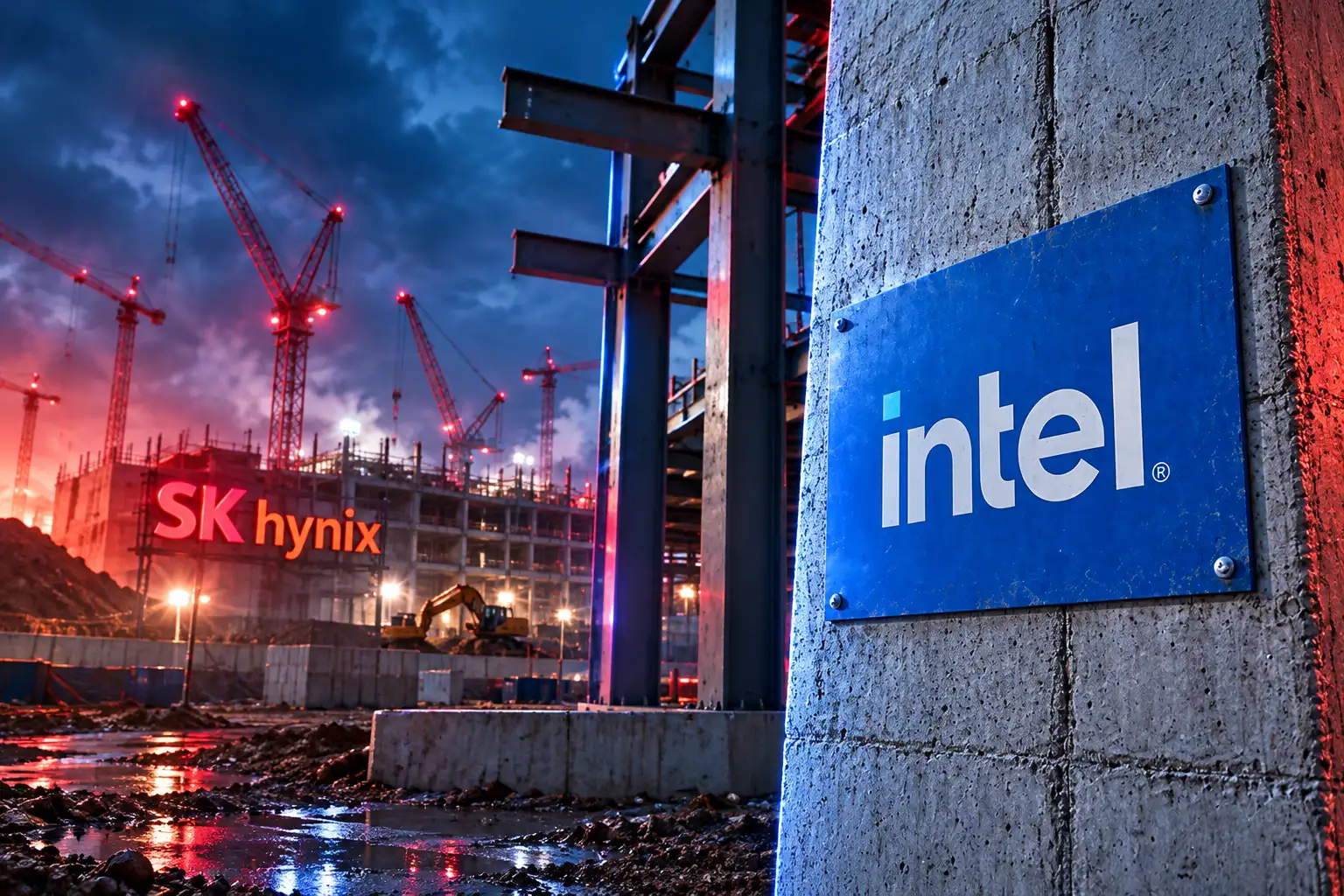
Intel announced the New Albany project in January 2022 and first aimed to start production in 2025. It said it could put up to $100 billion into what it then pitched as a huge Ohio complex. The $28 billion Ohio One campus now on the books is paced to customer demand, and Intel still says the first of two plants is due to be completed by 2031.
As of the end of 2025, Intel had spent more than $5 billion on the site. Including contract commitments, it puts the total closer to $7 billion. The campus covers nearly 1,000 acres. Lip-Bu Tan, who became chief executive after Pat Gelsinger left, slowed the build and said the company had put money in too soon.
New Albany Mayor Sloan Spalding said construction has had slowdowns and is picking up, and that Intel has been open about needing customers if the job is to keep a strong pace. Licking County Commissioner Tim Bubb called the project too big to fail, then asked who will actually run the lines, Intel, another firm, or a mix.
You better make sure you know what you’re ordering, because it’s like a two-year lead time and (it’s) very expensive to put the equipment there to make their chips.
Tim Bubb, Licking County Commissioner, on the New Albany site
Bubb said that, as far as he knows, Intel has not ordered those machines. A memory tenant would still need memory-specific tools, not a leftover logic line. Ohio was planned as a leading-edge logic campus. Even a signed lease would leave a long wait for gear, a cleanroom fit-out, and yield. It would not add wafers to this year’s shortage.
The Indiana Line Starts With Korean Silicon
SK hynix already has a U.S. memory project under way, and it is not a wafer fab. On August 27 it held a groundbreaking in West Lafayette for an advanced packaging plant that will stack and test high-bandwidth memory. The company put the investment at over $4 billion packaging plant in Indiana, with a cleanroom due by October 2028 and mass production in the second half of 2029.
Cutting-edge wafers will still be made in South Korea, then shipped to Indiana for packaging and test, after which the modules go to U.S. customers as Made in USA HBM. About 1,000 people are expected on site once the plant is running. SK hynix also projects about 7,000 direct and indirect jobs through construction and later operations, and it is looking at more than 100 suppliers.
Washington had already backed that plan. On December 19, 2024, the Commerce Department awarded SK hynix up to $458 million in CHIPS funding, plus up to $500 million in loans, for the Indiana packaging and research work. Chief Executive Kwak Noh-Jung used the groundbreaking to tie the plant to U.S. customers rather than to a full U.S. wafer base.
Today marks the day when the United States and SK hynix embark on a new future of AI together. We will expand our investments and collaboration in the US, grow together, and become the most trusted partner in shaping the future of AI in America.
Kwak Noh-Jung, Chief Executive, SK hynix, West Lafayette groundbreaking
Kwak also said in August that the memory shortage should last through the end of 2030. Indiana’s first output is dated for the second half of 2029. Ohio’s first plant is still aimed at 2031. Neither date moves HBM for the servers being wired now.
THREE U.S. MEMORY TRACKS
| Track | What it is | Earliest output | Where the wafers start |
|---|---|---|---|
| Intel Ohio talks | Possible lease or cloud joint venture, unsigned | First plant complete by 2031 | Not disclosed |
| Indiana packaging | HBM stack and test, under construction | Second half of 2029 | South Korea |
| Solidigm NAND | Possible upstate New York fab, unsigned | Not set | Would be U.S. if built |
The table is the whole U.S. map as it stands. One plant is being built, and it still begins with Korean silicon. The other two tracks are conversations.
Solidigm’s NAND Idea Points at New York
On September 18, three people familiar with the matter said Solidigm is considering a NAND flash factory in the United States, with upstate New York a leading candidate. They said the idea is separate from the Intel Ohio talks, and that no agreement has been reached because key details are still open. SK hynix said Solidigm is reviewing options and has not confirmed a specific plan.
A U.S. NAND line would cut Solidigm’s reliance on its only NAND plant, in Dalian, China. That factory is the same one Intel sold when it exited NAND. People familiar with the New York review said a domestic plant could also limit exposure to U.S. tariffs and to curbs on sending chipmaking gear to China.
HOW INTEL AND SK HYNIX GOT HERE
- October 20, 2020: SK hynix agrees to buy Intel’s NAND memory and storage business for $9 billion, including the Dalian plant, with Intel keeping Optane.
- Late 2021 into 2022: The first $7 billion payment and the Dalian transfer move after government approvals, and Intel later announces the Ohio campus with a 2025 production target.
- March 2025: The remaining $2 billion closes, along with NAND manufacturing intellectual property and the rest of the Dalian workforce.
- December 19, 2024: Commerce awards Indiana CHIPS money and loans for HBM packaging and research.
- July 10, 2026: SK hynix lists American depositary receipts on Nasdaq at $149, raising about $26.5 billion under the ticker SKHY.
- August 27, 2026: Groundbreaking for the Indiana packaging plant, with mass production dated for the second half of 2029.
- September 16, 2026: People familiar with the matter describe Intel talks on an Ohio lease or a cloud joint venture. SK hynix says nothing is finalized.
- September 18, 2026: People familiar with a separate review say Solidigm is weighing a NAND factory in upstate New York.
The loop is easy to miss if the story stops at “first U.S. memory chips.” Intel sold SK hynix a China NAND fab. SK hynix is now looking at a U.S. NAND fab through that same unit, while asking Intel about space in Ohio for other memory. In July, SK hynix said it had not moved to buy the Ohio campus. A lease or a venture is a smaller ask than a sale, and it is still unsigned.
A Korean Review Can Stop the Sensitive Work
South Korea’s trade ministry, asked about a possible U.S. production plan, said the decision would be up to SK hynix. If the work involves a national core technology, it would be subject to review under the Industrial Technology Protection Act. Advanced DRAM and high-bandwidth memory sit in that sensitive bucket, according to the people who described the talks.
Holders of those technologies must seek approval before exporting national core technologies, or file notice when government research money was not used, including for some overseas joint ventures. The ministry can order a deal stopped. That is a corporate-export screen, not a criminal spy case.
A separate Criminal Act amendment took effect on September 13, three days before the Intel talks became public. It widens espionage beyond an “enemy state” and sets prison terms from three to 30 years for leaking state secrets for a foreign country or equivalent group. Theft cases and an approved plant are different facts. The practical veto on a U.S. HBM or DRAM line remains the core-tech review.
THE SEOUL REVIEW TRIGGERS
- Company discretion: The trade ministry said a U.S. plant is SK hynix’s call if no national core technology is in the deal.
- Core-tech screen: HBM or advanced DRAM in Ohio could force prior approval or notice, and the ministry can halt a transfer.
- Joint-venture risk: A cloud-backed venture can still count as an overseas deal that needs the same paper, depending on what technology moves.
- Packaging gap: Indiana’s Korean-wafer model already keeps the front-end at home, which is one reason it has moved while a U.S. fab has not.
Seoul is also pushing SK hynix and Samsung Electronics to speed a new chip cluster in the country’s southwest. Two of the people who described the Intel talks said that tension has left SK hynix in a bind, with the government wanting any U.S. spending as leverage in wider talks with Washington, and Washington pushing the firm to commit fast.
Lutnick’s 100% Tariff Warning
Commerce Secretary Howard Lutnick has threatened to impose up to 100% tariffs on South Korean and Taiwanese companies unless they commit to more production on American soil. The White House said in January it could widen semiconductor import tariffs and offer relief to firms that invest in U.S. plants. That is the stick behind Chey Tae-won’s July comments, not a sudden taste for Ohio real estate.
South Korea last year pledged a huge U.S. investment package, about $350 billion, in return for lower tariffs. Some $150 billion was earmarked for shipbuilding. The remaining $200 billion is still undecided. SK hynix’s U.S. file now includes a Nasdaq listing, an Indiana packaging plant, unsigned Intel talks, and an unsigned Solidigm NAND review. Each item can be shown in Washington. Only Indiana is pouring concrete on a dated schedule.
Chey, who chairs SK Group, told reporters in July that customers and countries are pressing for more chips, and that a U.S. factory should be built if it can be done.
I think we need to build a factory in the United States. If possible, I believe we should build it.
Chey Tae-won, Chairman, SK Group, July 2026
He had also said a memory plant needs power, clean water, land, labor, and a supply chain, and that the company was scouting sites in the United States and elsewhere. Lutnick’s public push, including comments around a Micron event the day before the Nasdaq listing, is the pressure Chey was answering. A lease of Intel’s delayed campus is one way to show movement without a greenfield wafer fab.
What Memory Would Ohio Even Run?
No one has said what SK hynix would make in Ohio if a deal is signed, so DRAM, NAND, and high-bandwidth memory all remain on the table. HBM is the product that made the company indispensable to AI servers, and it is also the product Seoul is least likely to wave through as an overseas front-end.
SK HYNIX IN THE HBM MARKET
- Revenue share: Counterpoint Research put SK hynix at 58% of global HBM revenue in the first quarter of 2026, with Samsung Electronics and Micron Technology at 21% each.
- Shortage call: Kwak said in August the memory shortage should last through the end of 2030.
- Indiana’s job: The West Lafayette plant is dated for HBM packaging in the second half of 2029, using Korean wafers.
- Ohio’s clock: The first Intel plant is still due to be completed by 2031, with memory tools not known to have been ordered.
Cloud companies in a joint venture would be buying a claim on future supply, not a 2026 allocation. SK hynix’s 2026 DRAM and NAND output was already spoken for last autumn, and HBM has been the tightest slice of that book. A U.S. line that opens at the end of the decade is an insurance policy against tariffs and against a political demand to make chips in America. It is not extra silicon for the racks going live this year.
Building in the United States also costs more than building in Korea, two of the people said, because of labor, construction, and an Asia-heavy tool chain. NAND is a price-sensitive product, which is why a Solidigm New York fab would have to clear a harsher math test than an HBM package line. DRAM and HBM would face the Seoul screen. Every path still ends at an unsigned sheet of paper.
Around a dozen large cranes were standing at Intel’s Ohio One site in late July, on a campus whose first plant is still due to be completed by 2031. Spalding is waiting on a ribbon cutting. SK hynix has a packaging plant in the ground in Indiana and two open U.S. conversations, with Intel in Ohio and with itself at Solidigm. Until one of those conversations becomes a contract, the memory that trains the models still starts in Korea.

Ohtani Game 4 Logoman Card Sells for $3.24 Million

Cole Kmet’s Season Ends, and Chicago’s Tight End Plan Starts

NBA Seeks Soccer Money After EuroLeague Clubs Refused

Amazon’s First Bond Tests Leave the Broccoli Chair Empty

Tyrese Maxey Owns the Night Built for LeBron James

Warsh Rejects Rate Guidance and Still Moves Markets

Dana-Farber Exits an MGB Medicare Advantage Network Early

NASA Launches the Roman Space Telescope’s Cosmic Bet

OpenAI’s Cyber Letter Puts the Defense Bill on Governments

Russia Recycles Its Old Warning Over Storm Shadow Plants
-
 BUSINESS2 months ago
Warsh Rejects Rate Guidance and Still Moves Markets
-
 BUSINESS1 month ago
Dana-Farber Exits an MGB Medicare Advantage Network Early
-
 NEWS2 months ago
NASA Launches the Roman Space Telescope’s Cosmic Bet
-
 NEWS2 months ago
OpenAI’s Cyber Letter Puts the Defense Bill on Governments
-
 NEWS2 months ago
Russia Recycles Its Old Warning Over Storm Shadow Plants
-

 ENTERTAINMENT4 weeks ago
Primetime’s $2.7 Million Preview Tops Pitt’s Costlier Film
-

 BUSINESS2 months ago
Jet Drones Lock Down Kyiv and Strip Kherson of Heat
-

 NEWS2 months ago
Congo Starts Ervebo Vaccinations for a Different Ebola Virus