
NEWS
Arm Pushes One Compute Stack From Phones to Robots
Arm launched CSS for Mobile 2, Neoverse CSS N4 and an 80-company physical AI program, aiming to collect robot royalties the way it collects phone royalties.

On Tuesday, September 8, 2026, Arm Holdings put three AI compute products on the table at once. The Cambridge design firm used its Arm Everywhere event in Shanghai to show a phone subsystem, a server subsystem and a robotics partner program, and Arm shares changed hands at $262.08 in early New York trade, up 3.96% from the September 4 close of $252.09.
The three drops share a software story. If a model that runs on an Arm server CPU can also run on a phone cluster and a robot controller, Arm collects a fee each time a partner ships silicon, in the factory as well as in the pocket.
Arm Dropped Three Platforms on the Same Morning
Chris Bergey, executive vice president for edge AI, led the phone work. Mohamed Awad, who runs cloud AI, led the server work. Drew Henry, executive vice president for physical AI, led the robotics partner program. Each man described a different machine. All three described the same instruction set and the same developer tools.
That is the move underneath the product names. Arm already splits its sales map into Edge AI for phones and gadgets, Cloud AI for data centers and networks, and Physical AI for cars and robots. September 8 was the day those buckets got matching hardware kits.
THE THREE COMPUTE DROPS
| Product | Lead | Job | Headline claim |
|---|---|---|---|
| CSS for Mobile 2 | Chris Bergey | Phone and edge SoCs | C2 CPU cluster plus Mali G2-Ultra NX GPU |
| Neoverse CSS N4 | Mohamed Awad | Custom data-center silicon | Up to 128 cores per die, LPDDR6, PCIe Gen 7 |
| Total Design for Physical AI | Drew Henry | Robots, vehicles, industrial machines | 80+ firms and a robotics scorecard |
CSS is not a chip a shopper can buy. Partners such as phone and server chip firms license a pre-built compute block, add their own parts, and send the result to a foundry. Arm is paid a license fee up front and a royalty when those chips ship.
The Phone Chip That Orchestrates Agents
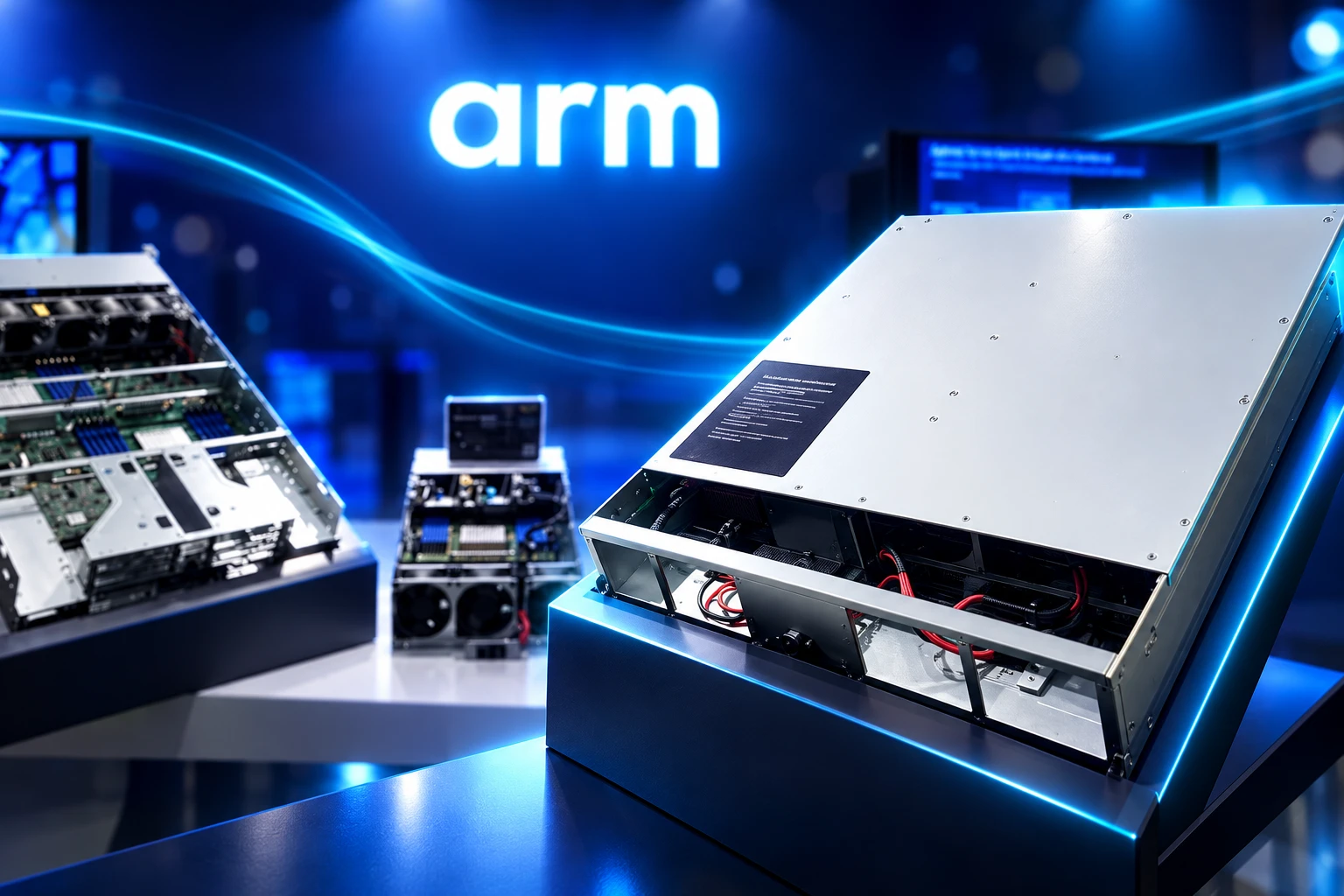
Bergey’s new CSS for Mobile 2 platform is the edge kit. It pairs a C2 CPU cluster, built from C2-Ultra and C2-Pro cores, with the Mali G2-Ultra NX GPU. The CPU is meant to keep an on-phone AI agent’s to-do list moving. The GPU is meant to draw frames and run neural graphics in the same pipe.
Arm says an agent on a handset now has to hold context, call apps, and act, not only run a model. That is why the cluster carries two SME2 matrix units, double the last kit, so some AI math stays on the CPU instead of hopping to a separate block.
C2 AND MALI G2 CLAIMS
- AI on the CPU: C2-Ultra reaches up to 1.7x the AI throughput of C1-Ultra.
- Everyday speed: Single-thread work is up 15%, with up to 38% less power at the same speed.
- SME2 pair: Two units, and Arm cites a 70% lift on the latest small language models.
- Neural GPU: Mali G2-Ultra NX is Arm’s first Mali with neural engines in the shader cores, at up to 4x the neural-graphics work per watt and 14% more on current games.
Game studios are already on the graphics path. Sumo Digital is building Neural Dawn on the new GPU. Tencent Games’ MagicDawn stack, Unity China’s Tuanjie engine, NetEase’s Where Winds Meet, Tencent’s Arena Breakout Infinite and Infold Games’ Infinity Nikki are named as neural-graphics partners. vivo said it is putting Arm Neural Technology on its latest flagship phones so neural graphics can land in shipping games, not only in slideware.
People who build phone games already treat this GPU path as a cousin of PC AI upscalers, frame generation included. The gap is the wait. CSS for Mobile 2 still has to become a MediaTek, Qualcomm or Unisoc SoC before any of those frames show up in a shop.
Introducing Arm CSS for Mobile 2. 📱
Built for the system-level demands of agentic AI and cinematic mobile graphics, our new AI-native compute platform brings together world-class AI CPU and GPU capabilities to change what the next generation of mobile devices can do.… pic.twitter.com/jtQmF3OBpj
— Arm (@Arm) September 8, 2026
Why a Robot Needs the Same ISA as a Server
Arm’s software pitch is blunt. KleidiAI libraries plug into the AI stacks developers already use. A new AI Portal points more than 22 million Arm developers, and the agents those developers spawn, at models tuned for SME2 and for GPUs with neural engines. The same portal is described as covering cloud, edge and physical AI, from a vision model on a robot to a small model on a phone.
That is how a royalty on a humanoid becomes thinkable. If the robot’s controller speaks the same Arm dialect as the training cluster and the engineer’s phone, the software cost of switching ISAs stays high and Arm’s cut stays in the bill of materials.
Richard Grisenthwaite, Arm’s chief architect, made the robotics half of that case in a Robotics Capability Framework manifesto. He argues the robot trade still lacks a shared way to describe what a machine can do, the way SAE levels describe driving automation. Arm wants latency, power, memory, safety and where the compute sits to be spoken in one vocabulary, then scored on a ladder from reactive machines to ones that improve themselves.
A scorecard that widely adopted would steer buyers toward whatever compute the scorecard assumes. Arm is writing the first draft.
Unitree, NXP and an 80-Company Bench
Henry’s group is trying to copy a partner model Arm already used for cloud chips. Total Design for Physical AI brings in more than 80 companies that sell models, sensors, control software, foundry capacity and finished robots. Named names include AWS, the Geely-linked auto computer firm ECARX, Hugging Face, Liquid AI, the auto and industrial chip firm NXP, PlusAI, PSYONIC, QNX, Alibaba’s Qwen models, Siemens and the Chinese robot maker Unitree Robotics.
A second ring is helping shape the robotics scorecard, among them ANYbotics, Fourier, GALBOT, Lenovo and McKinsey. Arm, AWS, Google, HERE, RemotiveLabs and Siemens already built a digital cockpit test bench on Arm’s Zena CSS so car software can be tried before the silicon exists. The robot program is that idea with legs.
THE PHYSICAL AI BENCH
- Cloud and models: AWS, Hugging Face, Liquid AI and Qwen sit on the training and software side.
- Chips and control: NXP, QNX and Siemens cover industrial compute, real-time software and factory tools.
- Machines: Unitree, ANYbotics, Fourier, GALBOT and PSYONIC are the robot and actuator names in the first wave.
- Vehicles: ECARX and PlusAI pull the same stack toward cars and driving software.
Henry puts a number on the prize. Arm estimates physical industries will need about $200 billion a year of compute in the 2030s, in mines, farms, factories and transport. That figure is Arm’s own, and it is a 2030s target, not a 2026 order book.
These industries represent trillions of dollars in global economic activity and a $200B annual compute opportunity in the 2030s, yet they remain among the hardest industries to transform.
Drew Henry, Executive Vice President, Physical AI, Arm
Introducing Arm Total Design for Physical AI — bringing an inital 80+ companies together around a shared goal to accelerate physical AI from development to deployment.
One of the first initiatives is a Robotics Capability Framework, creating a common language for defining… pic.twitter.com/sBgpoT5aWw
— Arm (@Arm) September 8, 2026
Neoverse N4 Follows the Hyperscalers
The server kit is Neoverse CSS N4, which Arm calls its most configurable CSS and its fastest path from a paper block to a tape-out. A die can hold up to 128 cores. The design supports LPDDR6 memory and PCIe Gen 7. Versus Neoverse CSS N3, Arm claims up to 2x the performance, up to 1.25x the performance per watt and up to 1.75x the memory bandwidth.
Awad’s argument is that AI agents in a data center spend more time on CPUs, not less, because they fetch data, call tools and talk to other agents. Some buyers want a custom chip around that CPU. Others want a finished part. For the second group Arm is selling AGI CPU silicon, and it lists OpenAI, Meta, Cloudflare, Oracle, SAP, Lenovo, Supermicro and Verda as firms building on it. ByteDance’s Volcano Engine is putting the first AGI CPU agent sandboxes into its cloud.
Google Cloud, Microsoft Azure with Cobalt 200, and Nvidia’s Vera CPU are already cited as Arm-based agent hosts. Arm also says IDC found that Arm-based rack-scale servers have overtaken x86 as the main accelerated computing platform. That is the cloud half of the same-stack bet, already further along than the robots.
Twenty-One CSS Licenses, Still a Small Slice
The money still leans on phones, even as the map on the slide says otherwise. For the fiscal year ended March 31, 2026, Arm booked $4.92 billion of revenue. Royalty revenue was $2.61 billion, up 21%. License and other revenue was $2.31 billion, up 25%.
On the February 4, 2026, call for the third quarter, revenue was $1.24 billion, up 26%, with royalties of $737 million, up 27%. Chief executive Rene Haas said data-center royalty revenue had grown more than 100% year on year, and he told investors that business should, in a few years, be larger than mobile.
Our data center royalty revenue has grown more than 100% year on year, and we expect in a few years our data center business to be our largest business, larger than mobile.
Rene Haas, Chief Executive Officer, Arm, Q3 fiscal 2026 call
CSS is the product shape that makes that shift possible, because it is sold as a block rather than a menu of cores. Haas said Arm had 21 CSS licenses across 12 companies, with five customers shipping CSS chips and the top four Android phone brands already selling CSS-based devices. Chief financial officer Jason Child said CSS had moved from approaching double digits of the mix last year to the teens this year, and that it could be as much as 50% in a couple of years.
THE CSS MONEY TRAIL
- February 4, 2026: Haas reports 21 CSS licenses, 12 companies and five customers shipping, with data-center royalties more than doubling.
- March 31, 2026: The fiscal year closes at $4.92 billion, with royalties of $2.61 billion and license revenue of $2.31 billion.
- September 8, 2026: CSS for Mobile 2 and Neoverse CSS N4 extend that block into the next phone generation and the next server generation.
Physical AI royalties, in Haas’s own cut of the pie, are still the auto and robot line, growing from a smaller base. The 80-firm bench is how Arm wants that line to look like cloud in a few years. It does not look like that yet.
Shares Bounce After the June Peak
The early New York bid left Arm at $262.08, a bounce from $252.09, and still a long way under the 52-week high of $452.70 set on June 18, 2026. The stock is treating Shanghai as a relief tape, not a reset of that peak.
Licensees still have to turn Mobile 2 and N4 into tape-outs. Robot firms still have to agree that Arm’s scorecard is the one that matters, while RISC-V and custom silicon remain options on the factory floor. Until those chips ship, the three-platform morning is a software promise sitting on a royalty base that phones still carry.
The next print that would make the bet real is not another keynote. It is a CSS for Mobile 2 SoC in a shipping phone, and a Unitree or NXP part that runs the same code the data center already knows.
Disclaimer: This article is news reporting and analysis of Arm Holdings product announcements and share-price moves, and it is for information only. It is not investment advice, a solicitation to buy or sell ARM or any other security, or a forecast of future royalties or tape-outs. Readers should consult a licensed financial adviser or broker before making any investment decision. Product claims, partner lists, royalty figures and the $262.08 print reflect company statements and market data available on September 8, 2026, and all of those items can change.

Pixel Buds Firmware 6.144 Ties New Features to Pixel Gear

Eve Markoski-Wood Backs Her Mum as Wood Fights Bail

Trump Rejects an Iran Deal as Diesel Holds Near Records

Amazon Cuts the S26 Ultra to $979 After Samsung’s Hike

Ice Caves Land in Minecraft 26.4 Snapshot 3

Warsh Rejects Rate Guidance and Still Moves Markets

Dana-Farber Exits an MGB Medicare Advantage Network Early

NASA Launches the Roman Space Telescope’s Cosmic Bet

Russia Recycles Its Old Warning Over Storm Shadow Plants

OpenAI’s Cyber Letter Puts the Defense Bill on Governments
-
 BUSINESS2 months ago
Warsh Rejects Rate Guidance and Still Moves Markets
-
 BUSINESS1 month ago
Dana-Farber Exits an MGB Medicare Advantage Network Early
-
 NEWS2 months ago
NASA Launches the Roman Space Telescope’s Cosmic Bet
-
 NEWS2 months ago
Russia Recycles Its Old Warning Over Storm Shadow Plants
-
 NEWS2 months ago
OpenAI’s Cyber Letter Puts the Defense Bill on Governments
-

 ENTERTAINMENT4 weeks ago
Primetime’s $2.7 Million Preview Tops Pitt’s Costlier Film
-

 BUSINESS2 months ago
Jet Drones Lock Down Kyiv and Strip Kherson of Heat
-

 NEWS2 months ago
Congo Starts Ervebo Vaccinations for a Different Ebola Virus