
BUSINESS
UK Food Export Volumes Fall to Crisis-Era Lows
UK food export tonnes hit levels last seen after foot-and-mouth and Covid, while whisky still rose and chocolate now sells more on the way in.

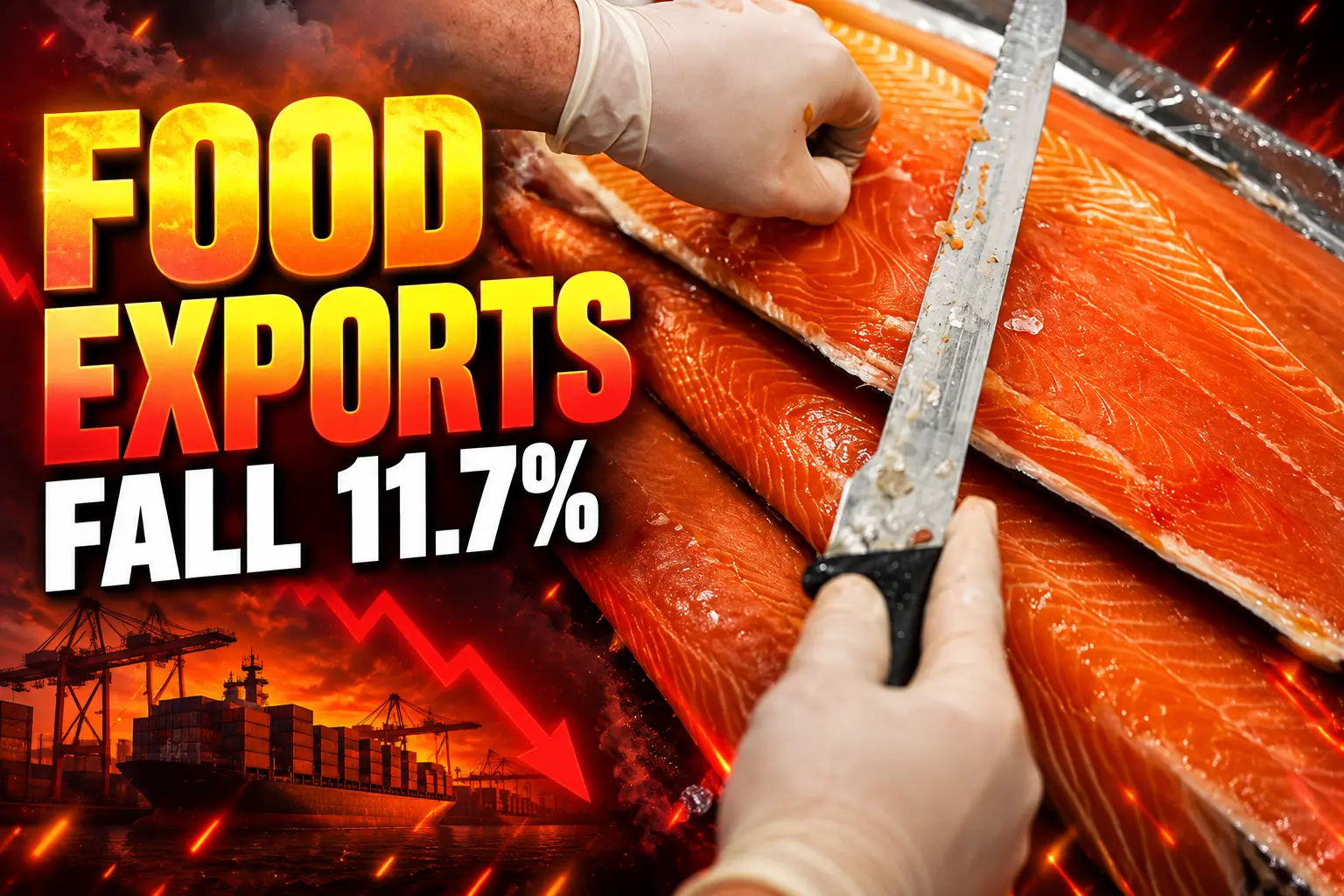
UK food export volumes fell 11.7% to 4.0 billion kilograms in the first half of 2026, the Food and Drink Federation said, the third-weakest H1 since 2000. Only the Covid trough of H1 2021, at 3.9 billion kilograms, and H1 2002 after foot-and-mouth, at 3.7 billion kilograms, were lower.
The cash trade deficit in food and drink reached £21.1bn, the largest since 2000, as export sales slipped 3.4% to £12.0bn and imports rose 0.9% to £33.1bn. There was no plague and no lockdown behind this print. Whisky still grew, chocolate now sells more on the way into Britain than on the way out, and tariff holidays on finished snacks are cheapening goods that UK factories also pack.
Four Billion Kilograms and Two Crisis Benchmarks
The federation’s 25 September release, drawing on HMRC figures, put H1 food shipments at the third lowest level on record this millennium. Kilogram volumes were also 5.0% below H1 2024, so the drop is not a one-year blip against a strong 2025.
Export value held up better than tonnes because the mix is shifting toward drinks. Sales of food and non-alcoholic drink fell 4.7% to £8.5bn, while shipments measured in litres rose 13.9% to 672.1 million litres and litres of pure alcohol rose 1.8% to 234.3 million. The UK is still bottling; it is moving a lot less solid food.
THE H1 2026 PRINT
- Export tonnes: 4.0 billion kilograms, down 11.7% on H1 2025 and only 0.1 billion kilograms above H1 2021.
- Export sales: £12.0bn, down 3.4% from £12.4bn, with the EU at £7.1bn and non-EU markets at £4.9bn.
- Import tonnes: 19.1 billion kilograms, down 2.5% on H1 2025 but up 3.0% on H1 2024, the second-highest H1 since 2000.
- Cash gap: imports of £33.1bn minus exports of £12.0bn leave a £21.1bn deficit.
Independent economist Julian Jessop estimated that cash gap at about 1.3% of GDP in H1, a little below the 1.4% he calculated for 2024 and close to 2022 and 2023. Almost any bill in pounds will look large against 2000. The tonne series is the one that sits next to a livestock cull and a pandemic.
Whisky Rose While Salmon Lost Nearly a Third
The FDF’s product table in its food export volumes down 11.7% snapshot shows a split, not a uniform slump. Whisky, still the top export, rose 2.2% in value to £2.5bn and 5.8% in volume. Beef jumped 22.7% to £451.8m. Lamb and mutton rose 15.4% to £398.3m. Gin ticked up 2.8% to £306.9m, and soft drinks rose 9.8% to £398.0m.
TOP TEN FOOD AND DRINK EXPORTS, H1 2026
| Product | Value | Value change | Volume change |
|---|---|---|---|
| Whisky | £2.5bn | +2.2% | +5.8% |
| Cheese | £460.8m | -4.6% | +15.4% |
| Milk and cream | £452.7m | -9.9% | -13.2% |
| Beef | £451.8m | +22.7% | +6.7% |
| Chocolate | £442.1m | -2.9% | -1.6% |
| Salmon | £406.0m | -30.8% | -31.0% |
| Lamb and mutton | £398.3m | +15.4% | +2.5% |
| Soft drinks | £398.0m | +9.8% | n/a |
| Gin | £306.9m | +2.8% | +1.3% |
| Savoury snacks | £275.6m | +2.8% | -6.8% |
Salmon is the wreck. Sales fell 30.8% to £406.0m and volumes fell 31.0%, the steepest drop among the top ten, after a year of extra US duties on British fish. Milk and cream fell 9.9% in value and 13.2% in volume. Cheese volumes rose 15.4% even as value fell 4.6%, which is more tonnes at a worse price. Savoury snacks repeated that pattern in reverse on price, with value up 2.8% and volume down 6.8%.
The Wrong-Way Trade in Chocolate
Chocolate is the cleanest picture of ground lost at home as well as abroad. UK chocolate exports slipped 2.9% to £442.1m and 1.6% in volume. Chocolate imports rose 2.4% to £1.5bn and 6.9% in volume, more than three times the export total. Foreign bars and bulk cocoa goods are taking space on British shelves while British chocolate loses a little overseas.
The same tilt shows up further down the import list. Savoury snacks coming in rose 5.9% to £1.1bn. Soft drinks imports rose 5.0% to £1.1bn. Fruits still lead inbound trade at £3.1bn, then vegetables at £2.1bn and poultry at £1.9bn, categories Britain does not fully feed itself. The finished-goods rows are the ones that sit on top of UK factory output.
Non-EU food import volumes are 22% higher than in H1 2023, against a 9.2% rise in EU import volumes over the same span. The FDF traces that non-EU jump to the risk-based Rest of World approach under the Border Target Operating Model, introduced at the end of 2023. Mercosur already sells £1.2bn of food and drink into Britain against £137.4m of UK sales the other way.
Why UK Ice Cream Faces a 30% US Duty
The United States is the UK’s third-largest food and drink export market, and H1 sales there fell 16.5%. British goods now face a stacked 10% US tariff on top of ordinary most-favoured-nation duties, while EU goods generally face only the 10% baseline. In lines that already carry a duty, the gap is a list price.
US TARIFF STACK, UK VS EU
| Example | UK total duty | EU total duty | EU edge |
|---|---|---|---|
| Tea (0% MFN) | 10% | 10% | None |
| Confectionery (5.6% MFN) | 15.6% | 10% | 5.6 points |
| Ice cream (20% MFN) | 30% | 20% | 10 points |
A British ice cream shipped to the US is taxed at 30%; the same product from the EU is taxed at 20%. Confectionery faces 15.6% from the UK and 10% from the EU. China sales fell 17.6% in the same half. The FDF says a further US round leaves EU plants in a better position than UK ones, and that the 16.5% drop is likely to deepen rather than fade.
Exports to India rose 10.1% in H1, before the UK-India free trade deal took effect on 15 July and started a decade of staged tariff cuts. Australia purchases of UK food and drink rose 3.0%; New Zealand purchases fell 24.7%. Preferential paper has not, on those two Pacific deals, produced a clean volume recovery.
Finished Snacks Got the Duty Holiday
Then-chancellor Rachel Reeves used the Iran war and household bills as the reason to suspend selected food import duties. A first list covering fruit, juices, pasta, couscous and tuna was set to run to 31 December 2028. HM Revenue and Customs then created tariff suspensions from 21 June across fish, fruit, tuna, cocoa butter, pasta and some sauces, nine days before the half closed. A second list of about 125 “everyday essentials,” including biscuits, chocolate, crisps, bread and baked beans, went to consultation through 24 June.
THE SNACK TARIFF CALENDAR
- 24 March 2026: Reeves says the Treasury will look at targeted agri-food duty suspensions to ease prices.
- 30 April 2026: a first tranche on selected fruit, juices, pasta, couscous and tuna is announced, due to lapse on 31 December 2028.
- 21 June 2026: autonomous suspensions take effect on the HMRC commodity list, including cocoa butter and pasta, not chocolate bars or biscuits.
- 24 June 2026: consultation closes on the 125-item list that names biscuits, chocolate, crisps and other packed foods.
The FDF’s own readout is that nearly 90% of the import value in the cost-of-living package already entered duty-free, so cutting the rest on packed goods helps rival plants more than it helps a British mixing line. It wants duties cut on ingredients, not on biscuits and bars that UK sites already make. The full import duty suspension reference list is updated by statutory instrument; later 2026 versions took effect on 5 August and 1 October, after the H1 window.
WHAT WE KNOW
- First tranche: pasta, tuna, citrus and cocoa butter suspensions were live from 21 June, covering only the last days of H1.
- FDF charge: the federation says the UK is suspending duties on manufactured foods this year and that Chinese biscuits are the example of the harm.
WHAT IS UNCONFIRMED
- Biscuit list: whether every 125-item line, including chocolate bars and biscuits, is fully in force is not set out in the 21 June HMRC notice.
- H1 effect: nine days of first-tranche relief cannot explain an 11.7% half-year volume drop; the federation is arguing about the path, not a June billing shock.
Karen Betts, the FDF chief executive, put the biscuit example in the 25 September statement and tied it to jobs.
When the government then chooses to remove tariffs on, for example, biscuits imported from China, it’s not surprising that they’ll be sold more cheaply here than biscuits made in the UK using British ingredients. But this is putting British products and British jobs at risk.
Karen Betts, Chief Executive, Food and Drink Federation
That is a producer complaint, and it collides with the original Treasury aim, which was a cheaper weekly shop during the Iran war. The two goals do not sit on the same ledger. Dairy farmers make a related point on standards: they are asked to match import prices set by systems with different rules and public support, and a duty holiday on packed snacks does not close that gap.
Ireland and France Bought Less British Food
EU sales, 59.2% of the H1 export total, fell 0.9% to £7.1bn. Ireland, still the largest market, was down 4.9%. France was down 4.6%. The FDF blames extra cost and paperwork since Brexit, plus uneven enforcement of rules across member states. In the 2025 calendar year, food and drink exports to the EU were 31% below 2019.
Non-EU sales fell faster, down 6.9% to £4.9bn. The UAE dropped 23.4% as the Iran war squeezed Middle East freight. Singapore rose 25.2% in the destination table, Japan 8.3%, Norway 7.4%. Those gains do not offset Ireland, the United States, China and the UAE. CPTPP expansion, with Indonesia, the Philippines, Uruguay and the UAE seeking to join, is the federation’s listed route back into some of those tariffs; it is not a H1 result.
The EU banned Brazilian meat from 3 September, while Great Britain still allows those imports pending its own review. Under a UK-EU sanitary and phytosanitary deal, the FDF notes, Britain would have to match that sort of restriction. The same deal is the one the federation wants used to put UK exporters on a level field with EU plants, not as a back door for more inbound product.
Burnham Is Asked to Reverse the Slide
Betts said constantly changing rules and high compliance costs leave UK firms “uncompetitive both here and abroad,” with energy, ingredients, logistics, packaging and labour all up. A CBI study cited in the FDF release put the burden of taxes and packaging rules on food and drink makers at nearly £10bn in 2025, equal to 23.8% of the sector’s gross value added. The federation forecasts food inflation at 3.9% by December 2026 and a peak of 6.4% in July 2027, and argues a sector squeezed at home cannot take share abroad.
Tom Bradshaw, president of the National Farmers’ Union, called the figures a “wake-up call” and said food security is national security. He said farm businesses face rising costs, regulation, extreme weather and volatile markets, and that “a strong food manufacturing sector depends on a strong farming sector.” The FDF puts the industry at more than £42bn of output and half a million jobs.
WHAT THE FDF ASKED THE GOVERNMENT TO DO
- Domestic rules: simplify regulation so plants will invest in Britain rather than overseas.
- Tariff design: use suspensions to cut ingredient costs, not to favour packed foods already made here.
- Trade deals: get firms actually using the FTAs already signed, including India after 15 July.
- SPS deal: make the UK-EU sanitary pact a level field for exporters, not a one-way alignment on imports.
As the federation headed to Liverpool, Betts called on Andy Burnham and his government to act on the H1 evidence with farmers and the plants that buy from them. The cash deficit can be argued as a share of GDP. The 4.0 billion kilograms cannot. Those tonnes are now within 0.1 billion kilograms of the Covid half, and the goods that still grow are mostly in bottles.

Pixel Buds Firmware 6.144 Ties New Features to Pixel Gear

Eve Markoski-Wood Backs Her Mum as Wood Fights Bail

Trump Rejects an Iran Deal as Diesel Holds Near Records

Amazon Cuts the S26 Ultra to $979 After Samsung’s Hike

Ice Caves Land in Minecraft 26.4 Snapshot 3

Warsh Rejects Rate Guidance and Still Moves Markets

Dana-Farber Exits an MGB Medicare Advantage Network Early

NASA Launches the Roman Space Telescope’s Cosmic Bet

Russia Recycles Its Old Warning Over Storm Shadow Plants

Primetime’s $2.7 Million Preview Tops Pitt’s Costlier Film
-
 BUSINESS2 months ago
Warsh Rejects Rate Guidance and Still Moves Markets
-
 BUSINESS1 month ago
Dana-Farber Exits an MGB Medicare Advantage Network Early
-
 NEWS2 months ago
NASA Launches the Roman Space Telescope’s Cosmic Bet
-
 NEWS2 months ago
Russia Recycles Its Old Warning Over Storm Shadow Plants
-
 ENTERTAINMENT3 weeks ago
Primetime’s $2.7 Million Preview Tops Pitt’s Costlier Film
-

 BUSINESS2 months ago
Jet Drones Lock Down Kyiv and Strip Kherson of Heat
-

 NEWS2 months ago
Congo Starts Ervebo Vaccinations for a Different Ebola Virus
-

 ENTERTAINMENT2 months ago
Midnight Spider-Man Turns Peter Parker Into Oscorp’s Hybrid