
NEWS
Poland’s Kaliningrad Alert Pulls Lithuania Into the Watch
Poland’s Kaliningrad surge is a police story in Warsaw. Lithuania and a German brigade already sit on the other fence, and the Suwałki Gap is the real stake.

Poland locked extra police, anti-terror teams and a Warsaw command onto its Kaliningrad border from Nov. 2 after spy services warned that armed groups might try to cross in the first half of November. Prime Minister Donald Tusk said people with flashlights were seen near Sępopol just after midnight on Nov. 3, and that a fast surge of officers may have stopped a provocation. He said they will never be able to confirm that was the intent.
The same day, Lithuania’s German brigade began sorting radio signals coming out of Kaliningrad and Belarus. The scare is being told as a Polish night on one fence. The load sits on the other fence too, and on the thin land bridge behind both.
Flashlights Near Sępopol, and Nobody Crossed
Tusk spoke at the start of a cabinet meeting on Nov. 3. He said the Border Guard woke him with a report of “disturbing movement” on the Polish-Russian line in the north, “individuals with flashlights.” Officers were sent in. No one crossed into Poland. Early accounts placed the sighting near Sępopol in Warmia-Masuria, a town on the Kaliningrad fence, not on the Suwałki strip farther east.
We very quickly mobilized the necessary security forces and means on site, and we successfully prevented any attempted acts of provocation, if that was the intention. Of course, we will never be able to completely confirm that.
Donald Tusk, Prime Minister of Poland, cabinet meeting, Nov. 3, 2026
That last clause is the whole file on the night itself. Allied services had been warning for weeks about “acts of diversion or more serious provocation” against the European Union, including “the intrusion of armed individuals into Polish territory.” What the public has been shown is still a light in the dark, then a pullback, then a claim of success that Tusk himself will not certify.
WHAT WE KNOW
- The clock: Police Chief Marek Boroń said the reinforced mission runs from Nov. 2 until at least Nov. 8.
- The place: Extra officers are in Warmia-Masuria, which meets Kaliningrad, and in Podlaskie, which meets Belarus and the Suwałki approach.
- The crossing: Polish officials have not said anyone entered Polish ground on the flashlight night.
WHAT IS UNCONFIRMED
- The intent: Tusk said the flashlight movement might have been a provocation and that this cannot be fully proved.
- The armed groups: The warning from Poland’s Military Intelligence Service and allied agencies described possible breaches by armed teams. No such team has been identified in public.
- The specific plan: By the afternoon of Nov. 3, Warsaw had not released evidence of a dated sabotage plot launched from Kaliningrad.
The gap between an armed-incursion warning and a flashlight sighting is not a side issue. It is how this kind of pressure is built: the defending state has to treat a maybe as a raid, then live with a night it cannot close.
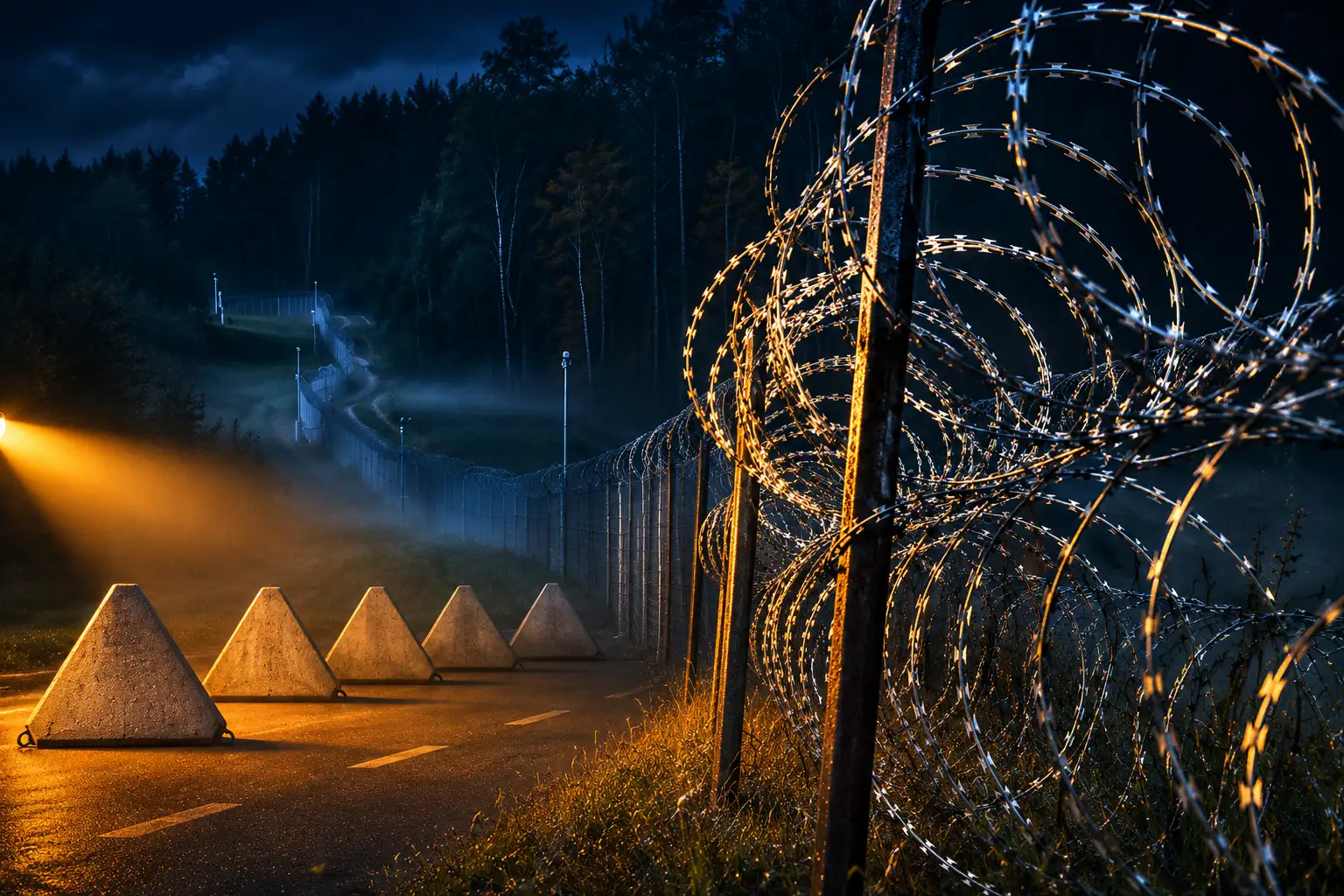
Police Headquarters Is Running a Kaliningrad Week
Boroń told RMF FM that a “large group of police officers,” including anti-terror units drawn from other provinces, was working with the army, the Border Guard and spy services. The mission is police-led. A special command sits at National Police Headquarters in Warsaw, with the provincial commands in Olsztyn and Białystok on the net. The aim, Boroń said, is to protect people who live on the line, watch facilities, and catch trouble early, including the work of foreign spy services.
“Police are securing the Kaliningrad region against possible events that could lead to acts of sabotage,” he said. He added that the information also came from “external agencies,” and that officers had to cover “a whole range of situations which could endanger society.” Poland has not given a headcount, and it has not said whether armor is on the road.
A letter to provincial commanders put forces on “full readiness” from Nov. 2 to Nov. 8. Online rumor tied that order to Poland’s fight over the Constitutional Tribunal. Police posted a denial. Boroń said the mobilization was about sabotage risk, not the court fight.
THE KALININGRAD ALERT CLOCK
- Oct. 13: Tusk, standing with Lithuania’s prime minister, cites a talk with NATO Supreme Allied Commander Alexus Grynkewich and warns about sabotage, including aircraft stunts or hits on border crossings.
- Late October: Poland’s Military Intelligence Service and allied agencies warn that armed groups could try to come across from Kaliningrad in the days ahead.
- Nov. 2: Boroń confirms the police-led surge in Warmia-Masuria and Podlaskie and the Warsaw command.
- Shortly after midnight, Nov. 3: Border Guard reports flashlight movement near Sępopol. Tusk is woken. Officers move. No crossing is reported.
- Nov. 3, daytime: Tusk briefs ministers. Lithuania’s defence minister says the two countries’ spy services compared notes. German troops in Lithuania start a new signal watch.
- Nov. 8: The police readiness window runs at least to this date. The broader warning still covers the first half of November.
Tusk said that after “more precise” information that incidents, including an armed entry, could happen in this period, Warsaw sent “substantial” police and anti-terror forces to the line and reinforced the Border Guard. He told Poles to stay sharp. He said the tension from Russia may last, and that the job is to stop sabotage not only on the fence but inside the country.
Lithuania Already Had Soldiers on the Other Fence
Kaliningrad is a Russian territory on the Baltic with NATO on two land sides, Poland to the south and Lithuania to the north, and water to the west. A scare on the Polish fence is a test of the Lithuanian fence whether or not the flashlight team ever walks east. Lithuania had already moved on that logic before Tusk’s midnight call.
Defence Minister Robertas Kaunas said border protection was tightened several weeks earlier because provocations, including illegal crossings, were judged possible. He said Lithuanian and Polish spy officers compared the newest information on Nov. 3. If nothing happens, he said, that is likely because of work that never makes a briefing: spy officers, internal security, and the army blocking attempts before they become incidents.
The interior ministry said it saw no need to thicken Lithuania’s Kaliningrad line again on the back of the Polish night. Giedrius Mišutis, a spokesman for the State Border Guard Service, said the present mix of crossings, smuggling, and threat matched “this day’s realities.” The soldiers already sent to help the border guard will stay through November, and longer if needed. About 100 troops have been on that fence since early October, a deployment first framed around possible refugee pressure from Kaliningrad and then held as a hedge against provocation through mid-November, a longer clock than Poland’s Nov. 8 police window.
THE OTHER SIDE OF THE EXCLAVE
- Lithuanian troops: About 100 soldiers have helped the border guard on the Kaliningrad line since early October, with the extra watch set to run through mid-November.
- Intel share: Kaunas said Lithuanian and Polish spy services sat down on Nov. 3 and that a quiet night is not proof that no one tried.
- German sensors: Troops from the 45th brigade began standing up electronic-warfare and scouting posts and classifying signals from Belarus and Kaliningrad.
- Nausėda’s label: On the same day in Berlin, President Gitanas Nausėda called “hybrid threats” a “convenient euphemism” and said some recent attacks “in essence are kinetic attacks.”
Vice Admiral Thomas Daumas, speaking for the German force, described the sensor work as early warning for the brigade and extra value for Lithuania, with the take feeding electronic-warfare databases, Eurofighter missions, and Lithuanian units. Patrick Jesche, the German army’s innovation chief, said the problem now is finding the few signals that matter inside a crowded spectrum. The troops are trying drone-detection tools, jammers, and sensors that ship raw take back for slower analysis. Officials in the Baltic states and Poland were also warned over the summer about possible Russian false-flag operations, provocations, and sabotage.
Nausėda, opening the Berlin Security Conference with Germany, treated Germany’s 45th Armoured Brigade in Lithuania as the core of that partnership, alongside a Rheinmetall artillery-ammunition plant already going up and a KNDS project to assemble and repair Leopard tanks. The brigade is due to be fully in Lithuania next year. That German bet on the eastern flank sits beside a separate U.S. debate on cutting forces in Germany, which is why a Polish flashlight night is not only Warsaw’s problem. It is a test of who is actually on the line.
Why the Suwałki Gap Sits Behind This Alert
The flashlight sighting was at Sępopol, on the Kaliningrad-Poland fence in Warmia-Masuria. The operation still covers Podlaskie, the province that holds the Polish side of the Suwałki Gap, because an armed-group warning on this exclave is a warning about the only land road from Poland into the Baltic states. The Gap is the Polish-Lithuanian border between Kaliningrad on the west and Belarus on the east. If that strip is closed, Lithuania, Latvia, and Estonia take reinforcements by air and sea.
A 2018 study for the Center for European Policy Analysis, led by retired U.S. Lt. Gen. Ben Hodges, called the corridor a 65-kilometer-wide stretch of land and “some of the most important territory within NATO’s borders.” The authors counted two narrow highways and one railway. The winding Poland-Lithuania border along that seam is about 104 kilometers, a different measurement from the 65-kilometer width between the two tripoints. Poland’s own border with Kaliningrad is 232 kilometers, a third figure, and the one Boroń’s officers are actually walking this week.
THREE BORDERS, THREE LENGTHS
| What is measured | Figure | Why it is in this story |
|---|---|---|
| Suwałki Gap width, Kaliningrad to Belarus | 65 kilometers | The land bridge from Poland to the Baltic states |
| Poland-Lithuania border along that seam | 104 kilometers | The fence Lithuania and Poland actually share |
| Poland-Kaliningrad border | 232 kilometers | The line under the Nov. 2 police surge |
| Roads and rail through the Gap | 2 highways, 1 railway | What an armed stunt would be trying to rattle |
Sępopol is not Suwałki. Treating them as one place is how a local sighting becomes a cartoon. The reason Podlaskie is on Boroń’s map anyway is that Kaliningrad and Belarus pinch the same corridor. A scouting group with lights on the Warmia fence, or a later group with rifles on the Podlaskie fence, would be read in Vilnius as a probe of that pinch. That is why a German brigade in Lithuania started logging emissions the morning after a Polish midnight call.
A Drone Plant Fire, Then a Starlink Station
Warsaw did not invent a sabotage problem in November. It spent the autumn putting names on fires. On Aug. 31, a blaze tore through storage at the WB Electronics plant in Skarżysko-Kamienna, which builds parts for FlyEye reconnaissance drones and Warmate loitering munitions used by Poland and Ukraine. Prosecutors opened a terrorism case and said a foreign spy service was involved. They said someone planted a charge with flammable material. Security video showed a masked person climbing a fence. Damage to the warehouses was put at at least 15 million zloty. No one was hurt. Tusk said the fire was deliberate arson and that Russia was likely behind it, “a continuation of Russia’s escalatory actions throughout the region.”
On Sept. 24 a fire hit a Starlink ground station in Wola Krobowska, about 50 kilometers south of Warsaw, run by state telecom Exatel. Deputy Prime Minister Krzysztof Gawkowski called it sabotage aimed at a station “crucial for the security and continuity of internet services in Ukraine,” and said the design was to knock the site out. The station kept working. Poland’s internal security agency and the police opened an investigation. Tusk, asked the next day, said he disliked slapping the word sabotage on an event without full proof, “but it looks bad.”
THE AUTUMN FILE INSIDE POLAND
| Date | Target | What officials put on record |
|---|---|---|
| Aug. 31, 2026 | WB Electronics, Skarżysko-Kamienna | Prosecutors: terrorist crime, foreign spy service, planted charge; Tusk: Russia likely |
| Sept. 24, 2026 | Exatel Starlink station, Wola Krobowska | Gawkowski: sabotage meant to cut a Ukraine internet link; station stayed up |
| Oct. 15, 2026 | WB Group’s Flytronic plant, Gliwice | A recruiter offered up to $30,000 to torch the site, in a sting by TVP’s Vot Tak desk |
The Gliwice offer never became a fire. It still sits on the same ledger: a paid job against a plant that builds drones for Ukraine, advertised like gig work. That is the pattern Tusk is now projecting onto a border at night. It is also the pattern that reaches past factories. Russian strikes that cut the road to Poland keep reminding Warsaw that the country is Ukraine’s land bridge, which is why a Kaliningrad stunt is never only local.
GROM Is There, and the Army Calls It Training
Polish reporting put the elite special-forces unit GROM on the Kaliningrad approach, some of it saying the unit was the main anti-terror force in the surge. The army will not tell that story. Lt. Col. Mariusz Łapeta, spokesman for the Special Operations Component Command, said cyclical training was under way and that it did not mean an extraordinary situation. Reports that this was an exceptional moment were, he said, a definite exaggeration. GROM, he said, is one of several special-forces elements that train on a regular cycle, including near Kaliningrad, as “part of our everyday service.” He asked the public not to draw a war-scare from a training map.
Both things can be on the same ground. Police are running a named surge with a Warsaw HQ and a Nov. 8 date. Special-forces soldiers are in the same provinces, and their command insists the calendar is ordinary. For a Russian planner, that blur is useful. For a Polish village on the line, it is the same extra trucks either way. Boroń has not released a troop figure that would let anyone settle the argument.
Kaliningrad’s value to Moscow is not a mystery. It holds the Baltic Fleet’s headquarters and, in Western military writing, a dense stack of missiles and air defences. It is the territory from which a limited, deniable probe of NATO would be easiest to stage and easiest to walk back. Tusk said Grynkewich had personally reinforced the warning during a visit to Poland. The SACEUR’s name in a domestic briefing is itself a signal: this is being treated as an alliance problem, even while the only open incident is a flashlight team that never stepped across.
Moscow’s Line Stops Short of Article 5
Sir Ken McCallum, director general of MI5, put the method in writing in his latest annual threat update. In 2026, he said, MI5 is spending more on state threats than it did in the Cold War, and the state-threats caseload has quadrupled in a decade. He named Russia first.
Russia remains aggressor number one, as Putin’s Kremlin continues to lash out at the UK and its allies. Like a number of national leaders have recently highlighted, the Russian military and intelligence services are once again escalating their attempts at hybrid warfare, being careful to stay below the NATO Article V threshold it’d be foolish for them to cross. This means Russia is using tactics that stop short, though sometimes not much short, of conventional conflict.
Sir Ken McCallum, Director General of MI5, annual threat update
On the MI5 page that carries that line, McCallum also pointed to a cyber-attack on Polish energy systems and a botched attempt to use an explosive drone against a cargo aircraft in Germany. He said almost 1,000 Russian spies have been expelled since the full-scale invasion of Ukraine, and that Moscow now pays criminals and “naïve volunteers” to do jobs the old rezidentura can no longer cover. The Russia remains aggressor number one formulation is the same ceiling Tusk is policing with flashlights: stay loud enough to force a response, stay deniable enough that Article 5 never comes off the shelf.
Nausėda’s objection, voiced the same day as Tusk’s cabinet remarks, is that calling those jobs “hybrid” has become a way not to say they are attacks. A factory fire with a planted charge is not a metaphor. A Starlink station set alight to pinch Ukraine’s traffic is not a grey-zone seminar. A line of people with lights on a NATO fence may be a probe, a drill, or a drunk walk. Poland has decided it cannot wait to find out, and Lithuania decided that weeks ago.
The police window still runs to at least Nov. 8. The first-half-of-November warning is still open. The German brigade is still learning which Kaliningrad and Belarus signals matter. The public file on the night of Nov. 3 is still a flashlight sighting near Sępopol, a surge of officers, and a prime minister who says the success cannot be proved.

Ken Urker’s Accidental Overdose Leaves His Finders Waiting

A Third Carrier Arrives as Hormuz Tankers Keep Burning

Shoe Prices Hit a Record as Flagship Pairs Stay Put

Nvidia’s First Call Without Huang Tests the Money Machine

Blake Griffin Says Oklahoma City Taxpayers Bought a Thunder Arena

Warsh Rejects Rate Guidance and Still Moves Markets

Davina McCall Reveals Cardiovascular Disease After Cholesterol Warnings

Dana-Farber Exits an MGB Medicare Advantage Network Early

NASA Launches the Roman Space Telescope’s Cosmic Bet

OpenAI’s Cyber Letter Puts the Defense Bill on Governments
-
 BUSINESS3 months ago
Warsh Rejects Rate Guidance and Still Moves Markets
-
 ENTERTAINMENT1 month ago
Davina McCall Reveals Cardiovascular Disease After Cholesterol Warnings
-
 BUSINESS2 months ago
Dana-Farber Exits an MGB Medicare Advantage Network Early
-
 NEWS3 months ago
NASA Launches the Roman Space Telescope’s Cosmic Bet
-
 NEWS3 months ago
OpenAI’s Cyber Letter Puts the Defense Bill on Governments
-

 NEWS3 months ago
Russia Recycles Its Old Warning Over Storm Shadow Plants
-

 ENTERTAINMENT2 months ago
Primetime’s $2.7 Million Preview Tops Pitt’s Costlier Film
-

 BUSINESS3 months ago
Jet Drones Lock Down Kyiv and Strip Kherson of Heat