
AUTO
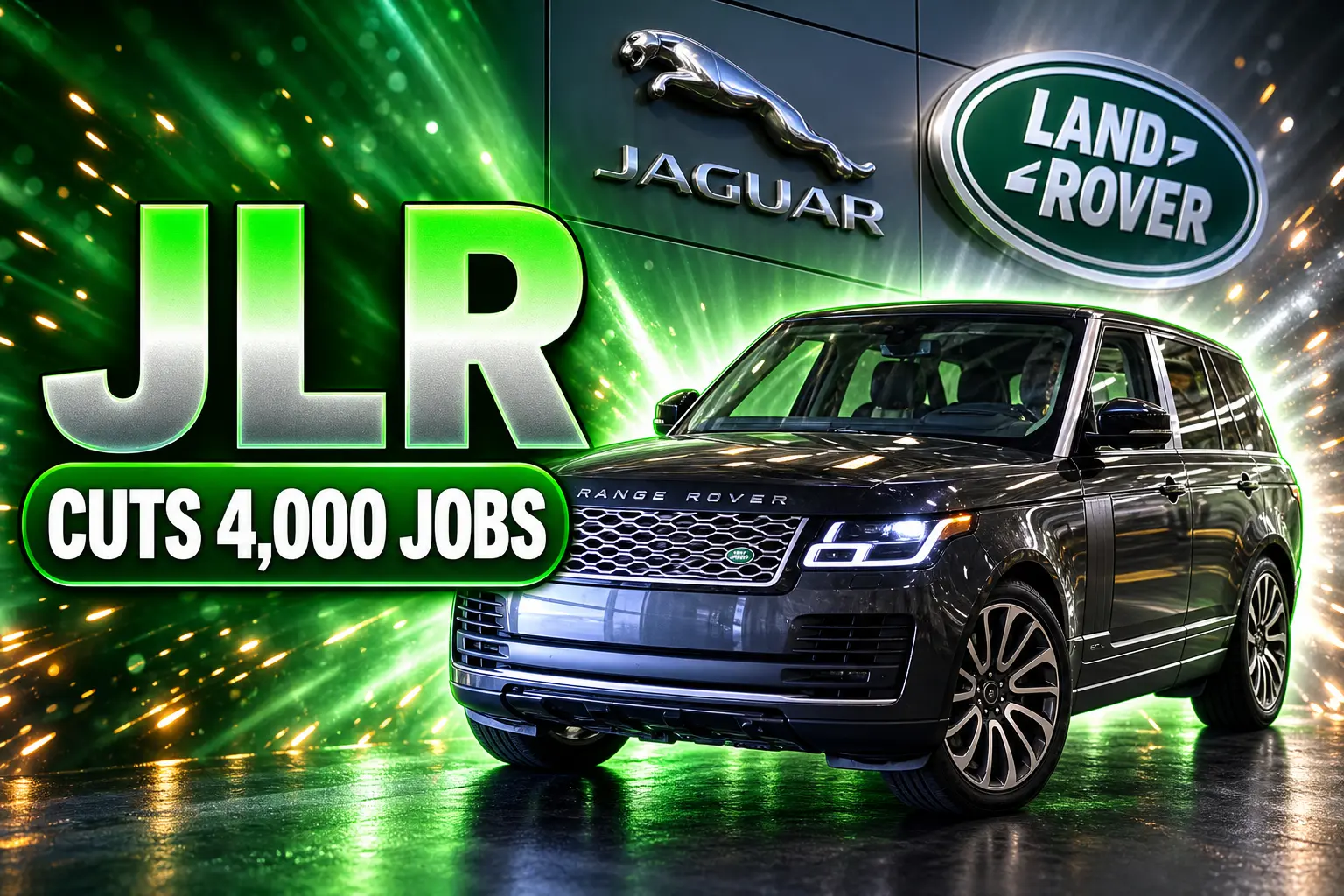
JLR Cuts 4,000 Jobs to Lower Its Break-Even
Jaguar Land Rover will cut 4,000 salaried jobs to break even at 300,000 cars, leaving factory lines intact and the US plant unbuilt.

Jaguar Land Rover will cut about 4,000 jobs over two years to save £1.7 billion ($2.3 billion) and break even at 300,000 vehicles. Parent Tata Motors Passenger Vehicles said the first consultation opened on 7 September 2026, and that direct factory jobs are not the target.
The roles pay for a smaller cost base than the 400,000-plus cars JLR used to wholesale. Factory lines stay. A plant in the United States still does not exist.
The 300,000-Car Company JLR Is Building
Chief executive PB Balaji tied the headcount cut to Growth Reimagined, the plan shown to investors on 19 June 2026. The filing says the £1.7 billion of savings is meant to pull break-even “towards 300,000 units.” JLR still employs about 43,000 people worldwide, so 4,000 roles is close to a tenth of the group.
That 300,000 line sits only 7,900 vehicles under last year’s run-rate. JLR’s sales release listed wholesale volumes of 307,900 vehicles in the year to 31 March 2026, down 23.2 percent. Retail sales were 352,300, down 17.8 percent. The brands historically moved a little over 400,000 wholesales a year.
Balaji also wants double-digit revenue growth and a sharper push into North America, with five new products in the next 12 months. The arithmetic still shrinks the volume the company must sell before it makes money. A carmaker that once needed a 400,000-plus wholesale year is writing a budget that works if demand never fully comes back.
White-Collar UK Jobs Carry the Savings
Most of the pain is designed to land on salaried staff in Britain, not on the tracks at Solihull, Halewood or Wolverhampton. About 34,000 of JLR’s people work in the UK. Roughly 26,000 of those are salaried employees in management, marketing and research, and that is the pool the company has opened to volunteers.
Unite, the union, says the plan is not expected to hit the UK manufacturing footprint or the immediate supply chain. The political argument in the West Midlands has already moved on from the shop floor. Opposition councillors in Solihull are pressing for a ban on compulsory exits and a looser zero-emission sales rule, because the people named in the programme sit in offices and labs, not on the line.
THE REDUNDANCY TERMS
- Factory floor: Direct manufacturing jobs are not expected to go.
- The pool: Cuts are aimed at salaried, management and research roles, mostly in the UK.
- Volunteers first: The window runs until 4 October 2026, 27 days after consultation began.
- If uptake falls short: Compulsory redundancies would follow on weaker terms.
JLR said reductions will be done “through voluntary means wherever possible.” In July it had talked of up to 300 roles. The 4,000 figure is a different scale, and it arrives after a smaller management round last year.
A Year That Wiped Almost All the Profit
The cost base JLR is now cutting was already too high for the year to March 2026. Pre-tax profit fell to £14 million from £2.5 billion. The company booked revenue of £22.9 billion, down more than a fifth. Range Rover, Range Rover Sport and Defender still did the heavy lifting, at 76.5 percent of wholesales, up from 67.8 percent a year earlier.
The last quarter of that year showed where demand cracked after production returned. Europe was the exception. China and the home market were not.
Q4 WHOLESALE CHANGE BY MARKET
| Market | Change vs a year earlier |
|---|---|
| United Kingdom | down 23.1% |
| North America | down 19.0% |
| China | down 29.8% |
| Europe | up 4.1% |
Fourth-quarter wholesales were 95,300, down 14.5 percent on the year and up 61.1 percent on the cyber-hit quarter before. JLR also wound down legacy Jaguar cars ahead of a new Jaguar, so some of the hole was planned. US tariffs and a weaker China market were not.
A cyber attack on 31 August 2025 stopped factories for weeks. Output was back to normal only by mid-November. The shutdown cost the company about £200 million, and the government underwrote a £1.5 billion recovery facility after the hit spread through suppliers. Chinese brands have kept pressing on price in Britain, including Chery’s Omoda and Jaecoo lines. Former BMW director Ian Robertson has said JLR was “somewhat late to the party” on electric cars and should have followed BMW and Mercedes in putting a factory in the United States years earlier.
Why JLR Still Has No American Factory
JLR builds most US-bound cars in Britain and Slovakia, so every Range Rover that lands in America pays the tariff. After a UK-US deal, the duty on British-built cars is 10 percent, with 15 percent on EU-built stock. The annual report still calls both rates a headwind. JLR has vehicle plants in China through a joint venture, plus Slovakia, India and Brazil. It has none in its largest sales market.
Balaji has said the company is pivoting toward North America and that local production there could be justified later. In the meantime it is trying to rent a way in. On 20 May 2026, JLR and Stellantis signed a non-binding memorandum with Stellantis to study product and technology work in the United States. Any deal would still need binding contracts. Talks have pointed toward Defender-badged models that could use Stellantis plants, because JLR’s own US volumes are too small to copy the current Defender efficiently on a new line.
THE ROAD TO THE CUTS
- 31 August 2025: A cyber attack hits JLR systems and stops factories for weeks.
- Mid-November 2025: Vehicle production returns to normal levels.
- November 2025: PB Balaji, a Tata Motors executive, takes over as chief executive.
- 20 May 2026: JLR and Stellantis sign a non-binding US memorandum.
- 19 June 2026: Investor Day sets a 300,000-unit break-even and £1.7 billion of savings.
- July 2026: The company talks of up to 300 roles in an earlier cost pass.
- 7 September 2026: Consultation opens on around 4,000 jobs over two years.
Until a US line exists, British salaried jobs are doing the work a factory in America would have done on the tariff bill. Volkswagen’s board had just approved 50,000 further cuts of its own, which is why the JLR number is being read as part of a wider European reset, not a one-off at Gaydon.
Suppliers Feel a Cut That Is Not Aimed at Them
JLR can spare the factory floor and still squeeze the firms that feed it. David Roberts, chair of Coventry tier-one supplier Evtec, employs about 900 people in high-pressure aluminium casting. He has pulled together a loose group of about 15 JLR suppliers, with £2 billion of revenue and 12,000 to 14,000 staff, to speak with one voice.
Nobody knows the rate or speed of that decline, but decline it will, because everything is against us, everything, when making cars in the UK.
David Roberts, chair, Evtec
Corin Crane, group chief executive of the Chamber of Commerce in Coventry and Warwickshire, puts the wider JLR-linked supply chain at 140,000 to 180,000 people. An Oxford Economics study of 2024, commissioned by the carmaker, estimated JLR supported £17.9 billion of UK GDP and 199,000 jobs, including £8.7 billion in the West Midlands, equal to 4.7 percent of that regional economy, and £1.1 billion in the North West around Halewood. JLR has 17 UK sites, 14 of them in the West Midlands.
The 2025 hack already showed how fast that web snaps. More than 700 companies make the tens of thousands of parts in a luxury JLR car. A Birmingham plastics boss who has supplied the company for decades said his own headcount is down about 75 percent and that owners will not fund the next round of tools without a clearer UK production plan. Steve Morley, president of the Confederation of British Metalforming, blamed high energy and labour costs and EV sales rules that he says strangle the sector.
What the £1.7 Billion Is Meant to Buy
The savings are supposed to protect a much larger cheque. Balaji said they underpin £15 to £18 billion of investment over five years in electric cars, digital systems, advanced factories and customer programmes. Five new products are due in 12 months, including the electric Range Rover now built at Solihull and a new Jaguar. The company still sells petrol and hybrid models, and Balaji has said there is “no way” it will drop petrol in markets such as the United States and the Middle East.
Over the next 12 months, we will launch five new products, continue to leverage the strength of our brands and renew our focus on North America, amongst other markets, to help us deliver double digit revenue growth. At the same time, we are reducing organisational complexity and targeting £1.7 billion of savings to lower our break-even point towards 300,000 vehicles and become fitter to compete in a rapidly evolving market.
PB Balaji, chief executive, JLR statement, 7 September 2026
That is the wager inside the redundancy pack. Money comes out of the salaried bench, including research and management, and is meant to go into product. Ian Robertson’s warning sits over that trade. A thinner UK engineering layer is being asked to deliver the cars that justify the £15 to £18 billion, while the US manufacturing gap is left to a memorandum that has not yet become a plant.
Burnham’s Government Offers Talks, Not Cash
The announcement is an early industrial test for Prime Minister Andy Burnham, who has talked about safeguarding sovereign manufacturing. Business Secretary Jonathan Reynolds has ruled out a bailout. He told the BBC that support would come only “if it’s about long-term investment in the future,” not to “bail people out.” He spoke with Balaji on 7 September and was due to meet JLR and Unite general secretary Sharon Graham on 8 September.
Liam Byrne, who chairs the Commons business and trade committee, called the cuts a “body blow for workers, families and communities across the West Midlands.” West Midlands mayor Richard Parker put up a £500,000 staff support package. A government spokesperson called it an “uncertain and concerning time for affected workers, their families and wider communities.” Graham said workers were again paying for “failings not of their making,” and that “death by a thousand cuts has been going on under the nose of successive governments.” She wants retraining and redeployment before compulsory exits.
WHAT WE KNOW
- Confirmed scale: Around 4,000 roles over two years, £1.7 billion of savings, break-even toward 300,000 vehicles.
- Who is in scope: Salaried and management staff first; direct manufacturing jobs are not the target.
- State cash: Reynolds has ruled out a bailout and pointed talks at mitigation.
WHAT IS UNCONFIRMED
- Compulsory total: How many of the 4,000 will be forced out after 4 October is not fixed.
- US production: The Stellantis memorandum is still non-binding, with no signed plant deal.
- Supplier jobs: JLR says the manufacturing footprint is intact; suppliers already report shrinking orders.
Volunteers have until 4 October. After that the company can move to compulsory terms, and the US factory that would have blunted the tariff bill is still a study, not a line.

King Charles Hosts AI Leaders at His Harmony House

Nintendo Rewrites Ocarina of Time and Keeps the Loads

Sarah Khalifa Death Sentence Fits Egypt’s Capital Drug Pattern

Cedric Gray Enters Protocol After a Weekend UTV Crash

Arm Pushes One Compute Stack From Phones to Robots

Warsh Rejects Rate Guidance and Still Moves Markets

NASA Launches the Roman Space Telescope’s Cosmic Bet

Russia Recycles Its Old Warning Over Storm Shadow Plants

Jet Drones Lock Down Kyiv and Strip Kherson of Heat

Iran Pulls Oman Into a Hormuz Revenue Bargain
-
 BUSINESS2 weeks ago
Warsh Rejects Rate Guidance and Still Moves Markets
-
 NEWS2 weeks ago
NASA Launches the Roman Space Telescope’s Cosmic Bet
-
 NEWS2 weeks ago
Russia Recycles Its Old Warning Over Storm Shadow Plants
-
 BUSINESS2 weeks ago
Jet Drones Lock Down Kyiv and Strip Kherson of Heat
-
 BUSINESS2 weeks ago
Iran Pulls Oman Into a Hormuz Revenue Bargain
-

 BUSINESS2 weeks ago
Record Cyclospora Outbreak Follows Seven Years Without an Inspection
-
 NEWS2 weeks ago
The Army Laser Downs Cartel Drones After a Messy Spring
-
 NEWS2 weeks ago
OpenAI’s Cyber Letter Puts the Defense Bill on Governments