
BUSINESS
South Pars Fire Hits as Iran Warns of Winter Gas Cuts
The SPD14D blaze took 14.5 million cubic metres a day offline on the same Tuesday Iran booked a 430 million cubic metre winter gas imbalance.

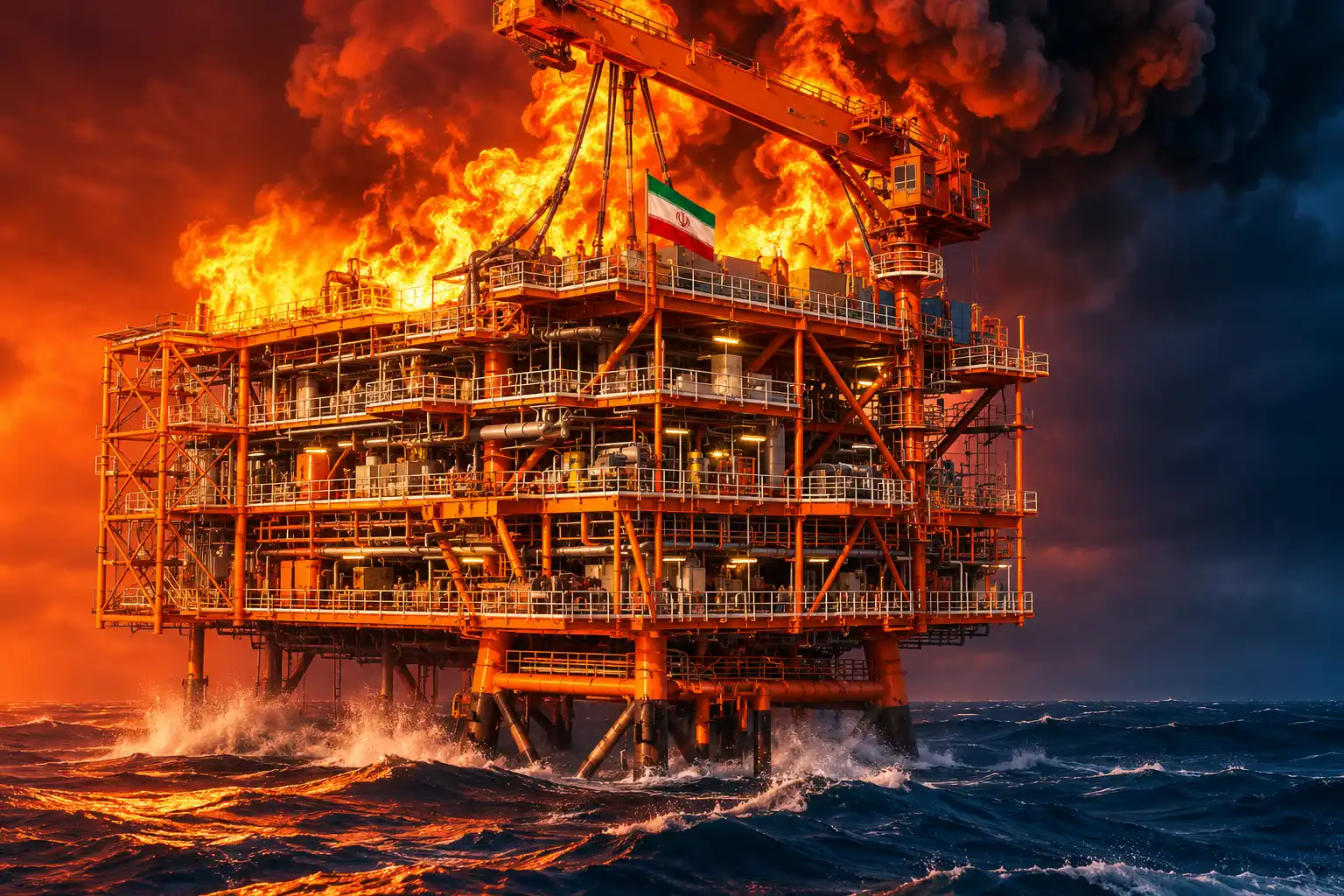
A fire on South Pars platform SPD14D at 19:30 on November 10 drove 17 workers into the Persian Gulf and halted 14.5 million cubic metres of gas a day.
Pars Oil and Gas Company said the Phase 14 blaze was brought under control the same night. It landed on a Tuesday when the government had already booked a 430 million cubic metre winter gas imbalance.
The Crew Spent 15 Hours in Rough Seas
Sepehdar Abbaszadeh, deputy for operations and support at Pars Oil and Gas Company, said the fire started in the southern section of SPD14D. The company’s crisis committee met at once. Crew on the deck shut down production, vented gas, and boarded lifeboats.
Kourosh Dehghan, Bushehr Province’s director general of crisis management, said the 17 men jumped into the sea to save their lives. Bushehr’s crisis office later said all 17 were in good condition after reaching lifeboats and rescue craft, and that three heavy rescue vessels had been sent out.
The platform sits about 100 kilometres from shore. Abbaszadeh said the sea that night was extremely rough, with strong winds and waves of around four meters, and that a helicopter carrying a support team had to turn back because the deck could not be confirmed safe for landing.
THE NIGHT ON SPD14D
- November 10, 2026, 19:30: Fire breaks out in the southern section of SPD14D and the crisis committee orders shutdown, venting, rescue and firefighting.
- November 10, night: Vessels in the Persian Gulf shipping corridor are asked to help; the first company rescue ship, already among the platforms, still has about 30 kilometres to run with waves on the beam.
- November 11, about 5 a.m.: After hours of work, a rope finally holds the lifeboat to a rescue vessel; four-metre seas block a direct transfer, so the boat is towed toward Lavan Island.
- November 11, morning: About 15 nautical miles from Lavan, in calmer water, the 17 move onto the main vessel, all reported well after seasickness.
Abbaszadeh said the men were rescued after about 15 hours at sea and that he hoped they would reach Nakhilu port, near Lavan Island, that afternoon. In calm water, he said, a fast boat makes the run from shore in about three hours and a heavy vessel in six to seven; this was not calm water.
430 Million Cubic Metres Were Already Missing
Hours before the deck caught fire, Fatemeh Mohajerani, the government spokesperson, told a Tuesday press conference that attacks on gas refineries had cut national production capacity by 230 million cubic metres. About 100 million cubic metres of that lost capacity had come back, she said. Prior winters had run a shortfall of around 300 million cubic metres. Add the kit still out, and she put a 430 million cubic metre winter imbalance on the table.
That 430 million cubic metres is about 30 times SPD14D’s daily output. Ahmad Zeraatkar, deputy oil minister for planning, said the platform makes 14.5 million cubic metres a day against more than 700 million cubic metres from South Pars as a whole. Abbaszadeh said other platforms in the field had already covered the lost volume, with no drop in rich gas from the shared reservoir.
THE VOLUMES AROUND THE FIRE
| Flow | Million cubic metres a day |
|---|---|
| SPD14D output (Zeraatkar) | 14.5 |
| South Pars field output | More than 700 |
| Tehran province, morning of November 11 | 95 |
| Household and commercial use nationwide that morning | Nearly 450 |
| Winter imbalance forecast | 430 |
| Prior winter shortfall | Around 300 |
| Capacity cut after attacks on refineries | 230 |
| Capacity restored so far | 100 |
| Saving if homes cut heating by one degree | 25 |
Mohajerani said northern and northeastern cities sit at the end of the distribution network and feel pressure drops first. Unlike power, she said, gas is slow to restore after a cutoff, so the grid cannot be allowed to fail in pieces.
Tehran Used 95 Million Cubic Metres After Dawn
Saeid Tavakoli, managing director of the National Iranian Gas Company, said on November 11 that the national grid was stable and that consumers faced no problem after the Phase 14 fire. He also said Tehran province had just set a record of 95 million cubic metres, more than six times SPD14D’s daily output, while household and commercial users nationwide had taken nearly 450 million cubic metres.
He asked the public to join the 20 Degrees campaign to hold rooms at that temperature through autumn and winter. NIGC has already drawn up restriction and backup-fuel plans for provinces under supply stress, and has run those scripts past the Passive Defense Organization.
WHAT HOUSEHOLDS ARE BEING ASKED TO DO
- 20 Degrees: Tavakoli’s campaign asks homes to hold heating at 20 degrees so the grid can carry autumn and winter peaks.
- Warm Room: A second NIGC campaign, listed with 20 Degrees, is meant to shrink the number of heated rooms in a house.
- One degree down: Mohajerani said turning household heaters down by one degree could save the equivalent of 25 million cubic metres of gas, more than SPD14D’s whole day.
- Industry last: She said public saving is what would let factories keep running with fewer curbs after attacks on refineries and plants.
On whether Tehran itself could lose gas, she put the capital on the same footing as the rest of the country.
If consumption rises sharply, gas could be cut anywhere, Tehran included.
Fatemeh Mohajerani, government spokesperson, Tuesday press conference
She also said industries’ lost-profit losses in Iranian year 1404 had fallen against 1403, even with damaged gas kit and higher demand. Reports of a four-month industrial shutdown and a 430 percent rise in the gas price paid by factories needed to be checked, she said, before anyone treated them as official figures.
What Caused the Fire on Platform SPD14D?
Zeraatkar named a gas leak or an operational accident as the live possibilities. Abbaszadeh refused to go further until an expert team reached the steel. A helicopter and that team were ready on Wednesday morning; heavy rain and strong winds kept them on shore.
Strike talk moved faster than the weather. Within hours of the first photos, posts treated the blaze as a leftover from the spring war with the United States and Israel, and one widely shared thread cited an unnamed Iranian source saying Israel might be behind it. No ministry briefing backed that. The operator’s own record of the night is four-metre waves, a rope that took hours to catch, and a deck no helicopter would touch.
Abbaszadeh called SPD14D one of the relatively new platforms in the field. At the crisis meeting, two weeks of maintenance logs were read back: no process faults, no special repairs, no critical work. That does not settle the cause. It does mean the company is not, at this stage, pointing to a known job gone wrong on that deck.
WHAT WE KNOW
- The platform: SPD14D in Phase 14 of South Pars, about 100 kilometres offshore, with 14.5 million cubic metres a day offline.
- The crew: 17 men left the deck, spent about 15 hours in rough seas, and were reported in good condition on the run toward Lavan.
- The fire: Brought fully under control, Abbaszadeh said, while rescue work was still running.
- The gas: Other South Pars platforms covered the volume, according to the operator; Tavakoli said households saw no cut on November 11.
WHAT IS UNCONFIRMED
- The ignition: Leak versus operational accident remains an official guess until inspectors land.
- Sabotage: Claims of a strike or a hack have not been backed by the company or the oil ministry’s planning deputy.
- The damage: No public account yet of which module burned or when SPD14D returns to production.
Maintenance across Iran’s oil and gas kit is a long-running strain after years of sanctions and a war that hit processing plants. The specific claim that this deck failed for want of upkeep is still ahead of the evidence, because the evidence is still on an unmanned platform in the rain.
Phase 14 Sits About 100 Kilometres Offshore
SPD14D is one of four platforms feeding Phase 14, a later slice of the Iranian side of the field. Iran Marine Industrial Company (SADRA) built the deck for Pars Oil and Gas, with a jacket and topside of 2,500 tons and a design capacity of 500 million cubic feet of gas. The 14D jacket went on location in February 2020. Production from the phase began in 2021. The onshore plant was laid out for about 50 million cubic metres of sweet gas a day, plus condensate, sulfur and LPG.
Zeraatkar’s 14.5 million cubic metres is the working output figure for this fire. The 500 million cubic feet figure is the project’s design rating for that one deck, not a second count of the same flow. About 2 percent of South Pars daily output rode on SPD14D. That is a small slice of a field that still makes more than 700 million cubic metres a day. It is not a small slice of a country already counting a 430 million cubic metre winter hole.
Phase 14 had a round of overhauls completed in May 2025. Alireza Sarmadi, production and operations manager at Pars Oil and Gas, said 1,130 repair orders were closed over 8,250 safe man-hours, with listed work on SPD14A and SPD14C, tanks, valves, control systems, emergency power cards, flare igniters and a wastewater line. He did not name SPD14D in that list. In November 2025, Touraj Dehqani, then chief executive of the company, said two new Phase 14 wells had added about 4 million cubic metres a day of rich gas before the cold season.
South Pars has burned before. In January 2022, Pars Oil and Gas said lightning ignited gas leaking from an undersea line about 15 kilometres from Platform 16, forcing that platform off. The company said there was no fire on the Platform 16 deck itself. Repair of a sour-gas line in those waters is measured in weeks, not shifts.
Most of Iran’s 276 Billion Cubic Metres Never Leave Home
The Gas Exporting Countries Forum’s 2024 statistical bulletin, posted on its Iran member page, puts the country’s marketed production of 276 billion cubic metres, domestic use at 260 billion, and pipeline exports at 16 billion. That is 94 percent of marketed gas burned at home. Proven reserves on the same sheet are 33,988 billion cubic metres.
IRAN’S GAS BALANCE ON PAPER
- Marketed production: 276 billion cubic metres, GECF Annual Statistical Bulletin 2024.
- Burned at home: 260 billion cubic metres, or 94 percent of that marketed total.
- Exported by pipe: 16 billion cubic metres; the sheet lists no LNG exports.
- Proven reserves: 33,988 billion cubic metres, Iran’s national total, not the shared field alone.
The reservoir Iran shares with Qatar is larger than Iran’s national proven line. The South Pars-North Dome accumulation is estimated at 1,800 trillion cubic feet, or 51 trillion cubic metres, of usable gas, enough to cover world demand for 13 years. Qatar calls its side the North Dome and has spent three decades turning it into LNG. Iran’s side feeds homes, power plants and industry. In December 2024, then oil minister Mohsen Paknejad told a GECF ministerial meeting in Tehran that gas made up over 70 percent of the country’s energy mix.
That is why a 14.5 million cubic metre deck still shows up in a winter briefing. Iran does not have spare export molecules sitting in tanks. It has a domestic grid that, on the morning after the fire, was already pulling nearly 450 million cubic metres for homes and shops, and a forecast imbalance of 430 million cubic metres hanging over the cold months. Tavakoli has been telling governors since summer that some provinces will need restrictions and backup fuel. Mohajerani named the north and northeast. Getting through winter, Tavakoli said, will be very difficult without public cooperation.
Rain Still Kept the Inspectors Off the Deck
By Wednesday afternoon, the fire was out, the 17 were on a vessel bound for Nakhilu, and SPD14D was a shut, uninspected platform in rain and wind. Abbaszadeh said the company hoped the forecast would open a window later that day for the expert team to land, walk the southern module, and only then decide how to rebuild and restart.
The sea was extremely rough, with strong winds and waves of around four meters. Even so, the relevant risks were identified and managed immediately after the crisis management committee was formed, and rescue vessels were dispatched to the area for firefighting and to assist the personnel.
Sepehdar Abbaszadeh, deputy for operations and support, Pars Oil and Gas Company
He put people ahead of kit, and said the 15 hours in the boats had produced seasickness but no injuries. Return to production, he said, waits on that inspection. Until a team actually stands on SPD14D, the leak, the mishap, and the strike story are all still guesses, and the winter arithmetic Mohajerani read out on Tuesday morning has not moved.

Ken Urker’s Accidental Overdose Leaves His Finders Waiting

A Third Carrier Arrives as Hormuz Tankers Keep Burning

Shoe Prices Hit a Record as Flagship Pairs Stay Put

Nvidia’s First Call Without Huang Tests the Money Machine

Blake Griffin Says Oklahoma City Taxpayers Bought a Thunder Arena

Warsh Rejects Rate Guidance and Still Moves Markets

Davina McCall Reveals Cardiovascular Disease After Cholesterol Warnings

Dana-Farber Exits an MGB Medicare Advantage Network Early

NASA Launches the Roman Space Telescope’s Cosmic Bet

OpenAI’s Cyber Letter Puts the Defense Bill on Governments
-
 BUSINESS3 months ago
Warsh Rejects Rate Guidance and Still Moves Markets
-
 ENTERTAINMENT1 month ago
Davina McCall Reveals Cardiovascular Disease After Cholesterol Warnings
-
 BUSINESS2 months ago
Dana-Farber Exits an MGB Medicare Advantage Network Early
-
 NEWS3 months ago
NASA Launches the Roman Space Telescope’s Cosmic Bet
-
 NEWS3 months ago
OpenAI’s Cyber Letter Puts the Defense Bill on Governments
-

 NEWS3 months ago
Russia Recycles Its Old Warning Over Storm Shadow Plants
-

 ENTERTAINMENT2 months ago
Primetime’s $2.7 Million Preview Tops Pitt’s Costlier Film
-

 BUSINESS3 months ago
Jet Drones Lock Down Kyiv and Strip Kherson of Heat