
NEWS
Pakistan Leaves the Mecca Pact Open During Iran Talks
Pakistan’s army voiced cautious optimism on US-Iran mediation and said its Mecca defence pact with Saudi Arabia and Turkey could admit Iran.

Pakistan’s army left the door open for Iran to join a three-nation defence pact. Its spokesman said the service is cautiously optimistic about mediating the eight-month US-Iran war.
Lieutenant General Ahmed Sharif Chaudhry, director general of Inter-Services Public Relations, spoke in Rawalpindi on October 30, four days after Field Marshal Asim Munir sat down in Tehran with Saudi and Turkish security chiefs. He warned of “powerful spoilers and detractors” who still think the conflict serves them, declined to say whether the United States had backed the trip, and would not describe what was said in the room.
Munir’s Second Trip Brought Riyadh and Ankara
Munir is Pakistan’s chief of defence forces and army chief, and Islamabad’s lead mediator on a war that opened on February 28. His first autumn visit to Tehran, on October 20, produced no deal. Interior Minister Mohsin Naqvi went with him. They met President Masoud Pezeshkian, parliament speaker Mohammad Bagher Ghalibaf, Foreign Minister Abbas Araghchi, and Mohsen Rezaei, who heads Iran’s Supreme National Security Council.
Rezaei told Munir that Iran would not let enriched nuclear material leave the country, and that talks with Washington would not resume until Tehran’s conditions were met. The trip tested whether a 14-point memorandum signed on June 17 could still be a base for talks. President Donald Trump had declared that memorandum over on July 8, and both sides had gone back to firing. Russian Foreign Minister Sergey Lavrov had been in Tehran the day before Munir arrived.
Dr Burcu Ozcelik researches the conflict at the Royal United Services Institute. She wrote that the June memorandum deferred the hardest questions into talks, with a 60-day window that did not hold. Munir went back anyway. Ali Bagheri, Rezaei’s deputy, later said the field marshal had proposed a four-country meeting during that first visit, and that Iran had accepted. Six days later he returned with company.
THE AUTUMN DIPLOMATIC CALENDAR
- October 20, 2026: Munir holds his first autumn meeting with Iranian leaders in Tehran, joined by Interior Minister Mohsin Naqvi.
- October 26, 2026: Saudi Defence Minister Prince Khalid bin Salman and Turkish intelligence chief Ibrahim Kalin join Munir for talks with Pezeshkian, Araghchi and Rezaei.
- October 30, 2026: Chaudhry, speaking in Rawalpindi, calls the trips a positive sign and warns of unnamed spoilers. Qatari mediators arrive in Tehran the same day.
- November 5, 2026: Turkey’s lawmakers approve the Mecca pact by 279 votes to 119.
- November 9, 2026: Qatari Prime Minister Sheikh Mohammed bin Abdulrahman Al-Thani meets Vice President JD Vance and then President Trump at the White House.
- November 10, 2026: Qatar’s foreign ministry says there is progress and that both sides have spoken positively about a diplomatic solution.
Asked whether two visits meant progress, Chaudhry said, “Why would the Field Marshal be going twice if it is not for some positivity? So yes, of course.” He added, “The word that we would use is always cautiously optimistic.”
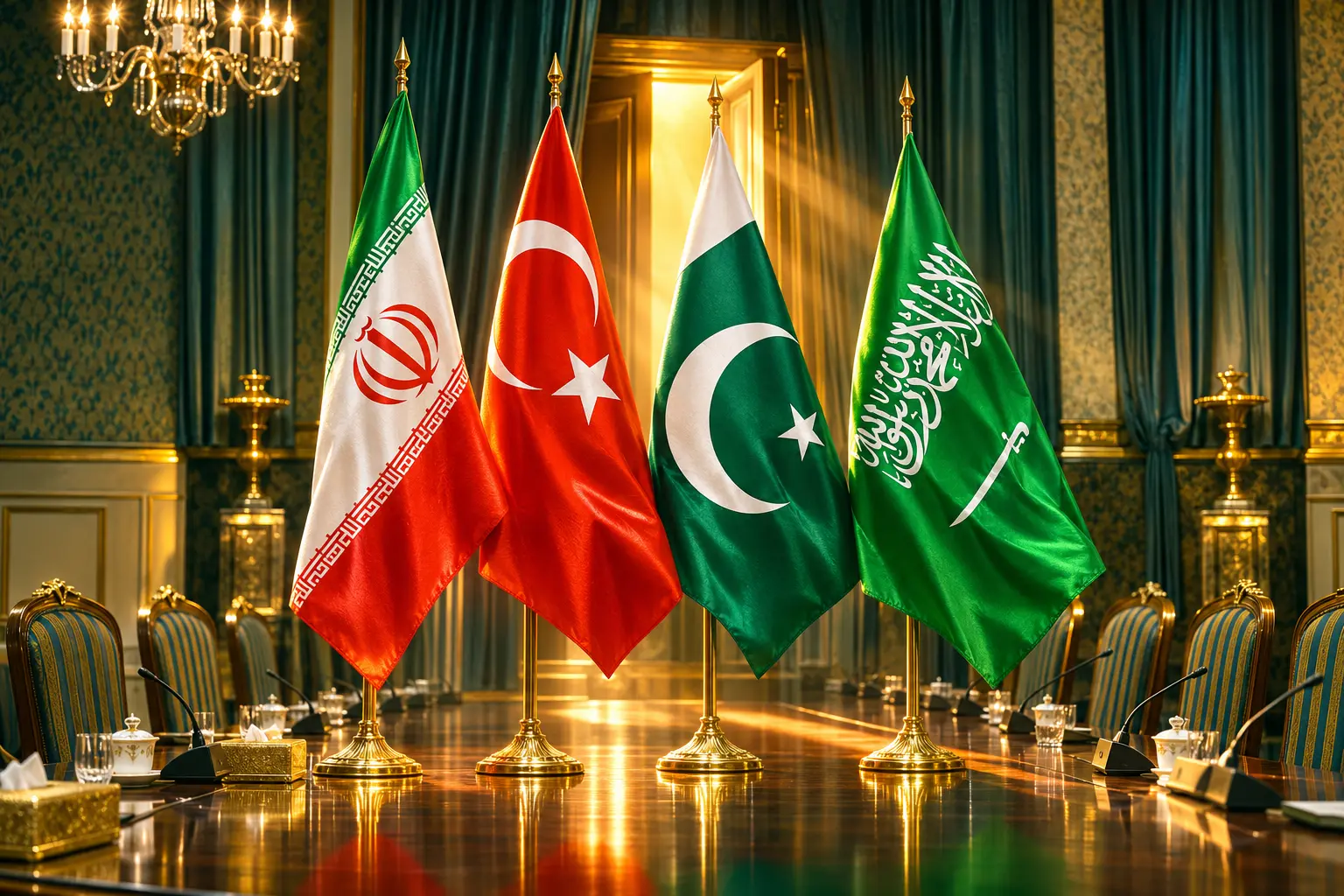
Iran Wants Regional Security Without Outside Hands
Bagheri did not describe the October 26 session as a courtesy call. He placed it inside Iran’s preferred security idea: the countries of the region should police the region, and extra-regional powers should stay out.
Iran’s strategic policy is to ensure regional security through the regional countries and to confront all foreign interference and infiltration, foremost that of the US-Israeli regimes.
Ali Bagheri, deputy secretary of Iran’s Supreme National Security Council, in Tehran
He said Saudi Arabia, Pakistan, Turkey and Iran could take a step toward “endogenous security,” a system run from inside West Asia, drawing on what Tehran calls its experience of building national security during the war. Rezaei, after the talks, said regional security should be ensured by regional countries without foreign intervention.
Iran’s government posted photographs of Pezeshkian hosting the three visitors. The caption put Islamic unity and regional security at the centre of the discussion and framed the war as US-backed Israeli aggression.
📸 HIGHLIGHTS: President @drpezeshkian hosted Saudi Def Min Prince Khalid, Pakistan Army Chief Gen Asim Munir & Türkiye Intel Chief İbrahim Kalın in Tehran. Discussions focused on Islamic unity, regional security & standing against US-backed Israeli aggression. #Iran #Diplomacy https://t.co/55fKvsQFFD pic.twitter.com/1AOXComBLm
— Government of the Islamic Republic of Iran (@Iran_GOV) October 26, 2026
Saudi Arabia’s foreign ministry said the visit was meant to support mediation led by Qatar and Pakistan. Accounts of the meeting put the Strait of Hormuz, Yemen, Palestine, Lebanon, and the US-Iran talks on the table. Nothing was signed. The public product was an agreement to keep talking, the first time all three Mecca pact members had sat with Iran at that level since February.
For Riyadh, sending the defence minister is a hedge. Iranian missiles and drones hit US bases in Saudi Arabia and elsewhere in the Gulf earlier in the war, and Yemen’s Houthi movement has again been firing at the kingdom. A government that still wants American help is also collecting other phone numbers.
279 Votes in Ankara Approve the Pact
The Mecca Joint Defence Agreement was signed on August 7 in Mecca by Prime Minister Shehbaz Sharif, Crown Prince Mohammed bin Salman, and President Recep Tayyip Erdogan. The 16-article text stayed unpublished until Turkey sent it to parliament in October. Lawmakers in Ankara approved it on November 5 by 279 to 119, with 398 of the 592 members taking part.
The trilateral text built on a Saudi-Pakistan mutual defence deal signed after an Israeli strike on Doha in September 2025. Azeema Cheema and Mohanad Hage Ali of the Malcolm H. Kerr Carnegie Middle East Center wrote in August that the accord was an attempt by three regional powers to prevent a security vacuum in the Gulf after the US-Iran war exposed the cost of relying on an American umbrella. The pact does not name an enemy. It does name a duty.
WHAT THE MECCA PACT COMMITS
| Article | Commitment |
|---|---|
| Article 2 | An external armed attack on one party is treated as an attack on all, with immediate help, including military means, within available resources, under the UN Charter’s right of self-defence. |
| Article 8 | A secretariat sits in Saudi Arabia. The first secretary-general is a Pakistani citizen, serving a three-year term on rotation. A political and defence committee meets twice a year. |
| Article 12 | Earlier international agreements of the parties are left untouched, a clause written for Turkey’s NATO membership. |
| Article 16 | The pact runs with no end date. A party may leave only after 10 years, with three months’ written notice. |
The Middle East Council on Global Affairs has described the deal as a framework for consultation, coordination and deterrence, not a rigid military alliance copied from NATO. Help is not automatic. The parties decide the scope after an honest look at what is needed, inside their own resources.
Turkish officials have said any deployment of personnel would still need a separate mandate from parliament. Chaudhry, asked about more Pakistani troops for Saudi Arabia, gave the same kind of answer: it would depend on the situation and on both countries’ political leaders.
The White House Meeting Followed Stops in Tehran
Pakistan is not the only mediator, and it is not the one carrying the latest draft into the Oval Office. Qatari officials arrived in Tehran on October 30, the day of Chaudhry’s interview. Iran said the delegation was in coordination with US officials. Sheikh Mohammed bin Abdulrahman Al-Thani is Qatar’s prime minister and foreign minister. He then went to Washington.
On November 9 he met Vance and, in a closed session, Trump. Ibrahim bin Sultan Al Hashmi speaks for the Qatari foreign ministry. He briefed reporters the next day and said the White House talks were “positive” and focused on narrowing gaps. He also said there is progress in the negotiations, and that details would come once the shape of an agreement is settled.
Al Hashmi said both sides had spoken positively about a diplomatic path, even as some coverage had turned negative, and that Doha would keep looking for any opening. He added that winter and the continued closure of the Strait of Hormuz are raising costs for everyone, above all for poorer countries already in an energy squeeze. The mediator, he said, is trying to end a state of “neither war nor peace.” The waterway is still shut. Tehran still wants the naval blockade lifted and sanctions eased before it talks nuclear terms in depth.
Could Iran Join the Mecca Pact?
Yes, on paper. Chaudhry said the wording does not bar new members, and that any country with a shared vision of collective deterrence and regional peace would be welcome. The three political leaderships would have to agree. The treaty already requires all three core parties to consent before anyone else can join.
Anyone who has a shared vision of collective deterrence and regional peace, why not? Everyone is most welcome.
Lieutenant General Ahmed Sharif Chaudhry, director general of Inter-Services Public Relations, in Rawalpindi
That sentence sits next to a hard fact. Pakistan is pledged to treat an attack on Saudi Arabia as an attack on itself. Iran is still at war with the United States, and Houthi attacks on Saudi targets have picked up again as the wider war has ground on. Putting Iran into the same treaty would turn a Saudi-Pakistan-Turkey club into something closer to the regional security table Tehran keeps describing. It would also bind Iran, on paper, to the defence of a kingdom its allies have been striking.
No one in Rawalpindi, Riyadh, Ankara or Tehran has said a membership bid is on the table. Chaudhry parked the decision with politicians. The military’s public line is the welcome, not a timetable.
The loudest objection among Pakistani critics of the Rawalpindi interview is the army’s standing at home. They treat a field marshal who brokers talks abroad as a man polishing a mandate he has not won at the ballot box. That fight is separate from whether Munir can move Washington and Tehran. It is not separate from whether foreign capitals want to be seen taking him seriously.
A Line Drawn Short of Yemen
Chaudhry was clearer about what Pakistan will not do than about what it discussed in Tehran. Pakistan, he said, is committed to defending Saudi Arabia and the holy sites of Mecca and Medina. It is not joining the war in Yemen.
“We are not part of the Yemeni conflict, which is an intra-Yemen conflict,” he said.
Fighting between Saudi Arabia and Yemen’s Iran-aligned Houthi group has been reignited by the Iran war. That is the fire the Mecca pact was not written to fight, and it is the fire now testing it. Ankara’s vote came as Houthi attacks on the kingdom continued. Officials in Turkey have talked about equipment, intelligence and weapons, not a desert deployment. Chaudhry put more Pakistani troops in the same file as the politicians.
THE LIMITS SET IN RAWALPINDI
- The Tehran agenda: Chaudhry declined to say what the delegation discussed.
- American backing: He declined to say whether the United States had supported the trip.
- Extra troops: Any further Pakistani deployment to Saudi Arabia, he said, depends on the situation and on both countries’ political leadership.
- Yemen: Pakistan is not part of what he called an intra-Yemen conflict.
- New members: Iran is welcome in principle; the three governments would decide.
Those limits keep Pakistan in the mediator’s chair and inside the pact at the same time. They also leave the hardest military question untouched. If Saudi Arabia is hit hard enough to trigger the shared-attack clause, Islamabad will have to decide what immediate help looks like, and whether the helper is still talking to Tehran the same week.
Spoilers Stay Unnamed After Tehran
Chaudhry would not name the “powerful spoilers and detractors.” The phrase does the work of a warning without picking a fight. Israel is the obvious candidate in Iranian speeches. Hardliners in Tehran who reject any nuclear concession are another. So are factions in Washington that want more strikes. He left all of them off the record.
Qatar, which has carried the heaviest recent load between the White House and Tehran, used its November 10 briefing to stress a different problem: a state of neither war nor peace, with the strait still closed and winter raising the bill. Al Hashmi said Doha would keep looking for any opening. He also restated Qatar’s solidarity with Saudi Arabia on measures to protect its territory.
Pakistan is trying to sit in both rooms. Munir can walk into Tehran with Saudi Arabia’s defence minister, float a welcome for Iran inside a pact that promises to defend Mecca, and still claim the vocabulary of a mediator. The June memorandum showed how fast that vocabulary can fail. The October trips showed why Islamabad keeps using it anyway.
On November 10, Doha said there was progress and would not describe the deal. The strait was still closed. In Rawalpindi, the spoilers still had no names.

Ken Urker’s Accidental Overdose Leaves His Finders Waiting

A Third Carrier Arrives as Hormuz Tankers Keep Burning

Shoe Prices Hit a Record as Flagship Pairs Stay Put

Nvidia’s First Call Without Huang Tests the Money Machine

Blake Griffin Says Oklahoma City Taxpayers Bought a Thunder Arena

Warsh Rejects Rate Guidance and Still Moves Markets

Davina McCall Reveals Cardiovascular Disease After Cholesterol Warnings

Dana-Farber Exits an MGB Medicare Advantage Network Early

NASA Launches the Roman Space Telescope’s Cosmic Bet

OpenAI’s Cyber Letter Puts the Defense Bill on Governments
-
 BUSINESS3 months ago
Warsh Rejects Rate Guidance and Still Moves Markets
-
 ENTERTAINMENT1 month ago
Davina McCall Reveals Cardiovascular Disease After Cholesterol Warnings
-
 BUSINESS2 months ago
Dana-Farber Exits an MGB Medicare Advantage Network Early
-
 NEWS3 months ago
NASA Launches the Roman Space Telescope’s Cosmic Bet
-
 NEWS3 months ago
OpenAI’s Cyber Letter Puts the Defense Bill on Governments
-

 NEWS3 months ago
Russia Recycles Its Old Warning Over Storm Shadow Plants
-

 ENTERTAINMENT2 months ago
Primetime’s $2.7 Million Preview Tops Pitt’s Costlier Film
-

 BUSINESS3 months ago
Jet Drones Lock Down Kyiv and Strip Kherson of Heat