
BUSINESS
Mars Spends £161 Million to Retool Melton’s Whiskas Plant
Mars will spend £161 million putting recyclable pouch lines into its 75-year-old Melton Mowbray plant, scaling a Whiskas pack switch that began in 2025.

Mars will spend £161 million turning its 75-year-old Melton Mowbray factory into its main UK plant for recyclable pet-food pouches. The family-owned company set out the plan on November 10, 2026, with work running through 2031 at the Leicestershire site that makes Whiskas and Pedigree.
The money pays for high-speed lines built to run fully recyclable mono-PP packs, smart optical sorting meant to cut production waste by over 50%, and utility upgrades. More than 30 technical and engineering jobs arrive in the first year, a skills add-on on a site of about 200 people rather than a hiring wave.
High-Speed Pouch Lines for a 1951 Factory
The plant opened in 1951, when Mars moved Chappie dog food production from Slough, and the name changed to Pedigree Petfoods in 1972. Whiskas canned cat food and Pedigree dog food were first sold to British owners from this site, which Mars still calls its first pet-care factory.
The £161 million Melton Mowbray factory upgrade is meant to make the site the company’s primary UK factory for pouched pet food. About 95% of what it makes stays in Britain, with the other 5% going to European markets, and the lines can turn out more than one million pouches a day.
Nick Foster, general manager for Mars Pet Nutrition in Northern Europe, said the UK is a cornerstone of the firm’s global pet-care business and that the spend is a statement of confidence in the UK market and in the role British factories play inside the wider European network. Business Secretary Jonathan Reynolds called the plan good news for the East Midlands and a vote of confidence in local talent.
WHAT THE £161 MILLION PAYS FOR
- Pouch lines: New high-speed equipment built to run fully recyclable mono-polypropylene packs instead of the old mixed-layer film.
- Optical sorting: Smart cameras and sorting kit designed to cut production waste by over 50% by catching defects earlier.
- Site utilities: Upgrades meant to cut waste in power, water and other factory services around the new lines.
- Year-one roles: More than 30 skilled technical and engineering jobs, with permanent apprentice posts rising from 26 to 33 by 2027.
Sharon Ross, plant manager at Melton Mowbray, said the town holds a unique place in Mars history as the first pet-care site and called the money a vote of confidence in the site, its staff and the wider community after 75 years of making food there.
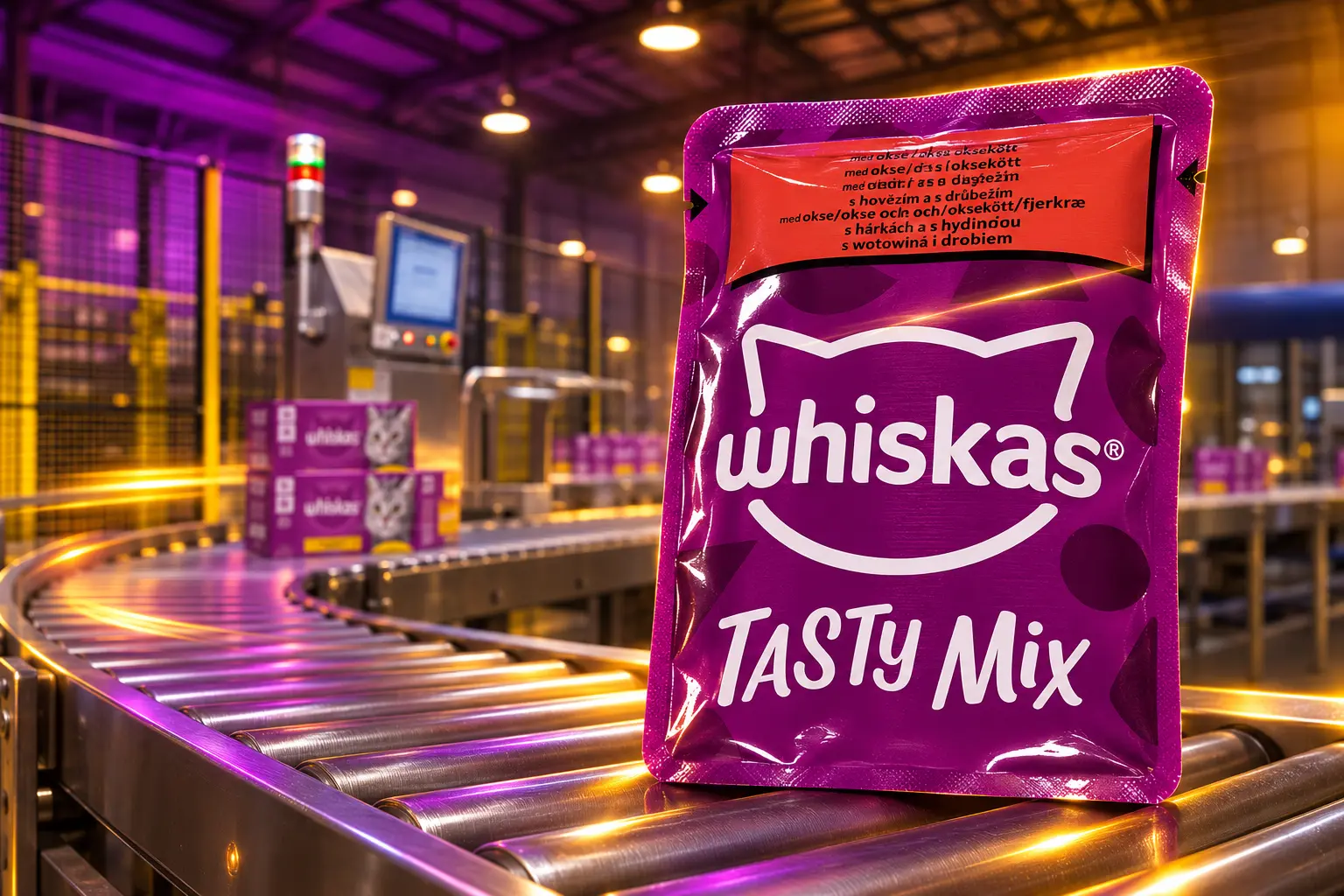
Mars Already Put Recyclable Whiskas Packs on UK Shelves
On July 31, 2025, Mars launched a mono-material polypropylene pouch for Whiskas in the UK and Germany, starting with the Tasty Mix Country Collection 12 Pack, sold through all UK retailers and at Rewe in Germany. That pack is the pilot. The Melton spend is how the rest of the pouch range is supposed to follow.
The company said the switch produced a 46% lower packaging carbon footprint than the old multi-material pouch, which mixed plastic and aluminium that recyclers cannot separate. Polypropylene can take the heat of sterilisation that wet pet food needs, which is why the old laminate existed in the first place.
We want to contribute to a circular economy where packaging material never becomes waste. The transition to mono material pouches has required ground-breaking, innovative material science and we will continue to drive innovation in packaging to help build the world we want tomorrow.
Elisabetta Pierangelo, VP R&D, Mars Pet Nutrition
Mars was careful in that 2025 note, calling the pack designed to be recyclable and compatible with current or emerging recycling systems. The factory work does not by itself put a film-collection round on every UK kerb.
THE PACK SWITCH, 2025 TO 2031
- July 31, 2025: Mars puts a mono-polypropylene Whiskas pouch on UK and German shelves, starting with one 12-pack recipe.
- August 12, 2026: The EU Packaging and Packaging Waste Regulation starts to apply, with a 2030 recyclability deadline hanging over packs sold into Europe.
- November 10, 2026: Mars announces £161 million to retool Melton Mowbray as its primary UK pouched pet-food factory.
- 2027: Permanent apprentice posts on the site are due to rise from 26 to 33.
- 2031: The modernisation is due to be complete, with the new pouch lines and sorting kit in regular use.
Fifteen months separated the first recyclable Whiskas SKU from the factory cheque. The remaining work is a five-year industrial job, not a label change.
Why Mars Is Rebuilding Pouch Lines in Melton
Wet-food pouches kept meat safe by stacking films that recyclers cannot pull apart, and UK and EU rules now attach a price to that design, which is why a 1951 plant is being rebuilt around a single polymer. Mars already proved the pack on one Whiskas recipe in 2025. The Leicestershire lines are how that format becomes the default rather than a special.
The UK Plastic Packaging Tax, in force since April 1, 2022, applies to plastic packaging with less than 30% recycled content. HMRC figures show the levy brought in £250 million in Plastic Packaging Tax in 2025 to 2026, down 4% from £261 million the year before, with 5,142 businesses registered as of August 13, 2026, and 37% of declared tonnage taxable.
THE RULES THAT SIT ON A POUCH
| Rule | Since | What it does |
|---|---|---|
| Plastic Packaging Tax | April 1, 2022 | HMRC levy on plastic packs with under 30% recycled content; £250 million raised in 2025 to 2026 |
| EU PPWR | August 12, 2026 | Packaging rules now in force, with recyclability required by 2030 for packs on the EU market |
| Mars mono-PP switch | July 31, 2025, then through 2031 | One polymer that can be sterilised and is designed to be recyclable, first on one Whiskas SKU, then on Melton’s pouch lines |
For brands that still sell into Europe, the 5% of Melton’s output that leaves Britain is not a rounding error. A UK plant that cannot run the new pack becomes the awkward node in a network that is already being rebuilt around it.
Coveris, which sells pet-food packs, used PATS UK at the NEC from September 27 to 29, 2026, to push recycle-ready pet food packaging solutions now that the EU rules apply. Vincent Larson, the firm’s UK pet-food key account manager, said the regulations are in force and that customers have stopped asking what they need to do later and started asking how to make the switch now.
WHAT WE KNOW
- The cash and the kit: Mars has committed £161 million through 2031 for mono-PP pouch lines, optical sorting and utility upgrades at Melton.
- The pack already exists: A recyclable Whiskas pouch has been on UK and German shelves since July 31, 2025, with a 46% lower packaging carbon footprint than the old laminate.
- The output split: About 95% of the plant’s production stays in Britain and 5% is exported to European markets.
WHAT IS UNCONFIRMED
- SKU timing: Mars has not published a public timetable for moving every Melton pouch recipe onto mono-PP.
- Collection: Designed-to-be-recyclable film still depends on local collection and sorting that varies by region.
- Who builds the lines: The company has not named the equipment vendors in the November 10 statement.
Flexible packs only dodge a poor recyclability grade when they are mostly polyethylene or polypropylene by weight, which is the whole point of ripping out mixed-layer kit. The 2031 factory date sits just after the 2030 recyclability line, which is not an accident of the calendar.
Melton Sends 95% of Its Pouches to British Homes
The UK is the world’s third-largest pet-food market, with about 12.5 million cats and 13.9 million dogs. Mars said its products reach 9.7 million cats and 8.8 million dogs, and that Whiskas feeds 6.6 million cats, more than half of the national cat total.
MELTON MOWBRAY IN FIGURES
- Workforce: About 200 people on site before the new technical posts land.
- Output: More than one million pouches of pet food a day.
- Where it goes: About 95% to UK households, 5% to European markets.
- House brands: Whiskas and Pedigree, with Sheba in the wider Mars pet range named in the same announcement.
Nearby, the Waltham Petcare Science Institute has studied companion-animal nutrition for more than 60 years and feeds recipes and quality standards back into Mars plants, including this one. The factory is not a satellite that can be swapped for a line in Poland without changing what British owners see on the shelf.
More Than 30 Technical Jobs on a Tight Headcount
More than 30 new technical and engineering roles on a site of about 200 people is about 15% extra skilled posts, not a broad hiring surge. Permanent apprentice places rise by 7, from 26 to 33 by 2027. Across its UK business Mars employs more than 140 apprentices and says 97% of those who finish are offered a permanent job, with training in digital systems, data and AI listed as part of that curriculum.
The spend is going into machines that inspect, fill and seal. Optical sorting exists to throw away less food and film, which cuts cost as well as waste, and a plant that runs fewer duff pouches needs process engineers more than it needs extra packers.
Kevin Crook, acting leader of Leicestershire County Council, welcomed the news and talked about local people finding work and about giving local suppliers and contractors a chance to take part. That last point is the one that matches the cheque. Most of the £161 million will be paid to whoever installs the lines and the sorting kit, and those contracts will dwarf 30 salaries if local firms get into the tender list.
Peter Fortune, the Conservative MP for Bromley and Biggin Hill and a shadow business minister, called the 30-plus skilled jobs good news while arguing that factory hiring nationally has stalled. The Melton plan fits that picture: capital goes in, a small skilled cohort is added, and the headcount story stays modest on purpose.
Melton’s Place in Mars’s European Supply Network
Britain is Mars’s second-largest market worldwide. The company says it employs over 10,000 people across the country and runs eight manufacturing sites, including Melton Mowbray, Slough, Plymouth, Birstall, Milton Keynes, Castle Cary and King’s Lynn, plus the Waltham institute in Leicestershire.
The Melton cheque takes Mars’s UK capital spend since 2021 to £661 million, spanning pet care, snacking and food. In September 2025 the company also said it would put €1 billion into European production and research during 2025 and 2026, with projects planned in France, Poland and Spain, a programme it framed as building a stronger, more resilient European business.
RECENT MARS UK FACTORY CHEQUES
| Site | Spend | What it is for | Horizon |
|---|---|---|---|
| Melton Mowbray | £161 million | Recyclable pouch lines, optical sorting, utilities | Through 2031 |
| Slough | £190 million | Chocolate factory upgrade | 2023 to 2028 |
| Birstall | £1.2 million | Pet-treats making and packing kit | Announced in 2026 |
Those three sums sit inside the £661 million UK total; they are not the whole bill. A Leicestershire wet-food plant that still ran mixed-layer pouches while continental sister sites moved to mono-PP would be the one that looked expensive, both on tax and inside Mars’s own network.
The UK is a cornerstone of our global pet care business at Mars, and this £161 million investment is a direct statement of our confidence in the UK market and the vital role our British factories play within our wider European network. Melton Mowbray has been feeding the nation’s pets for 75 years. By equipping our teams with world-class technology and sustainable manufacturing capabilities, we are strengthening the site’s role within our regional supply network and ensuring we can continue to meet the needs of British pet owners for years to come.
Nick Foster, General Manager, Mars Pet Nutrition, Northern Europe
By 2031 Melton is supposed to run that recyclable pouch at volume for a market that already puts Whiskas in more than half of Britain’s cat bowls. The pack is on a few shelves now. Whether those pouches get recycled still depends on collection and sorting that sit outside the factory gates.

Ken Urker’s Accidental Overdose Leaves His Finders Waiting

A Third Carrier Arrives as Hormuz Tankers Keep Burning

Shoe Prices Hit a Record as Flagship Pairs Stay Put

Nvidia’s First Call Without Huang Tests the Money Machine

Blake Griffin Says Oklahoma City Taxpayers Bought a Thunder Arena

Warsh Rejects Rate Guidance and Still Moves Markets

Davina McCall Reveals Cardiovascular Disease After Cholesterol Warnings

Dana-Farber Exits an MGB Medicare Advantage Network Early

NASA Launches the Roman Space Telescope’s Cosmic Bet

OpenAI’s Cyber Letter Puts the Defense Bill on Governments
-
 BUSINESS3 months ago
Warsh Rejects Rate Guidance and Still Moves Markets
-
 ENTERTAINMENT4 weeks ago
Davina McCall Reveals Cardiovascular Disease After Cholesterol Warnings
-
 BUSINESS2 months ago
Dana-Farber Exits an MGB Medicare Advantage Network Early
-
 NEWS3 months ago
NASA Launches the Roman Space Telescope’s Cosmic Bet
-
 NEWS3 months ago
OpenAI’s Cyber Letter Puts the Defense Bill on Governments
-

 NEWS3 months ago
Russia Recycles Its Old Warning Over Storm Shadow Plants
-

 ENTERTAINMENT2 months ago
Primetime’s $2.7 Million Preview Tops Pitt’s Costlier Film
-

 BUSINESS3 months ago
Jet Drones Lock Down Kyiv and Strip Kherson of Heat