
BUSINESS
Limpet Mines Hit a Hormuz Tanker the U.S. Called Safe
A small boat mined Louise 1 in the Strait of Hormuz hours after CENTCOM said the lanes were clear, while Oman pulled 25 sailors off a second tanker.

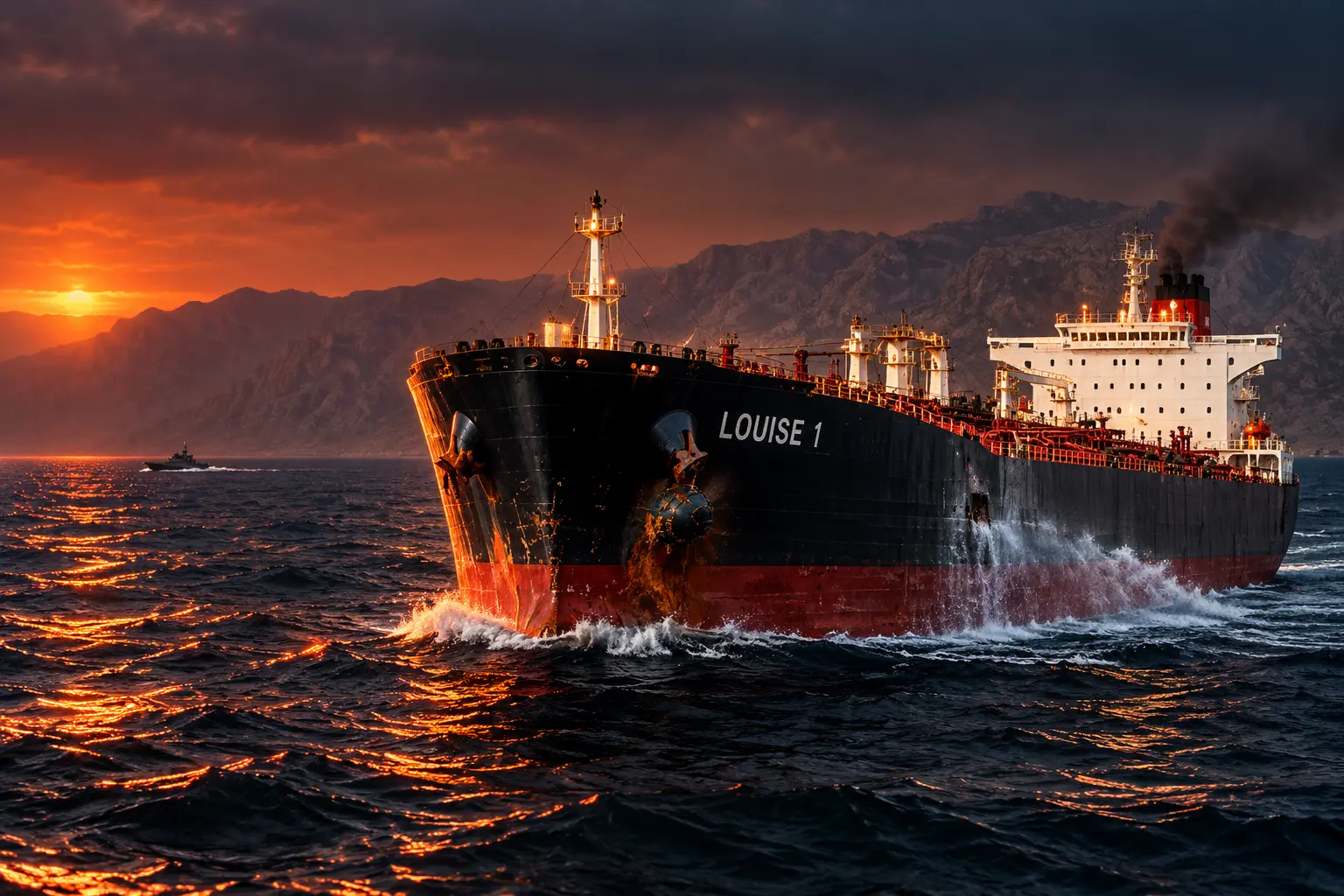
A small boat fixed two explosive devices to a tanker in the Strait of Hormuz on Oct. 29, starting an engine-room fire on a route the U.S. had just called mine-free. The United Kingdom Maritime Trade Operations centre said the outbound ship was 25 nautical miles (46 kilometers) northeast of Khasab, Oman, when the boat came up on the port side.
Maritime security firms named the ship as the Panama-flagged Louise 1. The fire went out, the tanker sailed on, and India’s shipping minister said its 27 Indian crew were unhurt. Oman’s navy the next day pulled 25 sailors off a second Panama-flagged tanker, the RITI, which had been targeted and set on fire closer to Musandam.
The First Limpet Mine of the War Hits Louise 1
UKMTO logged the Louise 1 strike at 2212 UTC on Oct. 29 and classed it as an attack after a verified update early on Oct. 30. A small boat, the advisory said, attached two explosive devices to the hull above the waterline. The blasts started a fire in the engine room and stopped the ship for a time.
The report indicates that the tanker was approached on the port side by a small boat which attached two explosive devices to the hull above the waterline. The subsequent blasts resulted in a fire in the engine room which temporarily disabled the vessel. The fire is now reported as extinguished and vessel is continuing to its next port of call.
United Kingdom Maritime Trade Operations, Warning 187-26 Update 001, Oct. 30, 2026
UKMTO did not name the tanker and did not assign blame. Three maritime security sources identified it as Louise 1, a Panama-flagged crude carrier of 159,092 deadweight tons. Ship-tracking data showed it heading for the anchorage off Khor Fakkan on the United Arab Emirates’ south coast. Dubai’s PRY Shipping, listed as the owner, did not immediately comment.
Security assessments described the charges as limpet mines, magnetic explosives a swimmer or a small boat crew can clamp onto a hull. Maritime sources said this was the first known successful use of those devices in the strait since the U.S.-Iran war began on Feb. 28, and the first in regional waters since June 2019, when a Japanese ship and a Norwegian ship were mined in the Gulf of Oman. A similar try in September did not detonate.
Greece-based maritime risk group Marisks said in a Friday note that a small craft able to approach a transiting tanker, plant explosives and withdraw is a serious security worry in crowded lanes. No group claimed the Louise 1 attack.
25 Crew Leave the Burning RITI off Musandam
Oman’s Maritime Security Centre said the Royal Navy of Oman evacuated 25 crew from the Panama-flagged merchant ship RITI after it was targeted and caught fire 1.6 nautical miles off Musandam. The sailors received medical care. The centre did not name who attacked the ship. Marine Traffic listed RITI as a crude tanker.
That is a different ship from Louise 1. Louise 1 was 25 nautical miles northeast of Khasab and kept sailing. RITI was almost on the Omani shore, and its crew came off. India’s ports and shipping minister, Sarbananda Sonowal, separately said a Liberia-flagged very large crude carrier, MT Arzanah, with two Indian nationals aboard, had been hit by a projectile on Oct. 29, and that all 29 Indian seafarers on Arzanah and Louise 1 were safe.
NAMED SHIPS IN THE OCT. 29-30 CLUSTER
| Ship | Flag | What was reported | Crew |
|---|---|---|---|
| Louise 1 | Panama | Small boat, two hull devices, engine-room fire, 25 nm NE of Khasab | 27 Indians, unhurt; ship sailed on |
| RITI | Panama | Targeted, fire, 1.6 nm off Musandam | 25 evacuated by Oman’s navy |
| MT Arzanah | Liberia | Projectile, Oct. 29 | 2 Indians, unhurt |
Iran’s Islamic Revolutionary Guard Corps told a different story on both days and did not identify ships by name. On Oct. 29 it said three tankers had struck naval mines on a southern route it called unauthorized. On Oct. 30 it said three tankers had run into trouble on eastern and western stretches it treats as off-limits, had ignored radio warnings, and had stopped in southern waters, with U.S. military backing alleged. Iranian outlets also described a fourth ship, a supertanker said to be carrying more than 2 million barrels, exploding after a mine hit. It was not clear whether those claims overlapped with Louise 1, RITI or Arzanah, and UKMTO’s hull-device report does not match a ship striking a moored mine.
Cooper Says Iran’s Navy Is on the Seabed
Adm. Brad Cooper, commander of U.S. Central Command, released a video on Oct. 30 from a visit that included an Oct. 25 flight over the strait in an Army CH-47 Chinook. He said he had seen cargo ships, crude carriers, LNG ships and U.S. air and sea drones, and more than 50,000 U.S. service members on the wider mission.
Here’s what I didn’t see. I didn’t see the IRGC out there at all. They patrolled the Strait of Hormuz and surrounding waters for decades, harassing and threatening and seizing commercial vessels at will. But they were not out there because Iran’s navy is all at the bottom of the sea. After we sank Iran’s navy earlier this year, we also successfully cleared the Strait’s internationally recognized primary transit routes of Iranian sea mines.
Adm. Brad Cooper, commander of U.S. Central Command, video statement, Oct. 30, 2026
Update from CENTCOM Commander: pic.twitter.com/oipZRRCJuE
— U.S. Central Command (@CENTCOM) October 30, 2026
Cooper said U.S. forces had helped Gulf partners export more than 1.5 billion barrels of crude since summer and were holding an “ironclad blockade” on Iranian ports. A CENTCOM statement around the Oct. 25 flight said more than 3,000 commercial ships had transited with U.S. support over six months and that over 95 percent had sailed through safely. CENTCOM also rejected an IRGC claim that Guard forces had taken control of a U.S. MQM-170 Outlaw drone in the western strait. Iranian state media said on Oct. 31 that Guard forces had captured a second U.S. reconnaissance and decoy drone intact west of the strait. The U.S. military had not confirmed that claim.
Clearing moored mines from the marked lanes and sinking the ships that used to patrol them is a real operational result. It is also a narrow one. The Louise 1 attack did not require a navy in the channel. It required a small boat, two charges and a hull that could not shoot back.
Why Ships on the Southern Lane Keep Getting Hit
Since U.S. and Israeli strikes on Iran on Feb. 28, commercial traffic has split. Tehran wants ships to coordinate with Iranian authorities and hug the northern shore. Ships trying to stay outside that system have used the southern lane along Oman, often with transponders off, under U.S. coordination. Iran calls that southern track unauthorized. Deputy foreign minister Kazem Gharibabadi said in late August that “the southern lane will be closed” under an interim Iranian-Omani traffic idea, without giving a date that held.
Most of those southern runs sit in Omani territorial waters, where armed guards are not allowed on board. Crews instead carry response officers from security firms on the bridge. That is a poor match for a speedboat that only needs a few minutes on the port quarter. A shipping monitor that tracks U.S.-facilitated transits counted about 30 vessels a day in the Oct. 25-28 window, many of them dark. Windward, a maritime intelligence firm, counted 13 crossings on Oct. 29, four of them with AIS off, and 124 ships on Iran’s public non-compliance list as of Oct. 28.
The protection pattern, as described by people familiar with the operation, is a moving layer of air defenses, jets, drones and warships that shepherds a group off the UAE coast, tells them to go dark, and hands cargo to other ships in the Gulf of Oman. Retired Vice Adm. Kevin Donegan, a former commander of the U.S. Fifth Fleet, called that arrangement a “moving sanctuary.” A Western official in the Gulf called the whole setup “completely unsustainable” if large-scale strikes on Iran resume. Private owners still largely stay out. The hulls that go are often state-backed, running dark, or both.
A Tactic That Does Not Need a Navy
Moored mines and limpet mines are not the same weapon, and Cooper’s clearance claim was about the first. A moored mine sits in a lane and waits. A limpet mine arrives with a boat, sticks to steel, and leaves with the people who planted it. After the regular navy is gone, that is the kit that still fits in a garage.
WHAT A SMALL-BOAT LIMPET RUN CHANGES
- The platform: A skiff replaces a minelayer, so a “cleared” lane can still be hit after the last Iranian warship is sunk.
- The aim point: Charges on the hull above the waterline punch the engine room, stop the ship, and, on Louise 1, spilled no oil.
- The denial: No group claimed Louise 1, while the IRGC spoke only of mines on unauthorized routes, leaving the two accounts side by side.
- The geography: The southern Omani-side lane, used to dodge Iranian coordination, is also the lane where armed guards are barred.
- The rehearsal: A September attempt failed to explode; the Oct. 29 devices did not.
Gregory Brew of the Eurasia Group put the wider contest this way: the United States has forced oil back through a waterway Iran tried to shut, “but it’s not enough,” and “as long as it’s contested, then Iran is achieving their objective.” A boat that can still reach a hull keeps that contest open without putting Guard patrol craft back on Cooper’s horizon.
What a Hormuz Transit Now Costs
The U.S. Energy Information Administration, in its World Oil Transit Chokepoints note updated March 3, 2026, put oil flows through Hormuz at 20.9 million barrels a day in the first half of 2025, about 20 percent of global petroleum liquids use and about a quarter of seaborne oil trade. About a fifth of world LNG trade also used the strait in 2024, most of it from Qatar toward Asia. That is the volume sitting behind every hull that still tries the lane.
THE BILL FOR A CONTESTED CHOKEPOINT
- War-risk premium: Brokers in October put extra cover for regional tankers at 6% to 10% of hull value, against about 0.25% before the war, or up to $20 million for one supertanker voyage.
- Crew toll: International Maritime Organization figures put confirmed attacks on merchant ships at 121 since late February, including 34 between Sept. 28 and Oct. 27, with 24 seafarers killed.
- Indian crews on this cluster: 27 on Louise 1 and 2 on Arzanah, all unhurt, plus 25 other sailors taken off RITI by Oman.
- U.S. export assist: Cooper’s more than 1.5 billion barrels since summer is the official count of crude moved with American help, not a return to unescorted peacetime traffic.
Joint Maritime Information Centre notices still list the threat in the strait as severe. Cover can be repriced on seven-day notice, which means a ship can leave port insured and arrive as a different bet. The Louise 1 fire produced no spill. The next engine-room hit, or a cargo of LNG, would not have to be so neat.
Talks Resume in Tehran Before Nov. 3
Qatari mediators were back in Tehran on Oct. 30 to keep a channel open between Iran and the United States. The talks have been aimed at inspections of nuclear sites, sanctions relief, and the terms for even sitting down, while President Donald Trump has kept large-scale strikes on the table after the Nov. 3 midterm elections. Trump said Friday that the war with Iran would end soon and that Washington wanted a guarantee Iran would never get a nuclear weapon. He did not say whether that end was a deal or more bombing.
UKMTO was still posting time-late projectile reports on outbound crude tankers on Oct. 30. The IRGC was still describing mine strikes on ships that ignore its radio. Cooper was still describing a strait with no Guard boats in it. In between those accounts sat two Panama-flagged hulls, one steaming on with a patched engine room and one emptied by Omani sailors a mile and a half from Musandam.
The marked lanes may be clear of the mines the U.S. Navy spent the summer sweeping. The southern shortcut used to avoid Iranian control is now a place a small boat can still reach at night, stick two charges on a port hull, and be gone before anyone has a navy to chase.

Ken Urker’s Accidental Overdose Leaves His Finders Waiting

A Third Carrier Arrives as Hormuz Tankers Keep Burning

Shoe Prices Hit a Record as Flagship Pairs Stay Put

Nvidia’s First Call Without Huang Tests the Money Machine

Blake Griffin Says Oklahoma City Taxpayers Bought a Thunder Arena

Warsh Rejects Rate Guidance and Still Moves Markets

Davina McCall Reveals Cardiovascular Disease After Cholesterol Warnings

Dana-Farber Exits an MGB Medicare Advantage Network Early

NASA Launches the Roman Space Telescope’s Cosmic Bet

OpenAI’s Cyber Letter Puts the Defense Bill on Governments
-
 BUSINESS3 months ago
Warsh Rejects Rate Guidance and Still Moves Markets
-
 ENTERTAINMENT1 month ago
Davina McCall Reveals Cardiovascular Disease After Cholesterol Warnings
-
 BUSINESS2 months ago
Dana-Farber Exits an MGB Medicare Advantage Network Early
-
 NEWS3 months ago
NASA Launches the Roman Space Telescope’s Cosmic Bet
-
 NEWS3 months ago
OpenAI’s Cyber Letter Puts the Defense Bill on Governments
-

 NEWS3 months ago
Russia Recycles Its Old Warning Over Storm Shadow Plants
-

 ENTERTAINMENT2 months ago
Primetime’s $2.7 Million Preview Tops Pitt’s Costlier Film
-

 BUSINESS3 months ago
Jet Drones Lock Down Kyiv and Strip Kherson of Heat