
NEWS
Israel’s One-Day Gaza Raid Tests a Moving Yellow Line
Israel ended a one-day raid beyond Gaza’s Yellow Line, a ceasefire map that has been moving for a year as 18,000 people fled.

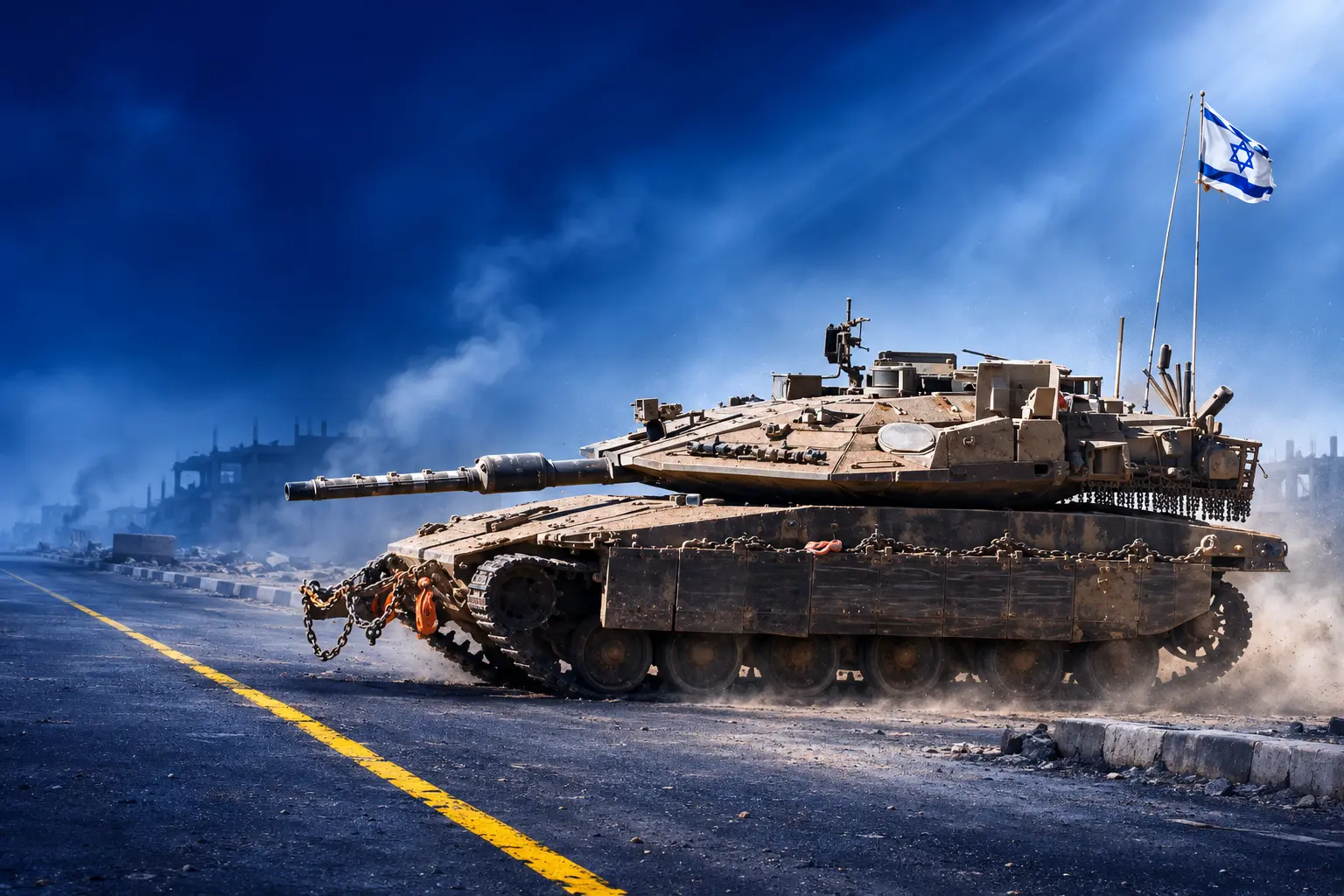
Israeli tanks rolled west of Gaza’s Yellow Line on November 18, then the army said on November 19 that the raid was over. COGAT, the defense ministry body that handles civilian affairs, said Salah al-Din Road was open again near the Nuseirat and Bureij camps.
The push was the first ground operation Israel publicly announced beyond that ceasefire boundary since the October 10, 2025 truce. It lasted a day. The map the raid stepped across has been moving for a year, and Defense Minister Israel Katz spent the same Wednesday describing the ground Israel already holds as a security zone it will not give back.
Tanks Crossed the Yellow Line for a Day
COGAT told residents in Arabic that the army had begun an operation around the Yellow Line in blocks 660, 661 and 666, and that a stretch of Salah al-Din, Gaza’s main north-south road, would be closed until the army said otherwise. Tanks and bulldozers moved toward that road, east of Nuseirat and north of Bureij, under artillery fire. Families who had already been displaced packed carts and walked west.
The army said the raid was a joint job with Shin Bet to dismantle “a terror tunnel west of the Yellow Line that posed an immediate and direct threat to IDF troops.” Hamas called the advance a “flagrant violation” of the ceasefire and asked mediators to step in. The Popular Front for the Liberation of Palestine called it a prelude to a wider push meant to force people out.
Palestinian medics said three people were killed in Israeli attacks on Wednesday, including one near the raid. Separate fire on Tuesday, according to Gaza civil defence and hospitals, killed six people, among them a six-year-old boy. On November 14 the army killed Samir Abu Younis, the Qassam Brigades commander in Rafah. Hamas said the caretaker government in Jerusalem was escalating to escape trouble at home.
On Thursday the army told reporters the operation was completed. COGAT said people could move again in the targeted area and that the Salah al-Din axis had been reopened. Residents still described the road as dangerous, with gunfire in the area, and stayed back.
WHAT WE KNOW
- The target: The army named blocks 660, 661 and 666 near Bureij and Nuseirat and said it was hitting a tunnel west of the Yellow Line.
- The clock: The raid was announced on November 18 and declared over on November 19, with the main road reopened by COGAT.
- The claim: Israel says it was answering Hamas ceasefire violations and removing a threat to its troops.
WHAT IS UNCONFIRMED
- The tunnel: No independent public evidence of the shaft has been shown, and the army did not say how far west of the line its forces remained after the announcement that the raid had ended.
- Outside clearance: An unnamed military source quoted on Israeli Army Radio said the push had been coordinated with the United States and would last several days; neither government confirmed that account.
A raid that ends in a day still does the work of teaching civilians to run. That is the part that outlasts the tanks.
How a Ceasefire Line Became a Moving Perimeter
The Yellow Line was supposed to be a temporary halt line, not a border. Under the first phase of President Donald Trump’s 20-point plan, Israeli forces pulled back to a marked strip that left Israel in 53 percent of Gaza, mostly farmland, high ground and the eastern approaches, and packed more than two million Palestinians into the rest.
Israel then added what it calls an Orange Line, an unmarked belt where aid groups need extra permission to move. Gisha, the Israeli access-rights group, using UN humanitarian mapping, put the yellow and orange lines at 64.9 percent of the Strip as of June 2026. UN Human Rights in Jerusalem has said the army started from nearly 53 percent with a publicly stated objective, from the prime minister, of reaching 70 percent, and that monitoring over the year found no single, identifiable line. Forces kept edging west along routes Palestinians could not see in advance.
THE MAP SINCE OCTOBER 2025
| Measure | Share or count | As of |
|---|---|---|
| Israeli-held share on the original Yellow Line | 53 percent | October 2025 ceasefire |
| Area inside the yellow and orange lines | 64.9 percent | June 2026, OCHA via Gisha |
| Stated Israeli objective for deployment | 70 percent | Prime minister, per UN Human Rights |
| People living west of the army’s lines | 2.1 million | 2026 population estimates |
| Of those living in tents | 1.43 million | OCHA map, November 2026 |
Approaching that moving edge can be lethal. UN Human Rights verified 331 Palestinians killed near the yellow line between the ceasefire announcement and the end of July 2026, including 66 children, 27 women and 238 men. Ajith Sunghay, who heads that office, said Palestinians were trapped in an ever-shrinking part of the territory and struggling for the basics of life. In many of the verified cases, the office said, there was no information that the dead had posed a threat.
Most of what used to be Gaza’s farmland sits east of the line, under direct Israeli control. Gisha notes that farmers still cannot reach those fields. The original ceasefire share and the later yellow-plus-orange figure are different measurements from different dates; the 70 percent figure is a stated goal, not a completed survey. All three describe the same direction of travel.
18,000 People Were Living Where the Tanks Went
Farhan Haq, the UN deputy spokesperson, told reporters on November 18 that OCHA’s first cut of the raid zone was small on a map and crowded on the ground.
Initial analysis suggests that more than 18,000 people were staying in the affected area, which spans about 2.5 square kilometres. About 4,000 of them were staying in displacement sites.
Farhan Haq, UN deputy spokesperson, to reporters in New York
Haq said people were already moving west and southwest from the Deir al-Balah area, and that the same patch of ground had drawn six Israeli displacement orders between December 2023 and June 2025. Civilians who flee, he said, must be allowed to return as soon as circumstances allow.
THE PEOPLE IN THE PATH
- In the raid zone: More than 18,000 people were living in about 2.5 square kilometres, including 4,000 in displacement sites, per Haq.
- Across the Strip: An OCHA access map in November 2026 counted 1.43 million people in tents, 68 percent of a 2.1 million population, and 673,000 still in buildings.
- Since the ceasefire: Gaza’s Ministry of Health puts the toll at 1,658 Palestinians killed and 6,000 wounded. The Israeli military says five of its soldiers have been killed in the same period.
- Shelter stuck outside: The International Organization for Migration says about 100,000 tents are waiting to enter Gaza, held up by closed crossings and long security checks.
Mahmoud al-Saafin, 27, from Bureij, said he feared a broader operation and a new round of flight, because people had not recovered from the last war and the last displacement. Um Ahmad al-Tartoori, also from Bureij, said the shelling terrified families living close to the points of entry.
The raid landed on ground that was already wet and worn. Heavy rain from November 6 left more than 40,000 family shelters damaged, OCHA reported, with about 46,000 households, some 226,000 people, affected and more than 9,000 shelters listed as wrecked beyond repair. Eighty-five percent of households in a WASH Cluster survey had moderate to severe water insecurity. About 42 percent of medicines were at zero stock in October. A one-day tank push does not create that backlog. It runs through it.
Katz Called the Held Ground a Permanent Security Zone
Katz issued his territorial terms on November 18, the same day the tanks moved. Israel, he said, would not withdraw from the current lines of its security zones in Gaza, Lebanon and Syria, and would not redeploy inside them, until Hamas is dismantled and Gaza is demilitarized, Hezbollah is disarmed across Lebanon, and what he called jihadist threats are removed from Syria.
Beyond that, in the event the fronts flare up, the IDF is prepared to maneuver and capture additional territory, while evacuating the residents and destroying the terror infrastructure there, and turning them into part of Israel’s permanent security zones in the north and the south.
Israel Katz, defense minister, statement on November 18, 2026
He has said before that Israel could move from controlling almost 70 percent of Gaza to all of it. The language matches a clause already sitting in the ceasefire’s UN file. When the Security Council adopted resolution 2803 on November 17, 2025, by 13 votes to none with China and Russia abstaining, it said Israeli forces would pull back against demilitarization milestones, save for a remaining security perimeter presence until Gaza was “properly secure from any resurgent terror threat.” The Board of Peace was authorized through December 31, 2027.
Katz spoke as a caretaker minister. The October 27 election left Benjamin Netanyahu’s bloc with 53 seats in the 120-seat Knesset and Gadi Eisenkot’s four-party list with 48. Arab-led parties won 19. President Isaac Herzog tasked Eisenkot, a former army chief who leads the Yashar party, on November 8 with forming a government, giving him 28 days, until December 6. Netanyahu stayed on in a caretaker role and has pressed for a unity cabinet. Eisenkot has called that a trick.
On Gaza the two men are closer than the coalition math. Both say Israeli forces should remain until Hamas is disarmed. A new government, if one forms, inherits a line that has already moved and a public raid that showed the army can step over it in daylight.
What the Board of Peace Told the Security Council
The US-backed Board of Peace, chaired by Trump, sent its second 12-page report to the Security Council as the raid began. Diplomats are due to take it up at the end of November. The board blamed both sides. It said Israel had kept restricting aid and had not taken the decisions needed to train, deploy and return civilian police to Gaza. It said Hamas had kept up armed activity and had been taxing goods that enter the Strip. Senior Hamas official Basem Naim called the report “pure disinformation.”
WHAT THE BOARD PUT ON PAPER
- Israel: Limits on supplies and equipment, plus no green light for Palestinian police, which the board said effectively leaves Hamas in charge.
- Hamas: Continued militant activity and levies on incoming goods, which the board said keep the Strip from a civilian administration.
- The risk: A truce that produces nothing people can see, the board wrote, cannot be held up forever.
The report’s own sentences are blunter than most ceasefire briefings.
The distance between what has been agreed and what is happening on the ground nonetheless remains the principal risk to the process. A ceasefire that delivers nothing visible cannot be sustained indefinitely. Should it collapse, there would be no road map to return to, no administration to deploy and no enabling environment to rebuild.
Board of Peace, second report to the UN Security Council, November 2026
It added that neither party may treat the other’s delay as a license for its own inaction. Hamas agreed on July 30 to a 15-point board roadmap to inventory weapons, hand them over under international watch, and transfer governing authority to a Palestinian technocratic committee. Israel rejected that sequence and says it will not pull back until Hamas is taken apart. The board wrote that every day of Israeli strikes delays the moment that Hamas offer can be tested.
The Police and the Force Never Made It In
Phase I of the plan did some of what it promised. The remaining living hostages came home. Israel released 1,970 Palestinian prisoners and detainees. Major combat stopped. The army pulled back to the first Yellow Line. Phase II, declared in January 2026, is where the file has sat.
THE YEAR THE NEXT PHASE DID NOT START
- October 10, 2025: The ceasefire takes effect and Israeli forces withdraw to the original Yellow Line, holding 53 percent of Gaza.
- January 2026: Washington announces a shift to phase two. A Palestinian technocratic committee, the National Committee for the Administration of Gaza, is formed. Israel does not let its members leave Cairo into the Strip.
- July 30, 2026: Hamas accepts the board’s 15-point disarmament roadmap tied to staged Israeli withdrawals. Israel rejects the roadmap.
- October 27, 2026: Israel’s election returns no majority. Netanyahu remains caretaker prime minister.
- November 18, 2026: The board’s warning reaches the Security Council as tanks cross west of the Yellow Line and Katz describes held ground as a permanent security zone.
- November 19, 2026: The army says the raid is over and COGAT reopens Salah al-Din Road.
The International Stabilization Force exists on paper and in training slots, not on the Salah al-Din median. Morocco sent about 500 personnel into US-led training. Albania, Kazakhstan and Kosovo have pledged troops. Of some 283,000 Palestinians who applied to a new police service, about 16,000 have passed Israeli vetting, but Israel has not guaranteed that trainees who leave Gaza will be allowed back, which has stalled the pipeline. Hamas, in the area it still holds, has put its own armed police back on the street.
Reconstruction has followed the same sequence trap. The board in September floated a $2.45 billion six-month recovery list against damage estimates of $35.2 billion in the medium term. Dual-use rules still block a large share of building kit. Kerem Shalom is the only goods crossing since Zikim closed on May 24, 2026, and COGAT has counted trucks in ways aid groups say shrink real volume. On November 2 it told international organizations it would not facilitate aid from Egypt until further notice, citing smuggling concerns that included cigarettes.
Thursday’s reopen order put traffic back on a road the army had closed the day before. It did not put the Yellow Line back where the October 2025 maps drew it, and it did not put a Palestinian police unit or a stabilization force in the gap the tanks had just used. Katz’s test is simple enough: if the next incident is called a threat, the perimeter can move again, from a caretaker office, before anyone in New York has finished arguing about the last report.

Jeeno Thitikul Passes Annika on Three $4 Million Checks

Cohen Locks Skubal for $450 Million With No Opt-Outs

TCU Fires Sonny Dykes Seven Months After Extending Him

BepiColombo Reaches Mercury After a Shortened Capture Burn

Andromeda’s Bao Merger Times How Binary Stars Tighten

Warsh Rejects Rate Guidance and Still Moves Markets

Davina McCall Reveals Cardiovascular Disease After Cholesterol Warnings

Dana-Farber Exits an MGB Medicare Advantage Network Early

NASA Launches the Roman Space Telescope’s Cosmic Bet

OpenAI’s Cyber Letter Puts the Defense Bill on Governments
-
 BUSINESS3 months ago
Warsh Rejects Rate Guidance and Still Moves Markets
-
 ENTERTAINMENT1 month ago
Davina McCall Reveals Cardiovascular Disease After Cholesterol Warnings
-
 BUSINESS2 months ago
Dana-Farber Exits an MGB Medicare Advantage Network Early
-
 NEWS3 months ago
NASA Launches the Roman Space Telescope’s Cosmic Bet
-
 NEWS3 months ago
OpenAI’s Cyber Letter Puts the Defense Bill on Governments
-

 NEWS3 months ago
Russia Recycles Its Old Warning Over Storm Shadow Plants
-

 ENTERTAINMENT2 months ago
Primetime’s $2.7 Million Preview Tops Pitt’s Costlier Film
-
 BUSINESS3 months ago
Jet Drones Lock Down Kyiv and Strip Kherson of Heat