
NEWS
Humyn Labs Raises $47 Million on Filmed Workers Abroad
Accel led Humyn Labs’ $47 million Series A to pay workers in 20 countries who film chores that train unnamed US robots.

Bengaluru’s Humyn Labs has raised $47 million to pay people in more than 20 countries to film work that trains US robots. Accel led $26 million of equity. The other $21 million is venture debt, because the people on camera are paid by the day while the labs that buy the footage pay in 30 to 60 days.
The company announced USD 47 million in Series A funding to expand recording and robot-testing sites in Brazil, South Korea and India, and to put staff in San Francisco, London and Seoul. Co-founders Manish Agarwal, the former chief executive of Nazara Technologies, and Ishank Gupta, a former AB InBev executive, started the firm in February 2026. They already sell labelled video, sound, motion and touch data to 12 paying customers. Gupta said about 90% of revenue comes from the United States. He would not name the buyers.
Nearly Half This Round Is Payday Money
Agarwal told interviewers the startup generated $10 million in revenue between April and October, has another $20 million in signed contracts, and is chasing a further $20 million that is not yet closed. In its own statement the company said it had passed $50 million in annualised revenue within six months. Agarwal later said that run-rate figure is the average of September and October monthly sales, stretched over a year, which is a different clock from the $10 million already booked.
The split of the round is the tell. Equity builds the hardware and the labelling software. Debt covers the float between the field and the invoice.
HOW THE $47 MILLION SPLITS
| Slice | Amount | Who led | Job of the money |
|---|---|---|---|
| Equity | $26 million | Accel | Hardware, labelling engine, offices |
| Venture debt | $21 million | Lighthouse Canton | Pay collectors while labs settle in 30 to 60 days |
| Total | $47 million |
Trifecta Capital joined the debt. Equity also came from Prosus Ventures, BeeGlobal, Finserv Intelligence through Bajaj Finance, Bajaj Alts AI Opportunities Fund, Dallas Venture Capital, Lighthouse Canton, Jump Trading LLC, and Anita Pramoda, the former chief financial officer of Epic. Bajaj is a consumer-finance house. Its cheque sits next to a business that pays field partners daily or weekly.
Agarwal said that mismatch is why they borrowed. Selling more shares would have diluted the cap table to fund a payroll cycle. The collectors cannot wait for a frontier lab’s accounts payable team.
We're building the infrastructure that takes Physical AI out of the lab and into the real world.
And we've raised $47M to make that happen.
Physical AI models are getting better every month. But getting robots to work reliably in real-world environments, across full shifts and… pic.twitter.com/OIvBpQdCbf
— Humyn Labs (@humynlabs) November 18, 2026
Accel partner Pratik Agarwal said physical AI is a defining shift of the next decade, and that data and deployment are where a lasting edge will be built. Manish Agarwal, no relation, set a public target of $1 billion in annual revenue against what he called a $10 billion opening in data infrastructure.
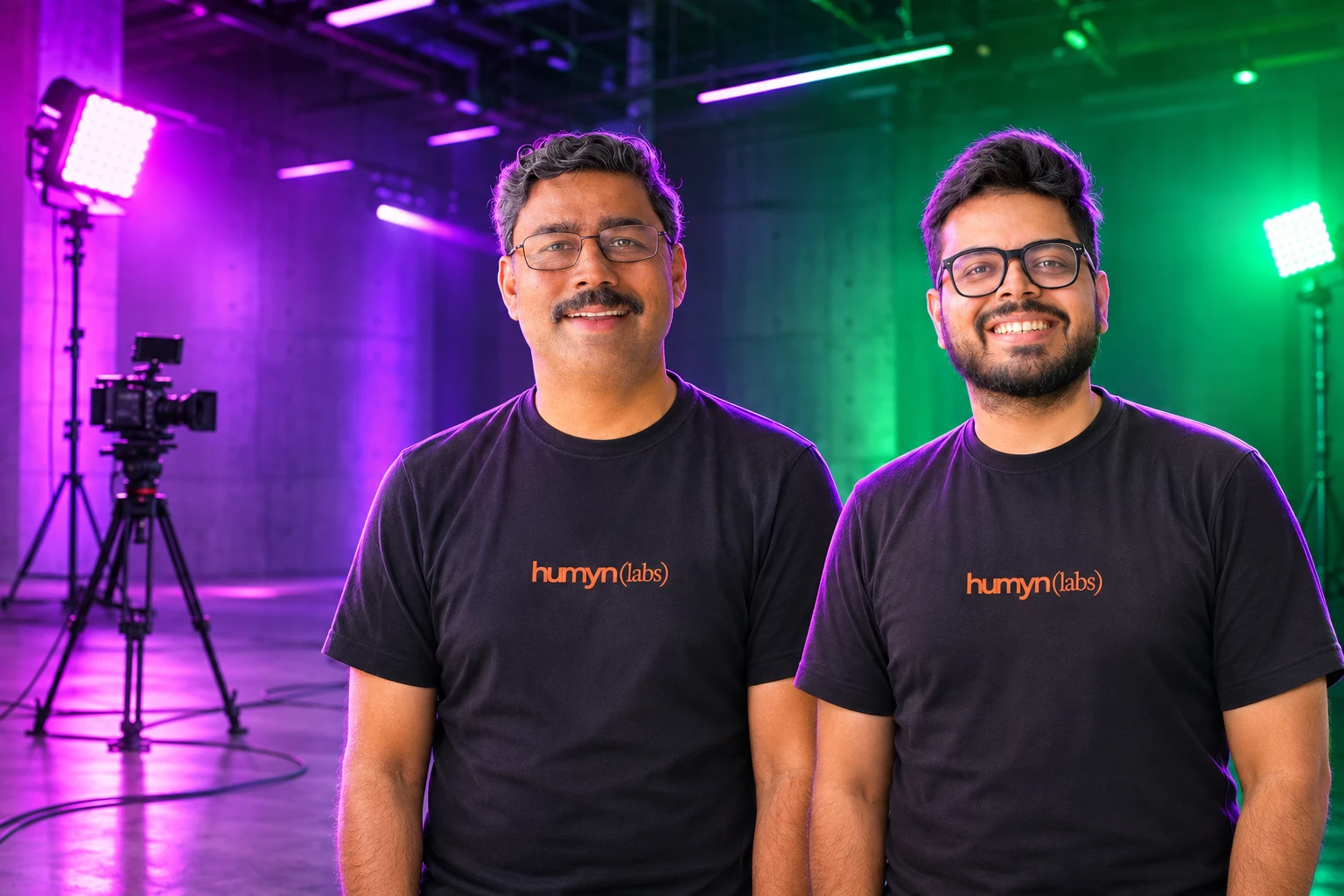
The Gaming Network Behind the Cameras
The people holding the cameras did not appear in the launch video. Humyn has 51 full-time staff, most of them in Bengaluru, plus local partners in the countries where it records. The partners find sites, watch the sessions, and keep the footage inside the spec the buying lab wrote.
Agarwal and Gupta previously built Kratos Studios, now KGeN, a gaming and identity network that Accel, Prosus Ventures and Jump also backed. Humyn uses that roster to reach people who will record inside homes, especially in Latin America. KGeN’s own documents describe 61.9 million users across 60-plus countries and $85.8 million in annualised revenue. That headcount is KGeN’s claim for its whole network, not a count of Humyn camera operators, and the distinction matters. The overlap is the pipe: a consumer network built for gamers is now a recruiting desk for first-person work video.
Agarwal said Humyn records people doing their usual jobs or household chores rather than staged skits, and that local partners pick the sites and watch the work. “The worker is a worker who is incentivized, but he needs to be monitored and supervised for the right input,” he said. Daily pay, weekly pay, and a supervisor on the feed are the operating system. The model looks like a research lab on the website and like a staffing firm in the cash ledger.
Brazilian Kitchens Train Someone Else’s Home Robot
Agarwal described one live job in plain terms. People in Brazil record household tasks for a company that is building robots for homes. Humyn pays those contributors, checks the clips, and ships the labelled set. Customers pay by the hour of video, with the price moving with how much processing they want. Projects can last a few weeks or several months, and the next order depends on whether the last batch landed on spec.
Labs that once asked for clips of 30 seconds to two minutes now want tasks of 10 to 20 minutes, Agarwal said. Some also want the person on camera to explain why they are doing the step, so the model can learn the reason as well as the motion. “They want everything yesterday,” he said.
A robot does not learn a job from the internet; it learns from the person who has done it for twenty years on the floor.
Ishank Gupta, co-founder, Humyn Labs, company statement
That line is the sales pitch and the labor fact at once. The twenty-year cook, warehouse picker or farmhand is the dataset. The robot that will use the lesson is being built for a different kitchen, often in a different country. Gupta said about 90% of sales already sit in the United States. Brazil, India and South Korea are the main recording hubs, with collection running across Latin America and Asia.
Diversity of rooms, tools and hands is the reason the geography looks like this. A model trained on one kind of counter height, utensil and lighting will fail in the next apartment. The same spread puts other people’s homes, children and neighbors into a training set bound for unnamed US labs.
Twelve Unnamed Labs Pay by the Hour
Humyn says its 12 paying customers include frontier AI labs, robotics companies and teams that build world models. Agarwal said the firm is in talks with 35 more, and that about 95% of revenue is robotics work with the rest from voice data. Those shares sit beside Gupta’s 90% US figure; one is the work type, the other is the buyer’s country. Confidentiality agreements, Agarwal said, are why the logos stay off the page.
WHAT WE KNOW
- Paying roster: Twelve customers are live, and 35 more are in discussion.
- Booked sales: $10 million came in from April through October, with $20 million in signed contracts behind that.
- Buyer mix: About 90% of revenue is US, and about 95% of revenue is robotics rather than voice.
WHAT IS UNCONFIRMED
- The names: No customer has been identified, including the home-robot buyer in Brazil.
- The extra $20 million: A further $20 million of deals has not been finalized.
- On-site robots: Agarwal said Humyn has not yet supported a commercial robot shift at a customer site.
New York’s Mecka, Munich’s MicroAGI and XDOF have also raised large rounds this year to buy filmed human work for robot models. Humyn is trying to compete with them from Bengaluru on price, geography and the KGeN recruiting pipe, while moving up from raw clips toward testing robots in the same places it records.
Delhi Asked Who Consents
On November 12, six days before Humyn’s public raise, India’s Ministry of Electronics and Information Technology sat home-service platforms down over first-person video shot inside houses. Secretary S. Krishnan chaired the session with Pronto, Urban Company, Snabbit and robotics firms. Humyn was not named as a target of that meeting. Its product still records people in homes and ships labelled footage to overseas labs, which is the fact pattern the ministry opened.
Pronto has been running an opt-in recording programme on some house-help visits. Urban Company founder Abhiraj Singh Bhal said his firm does not record inside homes and has no plan to start. Snabbit said it ran a one-time test in a training centre and stopped.
WHAT THE MINISTRY ASKED
- Overseas sharing: Whether footage from Indian homes is sold or sent to physical AI developers outside India.
- Contracts and storage: What data-sharing contracts exist, how long clips are kept, and whether they are tied to a worker’s identity.
- Consent: How workers agree to be filmed, and how household members who walk into frame are protected.
- Worker pay: How staff are told they are being recorded, and how much they are paid for it.
India’s digital personal data law lets firms send personal data abroad unless the government names a restricted country, and it has not named one. Truly anonymised files sit outside that law. Blurring a face does not, on its own, make a family’s kitchen anonymous. Humyn’s website lists a field-quality report with discard, drift and consent audits across collectors. The page marks that report as coming soon.
A monitoring service in the home and the onward sale of footage to third-party AI labs are two distinct purposes.
Apar Gupta, Internet Freedom Foundation
Each purpose needs its own consent, Gupta has argued, and once a clip leaves the first company, or leaves India, it is harder to say who still holds that consent. Agarwal’s version of the safeguard is incentives plus supervision, and collection from people doing their own work rather than from a cleaner walking through a stranger’s flat. That is a different setup from the home-service apps Delhi called in. It does not answer what happens when a child, a neighbor or a brand on a shelf is in the shot, or when the labelled file is sold to a lab the worker will never meet.
How a Chore Becomes Training Data
Humyn built its own two-camera rigs to record jobs to a lab’s brief. Software then tracks hands, objects and the rest of the scene and turns the raw tape into training-ready files. The public site lists twelve signal types, from 21-point hand keypoints and stereo depth maps to action cuts, atomic labels such as reach and grasp, scene tags, a 6-axis IMU running at 300 Hz, and speech with code-switching left intact. Sight, sound, motion and touch are fused on one platform the company says it owns end to end.
WHAT HUMYN SAYS IT HAS SHIPPED
- Robot video: 200,000-plus hours of first-person video for humanoid systems.
- Faces: A dataset of 120,000 faces across five regions, listed on the same site as the robot corpus.
- Speech: 50,000 hours of speech data across ten languages, plus a separate 1,000-plus-hour voice set for Indian banking and insurance.
Outputs it names include MCAP, RLDS, LeRobot v3, ROS Bag, WAV, FLAC and JSON. “Scale, diversity, and quality are important aspects, and they need to work in tandem,” Agarwal said. The 120,000-face set sits in tension with the consent file in Delhi, even if it is a separate product line from the kitchen chores. A company that can ship faces at that volume is in the identity business as well as the robotics-data business.
The Robots Have Not Started a Shift
Asked whether Humyn has yet backed a commercial robot working on a live site, Agarwal said there were none. The new money is meant to build what the company calls deployment-readiness infrastructure, robot gyms in other words, in Brazil, South Korea and India, starting with a playbook in Bengaluru. Gupta’s public argument is that a robot that can do a task in a lab is not the same as a robot that can be trusted with the job across a full shift.
Until those gyms exist, Humyn’s business is still the older one: pay people, film the work, label the hours, invoice the lab. The collectors get paid first. The US buyer gets the file. Delhi has started asking who else was in the room.

Jeeno Thitikul Passes Annika on Three $4 Million Checks

Cohen Locks Skubal for $450 Million With No Opt-Outs

TCU Fires Sonny Dykes Seven Months After Extending Him

BepiColombo Reaches Mercury After a Shortened Capture Burn

Andromeda’s Bao Merger Times How Binary Stars Tighten

Warsh Rejects Rate Guidance and Still Moves Markets

Davina McCall Reveals Cardiovascular Disease After Cholesterol Warnings

Dana-Farber Exits an MGB Medicare Advantage Network Early

NASA Launches the Roman Space Telescope’s Cosmic Bet

OpenAI’s Cyber Letter Puts the Defense Bill on Governments
-
 BUSINESS3 months ago
Warsh Rejects Rate Guidance and Still Moves Markets
-
 ENTERTAINMENT1 month ago
Davina McCall Reveals Cardiovascular Disease After Cholesterol Warnings
-
 BUSINESS2 months ago
Dana-Farber Exits an MGB Medicare Advantage Network Early
-
 NEWS3 months ago
NASA Launches the Roman Space Telescope’s Cosmic Bet
-
 NEWS3 months ago
OpenAI’s Cyber Letter Puts the Defense Bill on Governments
-

 NEWS3 months ago
Russia Recycles Its Old Warning Over Storm Shadow Plants
-

 ENTERTAINMENT2 months ago
Primetime’s $2.7 Million Preview Tops Pitt’s Costlier Film
-

 BUSINESS3 months ago
Jet Drones Lock Down Kyiv and Strip Kherson of Heat